A Twitch and an Owl

Who else out there knows that sinking feeling when you show up for a field trip in the worst possible weather–and there are people waiting for you? And who understands how just a few seconds of birding with friends can make the worst weather disappear and the day brighten?

That was our experience this morning at Kitsilano Point and Vanier Park. It was miserable when I arrived, but the four of us put up our hoods and had a great time–and the weather actually improved, with a patch of dry sky mid-morning and nothing really worse than mist by the time we broke up at 11:00.

As usual, waterfowl provided the major highlights. The strange Bufflehead x Common Goldeneye hybrid was bobbing around at very close range, giving us great looks at this strikingly beautiful bird; Alison and I had seen it yesterday afternoon on our scouting, too, so I was glad it deigned to perform for the group this morning. A drake Eurasian Wigeon was on the Vanier pond–yesterday afternoon we’d also found a female, but she was sensibly tucked up somewhere out of the rain.

The scoter flock was very close to shore this morning, hundreds of Surf Scoters forming and reforming their lines and blobs and clusters. At least half a dozen White-winged Scoters were mixed in, and the morning’s real prize was a female Black Scoter, the first for me on English Bay of a species said to have been hugely abundant there not that many years ago.

So a great morning in great company, and  with the rain tapering off, I met Daniel at the eagle-adorned totem pole (real Bald Eagles, not just carved ones) and stopped quickly at home for another waterproof layer before heading south to Alaksen. We pulled in just to find a small group of birders leaving. Smiling birders. Happy birders. And we shared their delight when we found the lingering Yellow-breasted Chat right away, not just near but actually under the breezeway leading to the offices. She (a dull lore) was even vocalizing, giving a chat-like buzz and wheeze as she fed on the ground and in the open trees. Poor Karen, trying to get from one building to the other, was stranded for some moments as she very generously waited for us to tire or the chat to fly off–the latter occurred before the former, but not before we’d had splendid views of a major December rarity.

Where to next? Skies were brightening, so we decided to go looking for owls nearby. Big ones eluded us, but our 700th or so search of a trailside holly turned up a splotch of whitewash and its snoozing author.
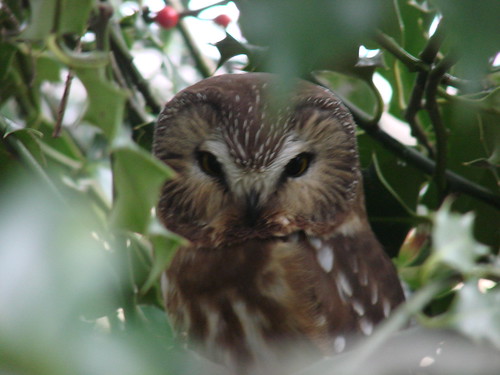
This was my first living Northern Saw-whet Owl of the year, and one of the sweetest little creatures of 2010 so far. And of course we paused on the way back out Westham Island Road for a look at the Northern Hawk Owl, making for a pretty good strigid day on top of a pretty good warbler day on top of a pretty good waterfowl day.

I like BC in December, I’ve decided.

Share

Another Seafaring Owl

Screenshot 2013-12-22 10.50.14

One of the earliest nature periodicals published expressly for use in the schools, Birds: Illustrated by Color Photography had a two-year run at the end of the nineteenth century. The promised photographs are indeed colorful — but they are all of stuffed birds, most of them in the collections of friends of the magazine’s Chicago publisher, W.E. Watt.

Each of the images is accompanied by two pages of text, one obviously addressed to the young reader:

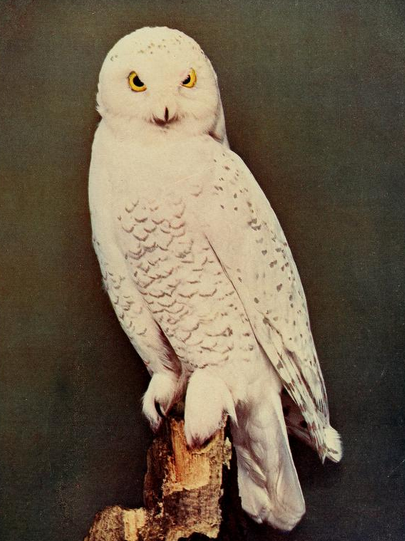
What do you think of this bird with his round, puffy head? You of course know it is an Owl. I want you to know him as the Snowy Owl.

The other text, more densely printed and in smaller type, is intended for the teacher, and usually comprises a plumage description, a note about distribution, an account of the bird’s food habits, and, more interestingly, the odd (and always unattributed, alas) anecdote:

The large round eyes of this owl are very beautiful. Even by daylight they are remarkable for their gem-like sheen, but in the evening they are even more attractive, glowing like balls of living fire. From sheer fatigue these birds often seek a temporary resting place on passing ships. A solitary owl, after a long journey, settled on the rigging of a ship one night. A sailor who was ordered aloft, terrified by the two glowing eyes that suddenly opened upon his own, descended hurriedly to the deck, declaring to the crew that he had seen “Davy Jones a-sitting up there on the main yard.”

Watt’s apparent source for this story (and for much of his Snowy Owl text in general) paraliptically explains the allusion:

It is perhaps unnecessary to state that “Davy Jones” is the sailors’ name for the evil spirit.

I wonder how many teachers repeated the story to their young charges: nightmare stuff, it seems to me.

Share

Citizen Nighthawk

Christmas of 1897 found a new and exciting book under many a young birder’s tree.

Screenshot 2013-12-21 14.28.41

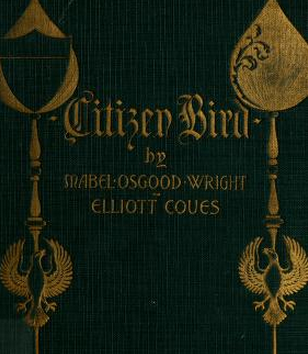
Citizen Bird was the latest offering from Mabel Osgood Wright, one of the turn of that century’s most important authors of bird books for children and novices. Written, as its subtitle promises, “in plain English for beginners,” Citizen Bird was a collaboration between Wright, Elliott Coues, and Louis Agassiz Fuertes — a high-powered team if ever there was one.

The book’s conceit is simple and straightforward: the Doctor, obviously Coues’s fictional alter-ego, takes his young daughter and her two cousins, along with the neighbor boy Rap, on a series of pastoral walks and leisurely carriage rides across Orchard Farm, where they encounter the wild birds and fall into conversation with Mammy Bun, a retired nurse, and Olaf, a fisherman.

Poor Rap always plays the bumpkin. One evening, when the party stops to admire a rural sunset,

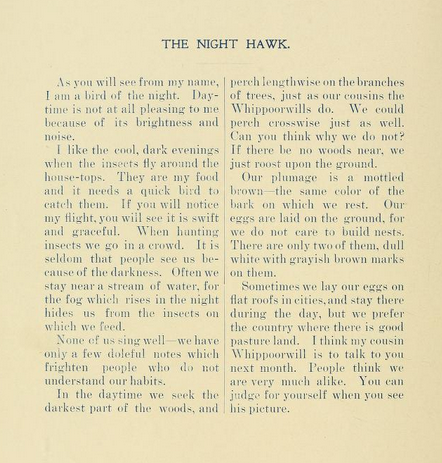
a large bird that had been sailing about overhead dropped through the air till it was almost over the surrey, then turned suddenly and darted upward again…. “That’s a Nighthawk … he’s looking for small birds to eat,” [said] Rap.

The kindly Doctor corrects him, of course:

“his broad, shallow mouth is only suitable for insect-eating … and the beak is equally small and feeble, not at all like the strong hooked one of a cannibal bird.”

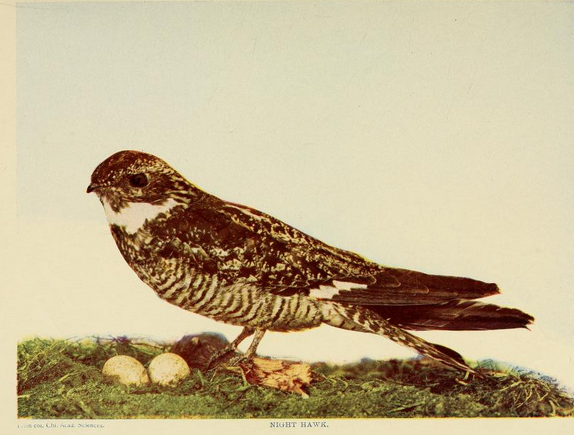
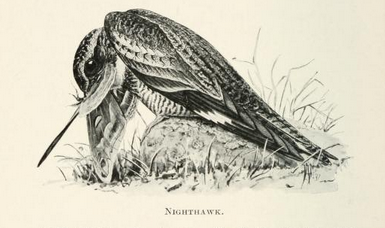
Interestingly, the Doctor characterizes the nighthawk as “belonging to the Ground Gleaners as well as Sky Sweepers.” Fuertes’s dramatic illustration of this “valuable Citizen” shows him engaged in the first activity:

Screenshot 2013-12-21 14.56.44

I can’t recall ever having seen a Common Nighthawk tussling with even the largest insect on the ground, but apparently it happens, and not just at Orchard Farm.

The 2013 ABA Bird of the Year


Share

Are Bald Eagles Really Bald?

Wild Turkey

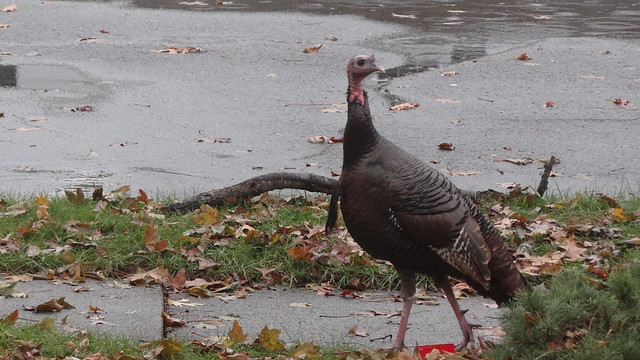
It’s almost Thanksgiving, and time once again to trot out the old and long discredited chestnut about Benjamin Franklin and the Wild Turkey. That one’s been debunked enough by now, I think. But what about the other bird in the Franklin story, the one that actually became our national feathered symbol?

Bald Eagle

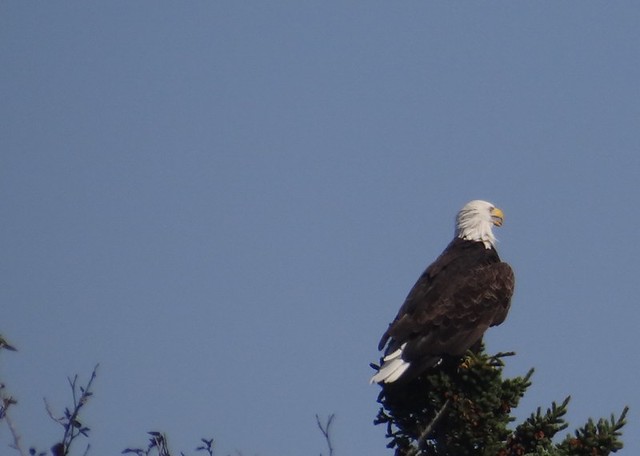
Franklinian irony aside, the Bald Eagle was a really good choice: big, powerful, “majestic.” And in the eighteenth century, the species was sufficiently widespread and sufficiently abundant that you could often as not just go outside, look up, and be reminded that you were a citizen (well, so long as you were white and male and owned property) of a country that aspired to some of those same slightly dubious qualities.

Admittedly, that name is a little awkward. But as generations of gullible American birders have been told (thanks, National Geographic!),

Screenshot 2013-12-22 13.21.58

Hm. Hm hm hm. Shall we try to think this one through?

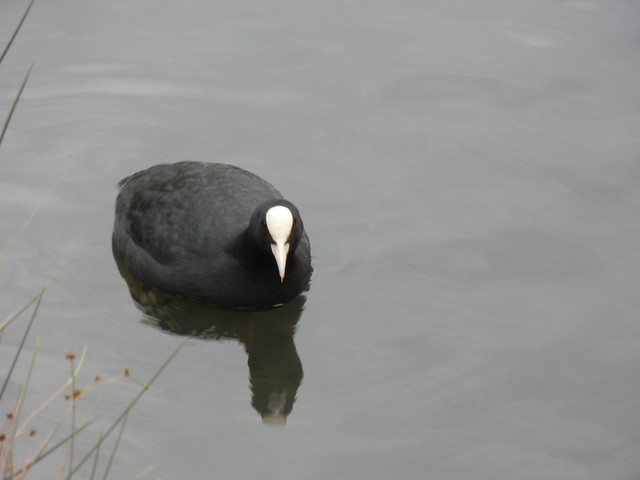
First, there is no such Old English word as “balde.” Second, the Middle English “balled” means not “white” but “marked with white on the forehead,” an excellent fit for, say the Eurasian Coot, but a bit strange for our eagle.

Eurasian Coot

But why are we getting bogged down in philologicalities anyway? I find it very hard to imagine that the seventeenth-century ornithologists and explorers who coined the name “Bald Eagle” — a New World species unknown, of course, during the Old English and Middle English periods — would have sought out an English epithet that was already then obscure, oblique, and obsolete.

What I can or can’t imagine, of course, doesn’t matter nearly so much as what the early natural historians themselves had to say about the name. And not one of them — not one — makes so much as an allusion to any “Old English” word meaning white.

One of the earliest accounts of the birdlife of the English colonies in North America is that in a letter from the Virginia planter John Clayton to the Royal Society, published in 1693 in the Philosophical Transactions. Clayton was first and foremost a botanist, but he devotes nearly ten printed pages to the birds of Virginia, among them

the Bald Eagle … the Body and part of the Neck being of a dark brown, the upper part of the Neck and Head is covered with a white sort of Down, whereby it looks very bald, whence it is so named.

Screenshot 2013-12-22 14.48.40

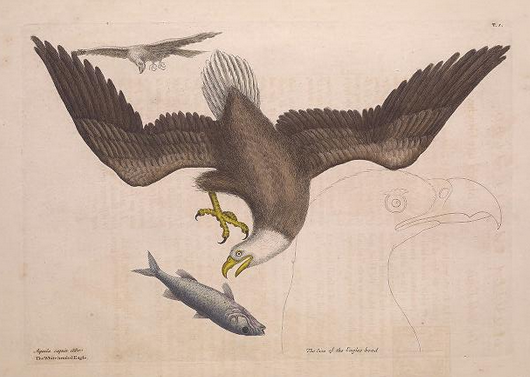
Clayton clearly means “naked,” not “white.” Twenty years later, Mark Catesby also uses the word “bald” in that same normal, modern sense:

This bird is called the Bald Eagle, both in Virginia and Carolina, tho’ his head is as much feather’d as the other parts of his body.

Alexander Wilson understood the word in exactly the same way:

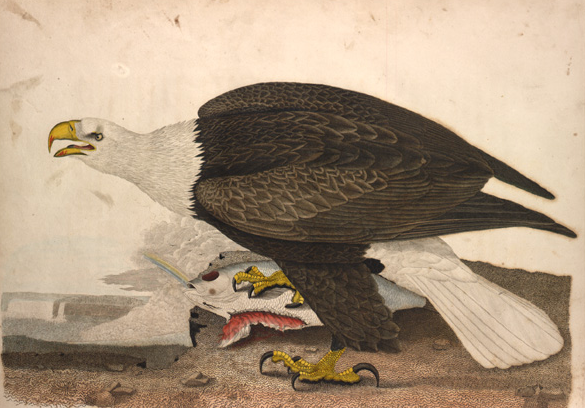
The epithet “bald,” applied to this species, whose head is thickly covered with feathers, is … improper and absurd … and seems to have been occasioned by the white appearance of the head, when contrasted with the dark color of the rest of the plumage.

Wilson, White-headed Eagle

Audubon, perhaps mindful of Wilson’s scorn for the name, avoids it entirely in the Ornithological Biography, giving the bird instead the more literal moniker “white-headed” and remarking

that the name by which this bird is universally known in America is that of Bald Eagle, an erroneous denomination, as its head is as densely feathered as that of any other species, although its whiteness may have suggested the idea of its being bare.

We could yield to the temptation of internet abundance and go on piling up examples, but the point is clear by now.

None of the earliest and none of the most important ornithologists in the first two centuries following the English settlement of North America understood “bald” in the eagle’s name to mean anything other than “naked,” “bare,” “hairless.” None so much as hints at a (non-existent) Old English or an (obsolete) Middle English word meaning “white-blazed,” which would be a poor description of the bird’s plumage in any case.

This is another instance of a “solution” being cobbled together well after the fact — to a problem that never existed.

The harder thing to think about is who is responsible for that convoluted and illogical tale and how it became the standard explanation for what is likely, at its root, a gentle joke (you can always tell it’s a joke if Wilson gets exercised about it).

Choate is surely largely to blame for the recent popularity of the story, but alas, he simply reports it as if it were true, without attribution. So here’s the challenge: Find the earliest attestation of the story, and help me trace this bit of inane but influential folklore to its source.

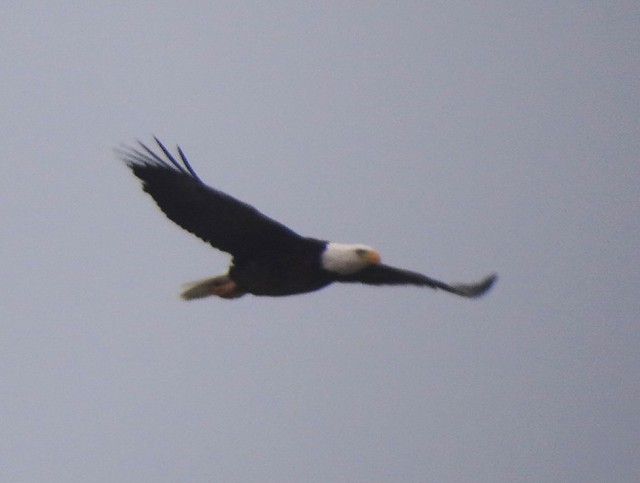
Bald Eagle

Share