Catesby’s Dopchick

Screen Shot 2013-09-16 at 1.24.41 PM

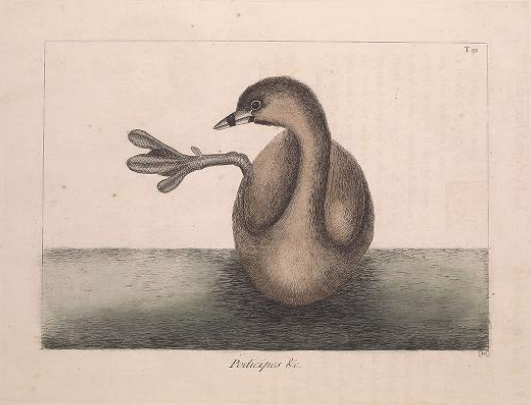
A funny bird with a funny name, the Pied-billed Grebe was first depicted and described by Mark Catesby nearly 300 years ago. The bird in Catesby’s painting was a male, collected in South Carolina, and its description is headed by a Latin phrase that very neatly sums up most of what most birders know about this species: Podicepes minor rostro vario, a “rather small grebe with a marked bill.”

For all its technical clumsiness (the bird and the water do not exist in the same space at all), Catesby’s painting is a remarkable piece of ornithological illustration. The distinctive markings of bill, throat, face, and eye are accurate and precise, and the strange, hair-like, silky texture of the feathers is admirably well drawn. The challenge of showing the most characteristic feature of all grebes, the outsized, extravagantly lobed foot, is neatly met by depicting the bird mid-preen, the body slightly a-list.

The visual eloquence of the painting contrasts strangely with Catesby’s description, which is taciturn and bland:

The Pied-Bill Dopchick.

This bird weighs half a pound. The Eyes are large, encompassed with a white Circle: the Throat has a black spot; a black list crosses the middle of the Bill; the lower mandible, next to the Basis, has a black spot: the Head and Neck, brown, particularly the Crown of the Head and Back of the Neck is darkest: the Feathers of the Breast are light brown, mixt with green; the Belly dusky white; the Back and Wings are brown.

These Birds frequent fresh water-Ponds in many of the inhabited parts of Carolina. This was a Male.

That’s it: no mention of the bird’s habits, its voice, or the structural peculiarities so carefully depicted in the plate.

The terseness and partially garbled syntax of the description and the unusually conspicuous typographical lapse in its title (P[R]ODICIPES) make me wonder whether something didn’t go wrong at this stage in the production of the book; had the printer perhaps spoiled or lost Catesby’s manuscript text, which was then hastily and carelessly replaced?

The first in a monthly series about the world’s grebes. 

Share

Best Wishes, 2013 BotY!

The 2013 ABA Bird of the Year

I set out a year ago to write 50 “blog” entries about the Common Nighthawk, the ABA’s 2013 Bird of the Year — and an inspired choice. The 2014 bird is just as exciting, I understand.

I don’t know about you — how possibly could I? — but I learned an awful lot about this common and familiar species this year, and I think, without having the time or the vanity to count, that I may have come close to my target in writing about the bird. I do know that I was extraordinarily grateful to get to speak to so many interested and interesting birding groups about the bird, its history, and its prospects, and there are still a few nighthawk lectures on my calendar for the New Year, so hope to see the rest of you out there, too.

One thing that I learned is that nighthawks, and probably most birds, can appear at times and in places that are utterly, entirely unexpected.

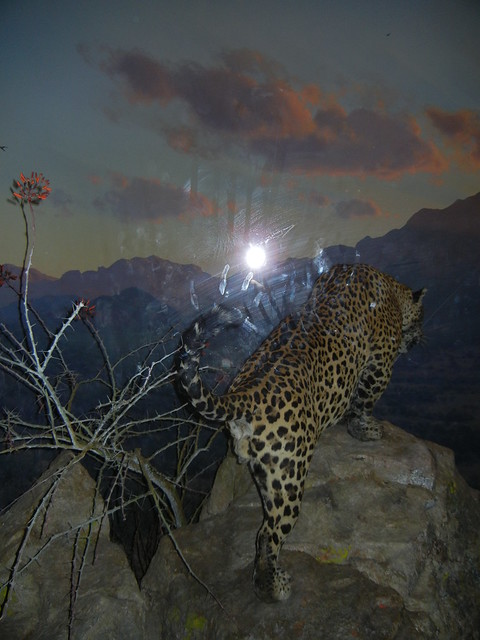
Jaguar, AMNH

One of my favorite habitat groups at the American Museum is the jaguars, an emphatically male mount and a large kitten perched on the rocks of a Sonoran mountainside at sunset. I’ve never seen that animal, alas, but I love Sonora and I love the thought of jaguars, and Alison and I always pause, in reverence and reverie, at this case when we walk through the mammals.

We’re not alone: there’s always a small crowd enthralled by these charismatic kitties. But how many notice the birds in the skies above them?

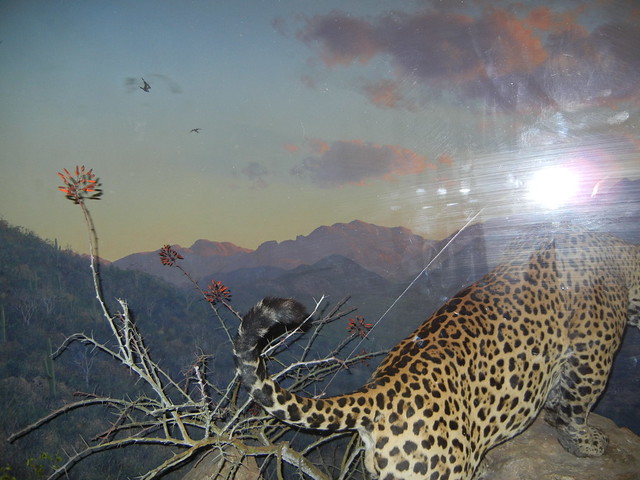
Jaguar, AMNH

Common Nighthawks aren’t, in my experience, hugely common in northwest Mexico, but they do occur, and their presence in this group adds to its wondrousness. I can feel the last warmth of the day, the cool air rushing down the canyon below, and the atavistic excitement of being in the presence of one of the few American mammals that can lord it over us humans. And I hear the buzzes and whooshes of the nighthawks high overhead.

Alison In New York

Let’s hope on this eve of a new year that jaguars and nighthawks and all of the other miracles of the Sierra Madre persist for the human generations to come, sending chills down the spines of our descendants in their different ways.

Share

Surly Motmots, Pouting Jacamars, and a Gloomy Birder

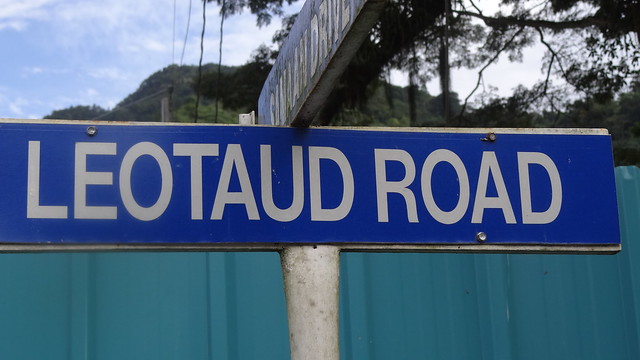
Leotaud Road Léotaud

On his long journey through the West Indies in 1888, the Canadian cleric Léon Provancher attended a reception in Trinidad at the home of the eccentric Sylvester Devenish, where he made the acquaintance of Dr. Léotaud, “an island celebrity of whom I had already heard,” and his son-in-law, also a physician.

Provancher, fully absorbed in his host’s collections of engravings, bronzes, photographs, relics, and “ornaments of all kinds,” has no more to say about the medical men in attendance, but I want to believe that they were relatives of an even more celebrated Trinidadian, Antoine Léotaud, author of what remains nearly 150 years after its publication one of the best and most ambitious, if necessarily imperfect, neotropical ornithologies ever written.

According to an obituary quoted by Junge and Mees, Léotaud was born on Trinidad 200 years ago this New Year; he studied the sciences in Paris, eventually taking a medical degree, and returned at the age of 25 to practice in Trinidad. Léotaud’s Oiseaux was published a year before his death on January 23, 1867 from “a painful malady of fourteen months’ duration.”

I don’t know whether it is poor health, frustration at his lack of scientific resources, or a literary tristesse tropicale that is to blame for the striking tone of disappointed nostalgia that Léotaud affects in the Oiseaux.

It would be the most offensive of positivisms to draw conclusions about Léotaud’s “real life” from the attitudes he strikes in his writings. But consider the fact that in 1865, while he was hard at work on the ornithology, Léotaud was awarded the gold medal of the Medical Society of Ghent for a study entitled “Sur les causes de dépérissement des familles européennes aux Antilles” — on the sources of degeneration in European families in the Antilles.

Somebody clearly missed Paris.

Whatever Léotaud’s own state, he had some pronounced ideas about the emotional and intellectual condition of the wild birds of Trinidad.

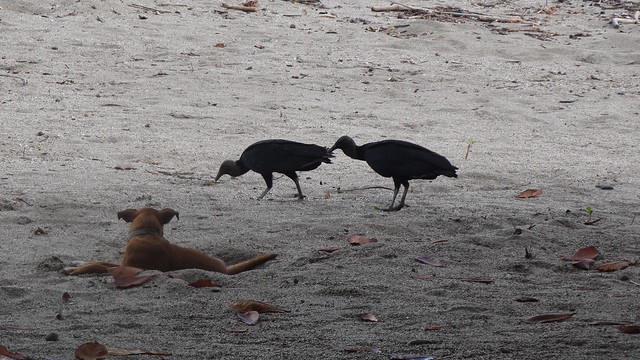
Black Vulture with dog

The Black Vulture, for example, moves in ways

destitute of gracefulness, revealing the bird’s insignificance; even its anger results in nothing more than an exhaled grunt which evinces its stupidity; its quarrels, lacking in energy of any kind, bear the sign of weakness…. Even in the pleasures of love it exhibits those sad characteristics that it reveals in everything else; it is silent, it is clumsy, its preparations are tedious and only with great effort does it manage to accomplish that act that is normally so effortless in almost all birds.

Projection? Pathetic fallacy? Or just a bad mood?

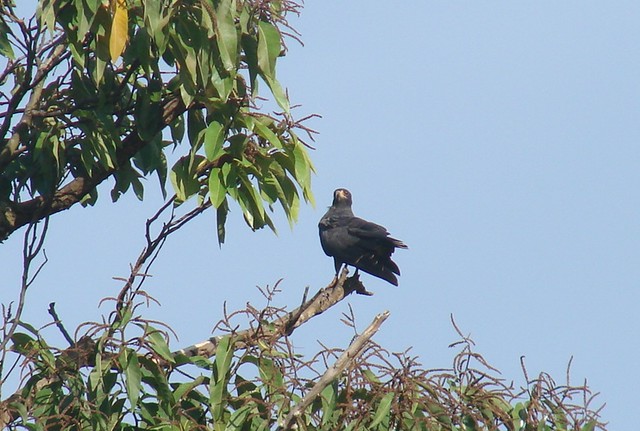
snail kite Guyana 2007 010

Léotaud writes with greater sympathy of the Snail Kite (the photograph here is from the South American continent — we did not see the species on our visit to Trinidad and Tobago).

This bird is rarely seen here…. It is always alone, no doubt because it finds no companions…. only a few individuals come to visit us around the month of July, and thus they find themselves in conditions contrary to their usual habits.

Loneliness, in fact, seems to be a problem for many of the birds of Trinidad, if we trust Léotaud. The poor little Tropical Screech-Owl sings a song that

inspires sadness, as this bird is heard only when everything in nature is ready for slumber; its song ushers in the dusk. No doubt he is calling his companion in this way….

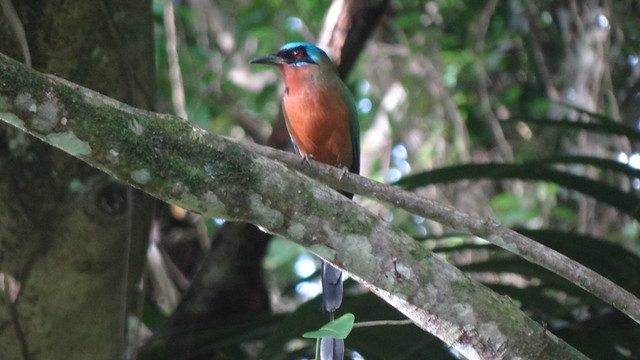
Trinidad Motmot

Even the beautiful Trinidad Motmot moves Léotaud to melancholy contemplation:

He prefers the dimness of our forests, which seems to suit so well the sluggishness of his movements and the sadness of his call. Having perched for a long time on a branch, he leaves it only with reluctance. Even the fires of love can barely raise him above his apathy. His call … is in no way meaningful; it is a call not of gaiety, or of anger, or of passion. And beyond that, his posture is heavy, his shape graceless… he draws attention only with his tail, [the shape of] which is one of those secrets that man will no doubt never manage to unravel. The female accompanies him almost always, but she is incapable of bringing animation to his so sad life.

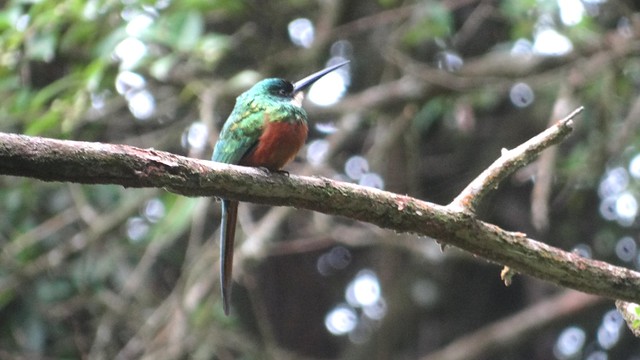
Yes, motmots are notoriously calm, but rarely have they been accused of having a flat affect. The reproach makes even less sense when Léotaud turns it on the flashy Rufous-tailed Jacamar:

he remains immobile for hours at a time, and hardly stretches out his beak to grab an insect that happens to stray within his reach…. His call is weak and plaintive…. His companion follows him almost always to share this life that seems so sad and monotonous.

Rufous-tailed Jacamar

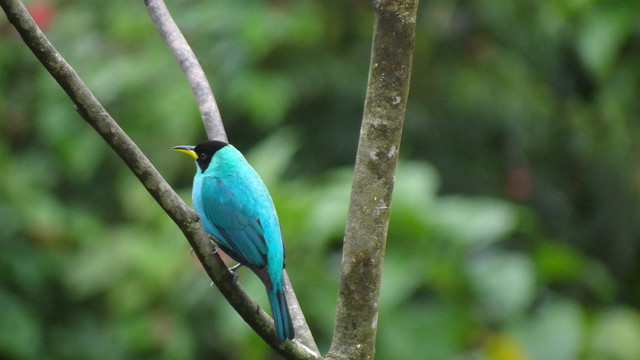
The most poignant case of all seems to be that of the Green Honeycreeper.

Green Honeycreeper

I’ve always found these sturdy little frugivores a colorful delight, but Léotaud had a different impression:

Its form is not very graceful, and its posture is somewhat heavy…. Its plumage is worthy of admiration, but its weak, insignificant call draws no notice. He is not made for captivity, and deprived of his liberty, he soon converts his cage into a tomb. Nevertheless one can accustom him to his prison, but only at the cost of so much effort and patience that it is a triumph of which only some people are capable, namely those whose interest in birds is a true passion.

It is harder and harder not to imagine that the author is speaking of himself and his own circumstances in such descriptions.

Share

Pyle: Mariposa Road

It wasn’t long before we moved to southeast Arizona for good—at last. Alison and I were coming down Miller Canyon after a quick pre-breakfast walk, and we ran into a group of binocular-wearing colleagues headed up. The usual greeting: “Seen anything?” The group’s apparent leader responded with the disyllabic question: “Sulfurs?”

Alison hesitated, puzzled, then pointed to the Sulphur-bellied Flycatcher squeaking its loud matins from the tree right above our heads. “Sulfurs?” was the bemused response.

They weren’t talking about birds.

Birders and lepers have a lot in common. Indeed, most of the latter started out as the former before discovering the pleasures of late rising and warm climates; as a result, the culture of butterflying, in North America at least, has closely mimicked the development of birding, with the signal exception of the big year: though well established in birding circles, the attempt to record as many species in a single annual cycle had never been attempted by a lepidopterist.

Until, that is, Robert Michael Pyle’s scaly-winged run in 2008.

Pyle—not to be confused with Hawaii’s ornithologist—is a highly respected butterflyer, an eloquent and influential conservationist, and a fine writer, and I was prepared to love Mariposa Highway, the account of his 2008 North American butterfly big year. Unexpectedly, however, the book (all 400+ pages of it!) never really catches fire, its gentle prose and unhurried rhythm descending—I hate to say it—into the monotonous after the first 100 pages or so.

Why?

Like most critics, I usually find it easier to identify the causes of failure than

the sources of success; that’s what reviewers are for, right? It was harder this time, though, given Pyle’s long record of wonderful publications. Soon enough I found myself concentrating more on the book’s failure to excite than on the events it recounts. What happened?

It wasn’t just the occasional editorial lapse, as when the well-known state park in southeast Arizona is called “Pacheco” rather than “Picacho Peak” or when Tom Beatty of hummingbird fame is called “Bentley.” Instead, I think Mariposa’s failure to excite lies in its single-mindedness, in the static nature of its subject, and in a certain narrative solipsism. Let me explain:

Peterson and Fisher’s Wild America, which Pyle takes as his express model here, was the account of a birders’ big year—and much, much more. There was little the two friends did not stop to think about, feathered or not, natural or cultural: they spent April 19 in Concord and Lexington, they made a pilgrimage to the abandoned cabin of a Sonora Desert hermit, they ended the book with an appendix on the history of the fur seal trade. Mariposa, in contrast, gives the impression of being about butterfly twitching and very little else. I haven’t counted, but my sense is that far more words and far more pages are filled with the lister’s veni, vidi, vici in Pyle’s work than in its great predecessor; this means that a reader who is not quite as enthusiastic a lepidopterist as the author may succumb before finishing the book.

There’s something about butterflies themselves, too, that makes it much harder to keep the non-specialist reader’s attention. Put simply, they don’t really give a listing writer much to say: they may be beautiful, they may be rare, but beyond hilltopping, sucking manure, and copulating, they just don’t do much. This challenge is visible in its extreme in Pyle’s accounts of finding (and listing) butterfly eggs for his big year; I admire the author’s observational skills, but it would take a finer writer even than Pyle to generate much narrative tension out of such a find.

Finally, and perhaps most importantly, Pyle’s big year was conducted largely on his own. Not even when he is butterflying with others does the hopeful reader find much in the way of interpersonal interest. Pyle is as dutiful as he is obviously sincere in thanking those who helped him, but I can’t say that at the end I had any sense at all of having got to know the secondary “characters” in his story. Not even Pyle’s wife, whose illness is a moving theme running through the book, ever really takes narrative shape here. Contrast this with the complicated relationship so charmingly drawn by the authors of Wild America, or with the priceless character sketches that punctuate the account of another solo big year, Kenn Kaufman’s Kingbird Highway. In Mariposa, we learn nearly as little about the author as we do about his friends; Pyle resembles Kenny Rogers, he went to Yale, that seems to be enough.

Butterfly devotees will read this book differently and probably with greater pleasure. The rest of us may come away disappointed that Mariposa doesn’t do a better job of spinning a more interesting story around the author’s year on the road.

Share