Archive for Bulgaria

I hope many of you can make it to tomorrow night’s lecture at the Sonoran Audubon Society‘s meeting in Glendale, Arizona. I’ll be talking about birding a part of the world many North American birders never even think of–and the ways that birding can help the establishment of a conservation ethic in some fascinating and ancient landscapes.

See you there!

  • Share/Bookmark
Categories : Bulgaria, Information
Comments (0)
Mar
10

Birds, Birders, and a New Bulgaria

Posted by: | Comments (0)

Just back from nine great days in Guatemala, I’ll be giving a lecture tonight to Tucson Audubon Society about the birds of Bulgaria and the BSPB‘s efforts to save them.

Join us at 7:00 this evening to see some photos, hear some stories, and learn something about what you can do–and what only the Bulgarians can do–to help preserve this country’s amazing natural richness.

  • Share/Bookmark
Categories : Bulgaria, Information
Comments (0)
Jan
15

A Couple of Lectures

Posted by: | Comments (0)

The announcement of my lecture on Bulgaria to the Tucson Audubon Society March 10 has appeared, and I hope that some of you can show up for it.

Meanwhile, I’m busy, busy getting myself ready for the keynote speech this weekend at Wings over Willcox, and looking forward to birding with many old friends and new! The lecture is sold out, but no doubt more for the food that precedes it than for the wisdom to follow the banquet.

  • Share/Bookmark
Categories : Bulgaria, Information
Comments (0)

Just what is the relationship between birding and bird photography? I know people who won’t ‘count’ a bird unless they’ve got a good image of it, and I know, alas, many people who leave the identifying of their photos to the sometimes dubious expertise offered by one or another of the internet “forums.”

I’ve ranted before about how twenty-first-century birding is on the path to overvaluing images and undervaluing thought; it’s part of a greater anti-intellectualism, I suppose, and it’s turning birding into something I don’t recognize and don’t much like. There is a very good, if slightly miscellaneous, article by Ted Eubanks about these problems in the newest issue of Birding; the author’s call for a return to “intuitive birding” should be required reading for those who post their House Finch photos under the terse heading “Identify, please.”

I wonder what the forums would say about these two images. I know what both birds are because I watched them, listened to them, took notes on them; but as usual, my pointing the camera at them was a tardy afterthought, and the images I got show it.

I suspect that this first one, of a bird singing in a small thicket on the Black Sea coast, is probably identifiable by someone who really knows her warblers.

Or maybe not. But knowing what it is, I can convince myself that I see the long, sloping forehead, the outsized bill, and the rounded tail of a Hippolais warbler; adding in habitat and range information, I suppose we can get to Olivaceous Warbler with some confidence. And that’s exactly what the bird was, one of many we got to enjoy all across Bulgaria.

The second one is much harder. It’s the only photo I got of the only member of this otherwise common species I saw this trip, and I’m not sure that anyone could make anything out of it. The bird was hunting in an open patch of woods near a couple of buildings.

Clue number one: No, it’s not a Mexican Chickadee.

Even knowing what the bird is, I’m stumped. The exquisitely slender tarsus suggests one of the ‘booted’ families, and rules out nicely such relatively clumsy groups as finches, sparrows, and tits; its length tells us we’re not dealing with a swallow. The square tail, the slim tarsus, and the habitat might lead us to…. I’d better stop, because I can feel myself already beginning to cheat, dropping my Cartesian pose and getting all a priori here.

What do you think about this bird? It’s an easy ID in the field, but is it even possible from this image?

[Answer: it was a Common Redstart.]

  • Share/Bookmark
Jul
21

Bulgaria 2007: Christmas Card Birds

Posted by: | Comments (0)

For a while in the 1980s, birders were playing a new and slightly perverse listing game: the Christmas Card Bird Count. If rightly I remember, Birding even published a few of the more impressive tallies. What struck me most at the time was how few Nearctic species made those lists. Once you’d ticked Northern Cardinal, Cedar Waxwing, and Eastern Bluebird, nearly every Hallmark bird was an Old World species.

That’s part of the reason that a birding visit to Europe, even a first birding visit to the continent, is so filled with déjà-vu moments. In Bulgaria this summer, time and again we ran across “familiar” birds that were in fact new to many on the bus, but whose colorful images had been impressed on memory for years.

European Bee-eaters were common enough in the appropriate habitats, at colonies in rough banks or charrupping in pairs and small flocks high overhead.

Perhaps the most abundant of European passerines, Chaffinches gave some in our party a run for their money, singing everywhere from invisible perches in mixed forests. But a few individuals were more accommodating.

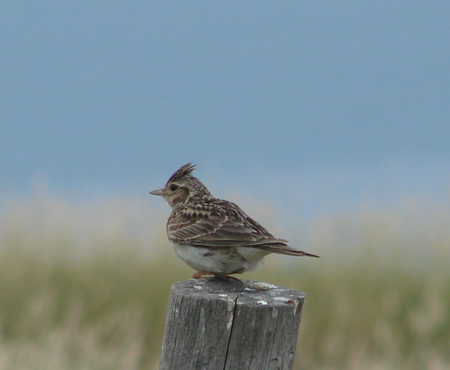
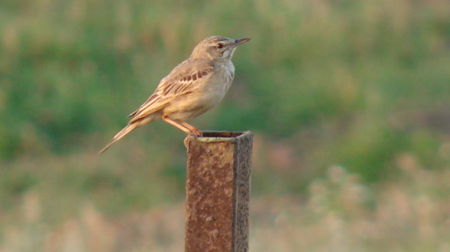
Eurasian Hoopoes whooped along the roadsides every day, but for some reason I was never ready with the camera when one showed itself. Earl got great photos of this individual, but I was satisfied with a distant shot taken while I was busy enjoying Greater Short-toed Larks (much the better bird than a “mere” hoopoe!).

I’ve always been fond of Christmas cards that are “seasonally inappropriate,” with bright yellow American Goldfinches or Magnolia Warblers atop the tree. House Martins leave Europe in the winter, but they are one of the most abundant and most conspicuous of Bulgaria’s summer birds.

I’m very proud of this picture, accidental though it may have been.

The Palearctic fringillids are always good for a winter greeting. Linnets are Alison’s favorite, and every one reminded me of her excitement at seeing her first in France years ago.

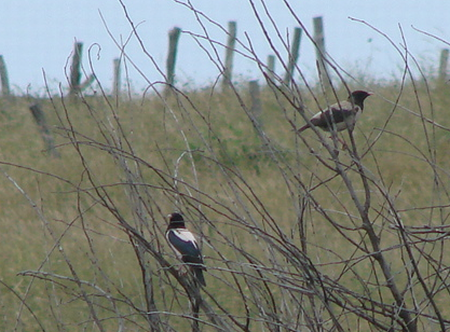
The CCBC lists always tallied good numbers of European Rollers, and we did too on our Bulgarian trip. Again, though, I was always watching something rarer, like a Montagu’s Harrier, when a roller would have let me take its picture, so the best I got was this rather blurry shot. But still, blurry or not, you’ve got to admit that this is one improbably beautiful bird!

I don’t think I’ve ever seen a Eurasian Thick-knee on a Christmas card, but they certainly deserve to be. We saw this species only a couple of times in Bulgaria, but each time it was worth the screeching of bus brakes.

And this picture resembles a Christmas card itself, with a bright male European Stonechat perched among the flowers. It would have been better, but I was watching a Black-eared Wheatear up the slope. (Excuses!)

As I look back through this selection of “pretty birds,” it occurs to me that all of them can be seen elsewhere in Europe, in Provence, for example. But Bulgaria has them all in an abundance I had never seen elsewhere, making every day of our trip a birder’s Christmas present.

  • Share/Bookmark
Comments (0)

 Subscribe in a reader

Nature Blog Network