Other People’s Bird Books: Audubon’s Birds of America

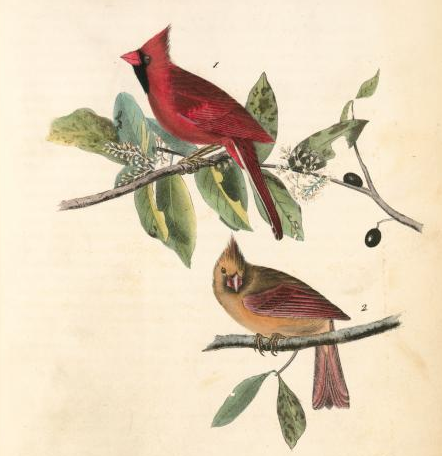
Northern Cardinal, the state bird of Indiana

It’s comforting to think that once an object enters the collections of a major museum it’s safe, preserved for all time and all people.

Comforting. And false.

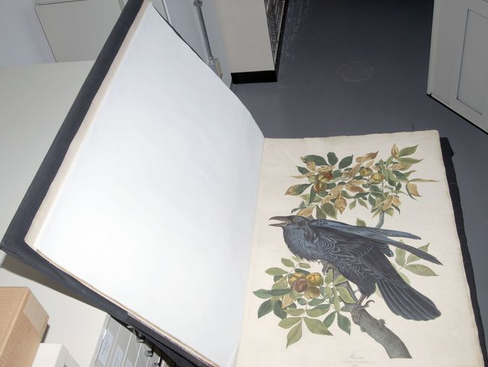
Museums and libraries, private and public, buy and sell and trade items from their holdings all the time, for all sorts of reasons. This coming April, the Indiana Historical Society will auction its copies of Audubon‘s Birds of Americaalong with the Viviparous Quadrupeds, purchased eighty years ago for the then princely sum of $4,000. The proceeds from the sale will be used to enrich the Society’s collections of books, papers, and artifacts more immediately connected to the history of Indiana.
Screenshot 2013-12-20 09.14.00

Thus far, the Society’s president, John Herbst, appears to have succeeded in forestalling the (often irrational) outcry that usually follows the announcement that a collection will be de-accessioning a prominent object:

The revenue should further the historical society’s modern mission of focusing on Indiana artifacts. The society would have loved to have had the money to buy a 1961 letter penned by Indiana native Gus Grissom during a recent auction, but the item — which alluded to the competition among Mercury 7 astronauts — slipped away. The same goes for a letter written by a Civil War soldier from Indiana, who was part of the 28th Regiment, United States Colored Troops.

“We continually see Indiana-specific items on the market that we’d like to have,” Herbst said.

Much of Audubon’s work — and particularly his masterpiece, “The Birds of America” — is publicly available through the thousands of prints, posters and cards that have been made, Herbst said. And there’s another original [copy] of that book at the Indiana University Library in Bloomington.
Screenshot 2013-12-20 09.17.16

And besides that, the IHS’s Birds and Mammals are both said to be in noticeably worn condition, after

years spent on the shelves of the Borden Institute, a private school in what was then called New Providence, Indiana. “They still are vivid colors, and there’s a lot of wonderful attributes that they still have,” Herbst said. “But they were materials that were in public libraries before we got them. They both had a lot of use before the society purchased them.”

As a result, Sotheby’s has set a modest reserve of only (only!) three million dollars for the Birds. If memory serves, the most recent complete sets of the Birds have brought three times that or more at auction. Somebody’s going to get a real bargain.

Given the poor-quality binding and the apparent rough condition of the plates, there would be nothing but sentiment to prevent that lucky purchaser from breaking the set up and selling the images singly, the fate of so many copies of this iconic book over the years.

With that prospect in mind, I hope that Sotheby’s and the Indiana Historical Society will make the effort to thoroughly document whatever signs of use are present on the plates. A pristine set of Audubons is a fine thing, but how much more valuable — intellectually, not financially — would be a copy, its binding shaken and its edges smudged, with the notes and arrows and marginal sketches of an early owner or user. I want to know what the boys and girls of the Borden Institute thought about this book, how they viewed it and what it meant to them. After all, what else are old books good for?

 

Share

Nymphs and Gnomes, Fairies and Sylphs

What a mess.

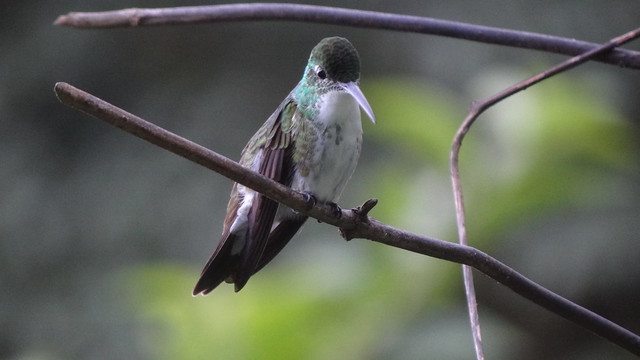
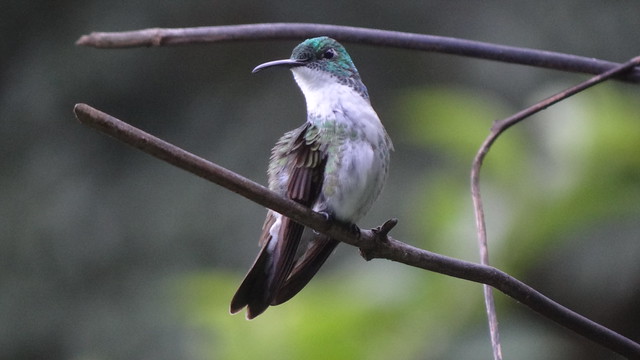
White-chested Emerald

White-chested Emerald, Trinidad

Or am I the only one who finds it hard to keep all those sapphires and brilliants and emeralds and rubies and topazes straight?

There are so many hummingbird species, and their classification has been revised so many times over the past two centuries, that the vernacular names have inevitably become a hodgepodge of historical relics and well-meaning neologisms, often enough reflecting neither relationship nor similarity.

In 1854, Ludwig Reichenbach, director of the royal zoo in Dresden, set out to clear the decks and introduce some of that good deutsche Ordnung into trochilid nomenclature.

The hummingbirds, like many another group of beautiful and popular creatures, have been worked on more in a spirit of pleasurable dilettantism than according to the stricter requirements of scholarship.

Firmly grounded in the powerful traditions of German Idealism and organicist aesthetics, Reichenbach lays out his taxonomic principles with great clarity:

It is necessary in a scientific work that we have always before our eyes the clear need to trace the development of the Type through its degrees of intensification, that we correctly evaluate the individual components in their significance to the whole, and that we be able to demonstrate the culmination of the Type as well as its deflection to heterogeneity.

Reichenbach goes on to observe that

Heaven and earth and all sciences and arts, even music in its chords and systems of tuning, are all four-parted, just as are all living things… and this quaternary system of divisions, whose accord echoes through all of Nature, … can be called a system that rests stable in itself.

All that theoretical hoohaw behind him, Reichenbach goes on to establish (you guessed it) four large categories –families, I suppose, though he doesn’t use that word — of hummingbirds: Nymphs, Fairies, Sylphs, and Gnomes. 

Each of those four large groups is further subdivided into four smaller categories — subfamilies — one of which is “typical” and the other three of which are “deflected into heterogeneity” by their similarity to one of the other families.

Thus, for example, there are “nymph-nymphs,” but there are also “fairy-nymphs,” “sylph-nymphs,” and “gnome-nymphs.”

Each of those subfamilies in turn comprises four genera, each of which in turn can be broken into four subgenera (again, only loosely translating Reichenbach’s categories into modern taxonomic terms). All of the known species of hummingbirds are then fitted into this scheme.

White-chested Emerald

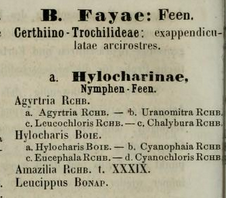
Our White-chested Emerald, for example, one of the most abundant and familiar trochilids of Trinidad and Tobago, would be a member of the family Fayae, the Fairies, which Reichenbach defines as “creeper-like” hummingbirds without head ornaments and with arched bills.

That family “culminates” in the subfamily Ochruraethe Fairy-Fairies, but the emerald and its close relatives apparently tend to the “heterogeneous,” making them members of the subfamily Hylocharinae, the Nymph-Fairies, the third genus of which is Amazilia.

Screenshot 2013-12-18 13.57.48

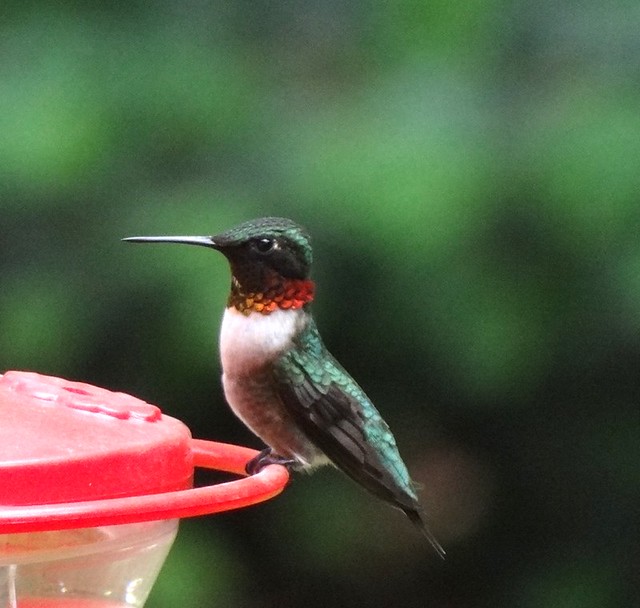
Richenbach’s “perfect” hummingbird, the culmination of the Type, has to be a Sylph, a member of the “genuine or typical Trochilideae: adorned with helmet, crest, ear-tufts, or extensive brilliant iridescence.” Naturally (or artificially, one might say), there are sylphs and then there are sylphs, but the ultimate hummer should be a Sylph-Sylph, of the subfamily Trochilinae. The first genus listed there is Trochilus — and the first species Reichenbach cites is Trochilus Colubris Linn. 1766.

Behold THE hummingbird,

Ruby-throated Hummingbird


the Ruby-throated Sylph-Sylph.

Share

A Fork-tailed First

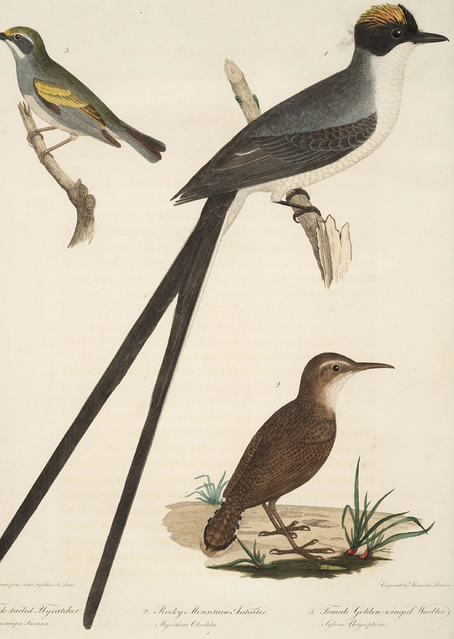
Audubon’s famous Fork-tailed Flycatcher, collected in New Jersey in June 1832, gets all the press.

But that wasn’t the first fork-tail recorded in the US — or even, amazingly enough, the first for New Jersey.

Screen Shot 2013-06-23 at 2.11.31 PM

Sometime before 1825 — the usual date in the secondary literature seems to be “around 1820,” while Boyle gives “around 1812” —

a beautiful male, in full plumage … was shot near Bridgetown, New-Jersey, at the extraordinary season of the first week in December, and was presented by Mr. J. Woodcraft, of that town, to Mr. Titian Peale, who favoured me with the opportunity of examining it.

“Me,” of course, is Charles Lucian Bonaparte, writing in his American Ornithologyfor which Peale also provided the rather stiffly elegant plate reproduced above.

When James Bond set out, almost 75 years ago now, to determine the subspecific identity of US Fork-tailed Flycatchers, he was unable to locate any of the specimens taken before 1834, “if any exist.” But even absent a skin, Bonaparte’s detailed description of the Bridgeton bird allows us to pin it down almost 200 years later:

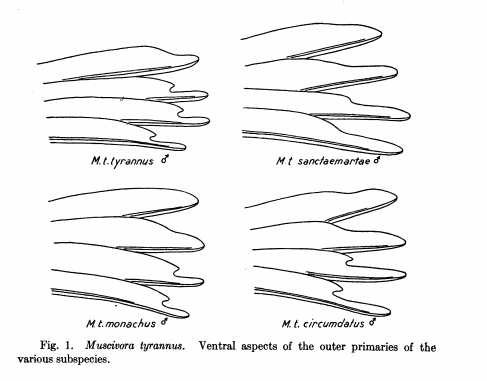
… the three outer [primaries] have a very extraordinary and profound sinus or notch on their inner webs, near the tip, so as to terminate in a slender process.

That is enough, according to Zimmer, to identify the Woodcraft specimen as a member of the subspecies savana (then known as tyrannus).

Screen Shot 2013-06-23 at 2.38.21 PM

That austral migrant, abundant in its range, is responsible for almost all northerly records of this species, though Zimmer identified one New Jersey specimen, of unknown date and locality, as sanctaemartae (a determination adjudged only “possible” by Pyle).

To Bonaparte, it was “evident” that his specimen “must have strayed from its native country under the influence of extraordinary circumstances.”

That’s for sure.


Share

Pizarro the Elephant

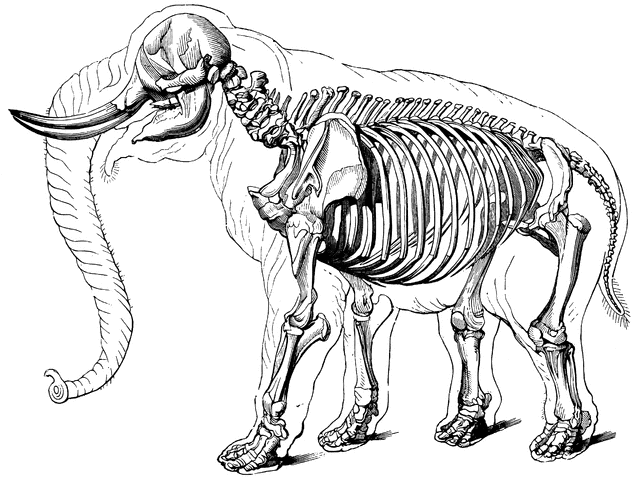
On this date in 1839, Raymond and Waring opened Cooke’s Circus in Philadelphia. Along with clowns, equestrian artists, and two camels, the show also included a male Asian elephant, Pizarro.

Pizarro killed a man in Louisiana in March 1845, but remained active as a performer.

Two years later, on April 15, 1847, the animal keepers forced Pizarro and a second elephant, Virginius, into the water at Greenwich Point, Pennsylvania, hoping that they would swim across the Delaware to Gloucester Point.

Both drowned.


Share

The First BO

They’re everywhere today, run by government bodies, NGOs, and even individuals in search of a tax break. They staff hawk watches, monitor shorebird nests, and work with landowners and managers to preserve habitat. They do a lot of good work — almost always without a lot of money.

Screen Shot 2013-11-05 at 2.13.14 PM

Bird observatories are so much a part of the modern birding landscape that we can easily forget they had to be invented. This is a great day to remember that fact — and to honor the founder of the first such institution in the world, Johannes Thienemann, born 150 years ago today in Thuringia.

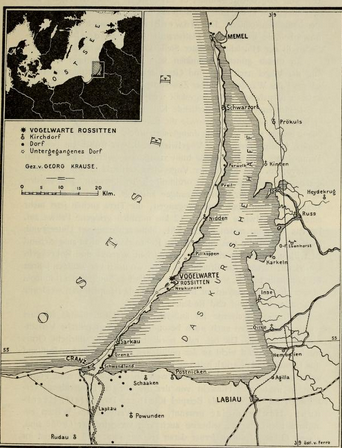
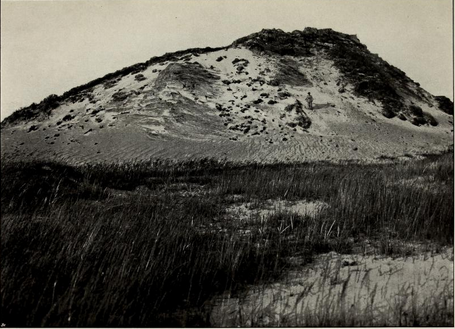
At the turn of the twentieth century, Thienemann was living in Rossitten, then a village in East Prussia and now the Russian Rybachy. In October 1900, he was assigned a spot on the agenda at the Leipzig meeting of the German Ornithologists’ Society. His was the final paper in the Sunday morning session; in his remarks, he presented the plan for an ornithological observation station on the Curonian Spit, that long slender bit of sand now connecting Lithuania and Russia.

Screen Shot 2013-11-05 at 4.59.21 PM

In mid-December, the Prussian Ministry for Religious, Education, and Religious Affairs issued a decree establishing the Vogelwarte Rossitten, to be run by the DO-G and the observatory’s first  director, Johannes Thienemann.

Thienemann had set himself some ambitious goals. The new bird observatory was charged with maintaining thorough migration records, collecting life history information, investigating molt, monitoring crop depredations, undertaking habitat plantings, installing nest boxes, building feeding stations, and establishing a museum and library. Thienemann’s responsibilities would also include the publication of an annual report and occasional papers treating noteworthy observations and experiments; he was no doubt pleased by the assurance in the by-laws that

there are no restrictions placed on any other publication activity on the part of the Director so long as that activity does not interfere with the timely preparation of the official reports.

That must have come as a considerable relief to the new director as he wondered what to do with all his spare time.

Undaunted as only a young German can be, Thienemann set to work immediately, and the observatory was formally opened on January 1, 1901, with funding provided by the Royal Ministry of Agriculture and Forestry, the Province of East Prussia, and generous private patrons, among them Secretary of State von Moltke, not otherwise known as a birder.

Screen Shot 2013-11-05 at 5.24.46 PM

In 1907, the East Prussian state constructed a building to house the observatory and its staff, which at that time comprised Thienemann and a servant; a local taxidermist, A. Möschler, stuffed and mounted the specimens collected as part of the observatory’s work.

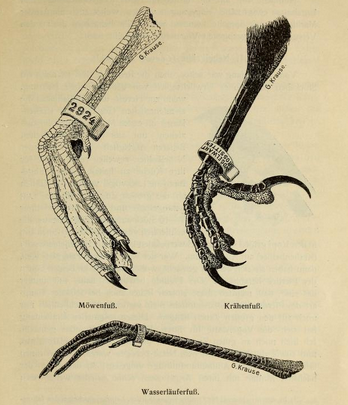
From the earliest days of Rossitten, Thienemann was particularly interested in marking migratory birds in the effort to determine their routes and timing.

If the colors of birds of the same species living in scattered localities were so strikingly different that, for example, eastern German storks had red legs and western German storks yellow, south German ones had green and those from the Russian provinces blue and so on, then we would quickly make good progress in our studies of migration; every migratory bird would carry its own passport, and we would always be informed about the Where From and the Where To of the travelers. Well, nature isn’t that accommodating, but perhaps we can help….

By marking and numbering the birds in a systematic, well-organized way, researchers could “raise the individual above the common run of his conspecifics,” and use the marked birds to discover things about their migration routes, their winter ranges, their ages, the sequence of their plumages:

This would mean the end of hypothesizing and the beginning of factual knowledge.

Screen Shot 2013-11-05 at 6.05.46 PM

Concerted banding began at Rossitten in 1903, with tantalizing results coming in almost immediately. Of the more than 900 Hooded Crows captured and ringed in the first seven years, fully 12% were recovered; one bird, marked in October 1903, was shot in May 1909 30 kilometers outside of St. Petersburg.

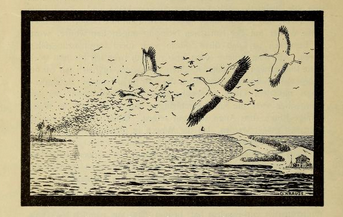
Black-headed Gulls and White Storks wandered even farther. One of the 40 foreign recoveries among the gulls came from Tunis, 2200 kilometers to the south, while stork bands were returned from Syria, Egypt, Palestine, the Sudan, Rhodesia, and what is now South Africa.

White Stork

Thienemann died at Rossitten in 1938, nine years after his official entry into what was a very active retirement. The bird observatory remained open until 1944, and was reconstituted after the war as a branch of the Russian Academy of Sciences; since 1997, its operation in Ribachy has been funded largely by the German Heinz Sielmann Foundation.

Ask almost any English-speaking birder about the history of German ornithology, and the first word out of her mouth will be “Heligoland.” But it all started far to the east, and it’s all thanks to Johannes Thienemann.


Share