Archive for Birding Festivals
Sparrizona
Posted by: | CommentsA wonderful long weekend–too short a long weekend–in southeast Arizona started with a surprisingly well-attended Sit at beautiful Boyce Thompson Arboretum.

Counting my co-leader Darlene and our sponsor Paul, we were a group of forty-nine, making this one of the three or four largest trips I’d ever led for Tucson Audubon.

The company was great, the birding perhaps a bit subdued, thanks to the chill and cloudy day. The clear avian highlight was, naturally enough, a sparrow, a wintering Red Fox Sparrow that eventually gave everyone ooh-aah views as it fed near the Demonstration Garden with White-crowned Sparrows and Lesser Goldfinches. Any fox sparrow (or should I write fox-sparrow?) is a “good” bird in southern Arizona, and this one started off a nice run of emberizids that lasted the entire weekend.

Friday I spoke at the Wings Over Willcox festival, but I had the morning and Saturday, too, to run around looking for puddles with sparrows in attendance. Brewer’s and Vesper Sparrows were around in heartening numbers, joining the thousands and tens of thousands of Lark Buntings out in the Sulphur Springs Valley.

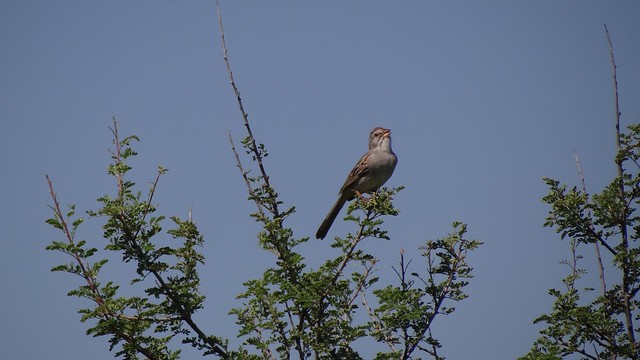
A single Cassin’s Sparrow was a good find at the Willcox golf course’s leaf dump; that species is rarely detected in Arizona in winter. Less surprising but just as lovely was the Grasshopper Sparrow that joined a flock of Brewer’s Sparrows on the roadside; it’s just visible in the photo second above, but did step out from the crowd a few times to give nice, unobstructed views.

It’s always a delight to be reminded how colorful this bird is with its ochre face and purple collar.
I got back to Tucson too late Saturday to do any birding around town, but Darlene picked me up on Sunday for an excursion to Sweetwater Wetlands.

As it usually does, this urban oasis came through big time with winter rarities: a Chestnut-sided Warbler, a Summer Tanager, a surprising Solitary Sandpiper. There were a few Lawrence’s Goldfinches on the edges of the ponds, where they fed beneath buzzing and chattering Marsh Wrens while hundreds of ducks–including many hundred Northern Shovelers–courted and splashed.

Among all these birds one stood out: a Swamp Sparrow, annual at Sweetwater nowadays but still scarce anywhere in the state. This bird, with streaks still obvious on the upper breast, was probably in its first plumage cycle, putting paid to my old notion that Sweetwater had been hosting just one, long-returning individual.
Rain, welcome rain but cold, chased us out, and it was still spitting when I got up early Monday morning to go to Catalina State Park.

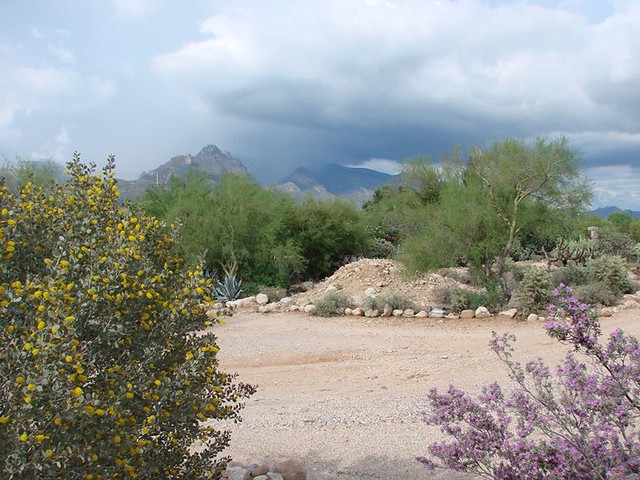
I wandered the washes and saguaro-studded slopes under a Chinese scroll of a sky, the mountains surging in and out of sight as the overcast rolled across their face.

The birding was good; I knew it would be when one of my first sightings was of a Lincoln’s Sparrow, one of two individuals I ran across on my walk. The emberizid flocks were composed mostly of White-crowned and Brewer’s Sparrows, as expected, but there were also four species of towhee mixed in: Abert’s and Canyon Towhees are common there all year, while Spotted and Green-tailed Towhees are only winterers in the park’s lowlands, both species in extremely variable numbers.

As I emerged into the drier desert on the ridges, Black-throated Sparrows became more and more conspicuous, their thin notes issuing from every clump of opuntia.

This abundant and familiar species is something of a nemesis bird for me: with what is fast approaching 40 years of birding under my belt, I’ve still never found this gorgeous sparrow anywhere in the east or midwest, where vagrants seem to show up–for other people–every winter.
Far less given to wandering is my favorite sparrow of all time.

I ran into only two groups of Rufous-winged Sparrows, one probably a pair, the other probably a family. After a moment’s fright, they all let me sit down with them and watch as they went about their quiet business on the ground beneath the catclaw, scratching for seeds and generally being irresistibly beautiful. No song yet from any of them, but it won’t be long. Wish I were there to hear it!
My weekend sparrow list:
Green-tailed Towhee
Spotted Towhee
Canyon Towhee
Abert’s Towhee
Rufous-winged Sparrow
Cassin’s Sparrow
Chipping Sparrow
Brewer’s Sparrow
Vesper Sparrow
Lark Sparrow
Black-throated Sparrow
Lark Bunting
Savannah Sparrow
Grasshopper Sparrow
Fox Sparrow
Song Sparrow
Lincoln’s Sparrow
Swamp Sparrow
White-crowned Sparrow
Dark-eyed Junco
And if you’re a traditionalist, Chestnut-collared Longspur, too.
Wings Over Willcox
Posted by: | Comments
Bendire's Thrasher, a Sulphur Springs specialty
Join me for my Friday lecture and for some excellent birding in the Sulphur Springs Valley.
See you there!
Spring Sounds
Posted by: | CommentsClick here and turn up the volume if you want to hear the sounds of spring in Buffalo County, Nebraska.
Can you identify that sweet thin warbled song? It’s one most of us don’t get to hear very often.

The Platte River at Fort Kearny.
Ferrug
Posted by: | Comments
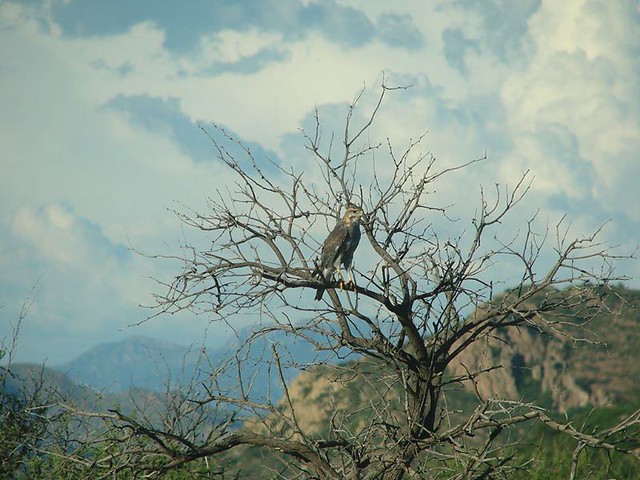
Yes, Wings Over Willcox is one of the great Sandhill Crane shows anywhere in the world–but the raptor display is every bit as exciting. This Ferruginous Hawk was one of about 5 our group saw on Saturday.
This is a globally rare bird, restricted during the breeding season to the western Great Plains, where it spends the hot summers making life miserable for prairie dogs and other terrestrial squirrels. We’re tremendously lucky here in southeast Arizona to have so many wintering in the area: a day spent in the Sulphur Springs Valley or on the Santa Cruz Flats is almost guaranteed to produce several sightings, often at dazzlingly close range.
Want to see some yourself? Come to next year’s Wings Over Willcox. The keynote speaker will be Ted Floyd, and if I’m lucky, maybe they’ll invite me to lead a tour or two again.
Wings Over Willcox 2011
Posted by: | CommentsOld friends and new on a great sunny afternoon in the Sulphur Springs Valley. Plenty of birds to watch, from hundreds of Lark Buntings to bathing American Pipits, but the highlights were certainly among the raptors, with Ferruginous Hawk, Golden Eagle, and Prairie Falcon probably the “best.”
We ended with a mimid bang when a fine Bendire’s Thrasher perched up on the roadside, letting us enjoy scope views for fifteen minutes of one of North America’s most range-restricted passerines (now there’s a poorly wrought phrase). The Sulphur Springs rules in winter!