
Archive for New Mexico

This is about as weird as it gets: a SUNGREBE was photographed yesterday at New Mexico’s Bosque del Apache. I find it really difficult to imagine that this could be a wild vagrant, though there is speculation that a bird could, might, just conceivably, remotely possibly, get onto the lower Rio Grande and swim north and west.

Stay tuned! And even if the bird turns out to be an escape, as I assume it will, what a moment that must have been when the discoverer figured out what she was looking at….

  • Share/Bookmark
Comments (0)
Jan
25

MEGA: Barnacle Goose in New Mexico

Posted by: | Comments (0)

Leading a WINGS tour in New Mexico, Gavin and Derek rediscovered the Barnacle Goose in Colfax Co., New Mexico, this morning.

Sightings of this lovely Old World species in North America are always clouded by rumors of captive origin, but ever since I saw one on my local patch in New Jersey, lo these many ago, I’ve looked with greater generosity on sightings of the bird, even far inland.

This tour has been hugely successful so far, starting off as it did with Rufous-backed Robin. Wonder what they’ll be turning up tomorrow!

  • Share/Bookmark
Comments (0)

It’s a long drive from Roswell to Tucson, but the excitement of having watched the chickens dance got us through. Besides that, there was much to see along the way, and we would probably still be in New Mexico had we taken every promising road and looked for every species that occurred to us as we drove along (“Hm, wonder if there are Boreal Owls in there….”).

My favorite of the brief stops we made on the drive west was the alkali flat at Holloman refuge, just east of Alamogordo. I’ll have to check my notes, but it seems to me that that was the very spot where Ted showed me my first Snowy Plovers years and years ago; and they were there yesterday, too, or at least their descendants, five pairs or more out on the shimmering expanse.

A dozen Western Sandpipers were out in the middle, looking hot and bothered, and a surprise Baird’s Sandpiper was a good find, too; this far west, Baird’s are much commoner in the fall (which, for Arctic-nesting shorebirds, starts in about 3 months).

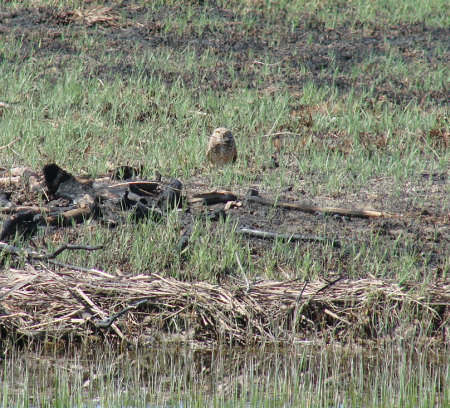
Technically not a shorebird, this little guy was on the shore of a wetland near Roswell; Burrowing Owls don’t need the water, but the disturbance associated with steep banks is of obvious advantage to them.

  • Share/Bookmark
Comments (0)
Apr
06

Love in the Afternoon

Posted by: | Comments (0)

I pridefully reject the label “chaser,” but I will admit that the point of our 1,100-mile trip to New Mexico this week was a single species: Lesser Prairie-Chicken. A couple of unexpected days off, a congenial group of fellow travelers, and explicit directions from Ernie at the Roswell BLM office combined to make this a perfect opportunity to finally chase (that word again!) the sole remaining Great Plains breeding species I hadn’t seen.

We dallied happily at a couple of sites along the way, but I kept an eye on the clock and we arrived at the lek in New Mexico’s choppy hills about 4:30 Wednesday afternoon. Less than an hour later, the first cocks strolled in, and suddenly, just about 6:00 pm local time, that familiar but still heartstopping general arrival took place, with nearly 30 birds walking and flying to the lek from the surrounding grassland.

I’ve wondered for literally decades whether I would be able to distinguish the bird visually from Greater Prairie-Chicken, and I’m afraid that at rest they so closely resemble their larger tallgrass cousins that I don’t think I could. I tried counting the bars on the breast feathers, I tried analyzing the pattern of the back feathers, but no luck.

That changed, of course, once they started to dance and sing.

No ghostly “old muldoon” booming here, just a weird, high-pitched bubbling cackle, sometimes resembling the distant gobbling of a tiny Wild Turkey. They also gave an ascending cack-cack-keer and the loud keening yeer-yeer indistinguishable to my ear from the cries of Greaters, but the sound of the lek as a whole was quite different.

And the neck sacs truly are reddish, not orange.

Great birds! I’m considering running an Aimophila Adventures tour next year to see the spectacle; let me know if you’re interested, since it will certainly be limited to a very small number of birders.

  • Share/Bookmark
Comments (0)

Only once before have I fallen victim to this illusion. It was a moonlight summer night on Long Beach Island, New Jersey, and I could not convince myself that the dunes were not covered with snow.

And then it happened again Wednesday morning, on a hottish bright day in New Mexico. Tell me that this doesn’t look exactly like snow drifts–and that the blue mountains behind the dunes couldn’t pass for the sea!

The gypsum sand doesn’t support many birds (Black-throated Sparrows, Say’s Phoebes, a Cactus Wren or two where the vegetation is denser), but the bizarre landscape held us until our dazzled eyes could look on it no more.

We looked, to no effect, for the bleached earless lizard that lives on the sands. We did, though, find clear signs of a much larger creature wandering the dunes.

Not one of us: we all remained decently shod and on the boardwalk.

  • Share/Bookmark
Categories : Information, New Mexico
Comments (0)

 Subscribe in a reader

Nature Blog Network