Grebe In Hand

One hundred years ago today, A.D. Henderson of Belvedere, Alberta, canoed Silvermore Lake with a friend.

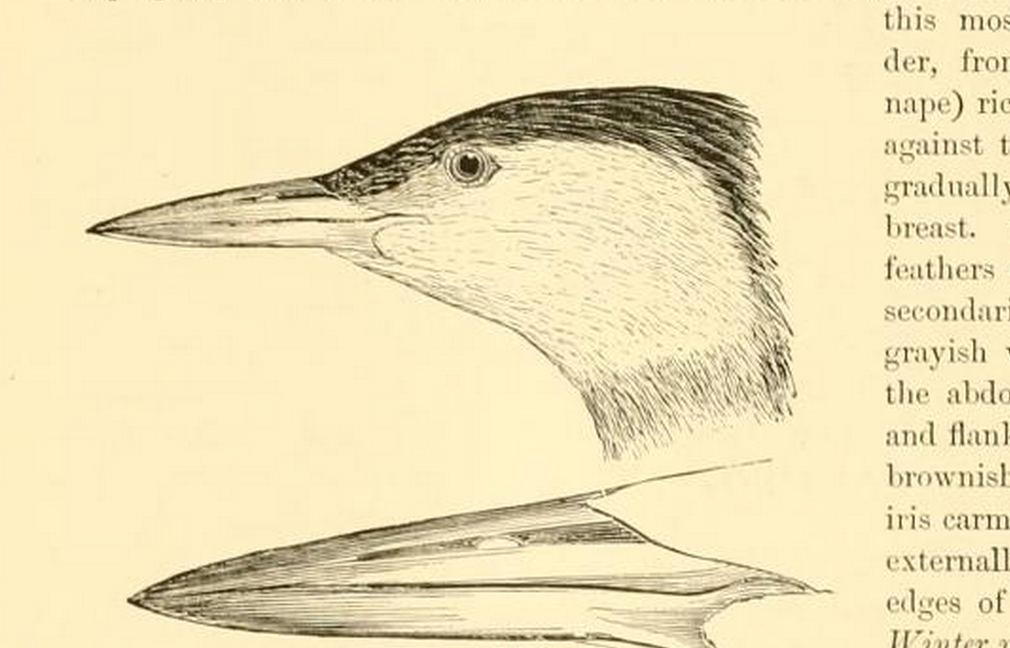
While paddling around we noticed a [Red-necked] Grebe swimming along with a young one on her back…. On our approach the parent bird dived with the young one on her back and carried it several yards under water. The young bird came up first and seemed bewildered or lost. We paddled up to it and my friend answered its plaintive peeping, whereupon it swam up to the canoe and into his open hand. We admired the curiously colored little fellow a while and then turned him loose.

No doubt to the relief of parent and young alike.

Baird, Water Birds


Share

Door County, Wisconsin: Day One

DSCN5581

I’d driven through Wisconsin once, long ago, on the way to points far west, but Monday marked the first time I’d ever set foot on Badger soil outside of an airport. I like it.

The drive north from Green Bay on that funny pointed peninsula was encouragingly rural, with small farms and fields and orchards lining the roads. Eastern kingbirds and meadowlarks ornamented the fences, and high above it all American white pelicans soared, alternating blinding white with near invisibility as they turned in the sky.

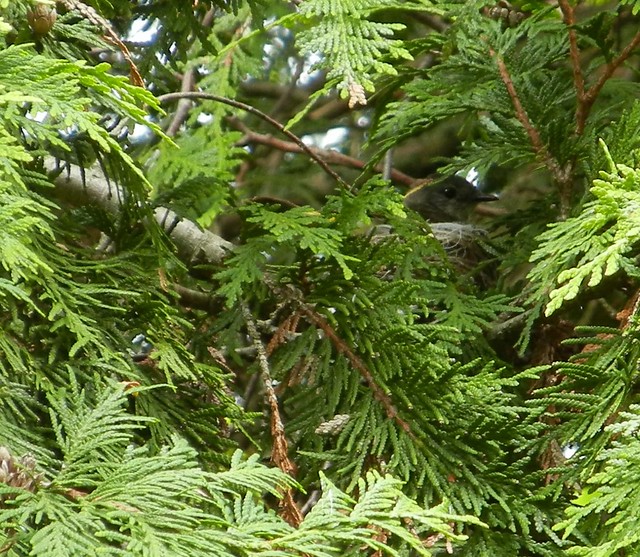
I’m staying in Bailey’s Harbor, at the Blacksmith Inn, a quiet and comfortable place right on the water. My little porch looks out at a bit of marsh, noisy with red-winged blackbirds and yellow warblers, and then on to the harbor itself, happy hunting ground for ring-billed and herring gulls and prehistoric-looking Caspian terns. The little yard attracts chipping sparrows and American robins, and a busy American redstart has her nest and her still tiny nestlings in a tree just at the corner.

American redstart nest

Dinner that first evening was in Fish Creek, an appropriate place, I thought, to have my first Great Lakes perch. The birds had the same inspiration: an adult bald eagle flew over carrying something scaled and struggling, and two black-crowned night-herons flapped past the restaurant windows hoping to catch their own in the dusk.

Here’s the complete list from the first day, if you’re interested:

June 23, 2014

Door County, Wisconsin

Canada Goose, Mallard

American White Pelican

Great Egret

Black-crowned Night-Heron

Turkey Vulture

Bald Eagle

Red-tailed Hawk

Killdeer

Herring Gull

Ring-billed Gull

Caspian Tern

Rock Pigeon

Mourning Dove

Downy Woodpecker

Pileated Woodpecker

Northern Flicker

Eastern Phoebe

Eastern Kingbird

Red-eyed Vireo

Blue Jay

American Crow

Barn Swallow

Tree Swallow

American Robin

Eastern Bluebird

European Starling

Cedar Waxwing

Yellow Warbler

American Redstart

Chipping Sparrow

Song Sparrow

Red-winged Blackbird

Eastern Meadowlark

Brown-headed Cowbird

Common Grackle

American Goldfinch

House Sparrow


Share

Ambassador of the Bright-feathered Throng

Today marks the 150th anniversary of the death of Christian Ludwig Brehm. Father of an even more famous son, Brehm was a dominant figure in continental natural history in the first half of the nineteenth century, a Roger Tory Peterson and James Fisher and David Attenborough and David Sibley all rolled into one.

Christian Ludwig Brehm 1787-1864.jpg
Wikimedia Commons

Brehm was, in both senses, a popular writer on the bird life of Germany and Europe, but his most lasting contribution was likely his personal collection of skins and mounts. Assembled with the help of his sons from two marriages, Brehm’s cabinet eventually included some 15,000 specimens. A generation after Brehm’s death, the birds were purchased by Lord Rotschild, whence they entered the collections of the American Museum 35 years later; some have meanwhile made their way back to German museums.

The importance of that collection to Brehm’s colleagues can be measured in the verse eulogy composed by the poetaster Ph. H. Welcker, who wrote the year after his friend’s death that

His publications commemorate his greatness in scholarship. / As a legacy he has left behind thousands of bird mummies. / And that trove of bird mummies, the envy of foreigners, / Is magnificently and realistically preserved, as if dressed by the hand of God. / Like his writings, that trove remains a witness to a well-lived life / Of inexhaustibly active industry and admirable effort.

This is, by the way, the only German poem I know to use the word “Vogelmumien” twice. (It’s hardly better in the original, but at least it rhymes there.)

Welcker also relates — also in rhymed couplets — a touching incident from Brehm’s funeral. When the casket had been lowered into the ground, a garden warbler burst suddenly into song in the nearby twigs,

You let your sweet full singing roll over the coffin of the man who knew your folk so well. You were the ambassador of your bright-feathered throng, greeting him one last time on the approach to the gates of darkness.

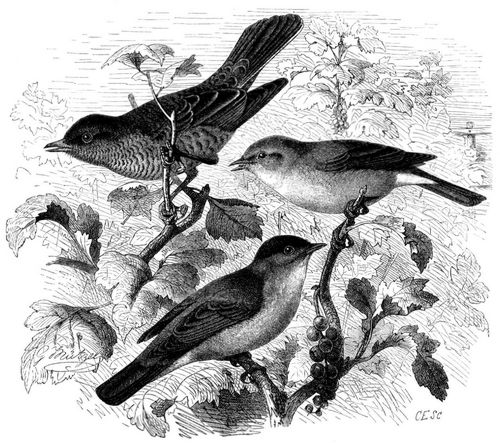
Barred warbler, garden warbler, and blackcap, from Alfred Brehm’s Thierleben

Did it really happen?

Who cares.


Share

National Meadowlark Day

Well, if it isn’t, it should be.
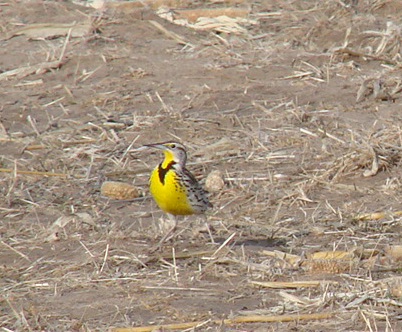
Western Meadowlark

On June 22, 1805, Meriwether Lewis wrote in his journal that

 there is a kind of larke here that much resembles the bird called the oldfield lark with a yellow brest and a black spot on the croop.

Lewis and the expedition’s crew knew the eastern meadowlark, “the oldfield lark,” and he observed that these western birds uttered a “note [that] differs considerably” from that familiar bird from back home. But

in size, action, and colours there is no perceptable difference; or at least none that strikes my eye.

And that was that. Lewis and Clark had in fact discovered a new species, the western meadowlark, but apparently thinking it just a variant of the well-known eastern bird, they preserved no specimens and prepared no formal description.

What happened next is well known. In May 1843, John G. Bell, the taxidermist on Audubon’s Missouri River journey, became aware of some

curious notes, without which [the meadowlarks above Fort Croghan, Dakota] in all probability … would have been mistaken for our common species.

On collecting a series of these “quite abundant” birds and comparing them to New York skins of the eastern meadowlark, Audubon — in contrast to Lewis, four decades earlier — determined that

the differences are quite sufficient to warrant me to describe the [western birds] as a new and hitherto undescribed species,

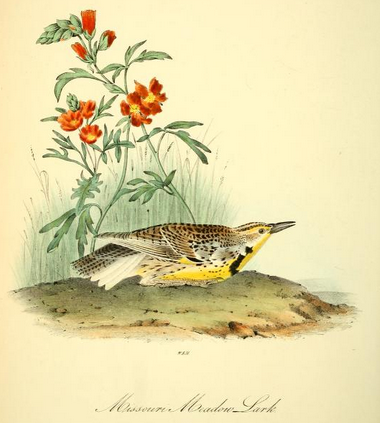
which he named the Missouri meadow-larkSturnella neglecta.

Aud, Oct 7, western meadowlark

That epithet, neglecta, is sometimes taken as another in Audubon’s collection of snide sideswipes at his colleagues and predecessors, but in this case, it is simply a statement of fact. And Audubon frankly includes himself among those naturalists who had overlooked the difference.

When I first saw them, they were among a number of Yellow-headed Troupials [yellow-headed blackbirds], and their notes so much resembled the cries of these birds, that I took them for the notes of the Troupial, and paid no farther attention to them.

Today is the day to be grateful that he and his colleagues eventually did pay attention.

Share

Fried and Roasted

Yes, I can tell you exactly, precisely, accurately how many Ross’s gulls I’ve seen in my lifetime: one, on a wonderful morning in Maryland nearly thirty years ago. 

It’s a happy memory, and one that makes it even more interesting to read accounts like this one, from the pen of Charles D. Brower at Barrow, Alaska:

I did get a good crack at the Ross gulls again this fall [1928]. One day, the 26th of September, they were around in thousands…. this fall I had them fried and roasted until I almost turned into a Ross Gull myself.

And what did these dainty dishes taste like? Chicken, right?

No:

They taste just as do the Golden Plover, and are just as fat in the fall.

Selby


Share