Barrow’s Birds

John Barrow Monument.jpg
Wikimedia

Cumbria memorializes a famous native son in a limestone tower, designed to recall a lighthouse but more closely resembling, to some eyes at least, a pepper grinder.

I’d like to believe that Sir John Barrow, who was born near Ulverston 250 years ago today, would appreciate more the feathered monuments to his long and richly varied life.
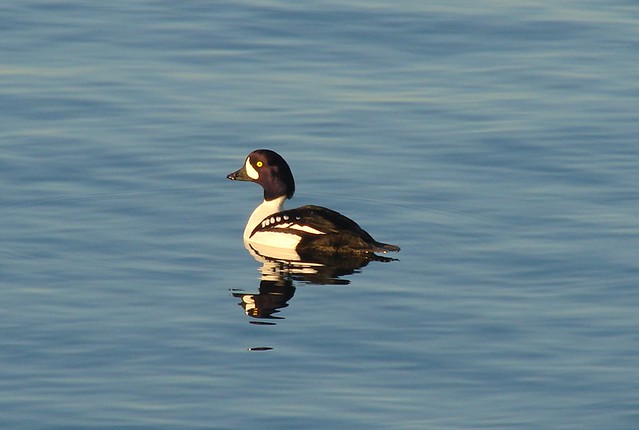
Barrow's Goldeneye

As most Northern Hemisphere birders know, Barrow is the English-language eponym of one of the handsomest of the mergine ducks. Richardson named the bird Anas Barrovii in the Fauna boreali-americana

as a tribute to Mr. Barrow’s varied talents, and his unwearied exertions for the promotion of science.

A high functionary in the British Admiralty, Barrow was a great promoter of Arctic exploration. Though he never saw the American high latitudes himself, his contributions are commemorated in a couple of famous place names, and thus, indirectly, in another bird of Alaska’s Arctic, the glaucous gull named barrovianus by Robert Ridgway in 1886.
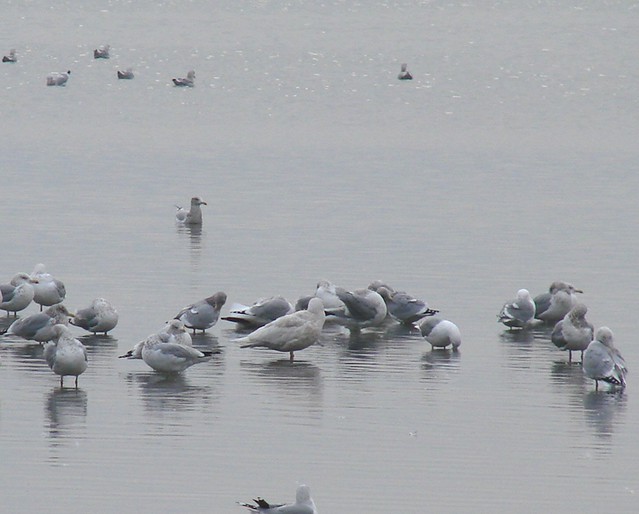
Glaucous Gull

Barrow’s career took him to China and South Africa, destinations every bit as exotic as the far north. After returning from Africa, Barrow wrote a memoir of his time there,

in which are described the character and the condition of the Dutch colonists of the Cape of Good Hope, and of the several tribes beyond its limits: the natural history of such subjects as occurred in the animal, mineral, and vegetable kingdoms; and the geography of the southern extremity of Africa,

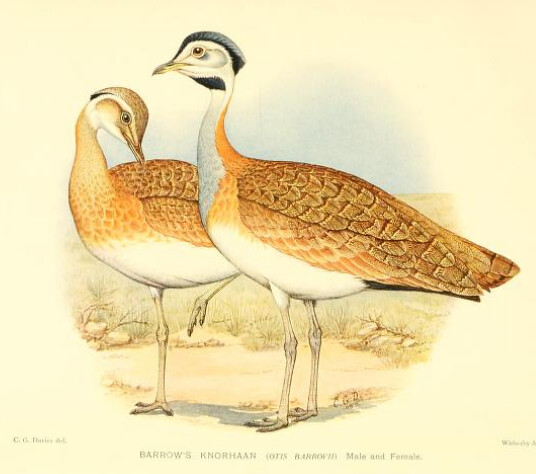
among other topics. Of greatest interest to birders is the account of a kind of bustard,

much the finest bird we had hitherto met with in Southern Africa, and which, though sufficiently common, is not described in the Systema Naturae. It is called here the wilde pauwe, or wild peacock…. The bird in question is a species of otis, and it is nearly as large as the Norfolk bustard…. the spread of the wings seen feet, and the whole length of the bird three feet and an [sic] half.

It’s clear that Barrow was intimately familiar with this bird:

the flesh is exceedingly good, with a high flavor of game.

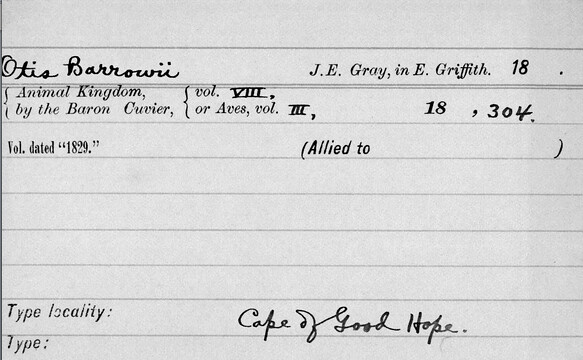
Sometime before 1823, John Latham discovered two “most beautifully executed drawings” of a hitherto unknown bustard in the collections of John Dent. Latham suspected that the bird depicted might be “the Wild Pauw, or Wild Peacock, of Barrow’s Travels.” He named it the blue-necked bustard, an English name taken over by John Edward Gray in the species accounts he prepared for Whittaker’s Animal Kingdom in 1829.
Barrow's Korhaan

Gray, too, was uncertain whether Barrow’s description was of the bird seen in Dent’s drawings. Whether it was the same species or not, Gray named it after its (possible) discoverer, Otis Barrowii.
Barrow's Korhaan

Barrow’s Korhaan (not “knorhaan” — that sounds like a soup mix) is now generally considered a subspecies of the white-bellied bustard. The trinomial, though — Eupodotis senegalensis barrowii — still recalls the life and the interests of a man who earned the respect of the natural historians and explorers of his day, and merits a mention even in ours, if not all the time, at least on his birthday.

Share

A Shabby Pitta?

This year marks the 300th anniversary of the birth of Jean-Thomas Aubry, one of the great natural history collectors of eighteenth-century France. Both Buffon and Brisson, the two most important ornithological cataloguers of the day, made extensive use of the birds in his cabinet, shipped back to France by correspondents and collectors around the world.

With characteristic graciousness, Buffon thanked the good Abbé:

We have often been furnished with specimens of new animals unknown to us by the Curate of St-Louis, whose beautiful collections are known to all scientists and scholars, and who combines a great knowledge of natural history with an eagerness to make that knowledge useful by freely and generously sharing all that he possesses of this nature.

Among the birds first described from Aubry’s collection was what Mathurin Brisson called the “merle verd à tête noire des Moluques,” the Moluccan black-headed thrush or, as we know it today, the hooded pitta.

Brisson, hooded pitta

The engraving cannot do this colorful bird justice, but Brisson’s description helps:

The head, the chin, and the throat are black. The back and the scapulars are deep green. The breast, upper belly, and flanks are of a brighter green. The lower belly is covered with feathers that are black at the base and tipped with pink. The undertail coverts are entirely pink. The rump, uppertail coverts, and wing coverts are a dazzling aquamarine. The primaries are black at the base, then white, and tipped with blackish brown; the secondaries are blackish, with the outer webs fringed with green; the tertials are entirely green. The tail is made up of twelve black feathers.

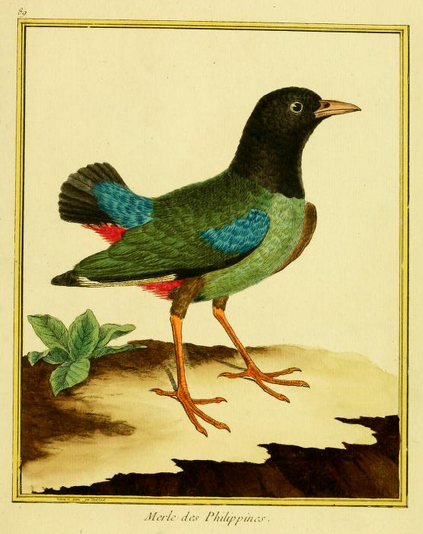
Buffon, observing “the structural differences by which Nature herself has distinguished them from the thrushes,” recognized the pittas as a distinct group, and eventually renamed Brisson’s bird — still labeled “merle” in the Planches enluminées — the “breve des Philippines.”

Pll enl 89, Merle des Philippines

While Buffon’s description is, surprisingly, fairly terse, Martinet’s new plate brings all the bird’s astonishing colors to life.

As of the mid-1770s, these two images and descriptions, and the now-lost specimen on which they were based, was all that European science knew about this colorful pitta. That is more than enough, though, to make me wonder what on earth was going through Philipp Ludwig Statius Müller’s mind in 1776 when he — with an explicit citation to Buffon — gave this pitta its “official” Linnaean name.

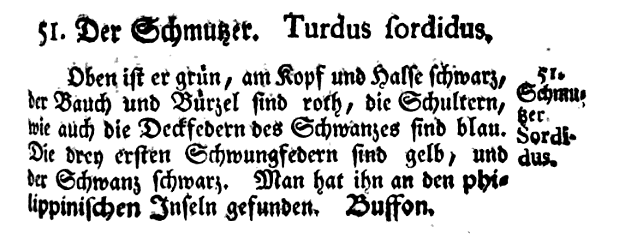
Statius Müller, Turdus sordidus

It is green above, black on the head and neck; the belly and rump are red, and the shoulders and tail coverts are blue. The three outermost primaries are yellow, and the tail is black. It is found in the Philippine Islands.

A brief description, obviously based exclusively on Martinet’s plate and simplified to the point of inaccuracy (compare Brisson’s description of the primaries with Müller’s) — but it still makes clear that this is a striking, brightly colored bird.

So what does Müller name it?

Der Schmutzer. Turdus sordidus.

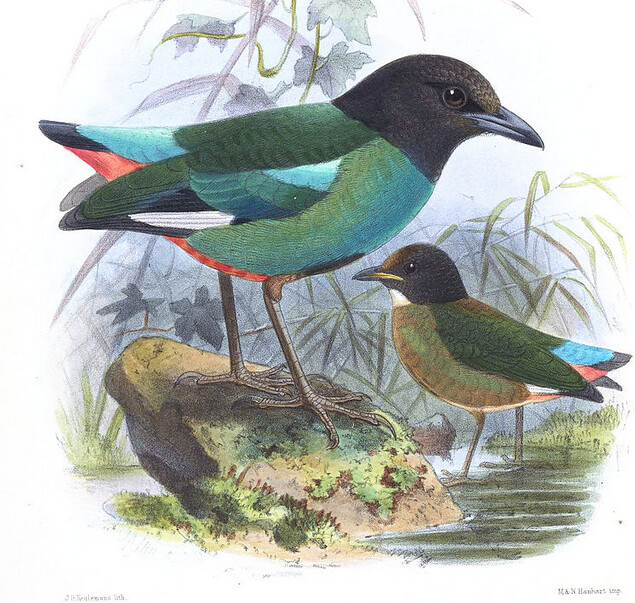
Pitta sordida sanghirana, Keulemanns, OrnMisc2

There are plenty of birds named sordidus/a/um or sordidior or sordidulus or sordidatus, and all but this garish pitta live up to it by being more or less dull, dingy, drab.

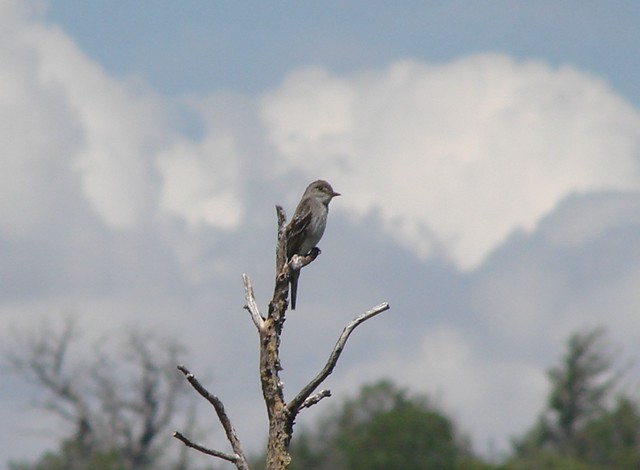
Western Wood-Pewee July 13 2007 038

I can buy sordidulus for the western wood-pewee, but Müller, unless he was completely off his ornithorocker, must have had some reason other than color to name his pitta sordidus (now, of course, it’s Pitta sordida).

That Müller had not committed a typo, or intended an otherwise unattested meaning of the Latin adjective, is clear from his simultaneous coining of the German name “Schmutzer,” something that smudges or stains (or is smudged or stained). What was in the back of his mind? Did he have a poorly colored copy of Buffon? Did the black head make him think the bird fed in the mud? Or did the dark bases of the pinkish belly feathers call to mind some sort of soiling?

Who can figure this out for me?


Share

Out on the Prairies with Frank Chapman

Screenshot 2014-06-12 10.13.21

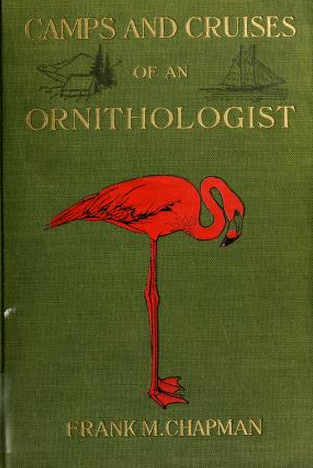
I can still lead you right to the battleship gray table in the basement of Love Library where I first made the acquaintance of Frank Chapman. It was thirty-five years ago this fall (thirty-five! years!) that I discovered the wonders of 598.2 C36, with its shocking cover and its weirdly captivating photographs of birds and birders at the turn of the twentieth century.

Screenshot 2014-06-12 10.25.31

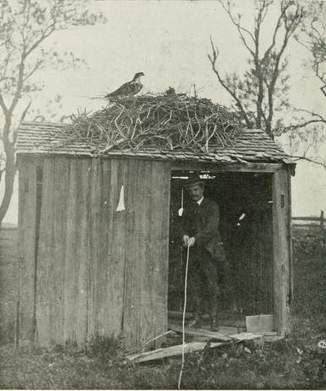
The travels Chapman recounts here don’t seem so exotic to me any more; but when I was sixteen, I could hardly imagine ever getting to the places Chapman and his friends got to bird.

Screenshot 2014-06-12 11.21.06

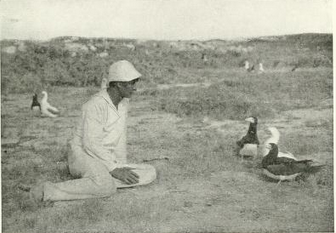
Barrier beaches and Florida heronries, alcids on the California coast and the flamingos of Caribbean islands: it was inconceivable that I should ever be able to witness any of those sites and sights.

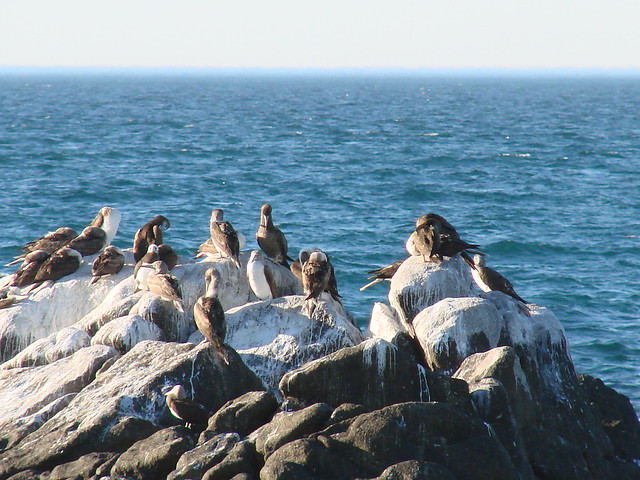
Boobies, PUerto P, Sonora, January 24, 2007 090PUerto P, Sonora, January 24, 2007 083

What really got my attention, though, was that when he wasn’t traveling around the bird world with his camera and his shotgun, this famous ornithologist and writer and museum man had actually birded my part of that world, Nebraska.

And he wrote about it in the Camps and Cruises.

Screenshot 2014-06-12 12.12.02

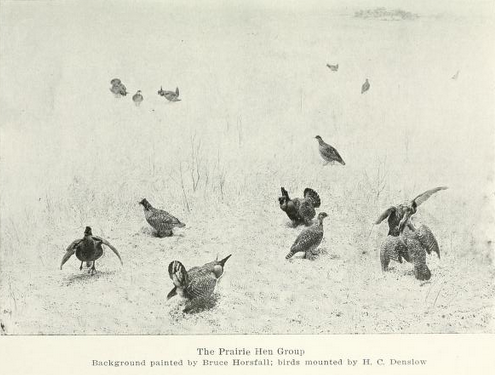
The travels Chapman narrates were all undertaken in the quest for specimens for new habitat groups at the American Museum. In the AutobiographyChapman would wax nostalgic when it comes to prairie-chickens: during his boyhood in New Jersey,

 the desire to form a collection … found expression in gathering the feathers and wings of birds. Of the latter I acquired what I should now term a “large series,” willingly cut by our cook from Prairie Hens which, in season, at that period (1872-1876) festooned butcher shops.

Thirty years later, when birds were needed not under glass but behind it, the eastern chicken — the famous heath hen — was long gone from New Jersey, and trains no longer supplied east coast gourmands with barrels full from the prairies of the west.

When, therefore, I made inquiry of various correspondents concerning a place where I might count on finding Prairie Hens in numbers, I was advised to go to the sand-hills of Nebraska…. [where] the bird proved to be abundant and here, doubtless, it will make its last stand.

Greater Prairie-Chcken

Chapman, accompanied by the principal players in the creation of the museum’s habitat groups — the famous painter Bruce Horsfall and the equally well-known preparator Jesse D. Figgins — arrived in Lincoln on May 1, 1906, where they got their permits in order and were joined by Lawrence Bruner, one of the leading lights of natural history at the University of Nebraska and author of a book I already knew well.

Sandhills

The party must have driven to Halsey (not yet the site of a unit of the Nebraska National Forest), as Chapman says that they reached the collecting site on May 3 and were finished there by May 6; indeed, they were already in Tucson on May 10.

When they arrived on the banks of the Middle Loup, the birders found the northward migration “at its height,” with many passage birds mingling with the local breeders. Like generations of happy observers after him, Chapman was impressed with the mix of typically eastern and typically western birds on Nebraska’s Great Plains:

The Prairie Hen, for example, extends more than half-way across the state where it meets the Sharp-tail Grouse or Prairie Chicken; the Great-crested Flycatcher meets the Arkansas Kingbird, the Blue Jay the Magpie, to mention a few of many similar cases.

Sharp-tailed Grouse

The most abundant species recorded in the sandhills around Halsey was, then as now, the western meadowlark.

Western Meadowlark

Its “hurried, ecstatic, twittering, jumbled” flight song making a big impression on Chapman, so much more used as he was to the “clean-cut fifing” of the eastern meadowlark.

On May 4, Bruner took Chapman and colleagues out to the lek of the greater prairie-chickens, where the easterners

listened for the first time to their booming, with doubtless much the same feeling that an ardent music-lover first hears the voice of a world-renowned singer. The birds were distant about a mile, but their pervasive, resonant, conch-like notes, came distinctly to the ears through the still, clear air.

I distinctly remember my mind’s wandering from that evening’s calculus homework to ponder the meaning of that inscrutable “conch-like.” There was no google for me to consult back then, remember.

Greater Prairie-Chicken

By the way, if you want to bird Nebraska in Chapman’s footsteps, consider joining me next March.

Share

It’s Not Easy Seeing Green

Green Heron

I can’t see it. No matter how many I’ve watched in the field, no matter how many skins I’ve handled, I just can’t see the green on a green heron. And I’m not alone: this name regularly shows up on those lists of “worst bird names of all time,” and I can’t count the times I’ve had to soothe sputtering colleagues in the field who, like me, can see blue and gray and purple and red, but not green.

It’s just a name, of course, and names don’t “mean” in the same way that real words do. There’s nothing to stop us from calling this bird the orange heron or the apricot egret or, for all I care, Hortense. Names can’t be “bad.”

But that doesn’t stop me from wondering why we call it green.

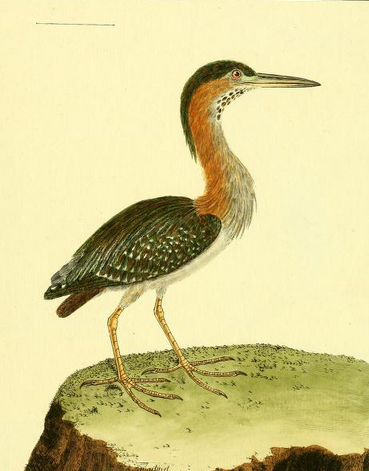
Hans Sloane seems to be the first European to have described this bird, which he encountered in Jamaica in 1687/88.

Screenshot 2014-06-13 08.32.02

Sloane’s description of his “small bittern” leaves no doubt as to the species under discussion, but he has very little to say about his bird’s colors — and he never mentions any shade of green. He does half-apologize for the engraving:

I know not but that some part of the odd Position of the Neck may be owing to the carrying of it, after it was kill’d.

Screenshot 2014-06-13 08.50.18

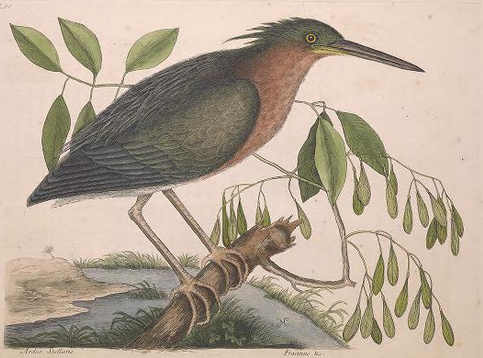
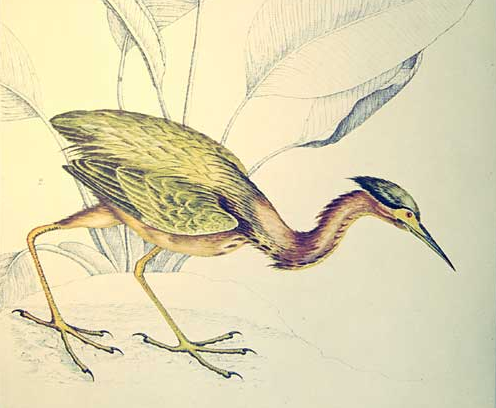
It was Mark Catesby who, in word and in picture, first convinced the scientific world that this bird was green.

A Crest of long green Feathers covers the Crown of the Head. The Neck and Breast of a dark muddy Red. The Back cover’d with long narrow pale-green Feathers. The large Quill-Feathers of the Wings of a very dark Green, with a Tincture of Purple. All the Rest of the Wing-Feathers of a changeable shining Green….

Given that description to rely on, it only made sense for Linnaeus to christen the bird Ardea virescens, “a heron with a somewhat crested crown, a green back, and a reddish breast.”

Screenshot 2014-06-13 08.58.52

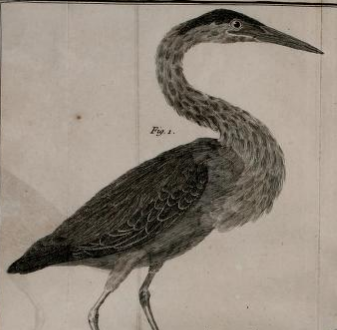
Catesby, like Sloane, still knew the species under the name “small bittern,” as Mathurin Brisson confirmed in 1760 in the Ornithologie. Rejecting the binomial Linnaeus had published two years earlier, Brisson assigned the bird the Latin label Cancrofagus viridis, which he translated in his French text as “le crabier verd,” the first time, so far as I know, that such a name was used in a European vernacular.

Green Heron, Martinet in Brisson 1760

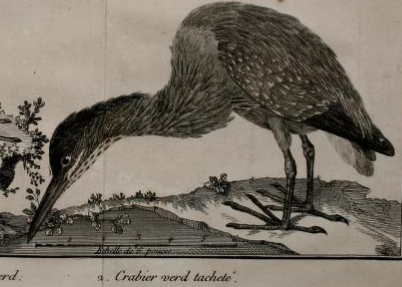
Martinet’s illustration is not what one might call overly successful, combining as it apparently does the body of a green heron with the legs and neck of another species or two. He does much better with the bird Brisson calls “le crabier verd tacheté,” occasionally considered in those long-ago days a distinct taxon or, later on, the female of the green heron. Martinet’s drawing is as delightful as it is readily identifiable, as a juvenile green heron.

Screenshot 2014-06-13 15.28.15

Twenty years later, Buffon retained Brisson’s “crabier vert” in the heading for his account of the species, and he continued, too, to recognize the “spotted green heron” as a distinct species.

Screenshot 2014-06-13 15.53.53

So far as I can tell, the first ornithologist to have rendered Ardea virescens or “crabier vert” in English was Thomas Pennant, in his Arctic Zoology of 1785. Not content just to call the bird “green,” Pennant goes lavishly, extravagantly out of his way to justify the name, describing the little wader as a

H[eron] With a green head, and large green crest … coverts of the wings dusky green, edged with white….

Pennant’s name appears to have been made canonical by its use in John Latham’s General Synopsis and Index ornithologicus. One holdout was William Bartram, who in his 1791 Travels used “green bitern” or “lesser green bitern” for the bird — an obvious nod in the direction of Catesby, whose itinerary largely inspired Bartram’s journey. 

Screenshot 2014-06-13 17.13.10

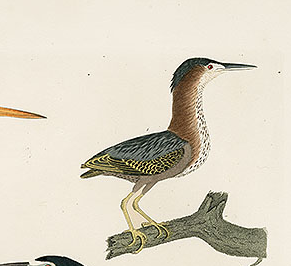
Bartram’s friend and disciple, Alexander Wilson uses the name “green heron” as the title of the species account in his American Ornithology; no doubt as a compliment to his patron, though, the text itself refers to the bird as “the Green Bittern.” Wilson also alludes in disgust to the “very vulgar and indelicate nickname” with which the bird is saddled by “public opinion”; “shitepoke” and similar names are still current today over much of this species’ US range, a rare example of the survival of a genuine folk name.

Screenshot 2014-06-13 17.31.34

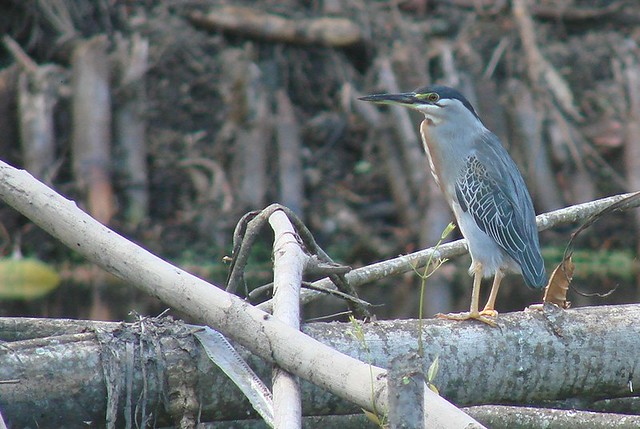
Bartram and Wilson were on the wrong side of onomastic history. It has been green heron ever since, except for that brief period when this species and the striated heron were “lumped” under the English name green-backed heron (intentionally or not, a direct translation of Linnaeus’s Ardea dorso viridi).

striated heron Guyana 2007 019

Once again, though, green heron it is, and green heron it will remain. Whether I can see it or not.

Green Heron 1

Share