The Pattycake Plover

Martinet, Dotterel

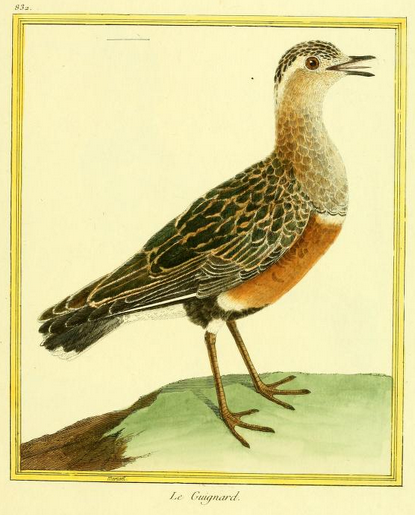
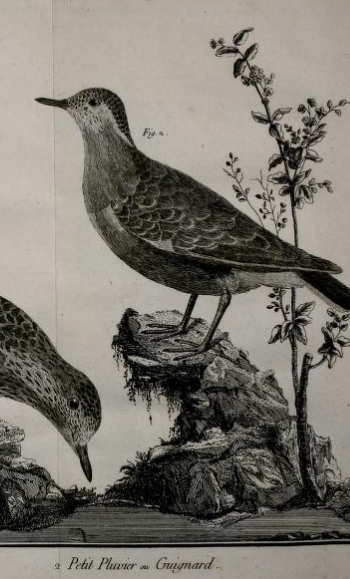
Good stories don’t need to be true — or rather, true stories don’t need to be factual. Here’s one of my new favorites, a tale purporting to explain the standard French name of the lovely Eurasian dotterel.

“Guignard” is another of those -ard names, indicating that the object or person so named does something to excess. In this case, the guignard does too much “guigner,” that is to say, it sneaks a look out of the corner of its eye at those who are watching or hunting it.

And the excess in that? As Aldrovandi tells us, quoting his English colleague John Caius,

this bird is extremely stupid, but very delicious as food, and we consider it among the finest of delicacies. It is taken at night with torches and by the movements of the hunter: for if he stretches out his arms, the bird extends its wings; if he raises his leg, the bird does the same. In short, whatever the bird catcher does, the bird does it, too. Paying so much attention to the gestures of humans, it is tricked by the bird catcher and snagged in his net.

Buffon adds that this “heaviness of mind and stupidity” is the source of the English “dotterel” and the Latin “morinellus,” both words meaning “little stupid creature.” The French name “guignard” simply specifies the form that stupidity takes, as the bird walks right up to its hunters as if entranced.

This remains the standard explanation of “guignard.”

But there’s an alternative, and this is the story that I find so captivating. Ménage and Jault report that this species is

restricted to the country around Chartres: it is a game bird of the size of a fat thrush, but rounder, and with unwebbed toes. This bird takes its name from a certain Jean Guignard, a citizen of Chartres, who in 1542 was the first to recognize how delicious it was. This Jean Guignard was the father of Denis Guignard, a lawyer in Chartres, and the grandfather of Jean Guignard, who had one daughter; she married the Sieur des Engins, also a lawyer in Chartres, and who in 1686 was alderman in that city.

The story is still encountered today, with the elder Jean Guignard identified more precisely as the pastry chef who created the first dotterel pies.

I’m skeptical, especially since my good friend google and I haven’t come up with an attestation for the tale before the nineteenth century. But that doesn’t keep me from liking this story. A lot.

Screenshot 2014-06-29 21.05.34


Share

Door County, Wisconsin: Day Four — North by Midwest

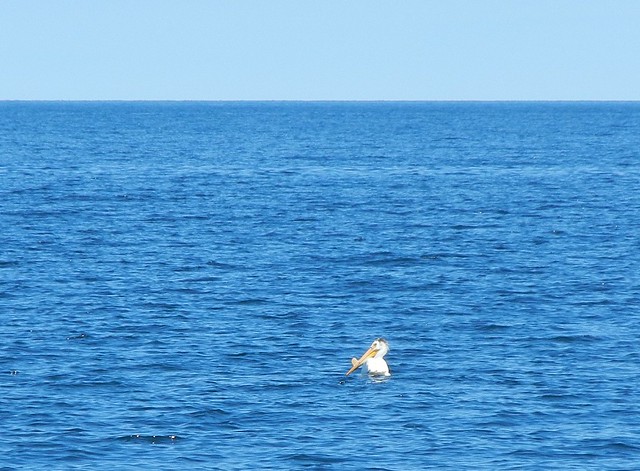
American white pelican, Lake Michigan, Wisconsin

Sometimes you hold all the stars in your hand. Sometimes the cards are aligned just right. And sometimes you get to be in Door County, Wisconsin, on the most heartbreakingly beautiful day of the summer.

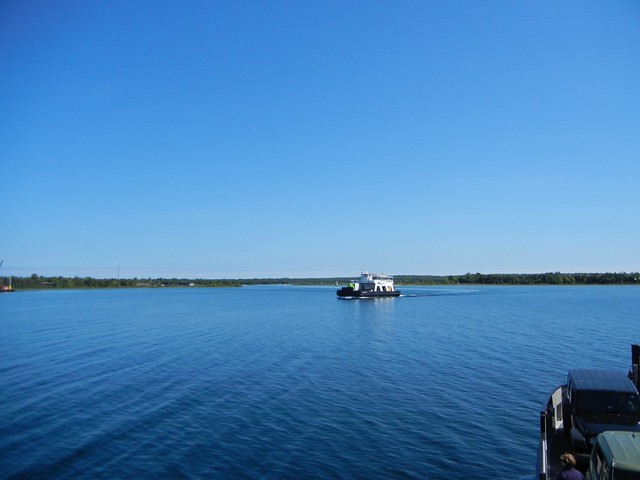
Ferry, Washington Island, Wisconsin

Better yet, I got to spend most of the day on Washington and Rock Islands, just off the northern tip of the long peninsula, birding. Melody showed me some really lovely spots and some really exciting birds, and my appetite is decidedly whetted for another visit.

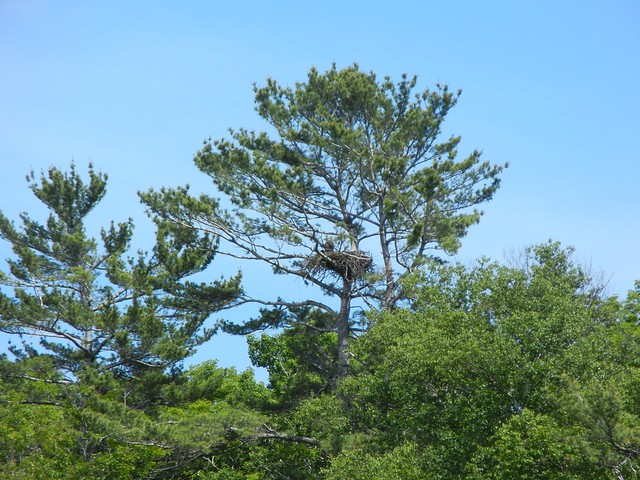
Bald eagle nest, Washington Island, Wisconsin

It seems like every would-be birding destination in the world touts its “diversity of habitats,” but Door County lives up to the boast. What’s more, those habitats — from hay fields and woodlots to boggy spruce forests and hemlock groves — unite the two great ecological systems that dominate the center of the continent. Here, the dickcissels of the midwestern prairies sing to the black-throated green warblers of the boreal forest.

The meeting of north and west is especially obvious out on the water. Not that long ago, American white pelicans were rare birds on the Great Lakes, even in migration. This week, it has been hard not to see these huge, magnificent birds, ones and twos sailing majestically on the waters of the bay and the lake or larger groups — up to 130 at a time — gliding and sailing with equal serenity across the blue skies.

American white pelican, Lake Michigan, Wisconsin

These classic birds of western prairie lakes and swales share the blue waters with surprising numbers of red-breasted mergansers.

Red-breasted merganser, Washington Island, Wisconsin

Most seem to be males, suggesting that the waters of Door County are a “molt migration” site for this species; while the females and young linger around the nest, the drakes, their work done for the year, take off for open water and shed their flight feathers in safety. Nearly every bit of shoreline — as here, on Washington Island — seems to have its mergansers, but the biggest flock Melody and I encountered was a whopping 310 birds, loafing and feeding just off Rock Island.

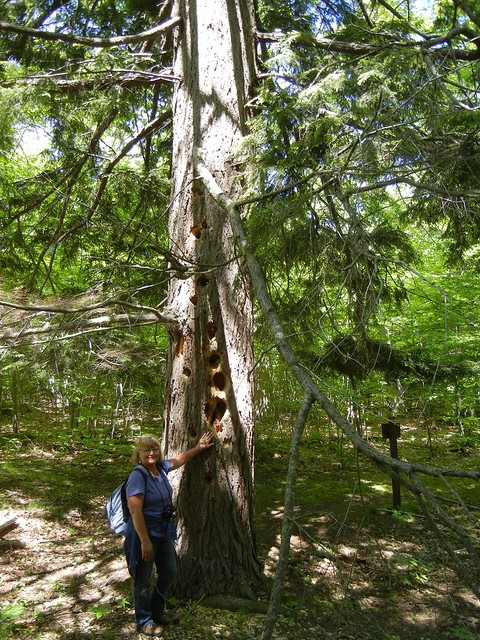
Melody with hemlock and pileated woodpecker work, Rock Island, Wisconsin

The wooded habitats, too, harbor a piquant mix of species. This enormous hemlock is the playground of a pileated woodpecker, a surprisingly common bird in Door County; in fact, with the exception of the ubiquitous northern flickers, I heard and saw more pileateds than any other picid this week.

Just a couple of miles away stands a dark, wet deciduous forest, the home of a family of red-headed woodpeckers. Quiet and furtive on a warm afternoon, the birds eluded us on our quick stop, but just knowing they were there, somewhere, made the peninsula a richer place to my mind and eye.

As a slender hint of just how rich Door County is for the birder, have a look at our day list, and note the enticing mix of northern and western and eastern birds you can find there — even in summer.

Canada goose

Mute swan

Mallard

Hooded merganser

Red-breasted merganser

Wild turkey

Common loon

American white pelican

Double-crested cormorant

Great blue heron

Great egret

Black-crowned night-heron

Turkey vulture

Osprey

Bald eagle

Cooper’s hawk

Broad-winged hawk

Red-tailed hawk

Sandhill crane

Killdeer

Ring-billed gull

Herring gull

Caspian tern

Common tern

Rock pigeon

Mourning dove

Chimney swift

Ruby-throated hummingbird

Northern flicker

Pileated woodpecker

Great crested flycatcher

Eastern kingbird

Red-eyed vireo

Blue jay

American crow

Common raven

Purple martin

Tree swallow

Northern rough-winged swallow

Bank swallow

Cliff swallow

Barn swallow

Black-capped chickadee

Red-breasted nuthatch

House wren

Blue-gray gnatcatcher

Eastern bluebird

American robin

European starling

Cedar waxwing

Nashville warbler

Yellow warbler

Chestnut-sided warbler

Black-throated green warbler

American redstart

Ovenbird

Common yellowthroat

Eastern towhee

Chipping sparrow

Clay-colored sparrow

Vesper sparrow

Savannah sparrow

Song sparrow

Northern cardinal

Indigo bunting

Dickcissel

Bobolink

Red-winged blackbird

Eastern meadowlark

Common grackle

Brown-headed cowbird

Purple finch

American goldfinch

House sparrow

Share

Bacmeister at War

The world changed forever 100 years ago today, and not for the better.

How to trace the cataclysmic fall of western culture without trivializing the deaths of so many?

Let’s try looking at the wartime career of a birder, namely, the jurist and amateur ornithologist Walther Bacmeister. Bacmeister was sent to the field at the age of 40, and served in the German army on both eastern and western fronts. In October 1916, he sent a poetic greeting, entitled “Draussen und Drinnen,” to his colleagues attending the annual meeting of the German Ornithologist’s Association:

For two full years, long ones and difficult / Our iron-hard defenses have stood armed out here. /  They are defending our dear fatherland, / surrounding it with a bronze cord. / Two years, and if it lasts that many years again, / All you enemies will still not attain your goal! / We stand firm in the howling of the storms, / We out here.

As the months come and go, / you at home have not been idle, / You have served, hardy, in silent strength / German science. / Keep building that proud firm structure, / Let it rise high into the blue of heaven, / And crown its cornices in spite of our enemies, / You in there!

After the poem was read to the assembled guests, Anton Reichenow led the cheer for “our ornithologists dressed in campaign gray.”

Reichenow and Bacmeister and most of their colleagues were on the wrong side in a war that didn’t have many right ones. As an officer, Bacmeister had a modicum of leisure to pursue his own interests, as when he was stationed in Strasbourg in spring 1917:

Whenever possible, my time off duty was used for ornithological observation…. When in the early morning of April 27, 1914, I rode through the lavish brush of the Rhine woodlands on the northeastern edge of Strasbourg, I thought to myself that this was a real willow tit landscape. Hardly had I had the thought when I heard the familiar and characteristic “däh-däh,” which I had heard many hundreds of times before in Poland and in northeastern France — in the Argonne, the area of Verdun, and Champagne.

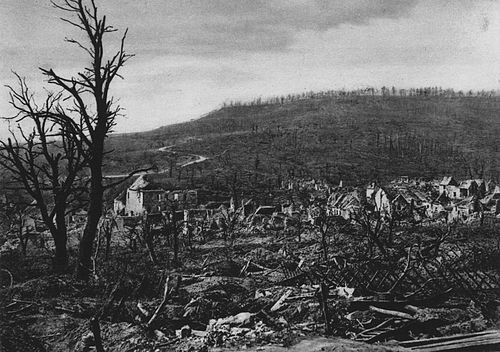
Infamous names in the history of European slaughter, rendered harmless by the presence of a gray parid.

Otto Kleinschmidt, the best known today of Bacmeister’s ornithological friends, provided the best account — nearly in “real time” — of Bacmeister’s collecting activities in the field. In an essay entitled “Miscellany on the Birds of the Enemy Territories Occupied by Us,” Kleinschmidt reported that

The first war souvenirs for my collection were two strikingly gray crested larks from the District of Warsaw. They were followed by both willow and marsh tits, collected on the triumphant march from the Beskids to Brest-Litovsk. The kind donor was Bacmeister…. On January 20 I received my first French willow tit, again from Captain Bacmeister, who had meanwhile returned to the western front after the conclusion of the Serbian campaign. Now shipment after shipment came in from east and west alike. None went missing — this must be emphasized, to the honor of our field post offices — and no bird arrived in unusable condition…. A magnificent series of “war birds” was assembled…. Collecting proceeded according to a system, namely, the focus on material that would be most important for the comparison of the Russian and the French avifaunas.

In the course of a rare leave from the front, Bacmeister was also able to hand over to Kleinschmidt specimens he had collected earlier — meaning, I think, before the war — in France and Poland.

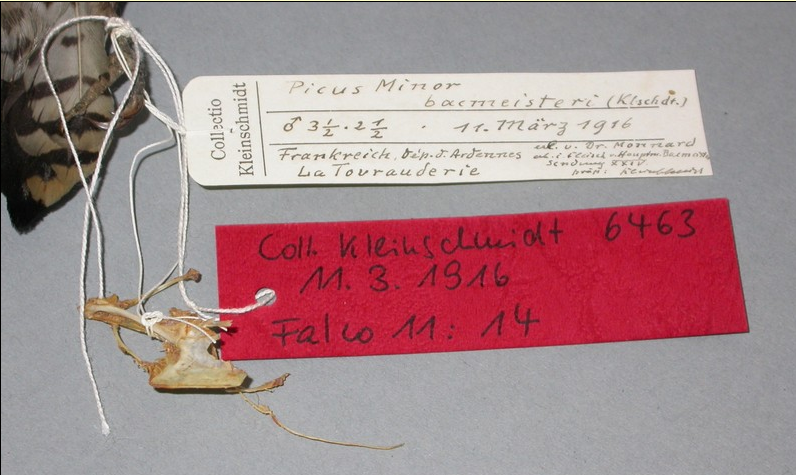
Kleinschmidt commemorated his gratitude to his friend and colleague in the name of a new race of the lesser spotted woodpeckercollected by Bacmeister in the Ardennes in March 1916.

Two males and one female are much more heavily marked than German, English, or north African specimens, such that this is the darkest European form…. I name these pretty birds Picus minor bacmeisteri.
Screenshot 2014-06-20 10.02.35

Kleinschmidt and Bacmeister together described another new taxon from birds collected in the Ardennes and Argonne.

Some of the long-tailed tits of eastern France have reddish upper eyelids in spring. Most are smaller than the subspecies europaea….

They named those birds Aegithalos caudatus expugnatus, “captured in battle.”

In his published writings, at least, Bacmeister appears to have thoroughly enjoyed his war. In a summary of ornithological observations made in eastern Poland, he recalls that

after the happy conclusion of the Easter battle in the Laborez valley in spring 1915, my division and I crossed the ridge of the eastern Beskids…. We passed through all of Galicia from south to north. Unforgettable days! We and our Austro-Hungarian allies had taken back Przemysl and Lwów. As if enchanted, we wandered after many months of spare living through the streets of Lwów, which were thronged by happy, festively dressed people. A joyous welcome was prepared for us.

Bacmeister found his time in the “magnificent city” far too short, but

still it was enough time to pay a thoroughly enjoyable visit to the splendid collections of Count Dzieduszycki, none of which — this must be emphasized — had been damaged by the Russians. It was a great pleasure for me to write my name into the guestbook directly below the names of the Russian visitors. Times change!

Only rarely and incidentally do grim realities intrude:

I encountered considerable numbers of barn swallows in virtually every village and town. In many places their nesting locations had been destroyed by the war. We learned that the Cossacks had sent special troops to burn down the villages that they had occupied and then been forced out of; those troops went from house to house and set the thatched roofs on fire with torches. The fires spread quickly to the entire house and left not much more than the chimney standing. From September 8 to September 21 I encountered migrating house martins.

Unlike so many millions, Bacmeister survived the Great War and returned to a prosperous and busy life in Germany. His family was not so fortunate the next time around, however.

On October 13, 1949, Bacmeister — by then a retired state’s attorney in Stuttgart — wrote to the president of the German Republic, Theodor Heuss, with “a request that is not my request alone, but shared by many who share my same grief.”

Our only son, Arnold Bacmeister, married and 42 years old, a lawyer, has been a prisoner of war since May 1945. He was a paramilitary soldier in Berlin. For three long, long years we knew nothing of his whereabouts or even whether he was still alive. Then, in August 1948, we learned from three separate returning prisoners that he was still living: He was a prisoner in the Buchenwald concentration camp [which had been transformed into a prisoner of war camp by the Soviets after its liberation by the Americans], where he most likely still is, if he hasn’t been sent somewhere else. He knows nothing of our condition or that of his wife, and cannot write; neither can we. This is psychic torture, for him and for us, and we can hardly bear the agony any longer.

Heuss replied, five days later.

Obviously, as you know, the power of the president is limited, and many Germans still live in the belief that all the head of the federal state needs to do is give a directive; they do not understand his authority and its complications. That dreadful fate that finds Germans still captive in the concentration camps of the eastern zone is well known to me from a long series of cases. The delicate position of the German Federal Republic with respect to the reconstruction of eastern and central Germany makes any concrete confrontation politically very tricky. Protest against this situation has, of course, already been registered by all parties. But I will be glad to take your letter as the occasion to raise this matter with Minister [Jakob] Kaiser.

The editors of Heuss’s official correspondence fill in the rest of the story: Bacmeister wrote to the president again in July 1950, after learning that his son had been sentenced to 18 years of prison. Arnold Bacmeister was released sometime between 1955 and 1957; he would publish an autobiography two years before his death in 1994.

Even through those excruciating years, the elder Bacmeister continued to write about birds and birders, ornithology and ornithologists. The family history mentions more than 240 (!) publications, most of them on natural history. He published biographical sketches on Theodor Heuglin (of gull fame) and the great Chilean explorer Christian Luis Landbeck. Of greatest use to the researcher is his bibliography of ornithology in Württemberg through the year 1943,

What are we to think, almost 50 years after his death, of the life and career of Walther Bacmeister? He was a loving father and a member of the Nazi party. He was an ornithological historian and an officer in the armies that devastated northern France.

Nothing’s ever simple, is it?
Wikimedia Commons
Share

Door County, Wisconsin: Day Three — Submarine Detectors


The scenic drama of the Niagara Escarpment, the limestone spine ridging Door County, can hardly be overstated. We got to admire it today from land and from water alike, first with a “trolley” ride through Peninsula State Park and then, on a cool and breezy afternoon, from the deck of a boat that took us out towards the Sister Islands and their white haze of ring-billed and herring gulls.

Exactly 100 years ago today, on June 26, 1914, R.M. Strong paid his own first visit to the Sisters as part of his study of the herring gulls breeding in Door County.

R.M. Strong, Door Co. gulls

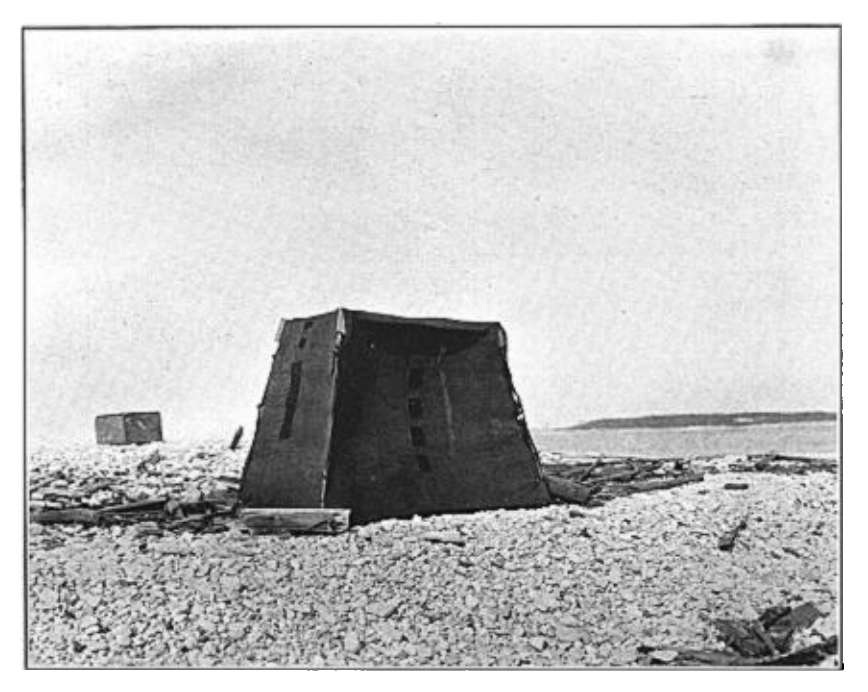
Over the course of that summer, Strong visited colonies on several of the county’s islands, making detailed records of their behavior and breeding from a cramped blind “made from dark green cambric lining cloth, costing seven cents a yard.”

R.M. Strong, blindFrom here, Strong was able to watch the birds pairing, building, incubating, brooding, feeding, and, of course, fighting. Our trip this afternoon confirmed that at least that last component of larid behavior persists.

Strong’s work in Green Bay ranked him among the authorities of his day on gull behavior. In 1917, a few months after the entry of the United States into the war, he turned his expertise to the investigation of another, more immediately practical problem:

I read in ‘Science’ the recommendation of the Committee on Zoology of the National Research Council that the problem of “utilization of gulls and other aquatic seabirds in locating submarines be studied.”

Strong’s experience had taught him that it would useless to try to train gulls captured as adults, so he secured a small corps of chicks of flighted juveniles to work with. His preliminary results were encouraging: the young birds quickly grew tolerant of their human keepers, and herring gulls, he found, could recognize new situations in their environment — the hope was, of course, that they could be taught to recognize submarines and somehow “alert” their human monitors to the threatening presence.

Strong’s scheme proposed capturing large numbers of unfledged gulls, raising them, and keeping them on board navy ships until “regions of danger” had been reached. Once released, he predicted, the gulls would make short feeding flights from their “home” ship, when

by careful watching … variations in their movements would at least suggest that an unusual object was in the water.

The plan — of which Strong admitted “that the chances of success were limited, to say the least” — was never carried out. While Strong and his colleagues were working out the details, other, “very efficient methods for detection of submarines were developed,” and the “raid” on the gulls’ nesting colonies was never carried out.

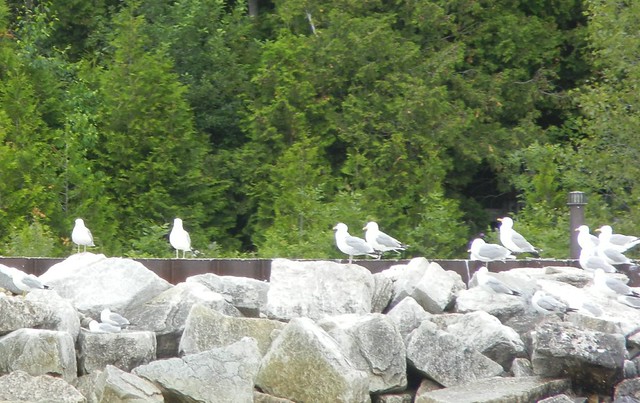
Herring gulls, Door County, Wisconsin

The herring gulls of Lake Michigan could go back to their loafing and squabbling, activities they continue to excel in today.

Strong never tells us what else he saw out in the gulleries of Wisconsin and Michigan. So here’s our day list from a hundred years later:

Canada goose

mallard

American white pelican

double-crested cormorant

great egret

turkey vulture

osprey

bald eagle

sharp-shinned hawk

red-tailed hawk

killdeer

ring-billed gull

herring gull

Caspian tern

rock pigeon

mourning dove

chimney swift

northern flicker

red-eyed vireo

American crow

common raven

blue jay

purple martin

tree swallow

northern rough-winged swallow

cliff swallow

barn swallow

black-capped chickadee

house wren

American robin

European starling

cedar waxwing

yellow warbler

American redstart

chipping sparrow

song sparrow

northern cardinal

red-winged blackbird

common grackle

brown-headed cowbird

American goldfinch

house sparrow


Share

Door County, Wisconsin: Day Two

DSCN5584

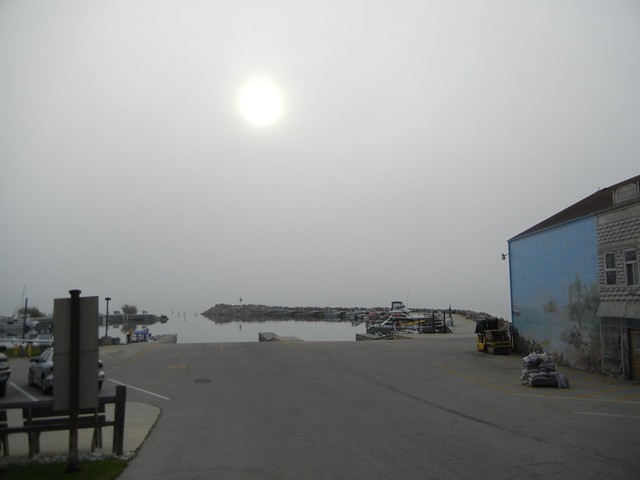
The fog made for an eerie morning here in Baileys Harbor, an impression only heightened by the screeches of invisible Caspian terns over the lake. But nothing can deter birders when they’re in a new place, and after breakfast, Marnie and I met up with Paul for an introduction to some of this long peninsula’s many and varied habitats.

DSCN5587

We started off on the bayshore of Peninsula State Park, where I was finally able to make sense of that mysterious word “alvar.” A bar far offshore was drifted with American white pelicans, and small groups, family groups, of red-breasted mergansers — a funny bird to see in the summer — dived and flew up and down in front of us.

DSCN5589

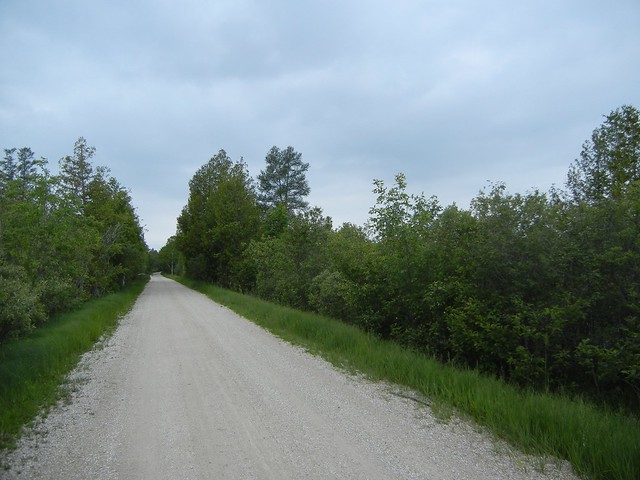
The boggy woods across the road in the park must be great for migrants earlier in the season, and even in late June are surely good for breeding birds earlier in the day. The dominant voices late this morning were red-eyed vireos and American redstarts, with ovenbirds, common yellowthroats, yellow warblers, and a distant Nashville warbler rounding out our parulid list for the site.

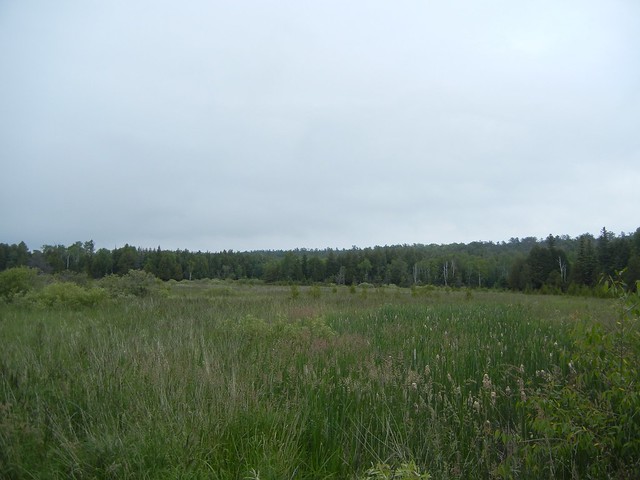
From Peninsula we went on to Mud Lake, approaching along a road that reminded me more of a tamarisk marsh in Maine or New Brunswick than of the Midwest.

Mud Lake, Limekiln Road, Wisconsin

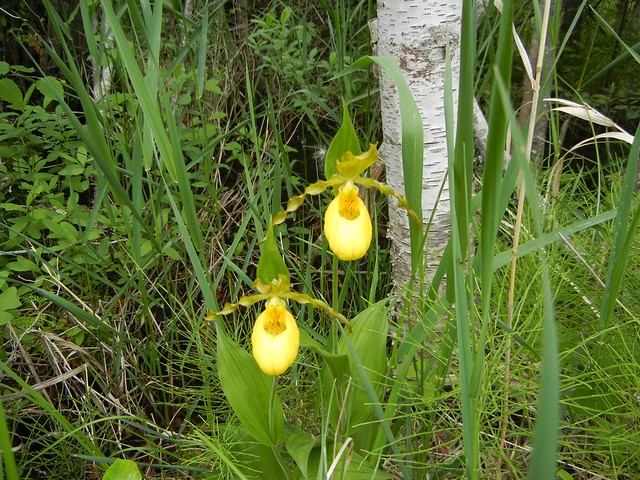
Delightful as it was to hear an alder flycatcher sneezing out in the alders, the roadside orchids were even more welcome a sight.

Yellow lady's-slipper, Wisconsin

We looked for but did not see the rare Hine’s emerald, though a couple of other odonate species were flying; Paul identified a corporal, a darner, and a twelve-spotted skimmer. In spite of the overcast, we found pearl crescents, a white admiral, and several mourning cloaks — and impressively vast numbers of the insects the locals call “mosquitoes.” They seem thirstier than the ones I’m used to.

We fled the buzzing horde to look for some farmland specialties.

Door County birders birding

Paul knew a bobolink field, so we spent several enjoyable minutes watching the males sing and dance over the tall grass; I got to see one female fly in and land in the grass with something wriggly in her bill, so maybe they can bring off young before the rest of the field is hayed. Savannah sparrows shared the hayfield and perched on the wires, and two male dickcissels buzzed at a frustrating distance before one came closer to the road and sang for us as we pulled away.

Door County, Wisconsin, bobolink field

Over the course of the morning we also found two pairs of sandhill cranes.

Sandhill crane, Wisconsin

Paul had been watching this pair, which, he told us, has a large but still flightless chick. The colt must have been hidden in the grass when we arrive — but no complaints about missing it after such a wonderful and quintessentially midwestern morning in the field.

Today’s list:

Canada goose

mallard

hooded merganser

red-breasted merganser

wild turkey

American white pelican

double-crested cormorant

great egret

turkey vulture

osprey

red-tailed hawk

killdeer

ring-billed gull

herring gull

Caspian tern

rock pigeon

mourning dove

chimney swift

ruby-throated hummingbird

alder flycatcher

eastern phoebe

eastern kingbird

red-eyed vireo

blue jay

American crow

common raven

purple martin

tree swallow

northern rough-winged swallow

cliff swallow

barn swallow

house wren

eastern bluebird

American robin

European starling

cedar waxwing

Nashville warbler

yellow warbler

chestnut-sided warbler

American redstart

ovenbird

common yellowthroat

chipping sparrow

field sparrow

vesper sparrow

Savannah sparrow

song sparrow

indigo bunting

bobolink

red-winged blackbird

eastern meadowlark

common grackle

brown-headed cowbird

house finch

American goldfinch

house sparrow

Share