Other People’s Bird Books: B.H. Swales

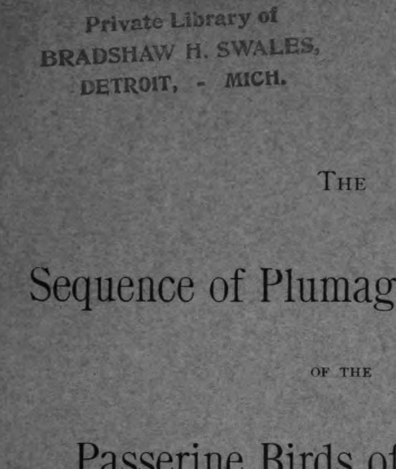
There’s a name familiar to Michigan ornithologists and birders: Bradshaw Hall Swales. On his premature death in 1928, Swales left some 2000 skins and his entire library to his alma mater michiganensis, which in gratitude renamed its ornithological holdings as the Swales Memorial Library.

Screenshot 2015-08-07 17.51.38

His widow, Mary Rhoda Medbury Swales, later endowed a graduate scholarship in ornithology in Ann Arbor, one still awarded today in her name — though the annual announcement barely mentions her otherwise, treating her as the wife of a famous dead man instead.

Some of Swales’s bird books were marked with just a simple stamp:

Screenshot 2015-08-07 18.08.32

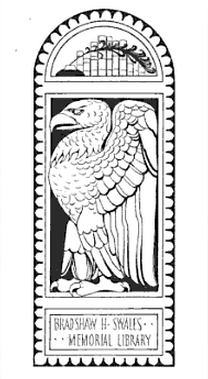
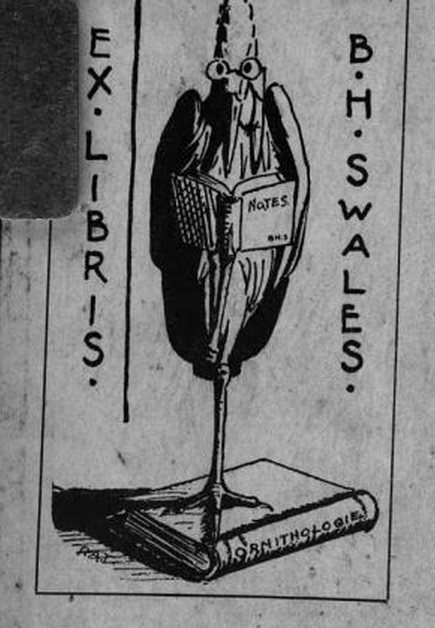
Others, though, still carry his bookplate, as delightful a specimen of the genre as can be imagined.

Screenshot 2015-08-07 15.36.45

I assume the choice of a marsh bird was a pun on Swales’s name; note that both the heron and the book’s owner are wearing the same spectacles.

Screenshot 2015-08-07 18.16.22

One thing still puzzles me, though. Why does the bird of the swales perch on “Ornithologie”? The fact that the word on the spine is not in English suggests that it denotes not a discipline but a title, that the heron is standing on a specific book from Swales’s collection.

Any ideas?

Share

Why I So Rarely See Eagles and Creepers Flocking Together

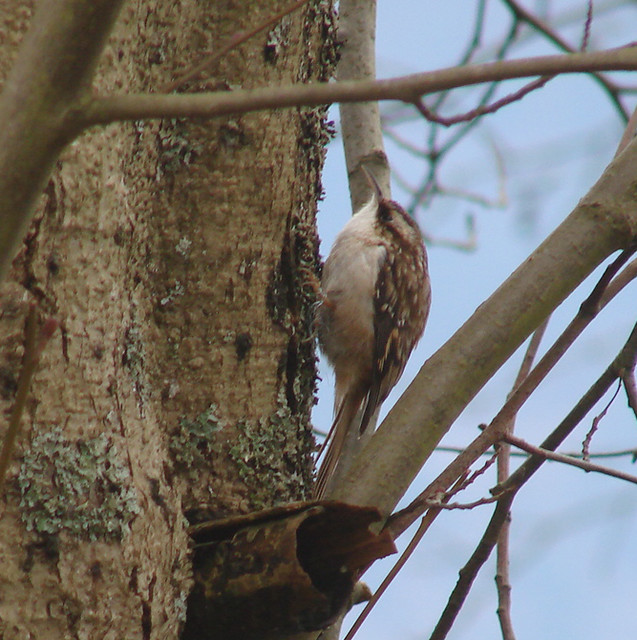
Brown Creeper

It’s bothered me for a long time, but at last I’ve come across the explanation. Writes Bartolomé Aneau in his Déscription philosophale,

The eagle is in a state of war with the treecreeper, which does the eagle great harm, breaking the larger bird’s eggs whenever it notices that the eagle is away from its nest.

Good to know.

Share

In Praise of Levaillant

429px-LeVaillant

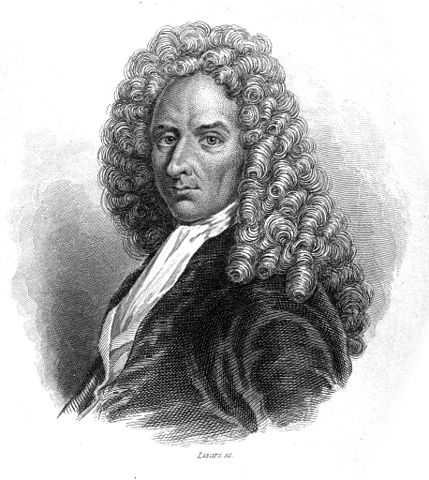
It’s François Levaillant’s 262nd birthday, occasion once again to wonder why there is no modern biography of an explorer and ornithologist whose works, now forgotten by all but the bibliophile, were tremendously influential in the nineteenth century.

Part of the reason is no doubt Levaillant’s tendency to exaggeration — a tendency that, to my mind, makes him an even more fascinating subject. The obvious errors in some of his ornithological studies have also rendered him persona less grata in scientific circles, but again, those slips simply serve to point out how busy he was and how far-flung his interests.

Levaillant hasn’t always been under-appreciated. Three years after the explorer’s death in 1824, Johann Georg Wagler, that most critical of critics, had this to say about the Frenchman’s publications:

After making two journeys through the interior portions of southern Africa, Levaillant published a report of what he had seen and observed; one cannot overstate how much his observations have enriched our knowledge of ornithology.

The high expectations that all experts in the field had for the untiring effort of this man’s natural history investigations were not just met but thoroughly exceeded by the vast store of outstanding observations he provided on not a few southern African birds that had eluded all investigators before him.

Wagler was not a great stylist, but you get the point. Levaillant’s eventual biographer — you know you’re out there — could do worse than to start with the words of his contemporaries and immediate successors.

Share

Reading Like a Positivist

Ever stop to think about just how you read your bird books?

Lately I’ve been reading all the published works of Louis Pierre Vieillot.

Who? 

That’s exactly the point of my plowing through the old books: to bestow on Vieillot the fame history has cheated him of.

At this early stage in the project, it’s a very different sort of reading I’m engaged in. I’m not learning much about birds, but I am learning, bit by painfully excavated bit, something about Vieillot’s life.

That’s a misuse, an abuse, even, of a text, the unpardonable sin of biographism. But it’s worth it, isn’t it, to learn, for example, that Vieillot was afloat on the North Atlantic at the latitude of Nova Scotia one August — August of a year I have yet to determine. And to discover that his may be the earliest record of cave swallows from northeastern North America, when

several of these birds landed in the rigging of the ship I was on.

Maybe the whole story of Vieillot’s life is still waiting for me in an archive in Rouen or Paris. But if not, I’ll keep reading like a positivist.

Petrochelidon fulva 1894.jpg
Petrochelidon fulva 1894” by Richard Bowdler SharpeA monograph of the Hirundinidae. Licensed under Public Domain via Wikimedia Commons.

Share