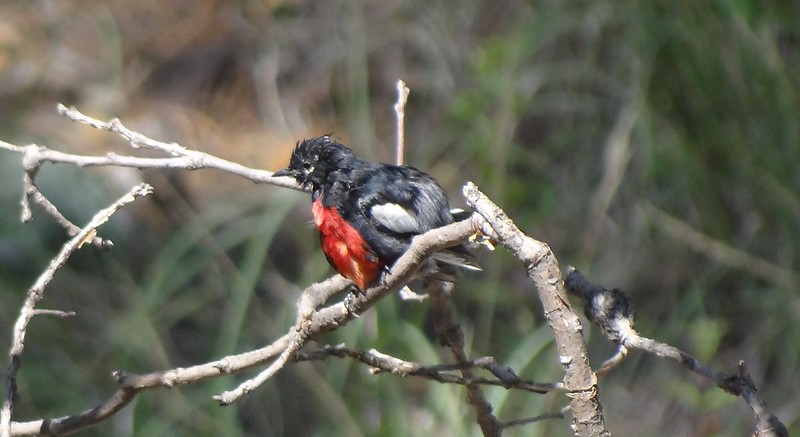
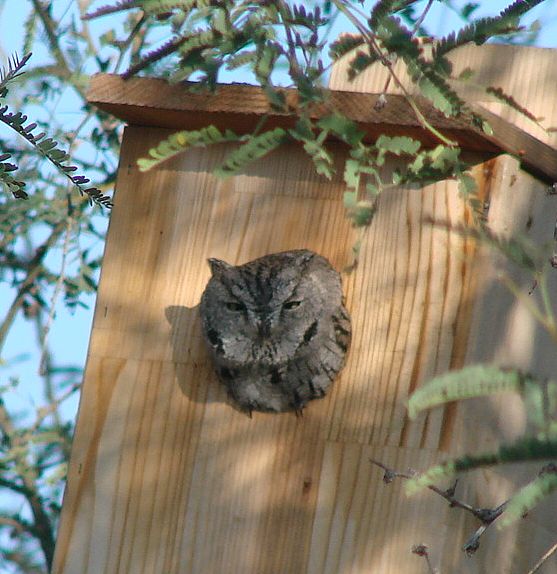
Even at 7000 feet, it was warm last week in Arizona. If you want to see how a painted redstart deals with the heat, click on the photo.


The Experience of Birding
Even at 7000 feet, it was warm last week in Arizona. If you want to see how a painted redstart deals with the heat, click on the photo.
Today we celebrate the 200th anniversary of the death of one of the real characters in French natural history, Jean-Baptiste Leblond, a physician, utopian politician, and the most restless of explorers.
Starting at the age of 19, in 1766, Leblond spent nearly 20 years walking the South American continent, from Grenada to Peru. On his return to France in 1785, he brought with him 250 pounds — pounds! — of platinum, along with a rich collection of natural history specimens.
No rest for the weary, though, and shortly thereafter he was ordered back to Cayenne, in search of new sources of quinine.
After all the effort, exhaustion, and suffering devoted to acquiring his collections, M. Leblond has made the exceedingly generous sacrifice of donating the specimens to the Paris Society of Natural History and certain of its members.
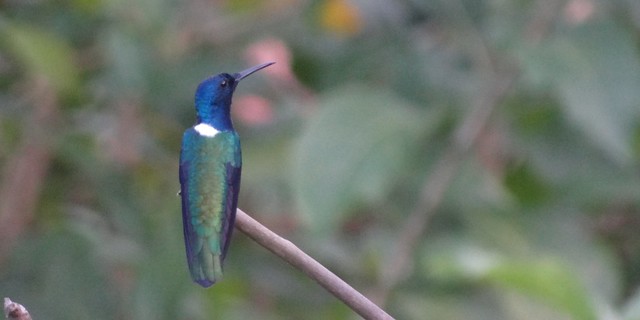
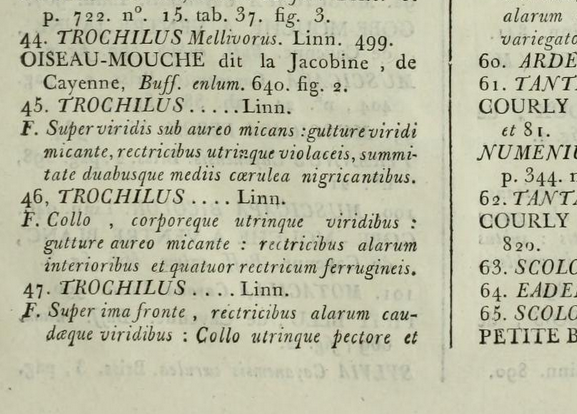
Among the donated objects were 111 South American birds, listed in the Actes of the Society for 1792. Most are identified with their Linnaean names and a citation to Buffon or Brisson, but not a few are brought down only to the genus level, with a brief description in hopes that someone someday might recognize them.
I don’t know where those specimens are now, or how many of them were eventually identified. It’s not easy, but if you want to try your hand at it, let us know how you do.

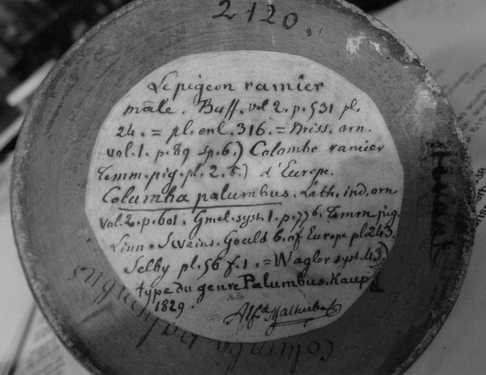
Tomorrow marks the 150th anniversary of the death of Alfred Malherbe, one of those great French amateurs to whom we owe so many collections — and so many pretty books.

Malherbe was born on Mauritius on Bastille Day 1804, but returned with his family to their native Metz, where he was appointed to the bench at the age of 28. His real passion, though, was natural history, and over the last two decades of his life he served as director of the Metz museum and president of the Société d’Histoire naturelle de la Moselle, the eventual heritor of his own extensive collections.
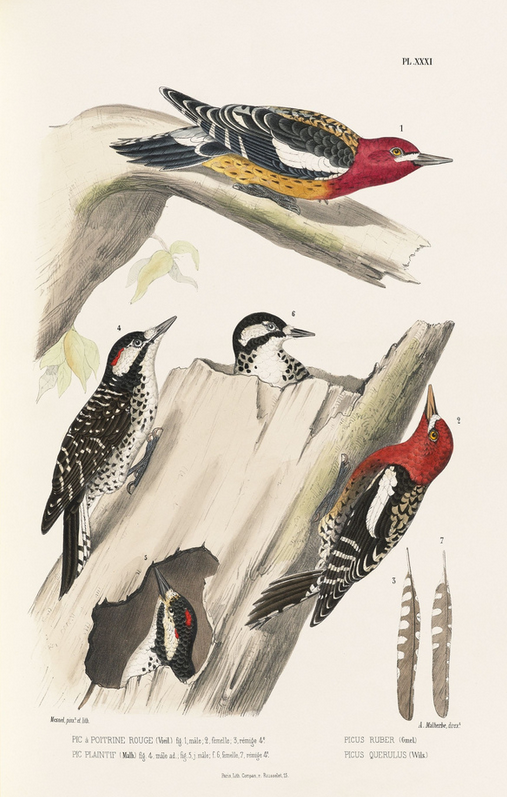
Malherbe is most famous today — if he is famous at all — for his Monographie des picidées, published in four volumes between 1861 and 1863.
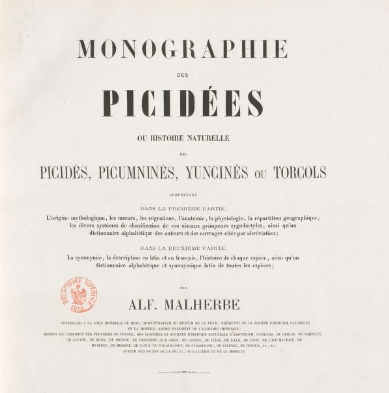
More than 15 years in the making, the work was greatly lauded on its appearance. Félix Guérin-Méneville greeted the first livraison in the pages of the Revue et magasin de zoologie:
One can find nothing more beautiful than this work by M. Malherbe, and one can confidently state that in the perfection of its execution it exceeds anything that has been produced up to now in France or abroad.
The plates, prepared from paintings by Luc-Joseph Delahaye and others, Guérin-Méneville called “magnificent … of an accuracy and truthfulness in color and form such as one rarely finds in the most luxurious of works.” All of the considerable number of new species described by Malherbe are depicted the size of life.
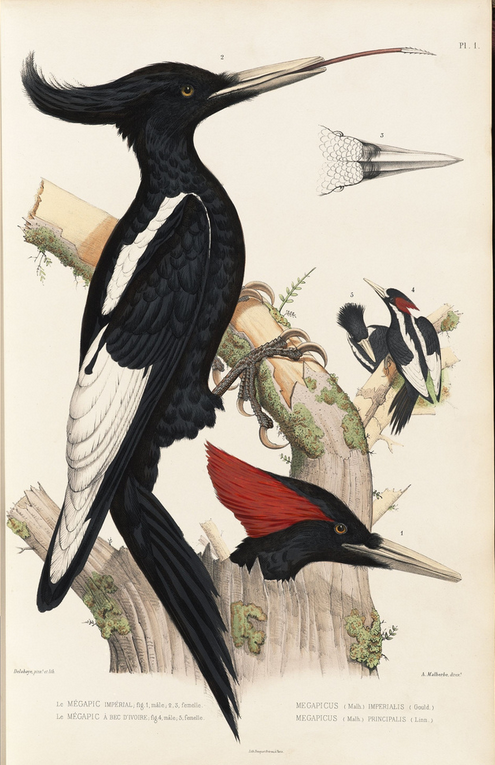
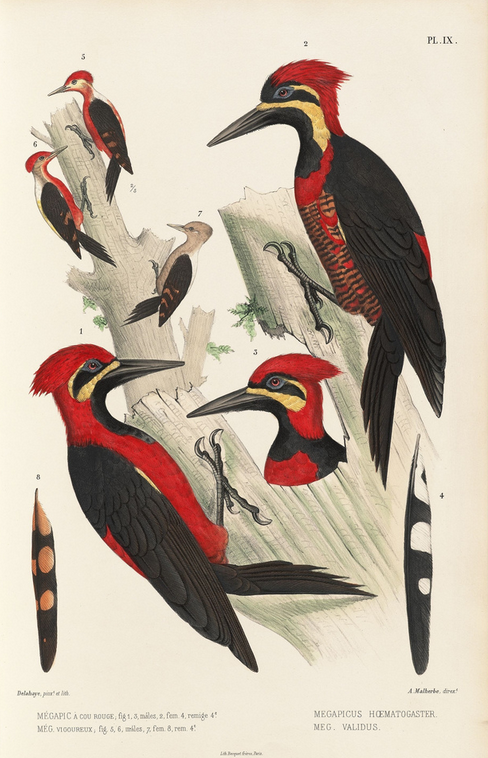
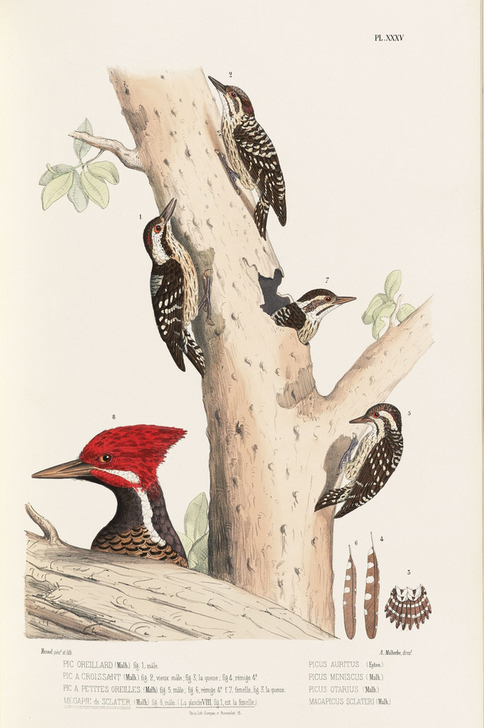
Charmingly, and invaluably, Malherbe begins his text volumes with two chapters treating of woodpeckers and people — a subject worthy of an entire book in itself. We learn about Picus and Canente, Picumnus and Pilumnus, and the powerful love philtre known as jynx. Malherbe collects stories of superstition from the Romans to his own nineteenth-century day, accounts of the medical and venatorial use of woodpeckers and their parts, and, naturally, tales of rustic feasts built around the flesh of picids,
which they even claim is delicious…. But having been so curious ourselves as to taste the flesh of French great spotted and green woodpeckers, we share the judgment of Audubon … who affirms that the flesh is detestable, that it tastes strongly of formic acid and is extraordinarily disagreeable….
They may not be tasty, but Malherbe takes a firm stance on woodpecker conservation.
If one considers the terrible ravages committed in orchards, forests, and farms by the innumerable myriads of insects in their terrible swarms, one can ask whether on balance the woodpeckers, far from being harmful, are not rather extremely useful to the owners of forest and field by devouring an immense quantity of larvae, caterpillars, and insects of all kinds every day, particularly when they are feeding young…. Count up the number of fruit trees, especially peaches, that perish from [insect damage], and you will become indulgent of these birds that are the principal destroyers of such insects.
Gone, happily, are the days when there were bounties on the heads of sapsuckers and other woodpeckers — in part, perhaps, thanks to the beautiful work prepared by Alfred Malherbe.
Ten years — that’s years — ago today I wrote my first entry on this blog.
Who’d have thought the medium would still be around — or that I would, for that matter.

The number of “rainbirds” around the world is legion. Rarely, though, is the explanation of the behavior as detailed as in this legend from southwestern France:
When the good Lord was creating the oceans, the rivers, and the springs, he asked the birds of the skies to help with the digging. They all set to work except for the green woodpecker, which mutinied and refused to budge. Once the task had been completed by the other birds, the good Lord took care to announce that the green woodpecker, having refused to help dig in the soil with his bill, would have to dig in wood to all eternity, and that not having contributed to excavating all of the earth’s bodies of water, the woodpecker would never drink any water but rain, which it would have to catch as it fell. And this is why the miserable bird never ceases to summon the clouds with its call, pluie-pluie, and why it always perches vertically, so that it can open its bill like a funnel to collect the raindrops that fall from the clouds.
Now you know. And you can test the theory with me this coming spring on either of my Birds and Art Tours to France.