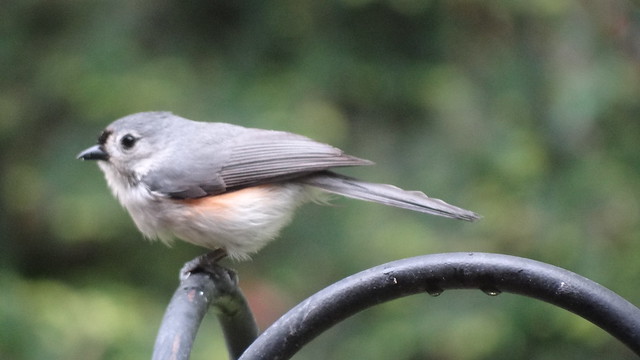
A hundred years ago today, Canada’s first Tufted Titmouse was discovered — where else? — at Point Pelee. What must it have been like to hear those now-familiar whistles for the first time?


The Experience of Birding
A hundred years ago today, Canada’s first Tufted Titmouse was discovered — where else? — at Point Pelee. What must it have been like to hear those now-familiar whistles for the first time?
Yesterday morning’s visit to the Pont du Gard was a good one: we missed the one “easy” target we’ve always got before — the charming little yellow-patched Rock Sparrow — but we made up for it.
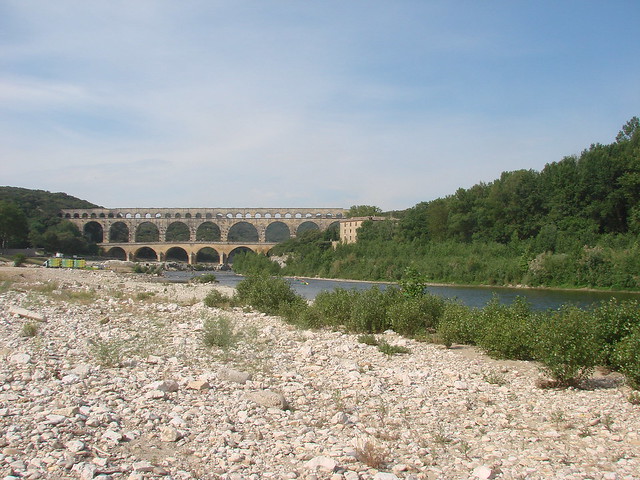
White Wagtails danced in the shallows, while the air was full of Crag Martins, House Martins, and Alpine Swifts so low overhead we could hear the wind through those arcuate wings. Careful scanning of the big flocks produced the only Red-rumped Swallow of the tour, one of just a handful I’ve ever seen in southern France and a life bird for several members of our delightful group.
It also pays to watch the rocks in the water, habitual perches for everything from Black Redstarts to Little Egrets.

The blue flash of the Common Kingfisher is a frequent sight here, too, but it is usually little more than that, an electric streak tracing the course of the river below us. This time, though, one decided that the waters directly in front of us must harbor the finest fish in France, and she hovered and dived for minutes at a time in plain view, coming up over and over with tiny silvery snacks. Yes, it’s a common bird, and no, we never miss it, but this may have been my favorite kingfisher experience ever.
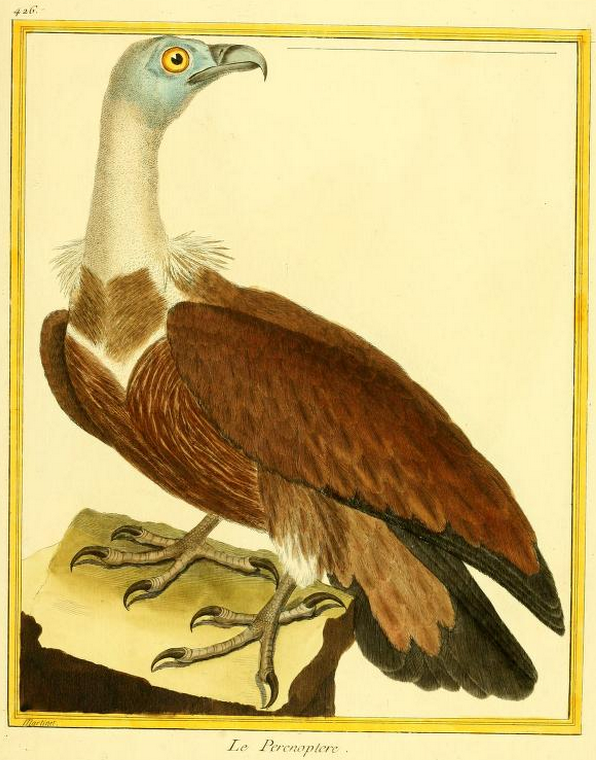
The clock reminded me that we needed to get to lunch in Beaucaire, and so I reluctantly sounded the retreat, Rock Sparrows or no. As we neared the parking lot, a great shadow passed over — and we looked up to find it cast by a Griffon Vulture. The great fulvous bird soared above us for several minutes before passing to the west, leaving us to wonder whether it was a bird from the Alps, the Pyrenees, or the central French massifs driven out into the lowlands of the Gard by hunger or curiosity.
Back when this species could still be spoken of as common, Crespon recounted the “manière particulière” with which the residents of the Cevennes hunted the great vultures:
It is a matter simply of constructing a square enclosure with sticks; they throw a piece of carrion into the middle of it, and in no time the vile odor that it gives off attracts the vultures, which drop out of the sky to feed. But once they have landed inside the enclosure, it is impossible for them to take flight again within the confines of the enclosure (their wings are so long that they need space to jump several times before being able to take off). And so it is easy to take them alive.
Just what the bold hunters wanted with these birds is unclear. Buffon notes that they — the vultures, that is —
are disgusting, thanks to the constant streaming of fluid from their nostrils, along with saliva that pours from two holes in the bill.
Not overly appealing, but it’s a great bird to see.
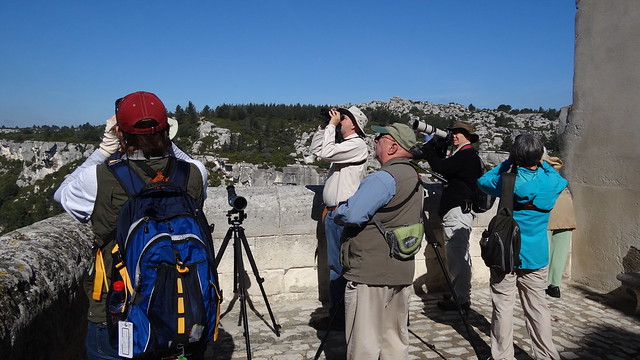
As if there weren’t already reason enough to bird Les Baux, the romantic ruined fortress is one of those magical places where you can get spectacularly close looks at mountain birds without going up into the mountains. On our visit yesterday, we admired Blue Rock Thrushes, Eurasian Crag Martins, and my favorites, the dashing Alpine Swifts skimming through the air just a few feet away from where we stood, breath held.
As it turns out, visiting birders aren’t the only ones to have noticed the speed and strength and skill of this largest of the Old World swifts. Crespon tells us that the “martinet à ventre blanc” (a dull name if ever there was one!) is known locally in Provence as the “grand balustrié.” Azaïs explains in his Dictionnaire des idiomes romans du midi de la France:
One gives this name to the Alpine swift because of the shape of its spread wings, which resemble an archer’s bow.
It’s a lovely metaphor, not least because the swift gets to play two roles simultaneously: it is both the bow drawn back and the arrow released, flying faster than any man-made dart ever could.
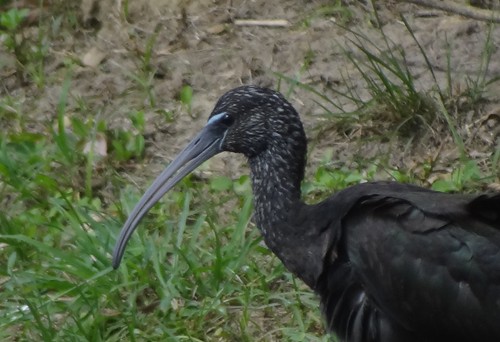
Famously, the Glossy Ibis (here represented by the photo of a bird on Tobago last fall) is spreading like wildfire in Mediterranean France; our counts these past few days have fallen, conservatively, between 60 and 100 each day, a far cry from the times — not that long ago — when a single individual would make the list of an excursion’s “good birds.” By 2012, the breeding population of the Camargue exceeded 350 pairs, and the bird, dramatic and beautiful, no longer strikes anyone as especially noteworthy here in southern Provence.
Though this species was a rarity through much of the twentieth century, Crespon, a hundred seventy-five years ago, knew it as a regular spring migrant in the Camargue:
This charming bird only migrates through those of our marshy landscapes that are closest to the Mediterranean; in the early days of May, it arrives in more or less large flocks.
It’s tempting to think of those nineteenth-century passage birds as would-be pioneers, and equally tempting to find a hint at the reasons for their failure in Crespon’s words:
Their flesh is hard and leathery, and tastes extremely bad; it has an odor of sardines.
Nobody’s eating them today, and these exotic beauties are free now to continue their conquest of the world, one marsh and one rice paddy at a time.
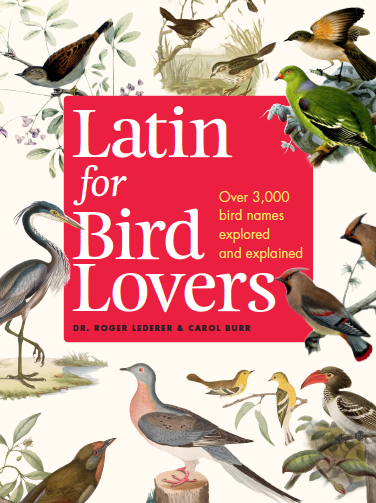
The authors of this new book on bird names graciously confess (p. 15) that
it may not be strictly entomologically accurate.
Res ipsa ladybug.