Mme Knip and Her Bird Book

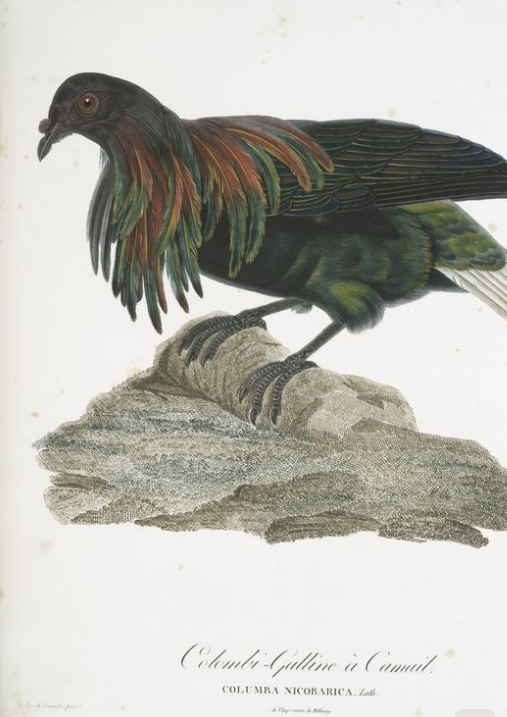
Nicobar Pigeon by Pauline Knip

Not every cause remains célèbre, but birders still recall, more than two centuries on, the noisy falling out between Coenraad Jacob Temminck and Pauline Knip, erstwhile collaborators on one of the loveliest of the illustrated bird books of the early nineteenth century.

Antoinette-Pauline-Jacqueline Rifer de Courcelles was born in Paris in July 1781; her marriage to the landscape painter Joseph Knip (he alone rates a Wikipedia article, by the way) ended in divorce, but she kept his name until her death in April 1851. A student of Pierre-Paul Barraband, Mme Knip specialized, like so many of her gifted female contemporaries, in scientific illustration, but, as a later biographer observed,

One has nevertheless encountered true artists in that inferior genre, to which they gave unexpected worth thanks to the genuineness of their exceptional talents. Mme de Courcelles, for example, at the beginning of the nineteenth century, while drawing and painting only birds, still managed to deserve a distinguished place among the artists of her day…. Even if one had no interest whatsoever in ornithology, no one could regret the time spent leafing through her splendid volumes.

In 1805, the artist provided the plates for Desmarest’s Histoire naturelle des tangaras, des manakins et des todiers, and three years later, she and Temminck began the publication of their Pigeons.

These pigeons, from our turtle doves and wood pigeons to the singular species of the tropics, they coo, they puff with pride; their wings life, their delicate and changeable colors shimmer in the sun; ingenious touches make the air and the light play among their silky plumes; their round eyes, even in the brute immovability, have the brightness and transparency of life…. Nothing better has ever been done in this genre.

It is not for her artistic skill that she is remembered, however. Elliott Coues tells the storyLes pigeons 

is one of the curiosities of literature…. The work was originally published in 15 livraisons, 1808-1811. At the ninth livraison, Madame Knip accomplished a piece of truly feminine finesse, by which she stole it from Temminck.

Knip intervened with the printer to change the cover of that ninth fascicle to make it seem that she was alone the author; apparently, to conceal her treachery, some copies were produced and sent to Temminck with his name on the title page. When the fifteenth was issued, though, she informed the binders that they were to omit all mention of Temminck, including the introduction and index he had written, “a bold trick, regardless of consequences,” says Coues.

What may have gone on under the surface would doubtless be even more curious….

Temminck himself identifies Knip’s motive:

The work she had thus mutilated was presented to her imperial highness Marie Louise, with the effect of gaining for Mme Knip the gratifying results her ambition had long coveted.

Only when he visited Paris from Leiden did Temminck find out what had happened. It was too late:

Every effort made to appeal against her arbitrary actions was useless, and it was not possible to raise my voice then against intrigues supported by such powerful protectors [namely, Napoleon and his second empress]; editors refused to publish my side in their papers, even in reply to an article published by [Mme Knip as] the new author.

I haven’t seen that article of Knip’s. Coues could not find it, either, and it is unmentioned in the most recent scholarship on l’affaire Knip and Temminck; it likely tells the story from a very different angle, one no doubt more sympathetic to the painter than the past two centuries of history and “delightful … gossip” have been.

Share

Pictures of Pigeons

Screenshot 2014-05-20 14.52.18

Remember how hard it used to be to gather image material for study or publication?

No, you probably don’t. I can barely recall those days of drudgery and trudgery myself, all that time in the library and on the telephone and at the post office. Now, it’s all (or much, with more every day) out there just a click away — a circumstance that keeps me wondering why on earth, in this year of sad commemoration, we haven’t assembled more of the pictorial record of the passenger pigeon.

Even Joel Greenberg’s now canonical Feathered Riverwhich offers a good selection of images — not a few of them new to me — is limited by the constraints of print to scattered black and white photographs and a single sixteen-page gathering of color plates. Maybe Pinterest is the way to go after all.

In any event, here are a few of the many images produced over the years and the centuries; critical remarks on some of them are offered in Schorger’s “Evaluation of Illustrations,” Chapter 16 in his Passenger Pigeon. I’ve forborne from posting the well-known plates by Wilson, Audubon, Fuertes, and Hayashi, all of which are widely and conveniently available.

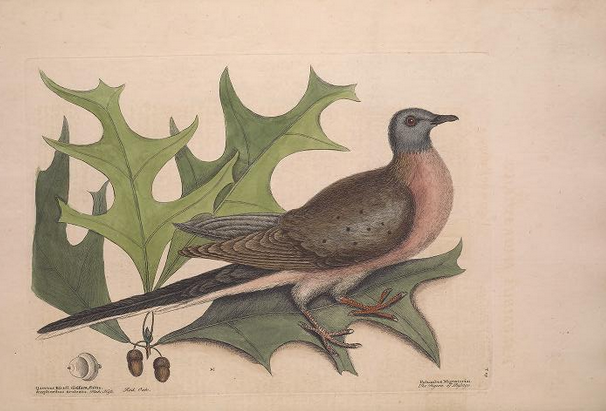
I make an exception for Mark Catesby, as many of the images credited on line and in print to his Carolina, Florida and the Bahama Islands are in fact from Seligmann. Here is the real thing, thanks to the Smithsonian Libraries and (again and again) BHL:

Screenshot 2014-05-20 15.00.28

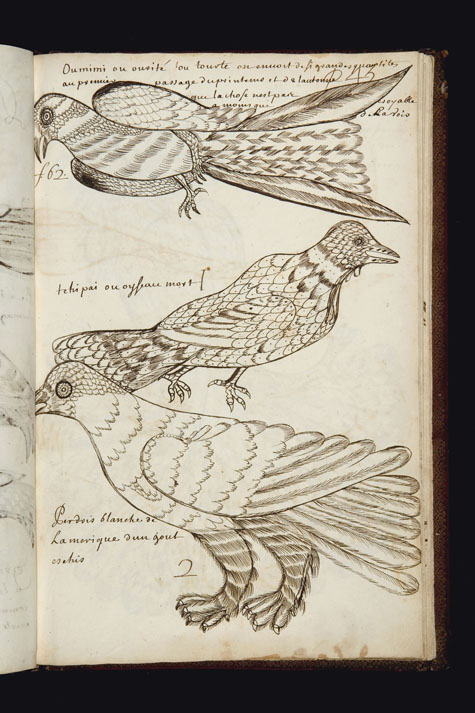
According to Schorger, Catesby’s painting was preceded some thirteen years earlier, “about 1700,” by the first European drawing of the species, in the Codex canadensis now attributed to the Jesuit missionary Louis Nicolas.

Screenshot 2014-05-20 15.21.48

The text reads, in translation,

Oumimi, or ourité, or dove. One sees such great numbers of this bird at the first passage in spring and fall that it is incredible unless seen.

(Incidentally, Nicolas’s other work, the Histoire naturelle des Indes occidentales, which appears to be known almost exclusively to botanists, includes an entire chapter on the passenger pigeon, unmentioned, if rightly I remember, in Schorger and in Greenberg.)

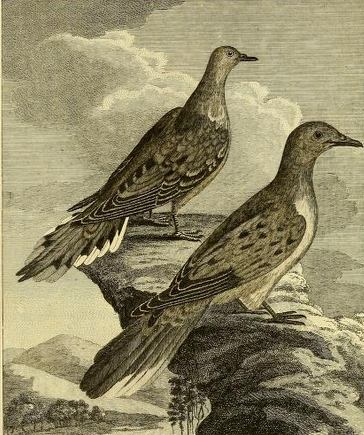
Thomas Pennant’s Arctic Zoology poses a passenger pigeon alongside its smaller cousin, the mourning dove:

Screenshot 2014-05-20 16.02.18

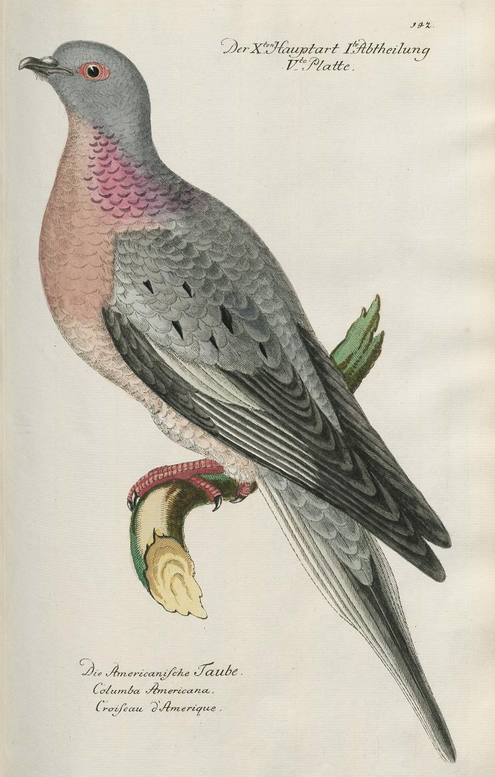
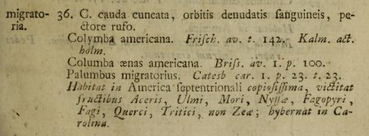
Mathurin Brisson rightly praised Johann Leonhard Frisch’s plate in the Vorstellung as “icon accurata”:

Screenshot 2014-05-20 16.52.55

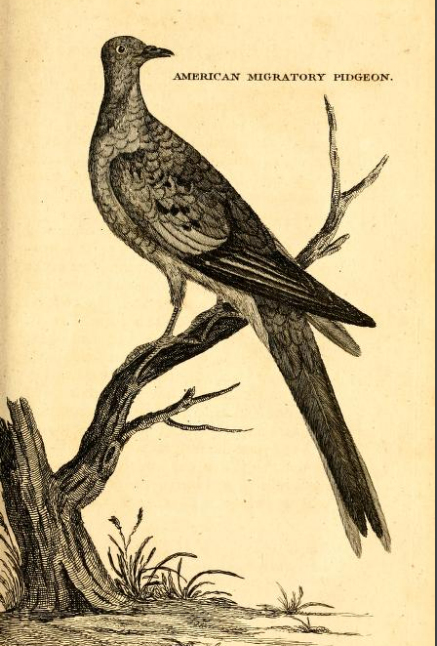
He could also have mentioned that it is one of the loveliest depictions of the bird ever published, a distinction that separates it vastly from the raggedy pigeon shown in Forster’s translation of Kalm’s Travels:

Screenshot 2014-05-20 17.08.51

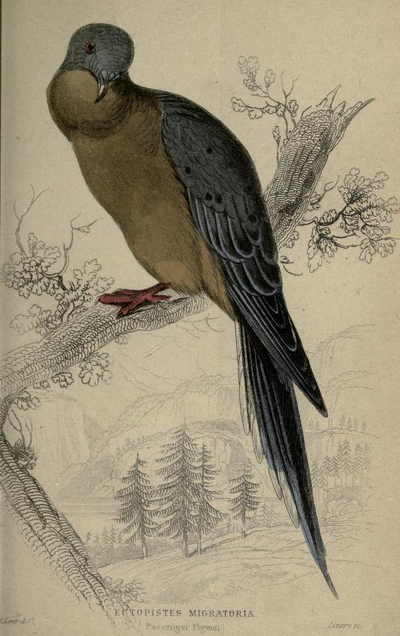
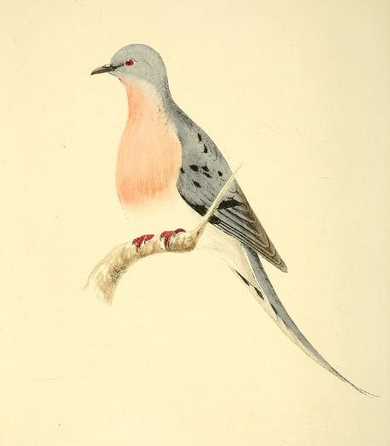
Surprisingly, E. Lear (I assume that E. Lear) was hardly more successful in the pigeon he drew for Prideaux John Selby’s Pigeons.

Screenshot 2014-05-20 19.13.24

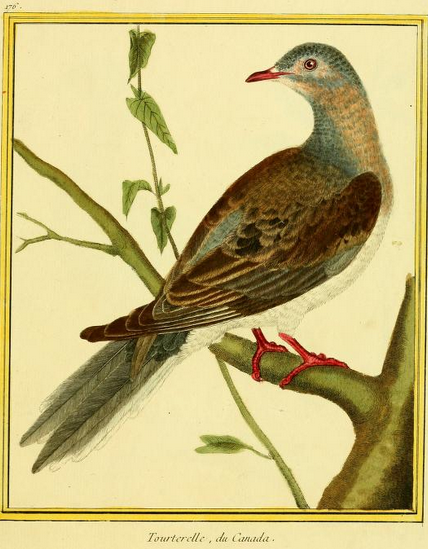
I can’t say that the figure in the Planches enluminées is too much better.

Screenshot 2014-05-20 19.27.46

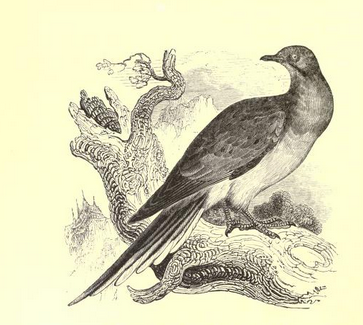
Eyton gets it closer to right in his History of Rarer British Birds.

Screenshot 2014-05-20 19.35.04

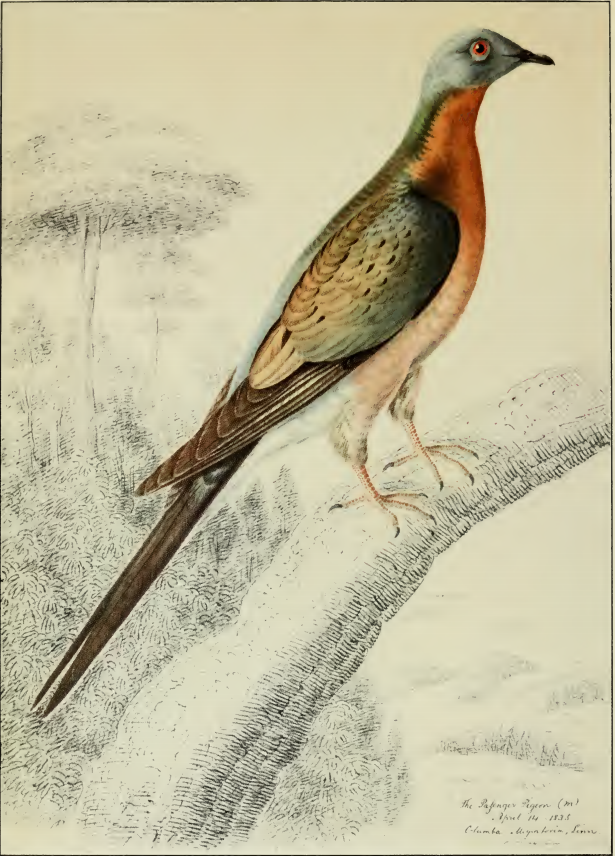
William Pope painted his bird in 1835.

Screenshot 2014-05-20 20.04.23

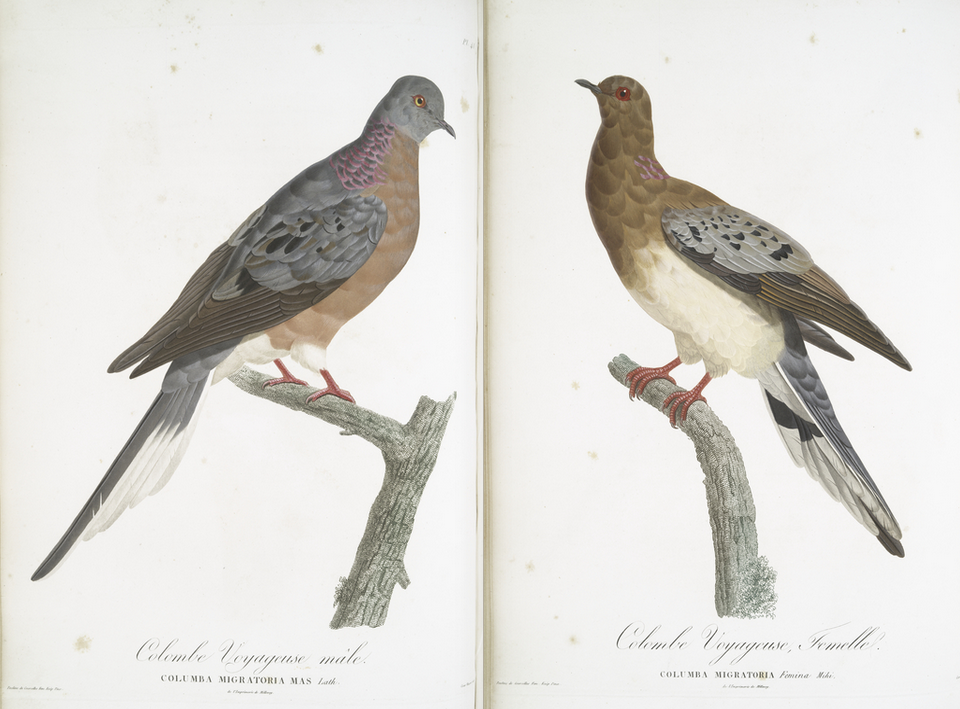
From earlier in the nineteenth century, the notorious Pauline Knip’s pigeon pair is decorative, but both birds are too obviously dead and stuffed for my taste.

Screenshot 2014-05-20 17.15.03

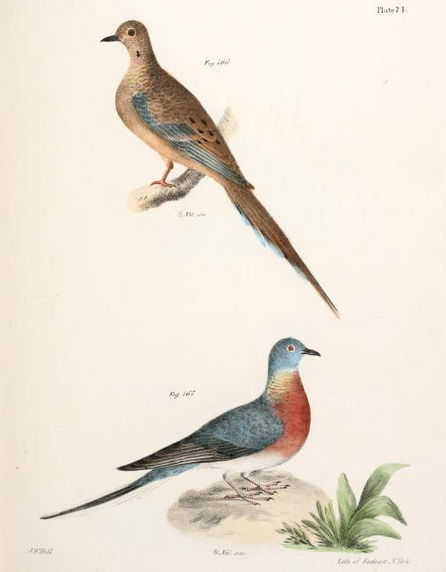
Both sexes are also shown in De Kay’s Zoology of New York:

Screenshot 2014-05-20 18.50.09

Henry Leonard Meyer’s colored portrait, almost two hundred years old now, has an orientalizing lightness to it that still appeals to my twenty-first-century eyes (Schorger, a sterner critic than I am, says “no merit as to drawing and coloring”).

Screenshot 2014-05-20 20.10.59

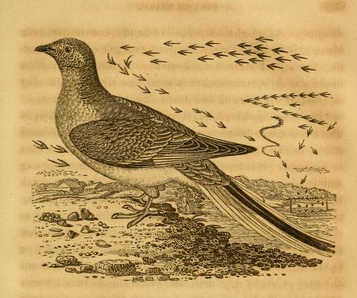
Copied and imitated and plagiarized again and again, the appealing woodcut in Thomas Nuttall’s Manual seems familiar even to eyes that have never seen it.

Screenshot 2014-05-20 18.33.51

It is not clear to me just who is responsible for the plate in Morris’s History of British Birds, whether Alexander Lydon or another painter; in any event, this is not a work many artists would rush to claim.

Screenshot 2014-05-20 17.24.26

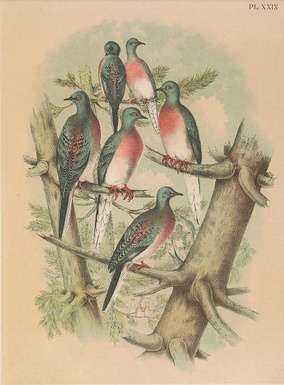
Still, it’s better than the infamous image of half a dozen shockingly colorful, big-footed birds in Studer:

Screenshot 2014-05-20 18.58.57

I prefer the justifiably wary birds in the background of this plate from the same work:

Screenshot 2014-05-20 19.07.28

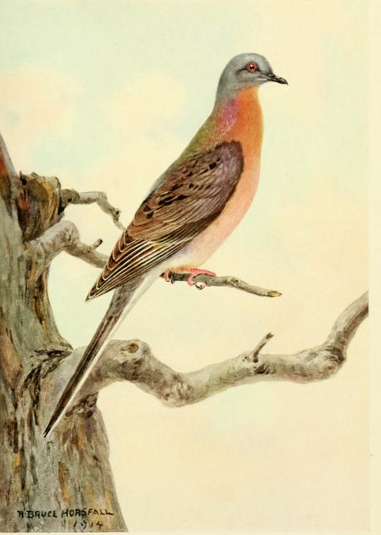
Published in the same year as the death of the last pigeon, Bruce Horsfall’s bird looks a bit too much like a mourning dove, I think.

Screenshot 2014-05-20 20.27.51

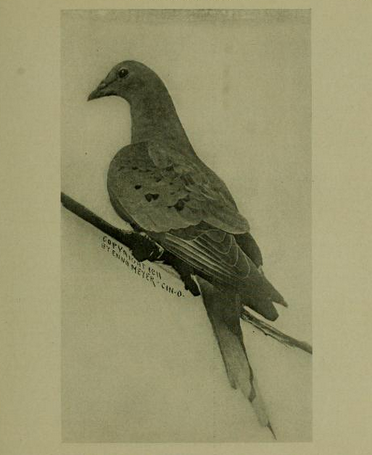
The passenger pigeon survived, at least in dribs and drabs, well into the age of photography. Martha, the last known individual of the species, may have been the most pictured of all individual American birds before the invention of the digital camera.

Screenshot 2014-05-20 17.53.11

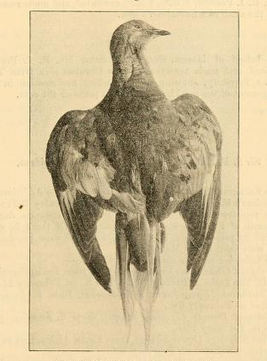
One of the last photographs of the dead Martha, taken by Robert Shufeldt while the corpse was still intact:

Screenshot 2014-05-20 17.34.44

The shutters didn’t stop clicking here. Sometime between now and September, I’ll post some of the published photographs of the dissection — memento mori.

Meanwhile, are there interesting and useful images I’ve missed?


Share

The Eider Economy, 1763

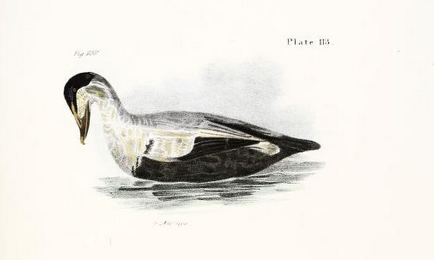
Two hundred fifty-one years ago, Morten Thrane Brünnich (yes, he of thick-billed murre fame) published his Eder-Fuglens Beskrivelse“A Descriptive Account of the Eider Duck.”

De Kay, Zoology of New York

The great Danish naturalist concludes his study with an impassioned appeal for common sense in the exploitation of this species:

Do not the highest reasons prove that this bird should deserve the protection granted it by our blessed kings, most particularly by King Christian VI piae memoriae, who forbade any and all in these lands to destroy a single one of these birds, on pain of imprisonment? Are there not enough other birds of sea and shore that can and do serve as human food that it should be unnecessary to rob this bird of his life, a life so useful both to him and to us? Can a man not find more usefulness in this bird by leaving its eggs alone, or by removing them only temporarily and returning them to the nest in order to encourage the laying of more? Is it not worth the effort to teach the ignorant Greenlanders and to encourage the sensible ones to collect the ducks’ down, which is otherwise harvested only by the wind? Are we not at considerable pains to raise silkworms, in spite of the fact that they are foreign creatures unsuited to our part of the world, in an effort to establish a silk industry here in Denmark? How much more we should devote our attentions to a bird that is native to our country, a bird that asks only for its life and the life of its offspring, a bird that every year offers us reliable tribute if only we take the trouble to accept it. Surely we could create a new trade in eider down that would be far more profitable for Denmark!

They don’t taste all that good anyway.

Share

Flatulent Field Ducks

Little Bustard

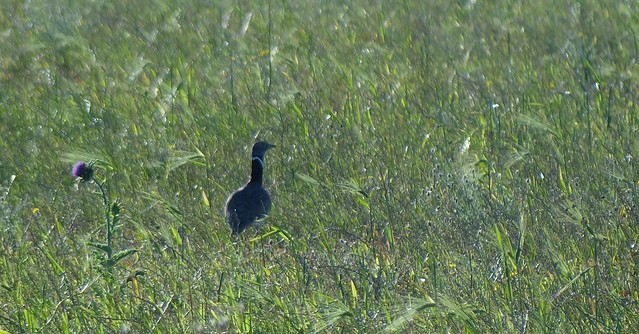
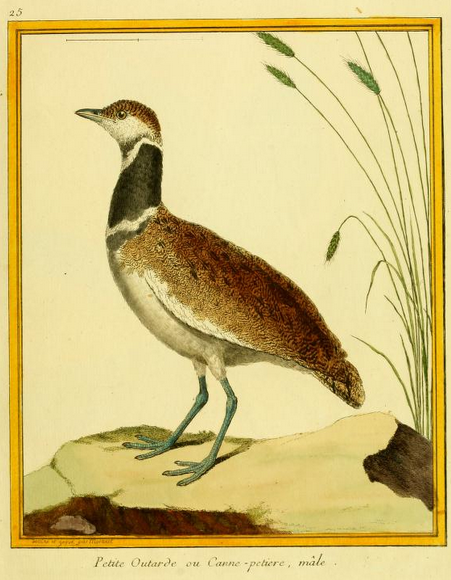
Now here’s one I haven’t quite figured out. Betty and Lorinda and I were watching little bustards last week near Eyguières when I happened to ask a French birder if he had any idea where the odd vernacular name “canepetière” came from. Just making conversation, don’t you know, and I hardly expected an answer — but he had one. A convincing one. “Cane,” he told me, was a name for “duck” (as in “canard,” for “drake”), and “petière” — well, let’s just say that that word refers, indelicately, to the reedy buzz, the “pet,” uttered by the bird on taking flight.

Little Bustard

“Farting duck,” in fact, is precisely the etymology given in most of the standard modern reference works. But the wrinkle is this: the earliest attestation of that name is found not in a medieval glossary, not in an early ornithological text, but in one of those exuberant lists so beloved of that most original of French writers, François Rabelais. In his Gargantua, published in 1534, Rabelais tells of the modest supper served to the aptly named Grandgousier:

six roasted cows, three heifers, thirty-two calves … 140 pheasants, some dozens of wood pigeons, river birds, teal, bitterns, curlews, plovers, partridges, daws, redshanks, lapwings, shelducks, spoonbills, herons, coots, egrets, storks, “cannes petières,” flamingos, turkeys….

It pays to be careful when reading Rabelais. Though all of the other bird names on the menu seem to be “genuine” — that is to say, they are well attested in earlier sources — it’s eminently possible that here, buried in this avalanche of words, is a specimen of our author’s famous carnivalesque wit, an example of the verbal playfulness that makes reading Rabelais so much fun and so much frustration all at the same time. I wonder, in other words, whether Rabelais didn’t make the name up.

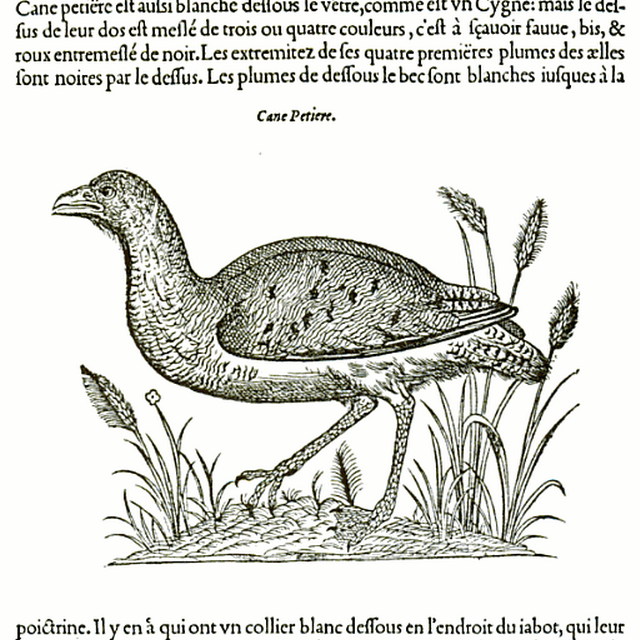
The fact that it does not appear in print again for another twenty years (in the ever-so-serious Pierre Belon’s Observations) suggests at least that “canne petière” did not enjoy great currency in the written language; Belon did use it, though, without etymological comment, in the species account he prepared for his 1555 Histoire naturelle des oyseaux

Screenshot 2014-05-18 11.21.42

Buffon, in the Histoire naturelle, doesn’t blame any individual author for the name, but he does suggest how it might have arisen. Quoting François Salerne’s remarks in his 1767 translation of Ray, Buffon argues that “petiére” is actually a “corruption” of the original

“canepetrace,” [a name given the bird] because it prefers to live in rocky places,

such as, for example, the steppes of the Crau.

La Crau

Buffon expressly rejects any etymology

from the bird’s “flatulence” … which seems to be based solely in the similarity of the word “pet” [to the word “petrace,” for “rocky”]: no naturalist has ever brought up anything of the kind in his account of the bird….

Screenshot 2014-05-18 14.44.40

I suspect that Buffon and Salerne are right, and that “canepetière” has its origin in the transformation of the genuine name “canepetrace.” The question remains whether that distortion was an intentional literary pun or the result of the phenomenon known as folk etymology. Myself, I wouldn’t put it beyond Rabelais.

Share

The Scarlet Tanager, Orange Variant

It seems like every spring is marked by a new fad in the world of digital birding.

Screenshot 2014-05-15 13.11.37

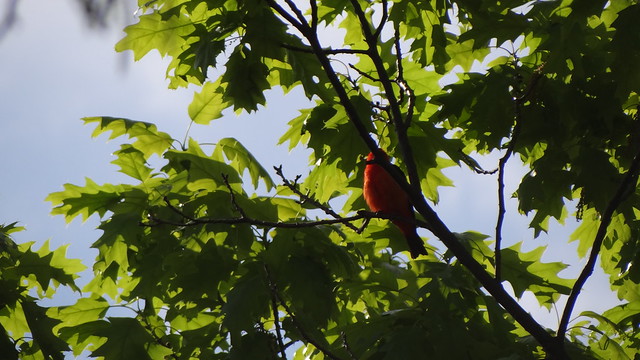
This year, it’s the “orange variant” of the Scarlet Tanager that has the internet abuzz. I can’t turn the machine on any more without reading about this “form,” and there is an abundance of photographic material out there purporting to show such individuals. Just google it.

There is no doubt that some males of this species in definitive alternate plumage are less scarlet than others; have a look at Larry Sansone’s photograph of a decidedly ochre-toned individual in Beadle and Rising’s Photographic Guide, for example. Rising comments that this bird falls notably towards the orange end of “the scale”; the implication is, correctly and appropriately, that there is a more or less continuous range of color to be observed, from the dull orange of some males to the classic blazing red of others.

Yes, they vary: They vary “considerably,” in the authoritative words of Robert Ridgway, “being sometimes of a flame-scarlet or almost orange hue.” But that doesn’t mean there is any definable “variant” among them, any more than there is an identifiable “yellow variant” of the American Robin or the Summer Tanager — two other species in which the reddish parts of males’ plumage can differ in brightness and saturation.

When most of us see a dull adult male Scarlet Tanager, we’re delighted and intrigued, and tend to say something like “Why, look, there’s a dull adult male Scarlet Tanager!” without elevating that individual bird to the status of “variant.”

Most of the photos being posted to the internet now, though, are not of adult tanagers at all. Image after image of these “orange variants” shows a first-alternate male Scarlet Tanager, readily aged by the molt limits in the wing. And many of those birds are indeed duller orange-red than the name “scarlet” might suggest.

Entirely as expected.

BNA tells us that first-alternate males are “orange-red to scarlet.” Dwight describes them as “sometimes pale or mixed with orange.” It’s simply normal — for lack of a better word — for some ten-month-old male Scarlet Tanagers to be orangish.

Where did the need to assign these birds to a class of “variants” come from? The obvious answer is provided by a painting in the first edition of the Sibley guide, a dull tanager captioned “variant adult male breeding.”

In a process of productive misreading, Sibley’s perfectly unexceptionable adjective “variant” — meaning “different” — has apparently come to be re-analyzed as the tendentious noun “variant,” a definable kind departing from the normal, a “morph.” But what the guide is describing, and what birders are observing, is simply individual variation, with some birds more orange, some birds more scarlet, some birds more yellow.

I’m not suggesting that we stop looking close at male Scarlet Tanagers, and I’m not suggesting that anyone stop “posting” photos of particularly bright or particularly dull or otherwise remarkable birds. But when we encounter a bird that strikes us as oddly colored, maybe we should remember that variation doesn’t always make a variant.

SCarlet Tanager

Share