Rick Wright, birdaz@gmail.com, is a widely published author and sought-after speaker at birding events. He leads birding and birds and art tours for Victor Emanuel Nature Tours, and is the book review editor at Birding magazine.
A native of southeast Nebraska, Rick attended the University of Nebraska and Harvard Law School, and holds M.A. and Ph.D. degrees from Princeton University.
As an undergraduate, he taught laboratory courses in ornithology with Paul Johnsgard and worked as a collections assistant at the Nebraska State Museum. In 1985, he was a founding member of the Nebraska Ornithologists' Union Bird Records Committee.
Rick lives in northern New Jersey with his wife, Alison Beringer begin_of_the_skype_highlighting end_of_the_skype_highlighting begin_of_the_skype_highlighting end_of_the_skype_highlighting.
After several days of watching the odd bloated carcass float past their steamer, John James Audubon and the members of his Missouri River expedition finally, in the last days of May 1843, saw their first living American bison. And killed a bunch of them, of course.
The men’s tutor in all things buffalo — their Bos boss, so to speak — was James Illingsworth, a trader and functionary at Fort George. Illingsworth supplied Audubon not only with specimens but with some very valuable practical information, too:
When calves are caught alive, by placing your hands over the eyes and blowing into the nostrils, in the course of a few minutes they will follow the man who performs this simple operation.
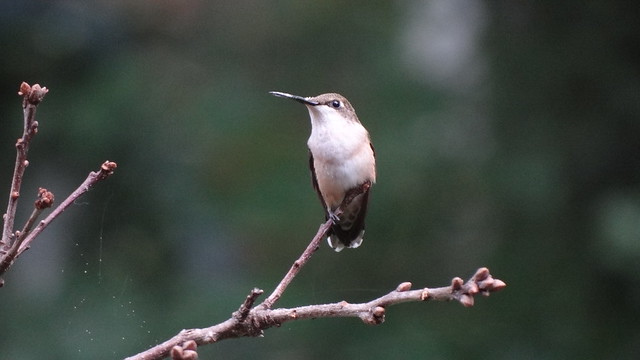
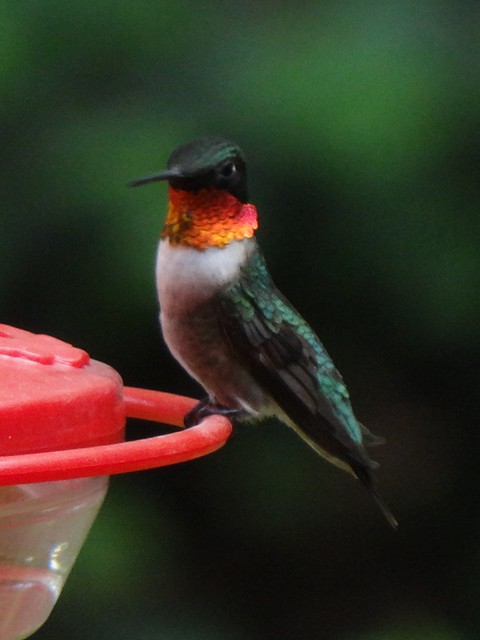
The past week or so has seen the annual online panic about the perceived lateness or scarcity of ruby-throated hummingbirds on their North American breeding grounds. If your favorite trochilid hasn’t “returned” to your feeders yet, you might take the advice of Althea R. Sherman, who in 1913 reported on
her experiment in feeding humming birds in an effort to get them to nest near her house. The birds were first tempted with a flower of oil cloth, gaily painted and containing a little vial of sweetened water. The same birds [!] have been coming back [!] year after year [!] since the beginning of the experiment…. The sugar syrup is now placed without concealment in bottles and the birds come for it with delight.
I’m busy manufacturing oilcloth flowers, which I expect to sell for, oh, say, $150 each.
It can be easy to forget that something as familiar as the habitat group had a beginning. It did, though, and apparently it took a little time for the fin de siècle museum-going public to catch on.
Two or three days ago several young women were passing, but, attracted to the [mounted] birds in the marsh [habitat group], stopped in front of the group. “That’s pretty good,” said one, “but I don’t see why the museum authorities allow that dirty water to stand there like that. You can smell it clear through the glass case, and I should think it would be unhealthy.” She was speaking of a celluloid preparation used as a water substitute which has no odor at all.
Now that’s success.
Leonard C. Sanford Hall of North American Birds, American Museum of Natural History
The story of the piecemeal discovery of the evening grosbeak is too well known to bear repeating here. One often overlooked piece of the puzzle, though, fell into place 171 years ago today, on the banks of the Missouri River in what is now South Dakota.
On May 29, 1843, John James Audubon and colleagues were hunting and collecting around Fort George. In his diary that evening, Audubon noted that John G. Bell — he of vireo (and later of sparrow) fame — had run across several evening grosbeaks in the course of the day. And in a bit of classically Audubonian snideness, he couldn’t help adding
therefore there’s not much need of crossing the Rocky Mountains for the few precious birds that the talented and truth-speaking Mr. —— brought or sent to the well-paying Academy of Natural Sciences of Philadelphia!
I don’t know whether those eloquent dashes were present in Audubon’s manuscript or we owe them to the punctiliousness of his famously fussy granddaughter and editor, but in either event, it is obvious that they conceal the name of John Townsend. The Mearnses tell the full story of Audubon’s struggle to get access to the nova Townsend had sent ahead to Philadelphia, a struggle Audubon himself describes in the bitterest possible terms in the Ornithological Biography. While Nuttall, who had been with Townsend in the West, “generously gave [Audubon] of his ornithological treasures all that was new,” Townsend’s specimens were in the possession, or at least under the control, of the Philadelphia academicians:
Loud murmurs were uttered by the soi-disant friends of science, who objected to my seeing, much less portraying and describing those valuable relics of birds…. seldom, if ever in my life, have I felt more disgusted with the conduct of any opponents of mine, than I was with the unfriendly boasters of their zeal for the advancement of ornithological science, who at that time existed in the fair city of Philadelphia!
Half a decade later, a thousand and a half miles away on the banks of the Missouri, it still rankled.
My Birding review of Joel Greenberg’s new Feathered River Across the Sky is “up” now at the ABA blog. If you’re interested in birds, history, or conservation, you’ll find the book well worth reading as we approach the centennial of the death of the last passenger pigeon.