Rick Wright, birdaz@gmail.com, is a widely published author and sought-after speaker at birding events. He leads birding and birds and art tours for Victor Emanuel Nature Tours, and is the book review editor at Birding magazine.
A native of southeast Nebraska, Rick attended the University of Nebraska and Harvard Law School, and holds M.A. and Ph.D. degrees from Princeton University.
As an undergraduate, he taught laboratory courses in ornithology with Paul Johnsgard and worked as a collections assistant at the Nebraska State Museum. In 1985, he was a founding member of the Nebraska Ornithologists' Union Bird Records Committee.
Rick lives in northern New Jersey with his wife, Alison Beringer begin_of_the_skype_highlighting end_of_the_skype_highlighting begin_of_the_skype_highlighting end_of_the_skype_highlighting.
Now there’s a name you don’t hear much nowadays. Henry Maurice Drummond, later Drummond-Hay, was born 200 years ago today, and would go on to be a founder and first president of the British Ornithologists’ Union.
On the edge of the Newfoundland banks he watched for some time a Great Auk which was within 30 or 40 yards of the steamer; and as he had his field-glasses, and could distinctly note the bill and white ear-patches, he felt that he could not be mistaken. He heard also from a friend in Newfoundland that in the following year [1853] a dead Great Auk had been washed ashore in Trinity Bay.
This record was apparently deemed credible by Alfred Newton, but nearly all of the more recent literature cites two specimens taken in 1844 as the “official” end of the auk. I’d like to think that Drummond-Hay actually saw the bird — at least we can let him have it on his birthday, can’t we?
As James and I work on our new Birds and Art tour, I’ve been putting in the odd moment learning the names of some of the many (very many!) birds we can hope to see in lovely Catalonia next April.
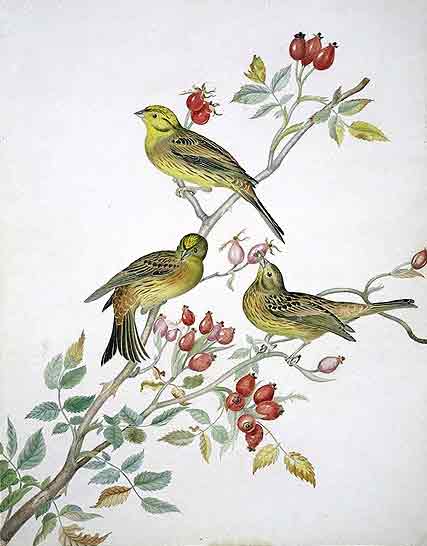
Yellowhammers, William MacGillivray
Naturally, I started with my favorites, the emberizid buntings, and was startled to find several species of these best of all birds given one of the strangest of all names in Spanish: escribano, the copyist.
With that name, these birds join the host of clerical fowl, from lettered aracaris and secretary-birds to, just perhaps, prothonotary warblers. But what’s so literate about a bunting?
The sources I have been able to run down all agree — both a good sign and bad, that — that the Spanish name, varied sometimes to “escribidora” or “escribiente,” refers to the irregular dark markings on the egg, which resemble carelessly written letters and words.
Reed bunting eggs, MNH Toulouse.
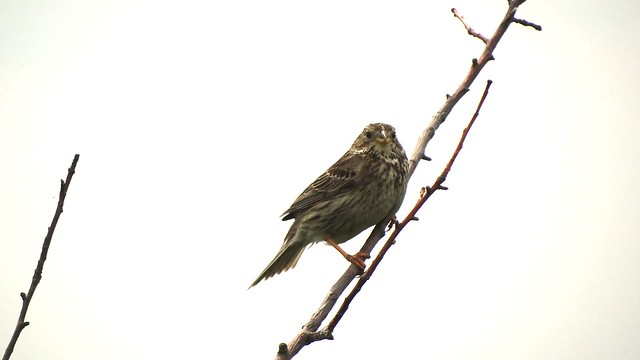
And that stirs a dim memory, a memory confirmed with just a little sniffing around in the old books. In English, “writing bird,” “writing lark,” and “writing master” are all attested as names for the yellowhammer and the corn bunting.
In his 1875 Rambles and Adventures, George Christopher Davies explains in no uncertain terms why: his energetic schoolboys
found two or three larks’ nests and some yellowhammers’ or “writing masters,” as the country lads sometimes call them, from the scribblings on the egg shells.
Ten years later, Charles Swainson also listed the names “scribbling lark,” “écrivain,” and “schryver” for the yellowhammer, all of them due, he writes, to “the curious irregular lines on the egg, resembling writing.” Swann adds “writing linnet” and “scribbler,” again “from the scribble-like markings on its eggs.”
Wonderings never come alone. Might this also be the explanation for the strange epithet of the lark sparrow, grammacus? It’s a clever idea, but like so many other clever ideas, it doesn’t pan out at all. Thomas Say’s original description of this “pretty species of sparrow” makes it plain that the eponymous grammee, the “pen strokes,” are the heavy markings of the “lineated head” and, alas, have nothing to do with the sparrow’s eggs at all.
We owe it all to dead things. Natural history hobbies today would not exist if long generations of our forebears hadn’t taken to the field with guns and nets and traps, stuffing and pickling everything unlucky enough to come across their path.
Wholesale collecting of birds was relatively easy, at least once the recipe for arsenical soap had been leaked: a huge number of skins could fit into a barrel or a box. Mammals have always been more challenging. Not only do the commonest and most frequently encountered species take up a lot of room even as skins, but for many species, skeletal material is indispensable.
Shrews? No problem. Bats? Easy. Bison and mule deer and elk? A different matter entirely.
I’ve been rereading Audubon’s Missouri River journals lately, and I quickly lost count of how many big, bulky skulls he and his colleagues — among them, famously, Sprague, Bell, and Harris — collected on their up and down the big river.
Unfortunately, the naturalizing team did not restrict its efforts to wild animals.
Until shockingly recently, the human inhabitants of the Great Plains were considered (yes, I nearly wrote “fair game,” far too close to the truth) appropriate subjects for natural history collecting. George Catlin’s fondness for human skulls pales next to the systematic thefts committed by Robert Shufeldt. In spite of repatriation efforts, some museums still harbor great troves of such things.
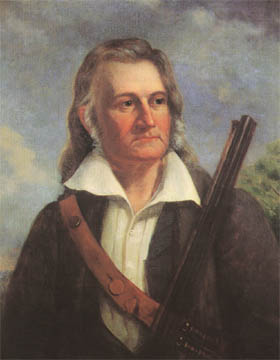
On June 18, 1843, “a beautiful, as well as a prosperous” day, Audubon
took a walk with Mr. Culbertson and Mr. Chardon, to look at some old, decaying, and simply constructed coffins, placed on trees about ten feet above ground, for the purpose of finding out in what manner, and when it would be best for us to take away the skulls, some six or seven in number, all Assiniboin Indians. It was decided that we would do so at dusk, or nearly at dark.
Four days later, during an evening “tramp” across the prairie, Audubon “found an Indian’s skull (an Assiniboin) and put it in my game pouch.” On July 2, Audubon and Mr. Denig celebrated the “cool and pleasant” Sunday by taking a walk
with a bag and instruments, to take off the head of a three-years-dead Indian chief, called the White Cow. Mr. Denig got upon my shoulders and into the branches near the coffin, which stood about ten feet above ground. The coffin was lowered, or rather tumbled, down, and the cover was soon hammered off…. The head still the hair on, but was twisted off in a moment, under jaw and all….
A mutual acquaintance filled Audubon in on the life of his specimen:
He was a good friend to the whites, and knew how to procure many Buffalo robes for them; he was also a famous orator, and never failed to harangue his people on all occasions.
Once the industrious and talented man’s skull was safely in their bag, Audubon and Denig
left all on the ground but the head. Squires, Mr. Denig and young Owen McKenzie went afterwards to try to replace the coffin and contents [minus the head, of course] in the tree, but in vain; the whole affair fell to the ground, and there it lies; but I intend tomorrow to have it covered with earth.
That was a nice gesture. Yeah. Thanks, JJ.
By temperament and training, I’m always willing to step back to consider facts and deeds in the context of their times. Not things like this, though.
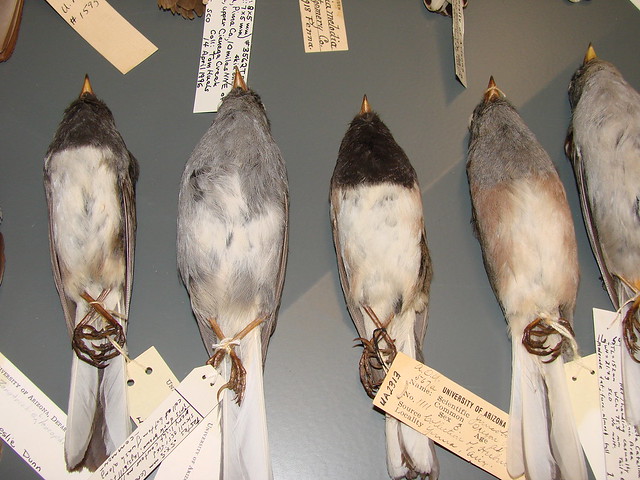
On this first truly hot day of summer, I’m deep in thought about — what else — juncos.
As devilishly tricky as it can be figure out just what kind of junco you have before you, there has historically been little difficulty in distinguishing the juncos from other thick-billed ground-dwellers.
But there are exceptions.
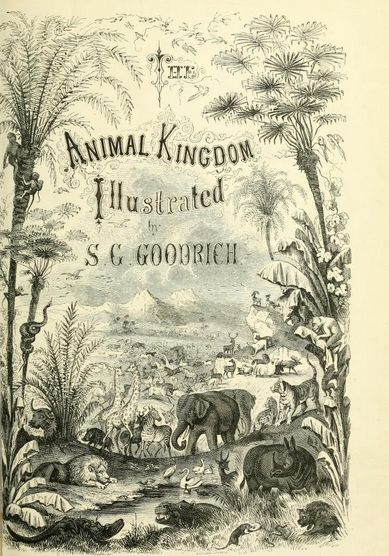
Samuel Griswold Goodrich’s Illustrated Natural History of the Animal Kingdom is remembered today, if at all, almost exclusively for its inclusion of a number of dinosaurs, still a novelty when this encyclopedia was first published in 1859. In its late nineteenth-century day, though, Goodrich’s compilation (republished in 1872 as Johnson’s Natural History) was a standard reference for young people with an interest in zoology, and this was the book that inspired the estimable career of none other than Frank Michler Chapman, whose 150th birthday approaches next week.
Goodrich was nothing if not assiduous as a copier and compiler, and his sources (often credited, sometimes not) include many of the most important naturalists of the eighteenth and nineteenth centuries, from Buffon up to Goodrich’s own day. Every once in a while, though, even Goodrich nods.
For example, when it comes to the juncos.
Somehow, Goodrich conflates three quite different species in his discussion of the genus Struthus. He gives a perfectly recognizable, if concise, description of a slate-colored junco:
color bluish-black; abdomen and lateral tail-feathers white.
But he goes on to apparently synonymize S. hyemalis — the junco — with Plectrophanes nivalis, the snow bunting. The next portion of the description applies to that very different species:
it is a shy, timorous bird, seldom seen except during snow-storms, when it appears in flocks around the houses. At this it presents much diversity of plumage, some being almost white, and others partially white.
The summary of range and habitat also belongs to the snow bunting — at first.
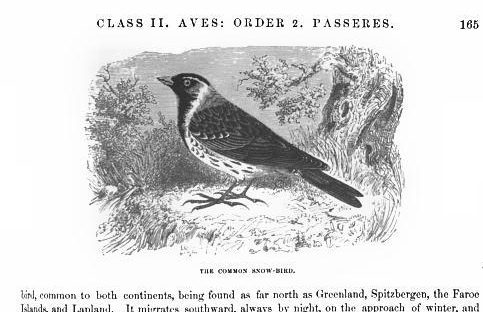
It is a northern bird, common to both continents, being found as far north as Greenland, Spitzbergen, the Faroe Islands, and Lapland. It migrates southward, always by night, on the approach of winter, and some go as far as England and France in Europe, and Virginia in America.
But get this:
Although they mostly breed in high northern regions, still some nests are found in most of the northern Atlantic states,
a statement that can be read as applying only to the slate-colored junco.
All that is confusing enough. But Goodrich goes on, keeping the promise proclaimed in his work’s title, to illustrate this “snow-bird.”
That’s not a junco, and it’s not a snow bunting. It is a common bird, and it is often found in snowy habitats, but I don’t think anyone, even 155 years ago, could really confuse a Lapland longspur with the other species in Goodrich’s jumble.
I doubt very much that the serious readers of the Illustrated Natural History were led significantly astray by this complex garble — which was repeated, words and picture alike, in the second edition. All the same, I’d love to see the young Frank Chapman’s copy of the book. I bet there’s an interesting note scrawled there.
On June 2, 1900, Frank Chapman “startled” his audience at the annual meeting of the New York State Audubon Society. In his lecture, which — still a novelty at the time — was illustrated with photographs, Chapman, cold man of science that he was, pushed as many rhetorical hot buttons as he could, citing, for example,
a shipload of ten tons of the willow grouse wings, the birds killed for the plumage…. [hawks and vultures] were trapped … the feathers pulled out, and then they were let go, but unable to fly.
On a single winter afternoon in Virginia, plumers “destroyed” 1400 gulls, their snowy breasts destined to ornament hats. “Is it fair,” Chapman concluded, “to deprive a beautiful bird of its life to make a hat like that?”
And the women in the audience clapped heartily to show their disapproval of millinery coffins.