

The Experience of Birding

Today marks the centennial of the death of the splendidly bearded and splendidly productive Daniel Giraud Elliot.
A founder and president of the American Ornithologists’ Union, Elliot was also a benefactor of both the American Museum and the Field Museum; he served for a dozen years as curator at the Field, but over most of his long career as collector, author, and explorer, Elliot was — following a long tradition not yet entirely vanished — an enthusiastic and knowledgeable amateur in the most honorable sense of the word.
Elliot’s scientific contributions are probably of only historical interest today. What lingers, though, and what birders still remember him for, are the great illustrated monographs in the European style, with plates by Joseph Wolf and J.G. Keulemans. Nothing can commemorate Elliot more appropriately than a browse through those images, still some of the finest ever produced.
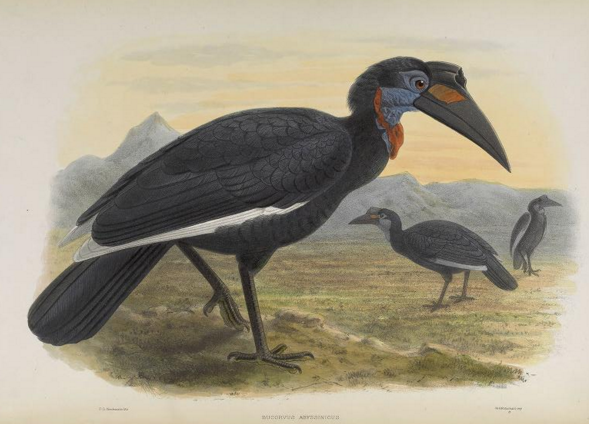
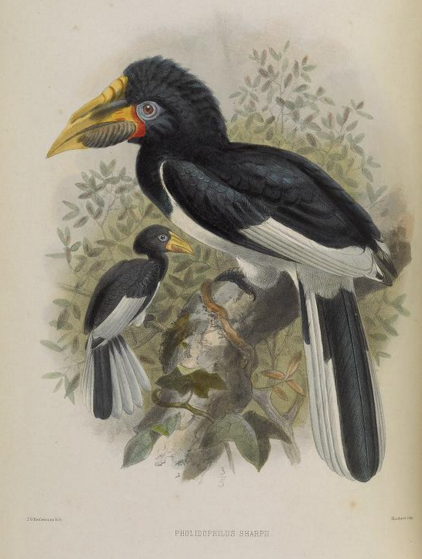
My favorites are the hornbills. Published — like most of his larger projects, at Elliot’s expense — when the author was only 46, the Monograph of the Bucerotidae is as stunning now as it was when it appeared in 1882, and the plates, “the happy results of Mr. Keuleman’s talented pencil,” remain as desirable.
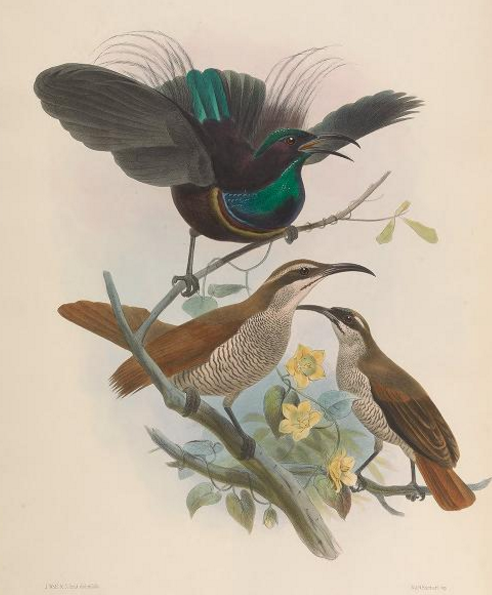
Ten years earlier, Wolf had prepared the plates for Elliot’s birds of paradise. It’s hard to disagree with Elliot’s assessment of his collaborator:
The drawings executed by Mr. Wolf will… receive the admiration of those who see them; for, like all that artist’s productions, they cannot be surpassed, if equalled, at the present time.
It takes a painter of great skill to keep these spectacular birds from looking merely gaudy.
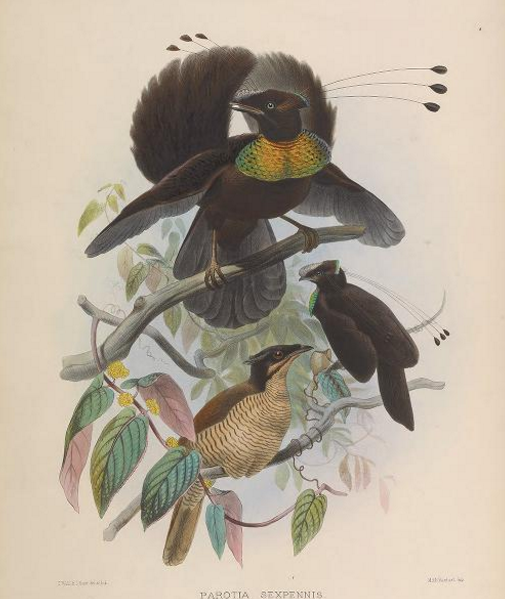
Wolf manages to do just that, though.
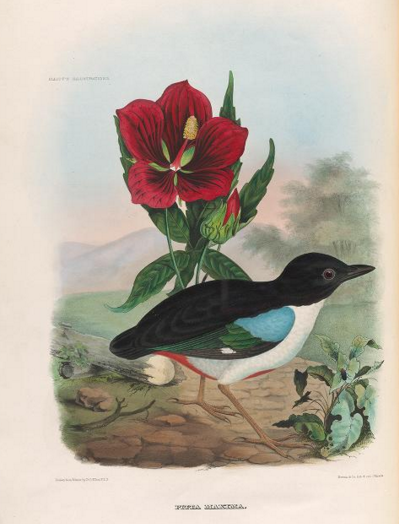
As a very young man in the 1860s, the author painted the birds himself in his monograph of the pittas.
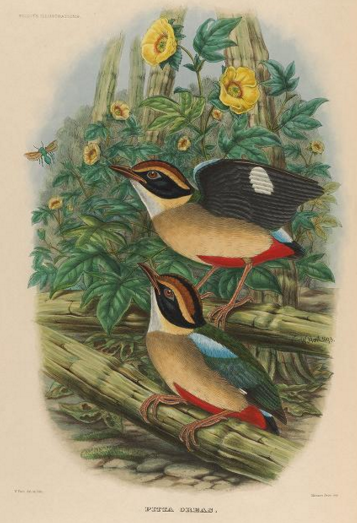
Frank Chapman, with the benefit of hindsight, would later allude a bit dismissively to Elliot’s abilities with the brush, but the pitta plates show him not entirely without talent as an illustrator.
A century is not the long time I once thought it was, and it is both humbling and encouraging to think that Elliot began his career at a time when Baird, Cassin, and Lawrence were the bright lights of American ornithology — and that his own works, now dedicated to mammals rather than to birds, were still appearing in the same twentieth century when we were born.
John Cassin was famously no friend of the practice of naming birds for people. Squabbling gently with his friend and colleague Spencer Baird over the naming of a new vireo, he wrote that
this kind of thing is bad enough at the best, but to name a bird after a person utterly unknown is worse.
There are plenty who agree with him today, and there were plenty who agreed with him in the mid-nineteenth century, when the rage for birdy patronyms was at its height. In 1839, for example, the baron de La Fresnaye expressed his own displeasure at the practice — even as he indulged in it himself. In naming a new American bird for the wife of a Bordeaux collector, La Fresnaye protested that
our sole intention in dedicating this species to Mme Brelay has been to pay tribute to the very special enthusiasm with which she herself has engaged in ornithology and collaborated with M. Brelay in forming his collection, which already includes many thousand individual birds.
But the lady ornithologist was an exception.
We by no means approve of the custom of giving new birds the names of women who are often enough entirely without any interest or expertise in ornithology; though the author of the name may be bound to them in friendship or family relations, these women can be of no interest to the larger circle of naturalists. We believe that the application of a proper name to a bird is in fact acceptable only when it commemorates that of some naturalist, author, explorer, painter, or zealous collector who has already rendered or is in the course of rendering some service to science.
La Fresnaye’s few flattering words are essentially all we know about the Brelays’ ornithological pursuits. Some of their specimens are still preserved in the Museum of Comparative Zoology, and the family historians are at least able to provide Mme Brelay’s dates of birth and death, but I fear that the bigger story was lost while the collections passed from the Brelays to La Fresnaye to the Verreaux brothers to the Boston Society of Natural History to, finally, Harvard.
Oh: the bird. Mme Brelay was immortalized 175 years ago in the species epithet of the rose-throated becard. Not a bad bird to lend one’s name to, not at all.

This American crow was hooting above the din of the tundra swans at Brigantine NWR this past weekend.

Two crows were perched very close to each other, almost touching; only one of them was making the mysterious note, a sweet, full, high-pitched repeated toot.
It went on for nearly ten minutes. Finally the crows took off, one flying out of sight, the other landing at the edge of the parking lot to utter a few honest to goodness caws before joining its companion.
I couldn’t remember ever having heard that sound from a crow, though once I determined its author, it seemed obvious enough.
Never a dull day when there are corvids around.
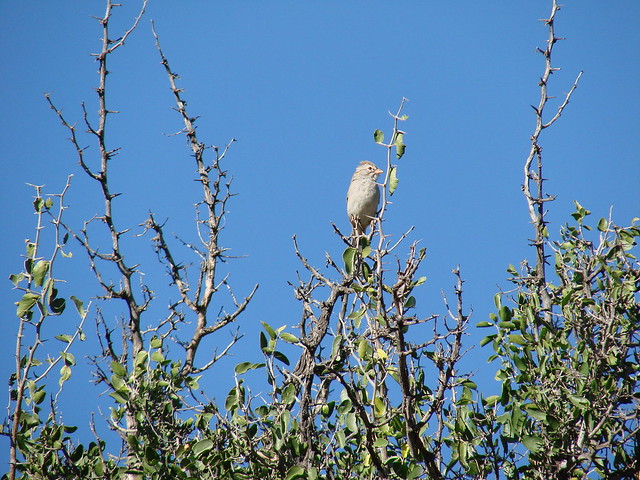
Beneath the streets and sidewalks of downtown Tucson lies the original site of Camp Lowell, which stood for eight years on Sixth Ave. before the malarial influences of the nearby Santa Cruz forced the move north to Pantano Wash. History-minded birders keep a special place in memory for Camp Lowell and its most famous ornithological inhabitant, Major Charles Bendire.
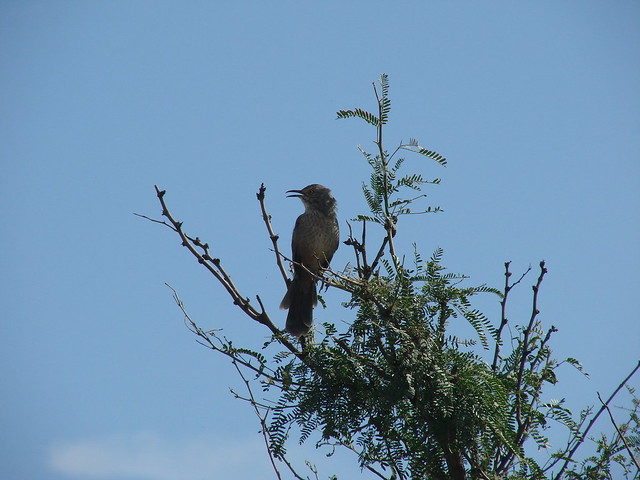 It was during his time here that Bendire collected the first rufous-winged sparrows and Bendire’s thrashers known to science, and it was during his time here that he had his famous adventure at the nest of the zone-tailed hawk.
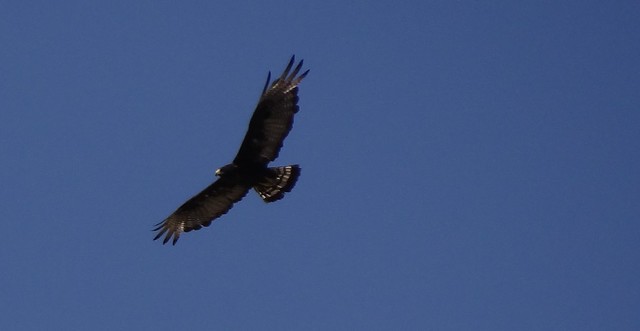
Those were red-letter days all, but what was a more normal birding day like for Bendire? He told us in 1890:
Large flocks [of terrestrial birds] would frequently alight on the open ground about my camp, especially about the picket line where the cavalry horses were tied up at night and fed, and at such times they would allow themselves to be approached rather closely, and it was generally an easy matter to select such specimens as one wanted while they were searching for food.
Far easier nowadays to just fill a pocket with millet.
