Overreacting

I’m not a scientist, and I certainly wouldn’t play one on TV, but as an outsider and a layman, it seems to me that some Ontario birders are rolling over and playing dead for no reason at all.

In November of last year, a suspect oriole was discovered in the eastern part of the province. In the first, rather poor photos I saw — there are now much better ones out there — the bird was gray-bellied and dull-throated, with a clear black eye line. A perfectly reasonable consensus was reached that the bird was a Bullock’s oriole, a nice find indeed but hardly earth-shattering at the season anywhere in the east.

The story continued to unfold in the usual way: the exuberant posts from exuberant birders tallying a lifer, the inevitable accusations of harassment and bad manners on the part of photographers and those armed with audio recordings, the gradual settling down as the bird gradually settled in. And the “rescue.”

The absurdity of “rescuing” vagrant birds in the wintertime is something I’m happy to rant about any time you’re ready, but in this case, holding the bird in captivity provided an opportunity to conduct a little genetic analysis. As it turns out, material gathered from the bird’s droppings included mitochondrial DNA identifiable as that of a Baltimore oriole.

Meaning, of course, that among this bird’s female forebears was a Baltimore oriole.

Now come the retractions, the recantings, the regrets. You can almost hear the check marks being erased from birders’ lists. But why?

There is probably no Bullock’s oriole on the planet that does not have a bit of the Baltimore coursing through its veins. We know this, and we’re happy to ignore it when we identify birds in the field — just as we gladly ignore the fact that the family tree of nearly every mallard on the east coast is studded with black ducks, and that there isn’t a “black” towhee on the great plains that is not the product of repeated miscegenation. It’s biochemically messy out there.

For the past century and a half, we’ve known that there is no such thing as a species. For the past century and a quarter, birding in North America has been intentionally cast as an exercise in identification of species. If we want to keep understanding birding in that way — and many of us do — we have to both acknowledge and insist on the difference between what we do and what the scientists do. Our tools are our eyes and our minds, not blenders and litmus paper.

If I were in Ontario and cared, I’d count it. And I wouldn’t let a little thing like DNA get in my way.

Share

National Hat Day, Of All Things

There are plenty of birds out there with caps and hoods and helmets, but precious few wear a simple straightforward hat.

Brazil’s white-vented violetear is one. Today it is classified once again in the humdrum genus Colibri, but for a while in the nineteenth century, it enjoyed the pleasing and mellifluous genus name Petasophora, the “hat wearer.”

Hector Bottai, wikimedia commons

Honestly, though: If you’d had that bird lying on your desk, would the crown have been the plumage character you’d have chosen to commemorate in the name?

Share

Malheur and the Plumers

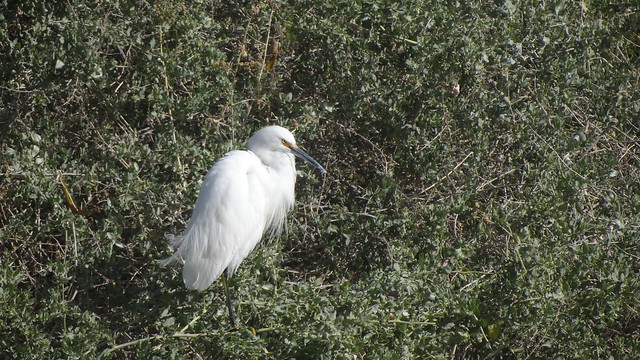
Snowy Egret

The print and online media, running out of things to say about this absurd “occupation,” have turned over the past few days to casting the confrontation as one between kooks and birders, an approach that may add a little bit of human interest but at the same time trivializes the matter: the struggle is one between armed insurrectionists and the principles of this country, not between one vaguely picturesque group of citizens and another. I for one will be happy to start reading essays and articles that frame the matter in those terms, rather than puff pieces worrying about Oregon birders’ year lists.

Meanwhile, the constant repetition of the same story of the refuge’s founding has started me wondering: was Malheur really created to protect the white herons of the desert marshes?

Kind of. Even in the late 1890s, plumers were shooting snowy egrets on Lake Malheur in horrific numbers; some claimed to have earned $500 a day from the feathers they stripped from the bird’s backs — and that in the long-ago time when a dollar was a dollar.

By 1908, though, when Roosevelt established the first wildlife reservations at Malheur, no one was shooting egrets, for their plumage or for any other reason: the birds were gone, nearly or entirely extinct in southeast Oregon. George Sizemore and Charles Fitzgerald, the first wardens appointed, were concerned instead with the water birds that persisted in the area: ducks and swans, shot “merely for the feathers, which are sold at so much per pound.”

And grebes.

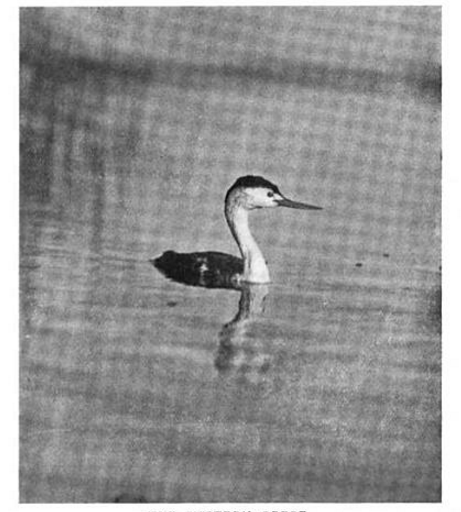
Clark's grebe

It’s been virtually obliterated from birderly memory, but the plumers of the west probably wrought more havoc on western and Clark’s grebes than on any heron species. The first indictments filed against feather poachers in Burns, Oregon, cited the killing of hundreds of grebes, with one hunter responsible for a full thousand birds; one shipment, seized at the post office, contained eight hundred skins, destined for New York City to be turned into fancy capes, collars, and muffs.

Those days are over. But I can’t help thinking it’s even worse now: a hundred-odd years ago, they were stealing the resources of the land. Today, it’s the land itself.


Share

Lonely at the Top

DSC08775

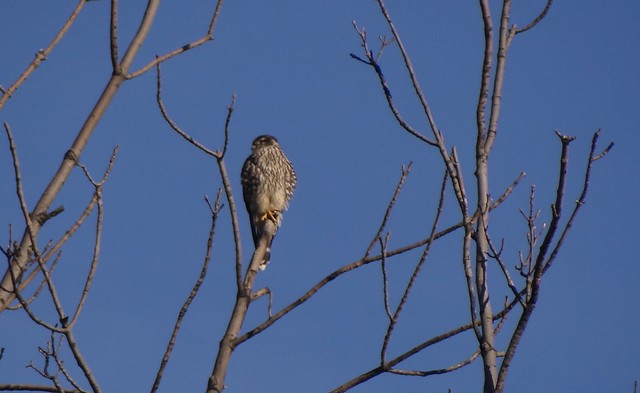
These trees at the edge of Brookdale Park‘s sparrow patch are usually filled with European starlings. These past few mornings now, however, there’s been just one lonesome bird perched high in the bare twigs.

merlin

She must have offended the others somehow.

Share