Longspurs in the Books

lapland longspur

I’ve been having a great time this evening reading around in the new National Geographic guide: learning new things, being reminded of old things, and all in all admiring the book more with each turn of the page.

But how does it stack up against the competition?

That competition includes the previous editions of Nat Geo, of course; I hear scandalous rumors that not everyone buys each new edition as it appears. You’ll continue to be happy no matter which edition you have and use, but this seventh has so many improvements, large and small, that I can’t imagine not wanting to move along.

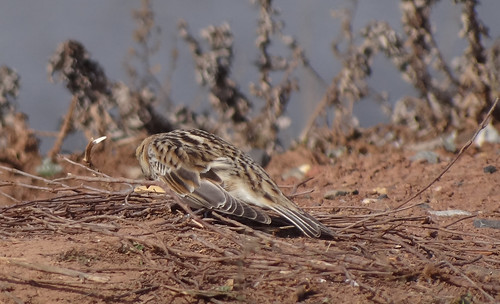
Take, for example, the Lapland longspur, a common bird and familiar to most birders, but one that can be hard to get a first handle on for new observers, especially in the east and southwest. The new Nat Geo retains the paintings of the species from the first edition, of 1983, but like the sixth, it annotates the figures with neat and concise summaries of the most important field characters. There is one critical difference, though: where the sixth edition simply points to the wingtip of one of the perched birds, noting the “very long primary projection,” the seventh adds an additional image of a disembodied folded wing, indicating that this is the “longspur with the longest primary projection past the tertials.” Each of the other longspur species now has a similar picture and a similar note, making explicit in word and image what before was available only in the facing-page text. 

Shifting that information from the main text onto the plate (and ever so slightly reducing the white space on the page) makes room for a slightly larger and noticeably more legible font, and also lets the authors add a line about the subspecific affiliation of a specimen collected in the outer Aleutians. Trivial? Not if you happen to be so lucky as to be birding Attu — and not if you are interested, as all birders are, in continuously expanding the range of your knowledge.

 The big Sibley guide has only four images of perched Laplands where the new Nat Geo has six, including a stub-tailed juvenile. But Sibley gives the reader four views of birds in flight, from above and below, which after all is how most longspurs are seen in the field. There is a picture of the folded wing here, too, with an annotation pointing out the length of the primary projection. Sibley’s feathers are more realistically shaped and the bunching of the outermost primaries more accurately depicted, but the whole wingtip is too short; the actual length is presented much more clearly in Nat Geo. Ten of one, five sixths of a dozen of the other. 

Both books show all the characters necessary for field identification, but only Nat Geo explicitly points out the usefulness of the warm brown or rusty nape. Nat Geo illustrates and briefly describes the juvenile, an age class not mentioned in Sibley. The Sibley guide offers a much richer description of the species’ song, but leaves unmentioned the fact that this longspur intersperses whistles in its rattled flight call — a characteristic noted in Nat Geo as “distinctive.” Nat Geo’s map includes the bird’s range in Greenland, and its statement of range and abundance, though equally brief, is more differentiated than that in Sibley. All in all, there is a bit more information in Nat Geo, though Sibley’s illustrations of the bird strike me as rather better in this case. 

The true acid test is a comparison with a book many birders might not think of at first. Birds of Europe by Lars Svensson, Killian Mullarney, and Dan Zetterström is widely acclaimed as the very best field guide to any avifauna anywhere in the world, and it is always worth consulting to learn more about any species that occurs in both the Old and the New Worlds. Its influence on North American field guides is most obvious in the use of annotations directly on the plates, an innovation meanwhile adopted by both the Sibley guide and, beginning with the sixth edition, Nat Geo. 

Svensson et al. crowd illustrations of three species onto their plate, while both Sibley and Nat Geo have only two. But the European guide manages to show eight individuals, including three birds in habitat, one in flight, and one facing away; there is also a skylark for comparison. Four different plumage aspects are shown: a first-cycle bird, an adult female, and three adult males at different seasons. There is no juvenile, though the species breeds in Iceland, Scandinavia, and western Russia, and has nested in northern Britain. 

The text here is remarkably long and detailed; naturally, that means that the type is quite small, tiny even when the book is open next to Nat Geo, but legible nonetheless. It begins with a coded summary of the species’ abundance and seasonal distribution in Britain, a neat feature impractical or impossible in a guide covering much of North America. Birds of Europe continues with a description of the breeding habitats, going beyond Nat Geo’s “arctic tundra” to mention some of the plant species with which nesting birds are associated. Alone among the guides compared here, this one warns the reader that the species is “rather wary,” creeping away or freezing when approached, then towering in powerful flight. These are essential details hinted at, but not completely laid out, in Nat Geo’s introduction to the family Calcariidae. 

The identification paragraphs (plural!) in Birds of Europe are very thorough; salient characters distinguishing the species from other buntings are printed in italics. Structure, soft part colors, and the precise breast pattern of males in winter are all described. Calls and songs are described in even more detail than in the Sibley guide, and this is the only guide to describe the song flight, performed “with fanned tail and intermittent hovering.” 

If Svensson et al. happened to cover the birds of North America, the choice would be clear. As it stands, though, for most birders, the choice between Nat Geo and the big Sibley will come down to taste and habit. The chief exception: beginners, who will be served much better by the more extensive prose and more complete information in the new Nat Geo. Every birder, however, will want to read this new edition and incorporate what it says into her store of birding lore.       

Share

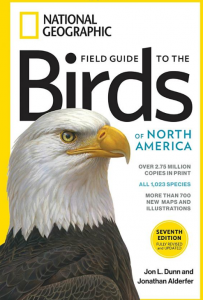
The National Geographic Guide, Seventh Edition

Screenshot 2017-09-09 13.53.17

Yes, the seventh. Nearly half the US population is younger than this canonical guide, which first appeared to great and justified acclaim in 1983. Thanks to conscientious updating by one of the finest birders in the world, each succeeding edition has been even better than the one before, with revised texts, repainted figures, and almost always a number of entirely new species accounts and illustrations.

This seventh edition carries on that estimable tradition of constant improvement, treating more than 1000 species from North America north of Mexico. Several accidentals previously relegated to the back of the book have been moved into the main text, and a brief appendix lists additional species from Greenland and Bermuda, preserving Nat Geo’s claim to be the most complete field guide ever produced to the birds of our region. Hawaii’s small but highly distinctive land bird fauna is not included.

Such comprehensiveness comes inevitably at the cost of portability, and the new edition, coming in at nearly 600 glossy pages, may prove uncomfortable for beginners hoping to pocket it in the field. Brick-like as it is, though, Nat Geo is still lighter than the big Sibley guide, and hardly heavier than the smaller regional Sibley volumes. At the same time, the illustrations here average almost twenty percent larger than those in any version of Sibley.

The illustrations remain one of the minor weaknesses of this guide. Many of the thousands of individual figures–Killian Mullarney’s and Jonathan Alderfer’s shorebirds, John Schmitt’s swallows, Thomas R. Schultz’s meadowlarks, and others–truly are among the best ever painted for a field guide, while others nearly approach the other end of the spectrum (everyone has her own anti-favorites here, but surely the sage thrashers and the vesper sparrow are high, or low, on most lists). it is not the variations in quality, however, that jar, but the discrepancy in styles: with almost two dozen artists responsible for the paintings in this edition, it can be a jolt to turn the page, or even to glance from one bird on the plate to another. Peter Burke’s highly (and attractively) stylized Basileuterus warblers, for example, contrast unpleasantly with Schultz’s more conventionally realistic palm warblers. Happily, ever more stylistic consistency has been imposed with each succeeding edition of Nat Geo, but there is still some distance to go before we can leaf through the guide without the occasional visual hiccough bringing us up short.

The new edition includes 330 entirely new figures, and several others, such as the common scoter, have been subtly touched up to correct or emphasize a useful field character. The ground-doves, for instance, are significantly improved, with informative insets showing the diagnostic pattern of the wing coverts; the flying individuals are now seen from below, a much more revealing view. The older images of hummingbird wing and tail structures have been replaced with new and clearer drawings. The white-breasted nuthatches are all new; they are perhaps less decorative than their predecessors in other editions, but this is now the best treatment of what are probably the three distinct species in the complex. Not all of the new plates are quite as successful. The Aztec thrushes are oddly stretched and starling-like, and the adult female is missing her tail and much of her foot. The new magnolia warblers, blurry in my review copy, do not seem to be painted to exactly the same scale as the other figures on the plate.

The layout of the text and illustrations is familiar and user-friendly, with plates facing the text and maps. As in the sixth edition, the plates are heavily annotated with descriptions of field marks and behavioral characters, a helpful feature shared with the Sibley volumes and, of course, the trend-setting European guide published in this country by Princeton University Press. The facing-page texts offer further identification strategies, voice descriptions, and a statement of range and abundance; in the case of rarities and vagrants, the distribution summaries can be remarkably thorough and precise. The font for these section appears to be very subtly different from that used in the immediately preceding edition, and all the text is dark and eminently legible. Paul Lehman’s maps are, as expected, accurate, precise, and up to date. Many have been redrawn for this edition; that showing the seasonal movements of the Hawaiian petrel is surely among the most remarkable in any field guide.

One of the great strengths of this guide from its very first publication has been its emphasis on geographic variation. Field-identifiable subspecies and subspecies groups are clearly labeled and treated in often impressive detail; of special interest to listers, predictions are offered about taxonomic “lumps” and “splits” to come (some of which have in fact been carried through since the manuscript was completed). In addition to plumage characters, Dunn and Alderfer conscientiously point out the vocal differences among populations, reminding birders to listen critically not just to red crossbills but to warbling vireos, evening grosbeaks, and blue-gray gnatcatchers across their ranges.

To their great credit, the authors of this guide have always aligned its taxonomy as closely as possible with the official checklist of the American Ornithologists’ Union, now the American Ornithological Society. The new edition adheres to the nomenclature set forth in the 2016 Supplement to that list, which instituted several quite significant changes, particularly to the sequence of orders and families: the pigeons and hummingbirds moved far forward in the list, the pelicans and herons towards the center, the hawks and owls to adjacent positions. There will inevitably be weeping and gnashing of teeth, but as Dunn and Alderfer correctly point out, updating the sequence in the field guide offers readers a more accurate insight into the relationships and evolutionary histories of the birds we watch; it also honors the historical link between birding and scientific ornithology.

Learning a new sequence–in effect, learning to find the bird in the book without wasting time thumbing through the index–is not all that difficult, and it keeps the mind limber and alert to unsuspected differences and similarities. It has long been my suspicion that just where a bird is in the field guide has an immediate effect on the species’ identifiability: birders of my generation are still more likely to mix up warblers and vireos than are those who came of birding age after the families were split up in the books, and I’m sure that generations to come, used to the wide separation between the hawks and the falcons, will look back with puzzled amusement on the still commonplace misidentification of sharp-shinned hawks as merlins.

It is a sign of how rapidly ornithological taxonomy is changing (and, one assumes, progressing) that the classification and sequence used in this brand-new edition are already out of date. The New World sparrows here still share a family with the Old World buntings, and the yellow-breasted chat and western spindalis occupy the positions they held before the AOS published its 2017 supplement in July. That same supplement altered the position of several passerine families, leaving the wrentit, the bulbuls, the whydahs, the wood-warblers, the spindalides, the yellow-breasted chat, the icterids, and the true tanagers out of taxonomic place in the field guide. Obviously, the authors were aware that such changes might be on the way as they completed their manuscript, and they are at pains to inform the reader of such anticipated innovations as the “lump” of the Iceland gulls and the “split” of the Cassia crossbill.

Nat Geo is as much intended for beginning birders as for the more experienced, and the concise introduction serves as a quick primer to birding and bird identification. Some of the terminology strikes me as old-fashioned: the unnecessary spelling “juvenal” is still used for the plumage worn by juvenile birds, and the markings on the lower portions of the bird’s “face” are still styled the “moustachial,” “submoustachial,” and “malar” stripes rather than the more straightforward and more readily memorable “whisker,” “jaw stripe,” and “lateral throat stripe.” Ages and plumages are designated using the life-year system, though in at least one case–the rock sandpiper–a plumage is referred to as “basic,” a borrowing from the now more familiar modified Humphrey-Parks nomenclature that is not defined or explained anywhere in the book.

Like every one before it, the seventh edition of Nat Geo is a handsome and sturdy book. Thumb tabs mark the larger families to help readers orient themselves in the book block. There are extremely few typographical errors, though it is unfortunate that three of them occur on the very first page of the text; the only misspelling I have encountered in the scientific names is “sinesciurus” instead of the correct original spelling “sinesciuris” for the Cassia crossbill. The prose of the species accounts and in the introduction is almost always clear and accurate; it is not true, though, that the third word in the scientific name of a subspecies is called a “trinomial.”

In their introduction, Dunn and Alderfer urge us, in italics, to remember that the most important thing is to “look at the actual bird” and to save reading the bird book for later. That’s good advice. But this latest edition of an eminent classic is so good that soon enough it won’t be read at all: it will be quoted, referred to, even recited by birders, young and old, who have committed its wisdom to heart and put its information to use every day in the field.

Share

The Moral Bobolink

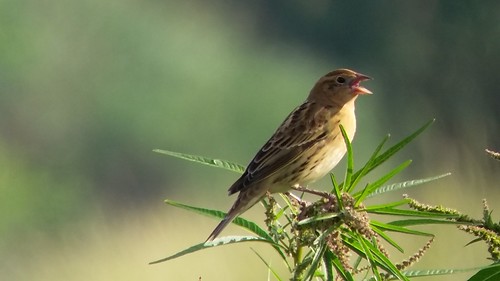
bobolink

Bobolink” is a fine example of that rare thing in English-language ornithology: a genuine, honest-to-goodness folk name that managed to make its way into the bird books. Along the way, those three syllables have conquered “reed bird,” “rice bird,” “maize thief,” “conquedle,” “whiskodink,” “winterseble,” and who knows how many other alternative names, naive and sentimental, accrued over the centuries.

Surprisingly enough, the earliest written attestation of “bobolink” I’ve encountered is not found in a natural history context at all, but rather in a petulant diary entry composed by John Adams during an early session of the Continental Congress. In October 1774, the future president complained that he found that body’s “consultations very tedious,” and singled out for special criticism one of the South Carolina delegates:

Young Ned Rutledge is a perfect Bob o’ Lincoln—a Swallow—a Sparrow—a Peacock—excessively vain, excessively weak, and excessively variable and unsteady—jejune, inane, and puerile.

Edward Rutledge, racist, slaveholder, and ditherer in the matter of independence, was no prize. But what did the poor bobolink ever do to be cast into such bad company?

It turns out that early America saw in the bobolink more than just another pretty feathered face. For at least some observers, the bird’s habits and plumages provided an allegory of human life—an allegory most decidedly in malam partem.

Washington Irving preserves the clearest view into this sinister reading of what seems to us a harmless and attractive bird. In Knickerbocker’s History, Irving makes an offhand mention of “the luxurious little bobolink,” a phrase that seems innocuous, even complimentary, until we remember that “luxurious” retained well into the nineteenth century the meaning of “given to self-indulgence.” That is no praise.

And neither is Irving’s description of the bird as a “little feathered voluptuary.” As a boy, Irving writes, he admired and envied the bobolink for its freedom:

No lessons, no tasks, no hateful school; nothing but holiday, frolic, green fields, and fine weather.

But watching the bird over the years, Irving discovered that

he gradually gives up his elegant tastes and habits, doffs his poetical and professional suit of black, assumes a russet or rather dusty garb, and enters into the gross enjoyments of common, vulgar birds. He becomes a bon vivant, a mere gourmand, thinking of nothing but good cheer, and gormandizing on the seeds of the long grasses on which he lately swung…. He grows corpulent with good feeding…. Last stage of his career, we hear of him spitted by dozens, and served up on the table of the gourmand, the most vaunted of southern dainties.

Just in case the message is not clear, Irving lays out a moral, “worthy the attention of all little birds and little boys,”

warning them to keep to those refined and intellectual pursuits, which raised him to so high a pitch of popularity, during the early part of his career; and to eschew all tendency to that gross and dissipated indulgence, which brought this mistaken little bird to an untimely end.

Irving’s nephew Pierre, commenting on his famous uncle’s work, was even more blunt: the bobolink, like the voluptuous scholar, “degenerates into a fat epicure,” and richly deserves his fate when he “is shot for the table.”

William Cullen Bryant’s famous spinking, spanking bobolink takes on a somewhat darker significance if we read that poem against this background. Robert o’Lincoln is a braggart, the very prince of braggarts, who “frolics about” while his pious wife patiently incubates their eggs.

Family life, he fears, “is likely to be/ hard for a gay young fellow like me.” When the “six wide mouths” appear, he grows “sober with work and silent with care.” He sets aside his fine plumage and his taste for “fun and frolic,” transforming into a “humdrum crone” before flying off for the winter.

For Bryant, as for Irving, the bobolink stands for the singer — the poet — who abandons his true calling for something less, something merely worldly, molting out of his wedding-suited bravado into fatal concern with the luxuries of the flesh. “Come back again,” Bryant’s lyrical voice cries, “when you can pipe that merry old strain,” when the bird can set aside once more what Irving called the gross enjoyments of everyday life.

Today, the bobolink no longer carries its burden of moral signification. We read — or we once read, I suppose — Bryant’s poem as merely an imagined conversation with a cute bird in a field. But a century and a half ago, this species meant something to Americans and the literary lights of the day.

bobolink

Share

In Eclipse

8477021127_19f3bc6867_z

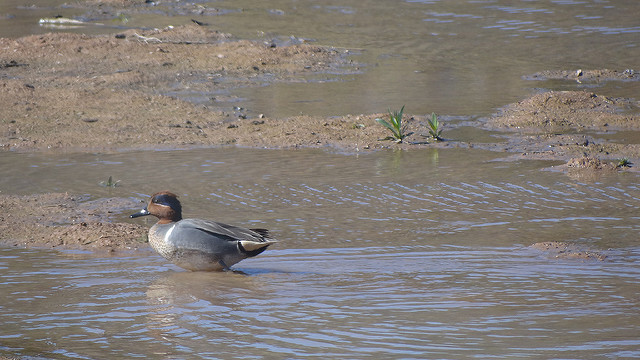
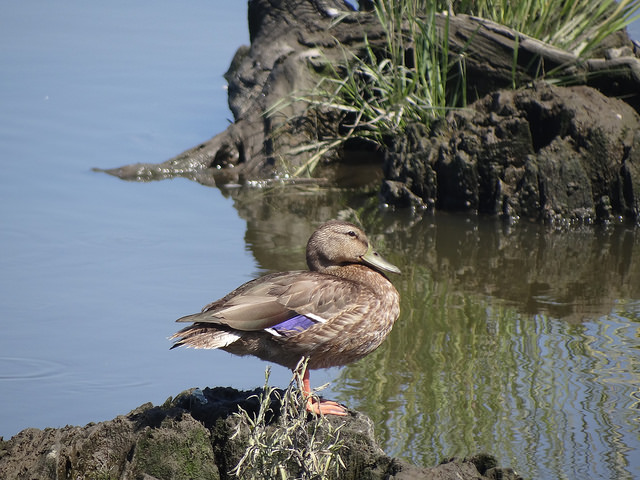
Few birds are as strikingly beautiful as male puddle ducks in winter.

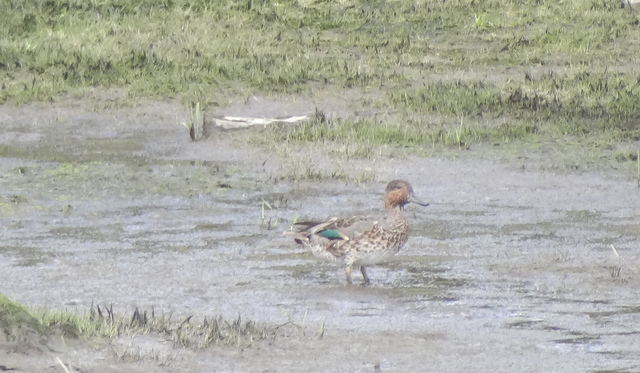
And few are as scraggly as those same male puddle ducks in summer.

27628523193_08f641501c_z (1)

That duller summer aspect — whether you believe that it is an alternate plumage or a chronologically displaced basic plumage — has long been called “eclipse” plumage. And surprisingly enough, we know who came up with what is now the familiar term for this “dingy garb.”

Screen Shot 2017-08-21 at 10.39.36 AM

Charles Waterton certainly deserves his reputation for eccentricity. Remembered today almost exclusively for his absurdly acrimonious feud with Audubon and his slightly creepy whimsies — tall tales of saddling crocodiles, taxidermic hoaxes, that sort of thing — Waterton was also a serious scientist and a truly undaunted explorer.

One of the questions that attracted Waterton’s scientific interest was the “very remarkable change of plumage” undergone by male ducks at the end of the breeding season.

All speculation on the part of the ornithologist is utterly confounded [by] the strange phenomenon…. [that] the drake, for a very short period of the year, should be so completely clothed in the raiment of the female that it requires a keen and penetrating eye to distinguish the one from the other.

Waterton refused to be confounded. Capturing two wild mallard drakes, he observed their plumage every day from mid-May to mid-October. To his satisfaction, he discovered that it was the dropping and regrowing of plumage — molt — rather than any simple alteration in the color of the feathers that was behind the odd fact that

once every year, for a very short period, the drake goes, as it were, into an eclipse [of] that plumage which, at all other seasons of the year, is so remarkably splendid and diversified.

20573621293_f29648a1a5_z
It took a while for Waterton’s felicitous coinage to catch on. Once praised by Alfred Newton in his great Dictionary, though, the term immediately became the standard, and we use it today without even pausing to think that someone, sometime, had to invent it.


Share

A Wren in the Sun

cactus wren sunning, Sonora

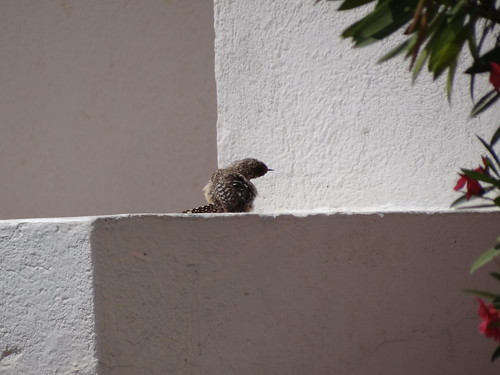
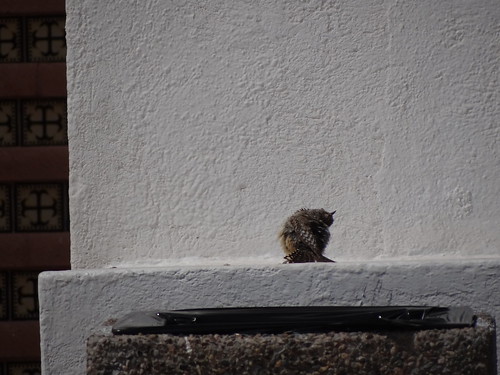
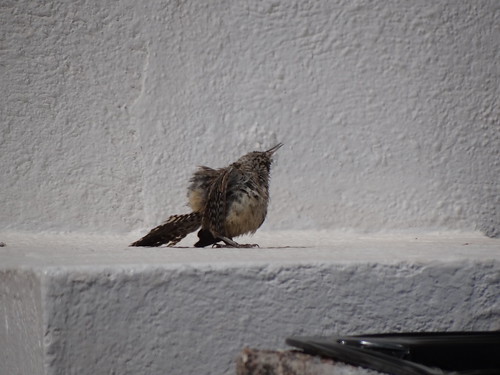
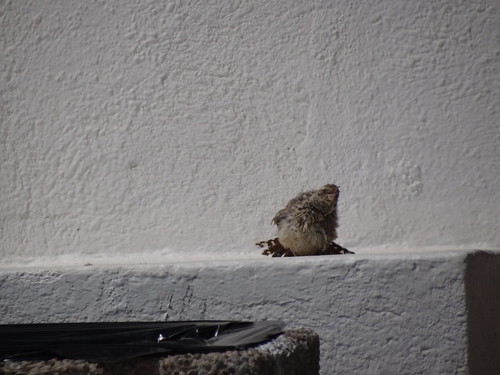
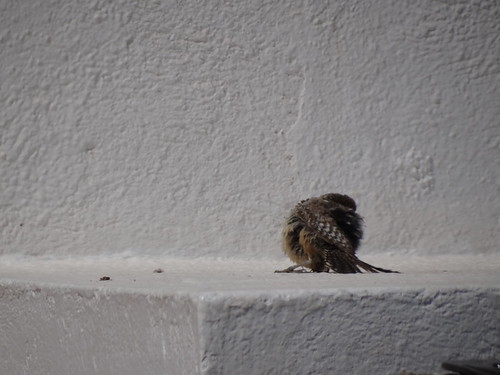
You’d think that cactus wrens would get plenty of sun just living where they do, but this one in Bahía de Kino the other day made a special effort to expose itself, writhing into postures startlingly reptilian even for this so saurian species.

cactus wren sunning, Sonora

It turns out, says BNA, that sunbathing in this desert wren is rarely observed and little understood.

cactus wren sunning, Sonora

I suspect that this bird’s contortions, which went on for a full five minutes while I watched in the mid-day heat, had something to do with the ragged state of its plumage, in turn likely the result of an ill-timed and itchy infestation of something or other during the pre-basic molt.

cactus wren sunning, Sonora

I’m eager to hear if you’ve seen this behavior. I’ve spent a lot of time watching cactus wrens, and can’t remember having witnessed anything quite this extravagant before myself.

cactus wren sunning, Sonora

Share