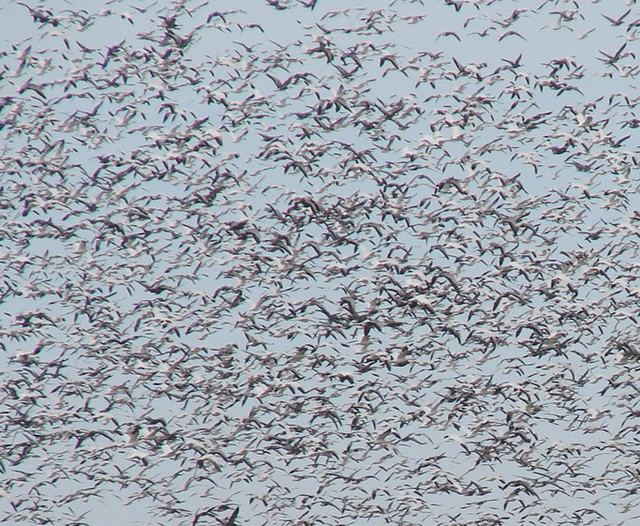
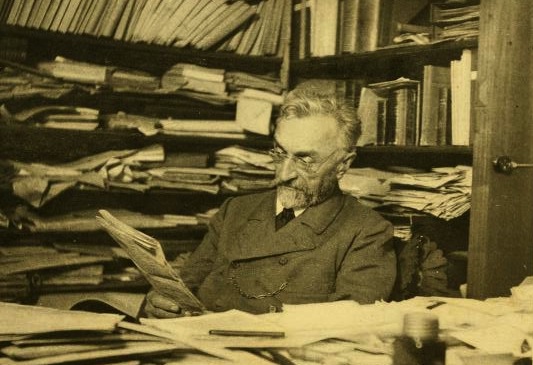
Who came up with the crazy idea — Kaufman rightly calls it “mostly imaginary” — of highways in the sky?
It turns out that the concept is significantly older than I had assumed. In 1876, sixty years before Lincoln’s Waterfowl Flyways of North America, the Finnish scientist Johan Axel Palmén published his Zugstrassen der Vögel, in which he described nine flyways — “migratory roads” — purportedly kept to by the birds of Eurasia as they moved each year between the breeding grounds and their winter homes.
The response came in 1881, in E.F. von Homeyer’s Wanderungen der Vögel.Homeyer pulled no punches, accusing his Finnish colleague of everything from harboring fixed ideas to plagiarizing his sources. He concludes that
obviously, Palmén’s conclusions are as false as his putative facts…. indulges in such vague theorizing, entirely without any basis in evidence, that we see no reason to follow him into the field of unmotivated speculation.
migratory birds merely [follow] a definite direction and … the members of a given species pass through Europe on a broad front…. the “flyways” of Palmén were the result of birds being forced together into narrow flight lines in mountain passes or other topographic features.
A hundred thirty-two years later, I think that’s how most birders think about migration — and how we think about migration hotspots. But as Kenn Kaufman points out, the idea of the flyway has enjoyed lasting popularity among non-birders and game managers, almost none of whom, I’d guess, know quite how old it is.
The meeting appears not to have been an altogether happy one, and they parted none too amicably after a warm dispute as to who [had] discovered Falco harrisii.
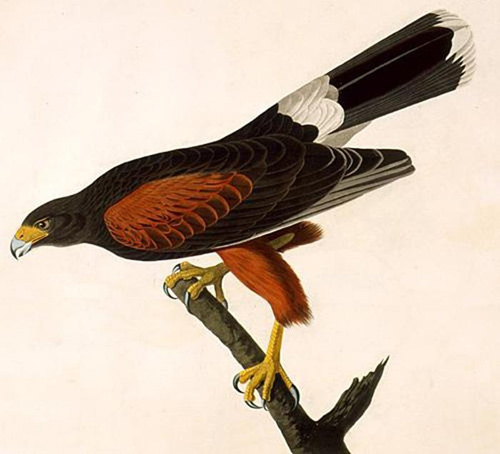
Audubon had done it again. Eight years before the meeting with Cassin, he had received the skin of a female hawk from Louisiana unlike anything he had seen before. He gave it the English name “Louisiana Hawk,” and in its scientific name commemorated his generous patron, sometime traveling companion, and constant
friend Edward Harris, Esq., a gentleman who, independently of the aid which he has on many occasions afforded me, in prosecuting my examination of our birds, merits this compliment as an enthusiastic Ornithologist.
Harris, the sesquicentennial of whose early death we commemorate this year, was in the room that afternoon in Philadelphia, and it must have been uncomfortable for him when Cassin pointed out that “his” hawk had never been Audubon’s to name: Temminck had already published the species a dozen years earlier, based on an immature specimen from Brazil collected by the great explorer and botanist Auguste de St-Hilaire and donated to the Museum of Natural History in Paris.
Temminck called the bird Falco unicinctus, the “hawk with a single band,” not a bad name and not a bad description. In addition to a very full description of the species’ plumage, he noted, for the first time, that in its structure this raptor falls somehow “in between” what we now know as the buteos and the accipiters:
In its general aspect it rather resembles a buzzard or even a harrier. Its wings, though pointed, are not as long as those of the buzzards; the way in which the flight feathers are arranged is precisely the same as in the European bird hawks, but it creates a profile that is more elongated and pointed. The curved edges of the bill place it nearer our bird-hawks than our buzzards. This species serves to remind us of the numerous subtly intermediate features that link our European raptor groups.
Audubon must have known Temminck’s description and the accompanying plate (Cassin most certainly did). But to give the American Woodsman the benefit of a slight doubt, he probably assumed that a species found “au Brésil” could hardly be expected to occur in the swamps lying “between Bayou Sara and Natchez.”
Audubon’s proclamation of his sp. nov. in the Ornithological Biography is as terse as Temminck’s was detailed.
A label attached to one of its legs authorizes me to say that it was a female; but I have received no information respecting its habits; nor can I at present give you the name of the donor….
The only real “ornithological” information he can provide is an assignment
to the group of what may be called indolent or heavy-flying hawks.
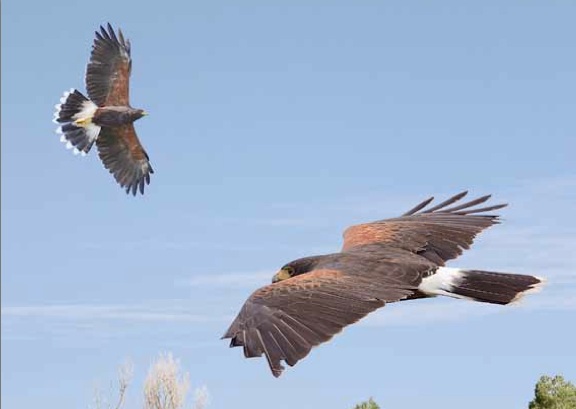
Anyone who has spent any time around Harris’s Hawks will be surprised by Audubon’s terminology here. The birds are often tame, hanging out in desert backyards and perching on urban lampposts, but they are “impressive sprinters as well, accelerating quickly at the first sign of prey.”
It turns out that Audubon’s class of “heavy-flying hawks” is a category nearly congruent with the modern birder’s notion of the “buteo.” In addition to the Harris’s (since 1874 in the genus Parabuteo), Audubon’s group includes the Golden Eagle (in the great eagle genus Aquila), the Red-tailed Hawk, the Harlan’s Hawk, the Broad-winged Hawk, the Red-shouldered Hawk, the Common Buzzard, and the Rough-legged Hawk. This is a “natural” grouping based on wing shape and flight habit: all these birds
can, indeed, soar to a very great height, but this [they] accomplish by a circling or gyratory flight,
precisely the behavior that birders today use to narrow the possibilities when they see a large raptor.
But Audubon also had a moral judgment in mind. He calls the flight of these birds “slovenly,” and all of them, he says, are to be considered
more or less indolent; one might say that they are destitute of the power of distinguishing themselves in any remarkable manner, and none of them shew a propensity to remove any great distance from the place of their birth, unless, indeed, when very hard pressed either by want of food or by very intense cold.
A positivist reader might find here a description ex negativo of Audubon’s own career and accomplishments, which echo in his description a few pages on of the “True Falcons“:
they appear to delight in following the myriads of the feathered tribes from which they have derived their subsistence.
Absent any more information about the Harris’s Hawk‘s lifestyle, Audubon’s use of the word “indolent” to describe this species created a veritable topos in nineteenth-century American ornithology.
Henry Eeles Dresser, in Texas in 1865, described the present species as “heavy” and “sluggish”; that latter adjective would become the species’ signature in Elliott Coues’s great Key, first published in 1872 and running through five editions before 1903. James C. Merrill, working in Texas a dozen years after Dresser, compared the birds’ behavior unfavorably to that of Crested Caracaras, calling them “not so active” as even those leisurely scavengers. Even Charles Bendire, whose extensive ornithologizing in Arizona should have taught him dramatically otherwise, found this species “a lazy sluggish bird, their flight slow, and not graceful.”
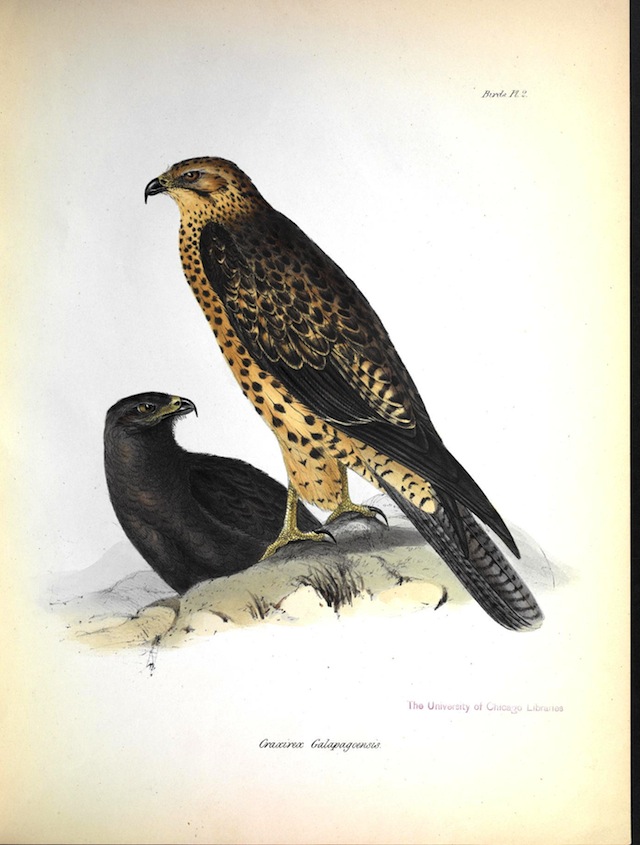
Ironically, it was John Cassin himself who in 1858 added another layer to the Audubonian cliché of the “indolent” raptor. In the ornithological volume summarizing the results of the 1853-56 Pacific Railroad surveys, Cassin and Baird moved Temminck’s Falco unicinctus into John Gould’s (“gratingly” and “inelegantly” named) genus Craxirex, which the British ornithologist had erected in 1841 to accommodate a new hawk discovered during the Beagle‘s explorations of the Galapagos.
In fact, Cassin and his co-authors went so far as to suggest that Temminck’s (and Audubon’s) hawk might even be conspecific with Gould’s, which he had described as
a most interesting link in the chain of affinities, by which the true buzzards pass into the great American sub-family of carrion-feeding hawks,
a characterization closely recalling Temminck’s mention of the “nombreuses nuances intermédiaires.” And unlike Temminck and Audubon, Gould was also able to communicate something of the Galapagos hawk’s habits:
These birds will eat all kinds of offal thrown from the houses.
That was all it took. On no other basis, it seems, than Gould’s description of a bird that might or might not be the same as the one found in the US, Baird and Cassin simply transfered the account of the Galapagos bird’s prandial preferences onto the Harris’s Hawk, which, they write, is not only “dull and heavy,” but “subsists for the greater part on dead animals.” Audubons’ picture of indolence was complete, and the notion of the lazy scavenger was entrenched. In the first edition of the Key, Coues said that the Harris’s Hawk “approached” the caracaras in its habits, an observation expanded on explicitly in the final, posthumous edition of the work, where it is described as “a sluggish, carrion-feeding bird” — and where the genus Parabuteo is called “Carrion Buzzards.”
The notion that the Harris’s Hawk was identical to Gould’s Galapagos bird would be definitively rejected by Robert Ridgway in 1874, but the damage was done. Dresser described the birds he encountered in Texas as “heavy” and “sluggish… subsisting, so far as I could see, entirely on carrion… regaling themselves on some offensive carrion.” Charles C. Nutting reported from Costa Rica in 1882 that this “abundant” species
“associates with the Carrion Crow [=Black Vulture], and eats offal.” A.K. Fisher, the patron saint of economic ornithology, reassured the American farmer in 1893 that this species “does very little damage to poultry or beneficial birds,” as its food “consists largely of offal, the smaller reptiles and mammals, and occasionally birds.” (Refreshingly, Fisher also defended the Harris’s Hawk against the usual charge of lethargy, noting that many observers had mistaken its habitual fearlessness for stolidity.) Even Salvin and Godman‘s Biologia centrali-americana, published at the very turn of the twentieth century, still reported that it was “frequently described as sluggish… eating offal.”
The only early dissenting voice seems to have been George Sennett‘s, who in the late 1870s found the crops of the birds he shot in the Rio Grande Valley full of such speedy little prey items as mice, lizards, birds, and ground squirrels, “proving them active hunters, and not the sluggish birds they appeared.” But it was not until the twentieth century that our swashbuckling Harris’s Hawk finally shook off its reputation for indolence. Bent, writing in 1937, acknowledges the traditional view of this species as “sluggish, heavy… slow of flight and not graceful,” but objects rightly that “no very slow or sluggish hawk could catch the lively creatures recorded in its food,” and quotes Allan Brooks on his experience of “this bird in action”:
a flutter of wings as a flock of teal rise in confusion with a dark shape striking right and left among them with all the dash of a goshawk…. the next attack may be on a group of small herons, one of which may be singled out and followed until killed.
Such noble prey is as unlike “offal” as can be, and “indolent” is the last word one would apply to “the dash of a goshawk.” Honest observation was finally, a hundred years later, casting off the weight of Audubonian authority.
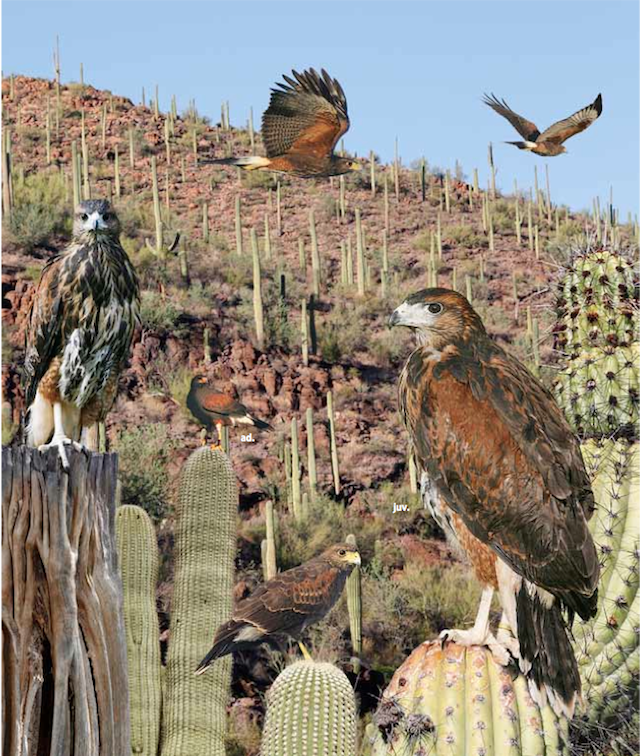
From The Crossley ID Guide: Raptors
Nowadays, we think of this species as able to “accelerate like lightning, turn on a dime, and anticipate a rabbit’s movements.” We admire the species’ extremely complex social structures, and few are the hearts that don’t quicken when we’re lucky enough to see a “pack” of these hawks on the hunt.
These and many other appealing aspects of the Harris’s Hawk’s biology and behavior went “essentially unrecognized” until the 1970s. It wasn’t that the birds were rare or elusive, but that we had already been told what they were like: lazy, sluggish, indolent, and dull, with an immoderate fondness for decaying flesh. Audubon, Cassin, and Baird had told us all we thought we needed to know.
To read more about raptors, raptor watching, and books about raptors, visit The Birder’s Library.
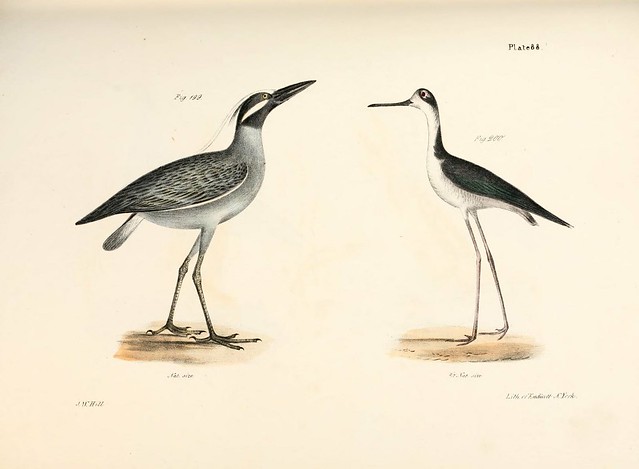
In his 1918 Game Birds of California, Joseph Grinnell writes that the American Avocet and the Black-necked Stilt are each “sometimes known as the ‘lawyer bird’ because of its long bill….”
That’s way too funny to be original, but I had no idea how venerable the pun was until I happened across this glancing reference to the joke: the stilt is known under a variety of “popular names,” including Lawyer:
The origin of this last popular name (which is most in use), I have not been able to discover: there appears to be nothing unusual in the length of its bill.
So writes James E. De Kay in 1844, in the Natural History of New-York. Even then, to judge by the way that he merely alludes to it in the negative, the witticism was not new.
How far back can we move this? Surely its origins are oral, anonymous, and irrecoverable, but I’d be surprised to find that De Kay was the first to quote it. Ideas?
It’s funny to think that of all the tens of thousands of birds names published over the years, there was a first.
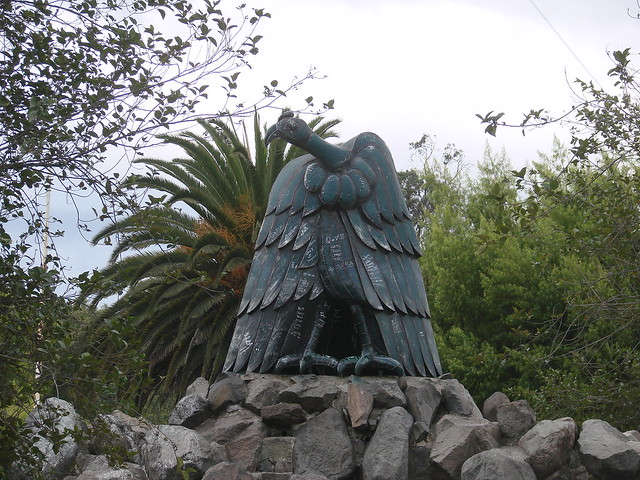
But it’s true. At the very head of the chronological list stands Linnaeus’s Vultur Gryphus, the great Andean Condor, followed by an equally impressive creature, the Harpy Eagle. And then, third on the page and third in the history of the ornithological binomial, comes this bird:
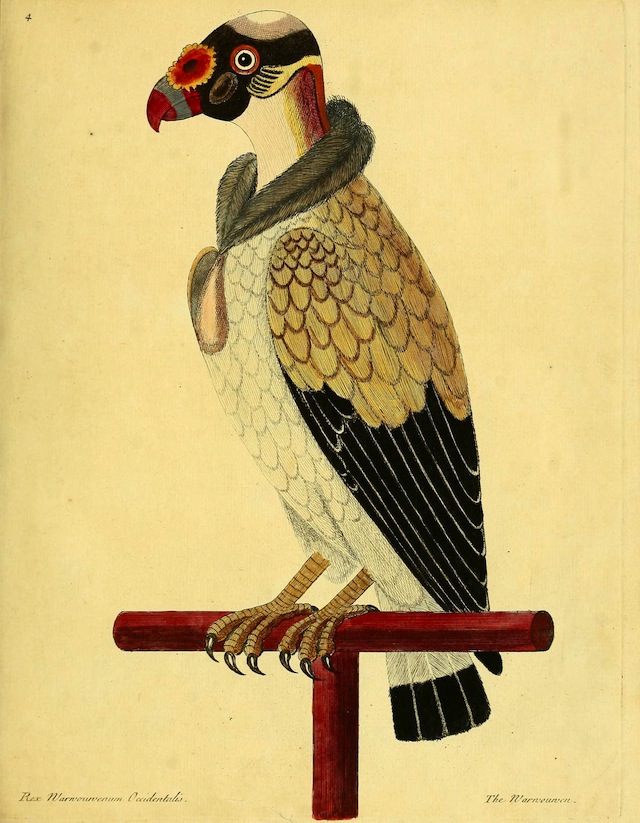
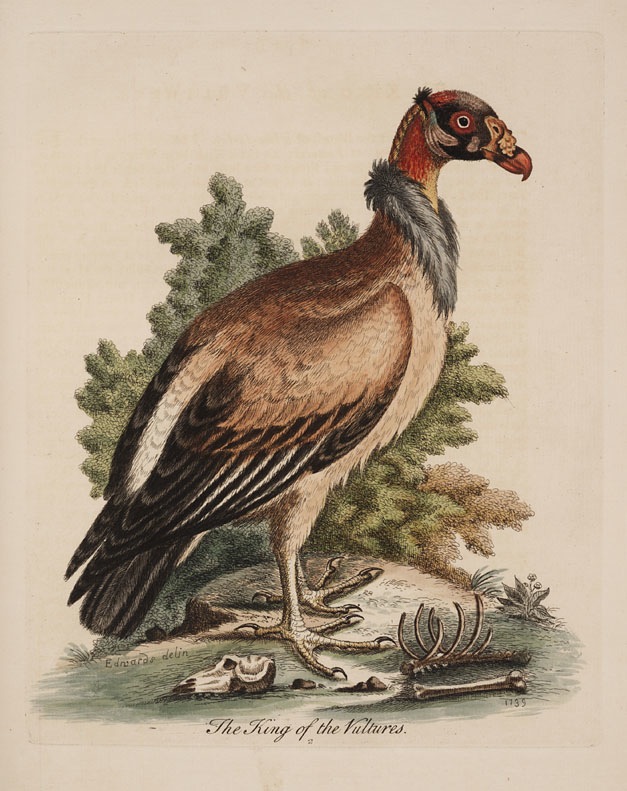
Linnaeus based his description in part on this painting in Eleazar Albin’s Natural History of Birds. Albin had encountered this specimen in the 1720s or early ’30s, “at the George Tavern at Charing-Cross, with the Cassowares,” and he adopted the name given by the bird’s “keepers” there, the Western King of the Vultures, Rex Warwouwerum Occidentalis. George Edwards, too, though he complains about the inaccuracies in Albin’s painting, takes over his predecessor’s name, calling the bird The King of the Vultures in his own work a decade later.
The Archiater cites both men as he names the Vultur in 1758, but he declines to follow either in his choice of epithet for his “new” species. Instead of christening the bird V. rex, Linnaeus (perhaps, if I read Jobling right, inspired by a manuscript note in his copy of Edwards) looked to another form of monarchy and called it Vultur papa, the Pope Vulture.
I don’t think he meant it as a compliment.
The 1758 edition of the Systema marks the beginning of modern taxonomic history, but that same fateful year was also when all of Linnaeus’s published writings were placed on the Index and condemned to be burnt as dangerous and immoral. It’s not clear whether the Vatican’s censors had objected to Linnaeus’s graphic descriptions of the salacious lives of plants or had discovered in the Systema some hint of an attack on the “fixity” of species — but whatever the reason, I’d be surprised if the son of a Lutheran vicar took it well.
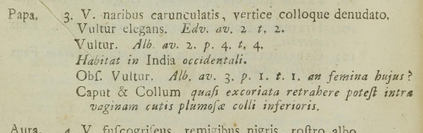
There’s no flattery, and maybe much of its opposite, in the way those terse Latin words lie on the page:
The pope (3) is a vulture with nostrils covered by warts and a naked crown and neck.
That end of the bird is further described in unappealingly suggestive terms:
He can draw the head and neck, which look as if they had been skinned, back into the sheath of the lower neck’s downy skin.
Linnaeus’s Pope Vulture — we’ve gone back to calling it the King Vulture in English, but it retains the epithet papa — stands at the head of a long line of clerical birds, cardinals and monklets and nunlets and maybe even prothonotaries, and I’m sure that some of those names, too, are meant to poke fun at their human namesakes — none of them, though, with quite the same ferocity that I think shines through here.
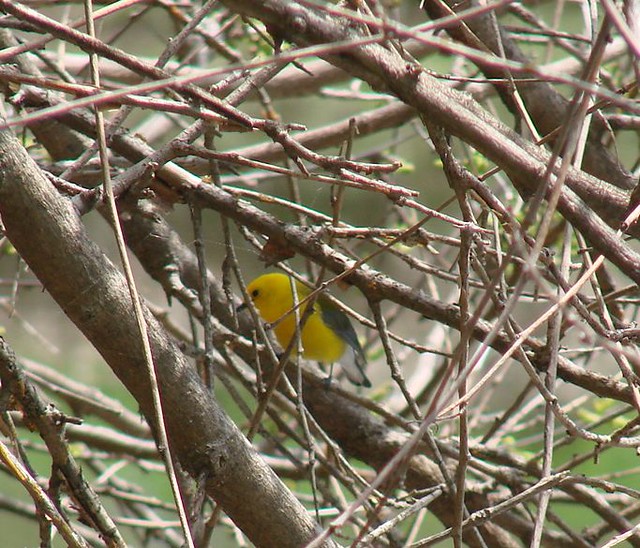
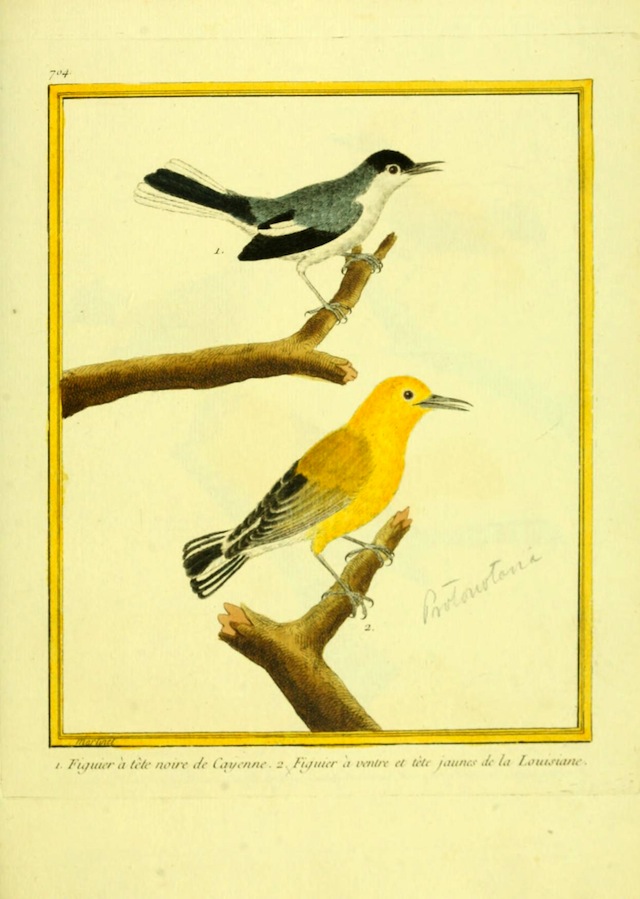
It’s the secret etymological handshake of the North American birding community: Do you know where the Prothonotary Warbler gets its name?
Knowing smiles all around; of course we do! The name alludes to the golden vestments worn by lawyers in the Roman Catholic Church, right? That’s what I’ve heard and read for all my birding life, and even Wikipedia agrees, so it must be true.
Right?
Maybe.
In birding as in all else, common knowledge is usually common — but only sometimes knowledge. Often enough, the stories we tell each other are contrived well after the fact, explanations cleverly thunk up to rationalize a set of circumstances we just don’t understand. And precisely that seems to be the case with this warbler story, a neat and often repeated solution to the problem of a name whose real origins we’ll likely never know.
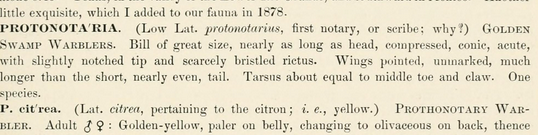
Suspicion rises immediately when we see that even the most authoritative of modern accounts of this name differ significantly. Gotch, as good a first stop as any, tells us that Protonotaria
refers to the Chief Secretary of the Chancery at Rome, who wears yellow robes.
The almost unfailingly reliable Jobling moves things to the Eastern Empire, deriving the genus name from the
late L[atin] protonotarius protonotary, a Byzantine court notary who wore golden yellow robes.
The popular literature may not be as trustworthy, but it does tend to codify received birderly wisdom. Diana Wells, in her 100 Birds, informs us that the bird’s
common name comes from its yellow plumage, the color of robes worn by papal clerks, or prothonotaries, when they met to confirm beatifications, canonizations, or other weighty matters.
Rome. Byzantium. The papal curia. Three different places, three different eras, three different bureaucratic hierarchies. Somebody’s making something up.
None of the three authors quoted offers any citation to an original source, so we have to do the work ourselves.
The name Protonotaria entered Linnaean taxonomy by way of Gmelin, who in his edition of the Systema naturae called the bird Motacilla Protonotarius, following the vernacular names given in Buffon, Latham, and Pennant. Says the last, in 1785: the Prothonotary Warbler
inhabits Louisiana. Called there le Protonotaire; but the reason has not reached us.
“The reason has not reached us.” Science was just as innocent twenty years later, when in 1807 Vieillot wrote that the name
“prothonotary” that one has retained for this bird is that imposed on it by the inhabitants of Louisiana; but no author has provided any etymology for this unusual designation.
Neither Wilson nor Audubon could offer any speculation about the origin of the name, and Bonaparte too seems to have passed over it in silence. Not even Cabanis, whose footnotes reveal such a fondness for etymologies, ventures a guess. Likewise, Baird, in elevating the name Protonotaria to generic rank, says nothing of its origins.
The reason for all this silence is simple: even the most learned, even the best-informed ornithologists of the eighteenth and nineteenth centuries did not know why the French-speaking inhabitants of the lower Mississippi had christened their “golden bird of the wooded swamps” Prothonotary. Elliott Coues, the greatest ornithological lexicographer who ever lived, could do no more than quote Pennant in the second edition of his Check List; twenty years later, the etymology offered in the final, definitive edition of the Key ends with a simple question: “Why?”
Neither is there any attempt at an explanation in Coues’s entry for the species in the Century Dictionary; it simply follows on the definitions of “prothonotary,” without etymological comment.
I hope that my point is obvious: if those who received and described the first specimens, and those who knew the bird in life in the earliest years of American ornithology, and those whose mastery of ornithological bibliography, lexicography, and etymology was unrivaled — if none of those men could draw a connection between the cavity-nesting warbler of “wonderful orange cadmium hue” and the berobed functionaries of some exotic court, then the connection must be a recent discovery or, more likely, a recent fiction. Who’s responsible?
As far as I’ve been able to determine without devoting entire days to the search, the earliest printed attestation of the story is in Bagg and Eliot’s 1937 Birds of the Connecticut Valley, later quoted in Bent:
We understand that Protonotarius is the title of papal officials whose robes are bright yellow….
This “we understand” is a bit hard to parse: are Bagg and Eliot adding something original to the discussion, or are they conceding the likelihood of what others have told them? In any event, those authors — writing more than a century and a half after Pennant first recorded the name — provide no authority for the “fact” that the papal lawyers wore yellow, a notion that I cannot find confirmed, either, in the standard ecclesiological reference; another site (reliability unknown) suggests that at least today the vestments of the prothonotary are … purple.
Perhaps it is best at this point to go back to Pennant’s source, the Francophone inhabitants of eighteenth-century Louisiana. It doesn’t seem very probable that the Cajun residents of swamp and bayou would have known much about the sartorial traditions of the Vatican, and indeed, the Catholic Encyclopedia tells us that the office of Prothonotary “had almost entirely disappeared” by the late eighteenth century (it was revived in 1838). Could the Louisianans have known the word in a different context?
It would please me no end to think that there is a legal historian reading this right now. In French-speaking America — in Canada and Louisiana — the notarial system was well developed and important in the eighteenth and nineteenth centuries.
An institution that would be called on to play a critical role in the economic and political life of the future state, the notariat was transferred to Louisiana from France at the beginning of the eighteenth century. Indeed, it was with the royal decree of 1717 establishing the first civil government in Louisiana that the powers and functions of the French notary were transplanted in the new colony. From that point on, all parties involved in a real estate transaction were obliged to record the contract in the presence of a notary.
In Quebec, and presumably in Louisiana, too, notaries, who became “an essential component in Louisiana’s civil legal system,” were required to deposit copies of all notarized documents and transactions in a central depot — overseen by a protonotary. The protonotaire would thus have been a significant and well-known figure in the Francophone community.
I suspect that this was the home-grown Prothonotary who gave the name of his office to a bird, not golden-clad monsignors, Roman clerks, Byzantine officials, or “the chief clerk of the English court system.”
It’s harder to say what the bird and the legal official had in common, but Robert Ridgway, in the 1905 re-issue of Baird’s History, adds an interesting note: he says that the species is not at all “noisy and vociferous, as its name would seem to imply.”
Like rural busybodies the world over, Louisiana’s protonotaireswere no doubt self-important buttonholers, given to saying the same thing over and over just to hear themselves talk. And there is no bird anywhere whose song is more monotonous than the tweet-tweet-tweet-tweet of a Prothonotary Warbler, holding endlessly forth from the depths of the hot swamp like the small-town functionary from his store-front office — the man who, I suspect, gave his name to the bird.