Separated By a Common Language

Ducks are strong flyers, and large bodies of water shouldn’t pose much of an obstacle to them in any case, so it’s no real surprise that so many northern hemisphere species are found in both the Old World and the New.
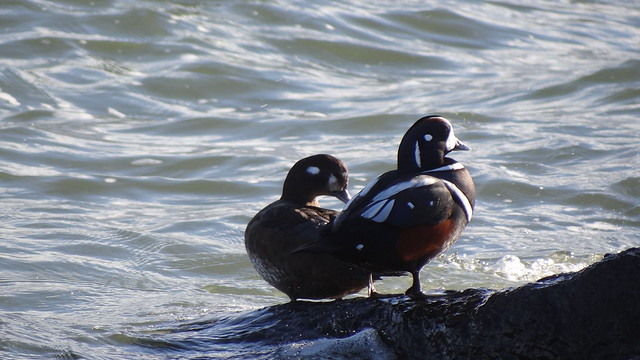
Some of those shared ducks are more abundant on one continent than on the other, of course. Think of the lovely and bizarre little Harlequin Duck, a vanishingly rare bird in western Europe, but common enough in parts of North America.

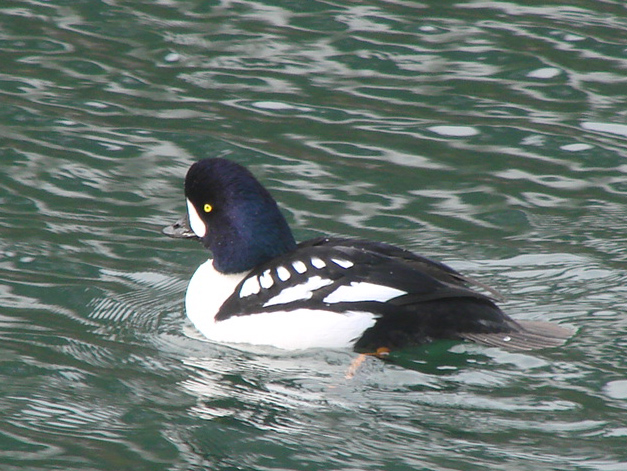
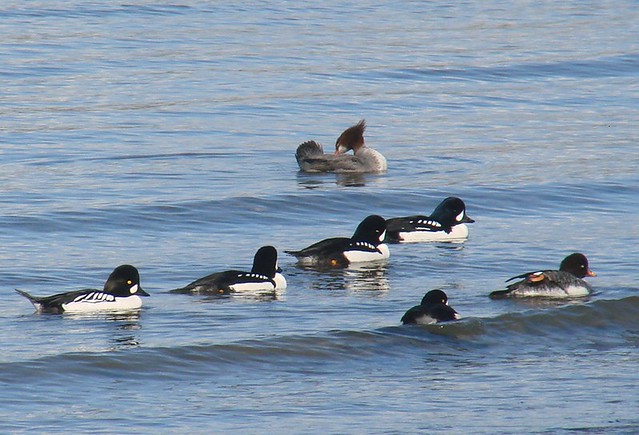
In one of those coincidences of distribution that birders so much love to ponder, the harlequin’s range is nearly identical to that of another chubby duck of rocky seacoasts, the bird named in Gmelin’s 1789 edition of the Systema naturae Anas islandica — a bird that we now know in English, most of us, usually, most places, as the Barrow’s Goldeneye.
Gmelin’s text is really nothing more than a simple translation of that in John Latham’s Synopsis:

General colour black. Head crested: fore part of the neck, breast, and belly, white: legs saffron-colour. Inhabits Iceland. Called by the inhabitants Hrafn-ond.

“Raven duck” didn’t make much sense to Latham, so he gave the bird an English name that reflected its range as then understood: the Iceland Duck. Gmelin was happy to adopt the same name in Latin, Anas islandica, which in turn provided most of the national languages in Europe with a vernacular name for this rare visitor from the land of the Vikings.
faunaborealiamer02rich_0700
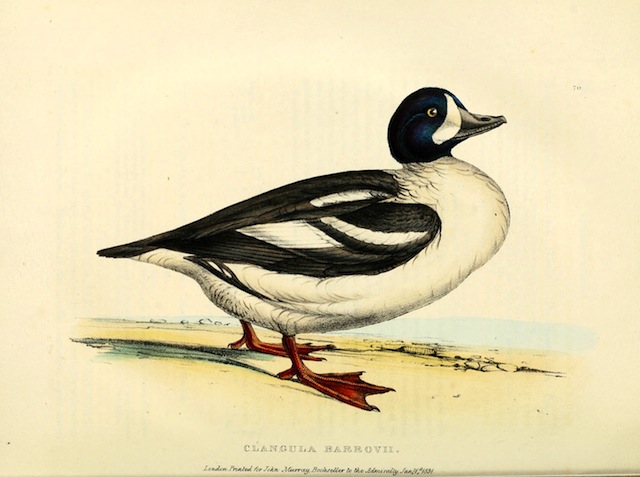
Baird (RR Pac., 1858) says that the specimen depicted here was probably given to John Gould, from whom it was later obtained by John James Audubon. 

In the course of one of the Franklin Expeditions of the 1820s, John Richardson killed an unfamiliar duck “on the Rocky Mountains” of America. Unaware, it seems, of Gmelin’s Anas islandica, he described it as new and named it Clangula barrovii, the Rocky Mountain Garrot, the scientific name honoring Sir John Barrow and his “unwearied exertions for the promotion of science.” (In a footnote, William Swainson, Richardson’s prim-and-properer co-author, warns against naming birds after people, but admits that Barrow deserves such a tribute if ever anyone did, for his discoveries in “Arctic America, Southern Africa, and China; … high benefits conferred upon the State; and … the possession and encouragement of zoological knowledge.”)

That Richardson’s garrot was, in fact, the same goldeneye species that occurred as a vagrant in northern Europe was first recognized by Charles Lucian Bonaparte.
Screen Shot 2013-02-26 at 3.23.54 PM

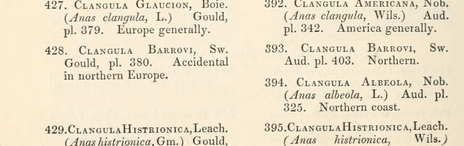
His Geographical and Comparative List of 1838 arrays the birds of Europe and America in parallel tallies; our little black and white duck occupies the same position in each column, but Bonaparte (unbound by the ICZN, obviously) opts for Richardson’s species name barrovi. The List does without English names, but the clear suggestion, of course, is that the bird would be known in the vernacular as “Barrow’s Duck” — precisely the name used by John Gould on the plate Bonaparte cites to from his Birds of Europe.

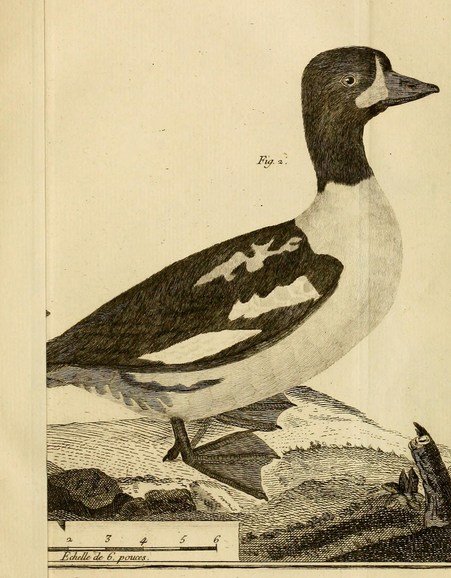
The extraordinary scarcity of this species in Europe is neatly attested by Eyton, in that same year of 1838: the author of the Monograph on the Anatidae knew of a grand total of three Old World specimens of Barrow’s Duck — one in his own collection, a recent specimen from Iceland, and a mount of unknown origin once in the collection of Réaumur and illustrated seventy years earlier in Brisson.
Screen Shot 2013-02-26 at 3.59.27 PM

By 1842, Bonaparte at least had rediscovered Gmelin’s name, and was calling the duck islandica in his Catalogo metodico. In the English-speaking world, though, where the species was thought of as thoroughly Nearctic, and where the name of Barrow (he would live to 1848) was so celebrated, there was no reason to revive Latham’s old vernacular name — and plenty of cause to retain Richardson’s.

Thanks to Anders for asking — 
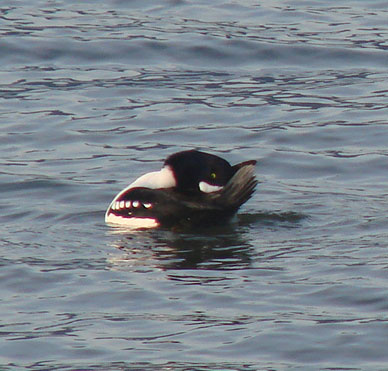
 Barrow’s and an apparent hybrid goldeneye

Share

Other People’s Bird Books: J. D’Arcy Northwood

Of the making of many books there is no end — and in my case at least, of the reading of many of them there is no beginning. My mind is full of the dimly remembered names of all those “minor” writers I’ve wanted to read, or should have read, or — when it comes to so many of my high school English assignments — claim to have read.

Every once in a while I try to make it up.

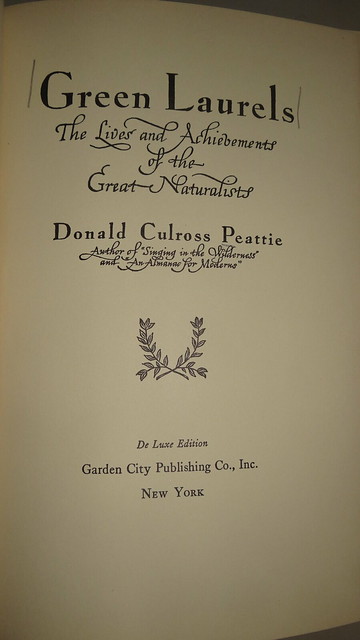
Donald Culross Peattie was a famous name well before I was born, one encountered again and again in all that sturdy, workman-like prose we read mid-century. For some reason, though, in spite of the praise heaped on him by my favorite naturalist authors, I never actually bothered to take up anything he’d written.

In this Wilson year, though, and in preparation for my August tour, I’ve been trying to read everything I can about the Father of American Ornithology; and I vaguely recalled that Peattie had somewhere published a brief biography.

It doesn’t take long in these days of internet wonders to put flesh on the bones of memory, and soon enough I had downloaded Green Laurels onto my trusty little kindle.

It will surprise some of you (wasn’t I called “an old fogey luddite” in a letter to the editor of Birding a couple of years ago?), but I don’t always mind reading books on line. In this case, though, I decided that I’d want to make some notes, an activity that I still find physically more comfortable with a pad and pencil and a “hard copy” of the book on the desk. So off trundled Alison to the library for me.

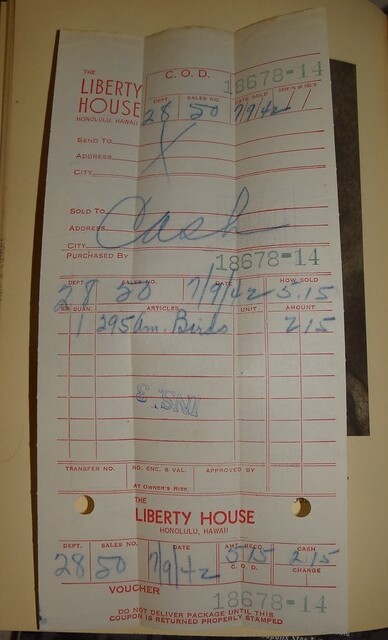
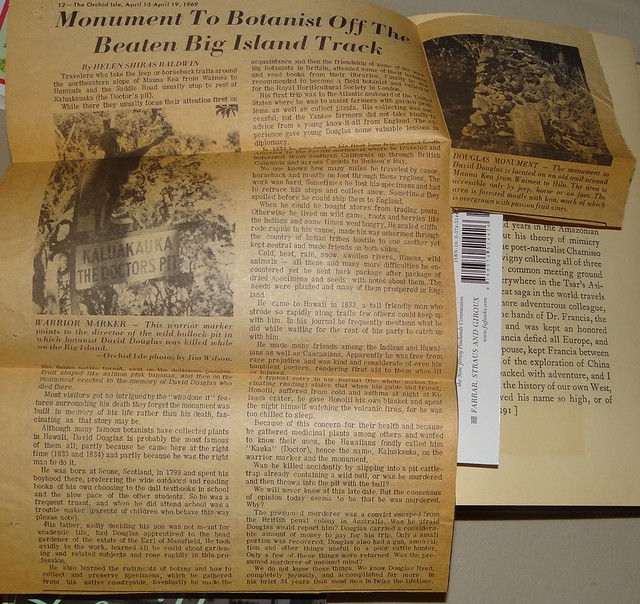
I was surprised that the book was available, and more surprised when I opened the clunky green-bound volume, its dust jacket long gone. The accession date penciled onto the flyleaf was nearly forty years later than the publication date: this book had been bought used. And whoever bought it had also purchased the original owner’s bookmarks.

Here, from July 1942, the receipt for something called “295 American Birds,” sold for $2.15 cash in Honolulu, Hawaii; and here, dated some 27 years later, a newspaper clipping observing the erection of a monument on Mauna Kea to the great botanist and explorer David Douglas.

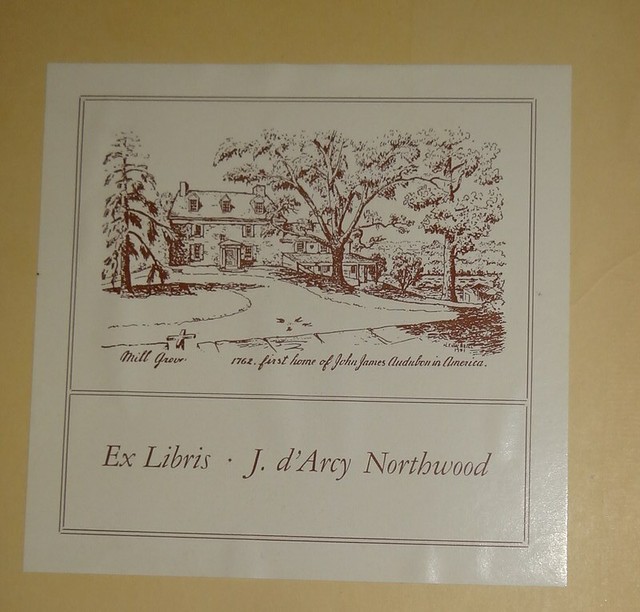
The Hawaii-Montclair connection, puzzling at first, came clear with a look at the bookplate on the front pastedown.

The volume was bought in January 1973 ex libris J. d’Arcy Northwood, a much-traveled figure in the history of twentieth-century birding, in New Jersey and across North America and its most far-flung islands, right up to his death in March 1972. Choate’s Cassinia obituary has Northwood — a British pilot during World War I, then a California-based sailor — landing in Hawaii, where he supervised plantations, served as a police chief, and in 1939 founded the Hawaii Audubon Society. A year later, he published his Familiar Hawaiian Birds

Then came Florida, where Northwood worked as an Audubon warden, and then Ithaca, where he studied ornithology. Montclair must have come into the picture during his tenure (“short,” says Choate, and not abundantly documented — thereby must hang a tale) as Executive Director of the New Jersey Audubon Society; we know he was living there in 1951, when he published a pretty trivial note in The Auk about swimming yellowlegses.

Northwood’s bookplate is adorned with a sketch of John James Audubon’s Mill Grove, where he was curator of the “Audubon Shrine” until his retirement. According to Clay and Pat Sutton, Northwood, “a character in his own right,” moved with his new wife, the writer and artist Anne Ardrey, to Cape May; their “ramshackle cottage” there is now the Northwood Center of the Cape May Bird Observatory on Lily Lake.

It will be an easy matter to find out which others of the books from Northwood’s Montclair library stayed in town after his death; meanwhile, this volume serves as a direct line from a twenty-first-century reader to a twentieth-century personality I might otherwise never have bothered to look up.

And I highly recommend Green Laurels, by the way.


Share

Other People’s Bird Books: Philadelphia Is a Small, Small World

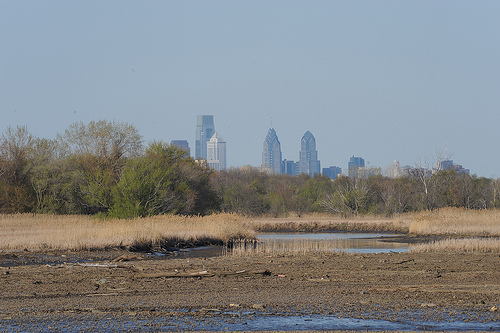
Philadelphia is a big city, larger than any other conurbation on the East Coast than New York, and I’ve never managed to create the sort of mental map required to make me feel genuinely at home on our infrequent visits.

I’m trying.

And I’ve always found that one of the best ways to figure a place out is to select a figure, an event, or an institution and trace it through time and space. For the birder, the obvious choice is the work of Alexander Wilson, the 200th anniversary of whose death we’ll be celebrating in August.

So far, our desultory explorations have had me sniffing out the Wilson specimens that survive in the Academy of Natural Sciences, running across surprise encounters between Wilson and other famous Americans, and watching with caught breath as Wilson risks drowning for an oystercatcher specimen.

But this is one of the weirdest things yet.

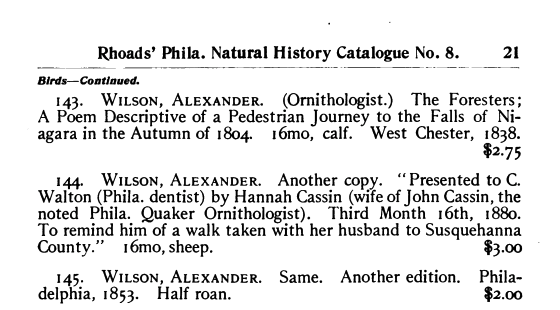
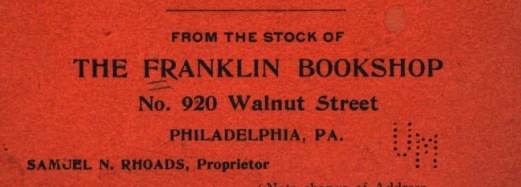
Samuel Rhoads listed in his 1908-1909 catalogue of natural history books three copies of Wilson’s poem “The Foresters.” One of them, for which Rhoads demanded the princely sum of $3.00, was a presentation copy, given to a Philadelphia dentist, C. Walton, in March 1880 by Hannah Wright Cassin, the widow of none other than John Cassin, one of the shining lights of nineteenth century ornithology in Philadelphia and anywhere else.

rhoads


Mrs. Cassin made the gift in memory of a walk along the Susquehannah taken, years before, by her husband and his friend. By choosing precisely this work of Wilson’s — subtitled by the author a “Description of a Pedestrian Journey to the Falls of Niagara” — she made explicit the line of intellectual descent from Wilson, the Father of American Ornithology, to Cassin, the equivalent great of his generation (Cassin was born two weeks after Wilson’s death in 1813). The book eventually made its way into the possession of Rhoads, the Haddonfield collector, ornithologist, and bibliophile book dealer — himself one of the founders of the DVOC.

image

I don’t know where the book is today, but I hope it sits, cared for and appreciated, on a shelf somewhere, still bearing witness a century and a quarter later to the way that ornithological knowledge used to be passed down through the generations, in Philadelphia and wherever birders gathered.

Share

The Other Ridgway — and the 2013 ABA Bird of the Year

As the brother of three immensely talented and enormously capable (and all very different, thankfully) siblings, I know what it’s like to be in the shadows sometimes. Between them, there’s nothing my brother and my two sisters can’t help us out with — generously enough, not one of them has ever come back to me with the request for one of my skills. I’m sure I’ve got some, somewhere.

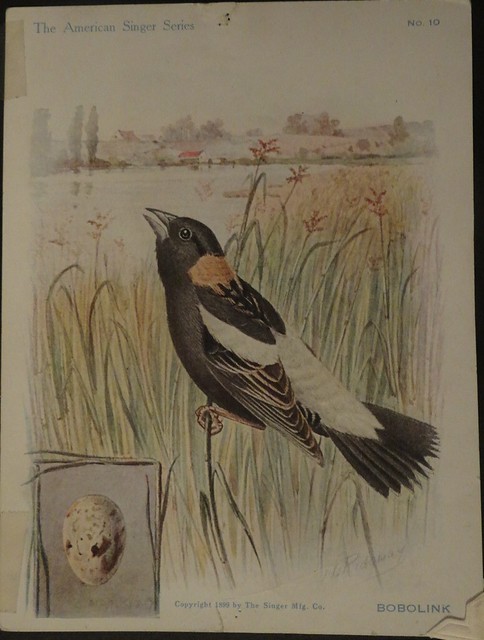
It must have been even tougher for John Ridgway, the younger brother of one of North America’s most famous and most productive ornithologists. An accomplished taxidermist and illustrator, John Ridgway worked at  the National Museum and for the USGS; he is best known today, if at all, for the series of cards he painted for Singer Sewing Machines.

The short obituary that appeared in the Auk — more than six years after Ridgway’s death in 1947 — provides a list of some of the ornithological works that he illustrated. The color plates in Turner’s 1886 Alaska seem to have been a cooperative effort, signed by both John and Robert Ridgway:

Screen Shot 2013-01-12 at 12.13.20 PM


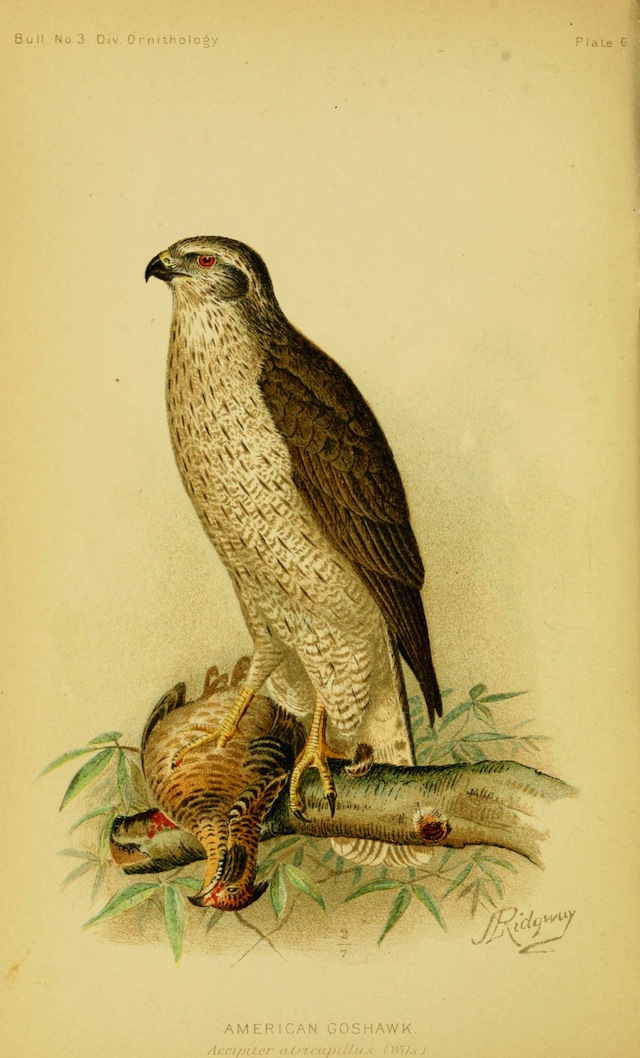
The younger Ridgway alone was responsible for the paintings — old-fashioned but often dramatic — in Fisher’s Hawks and Owls of 1893:

hawksowlsofunite00fish_0070

Oddly enough, Palmer’s obituary leaves unmentioned the one great work for which serious birders still remember Ridgway. Charles Bendire‘s Life Histories began to appear in 1892; the two volumes that were completed and published remained the authoritative work of their kind until Bent (and then, of course, BNA).

The paintings were produced by Ridgway, whom Bendire praises for his “skill and painstaking care.”  Joel A. Allen wrote that the plates were “[un]equalled in artistic effect or in faithfulness of execution,” while J.C. Merrill said simply “no superior work has ever been done.” Those encomia and others were cited by Harry Harris in 1927, in his account of an interview with Ridgway, who was then at the Los Angeles County Museum.

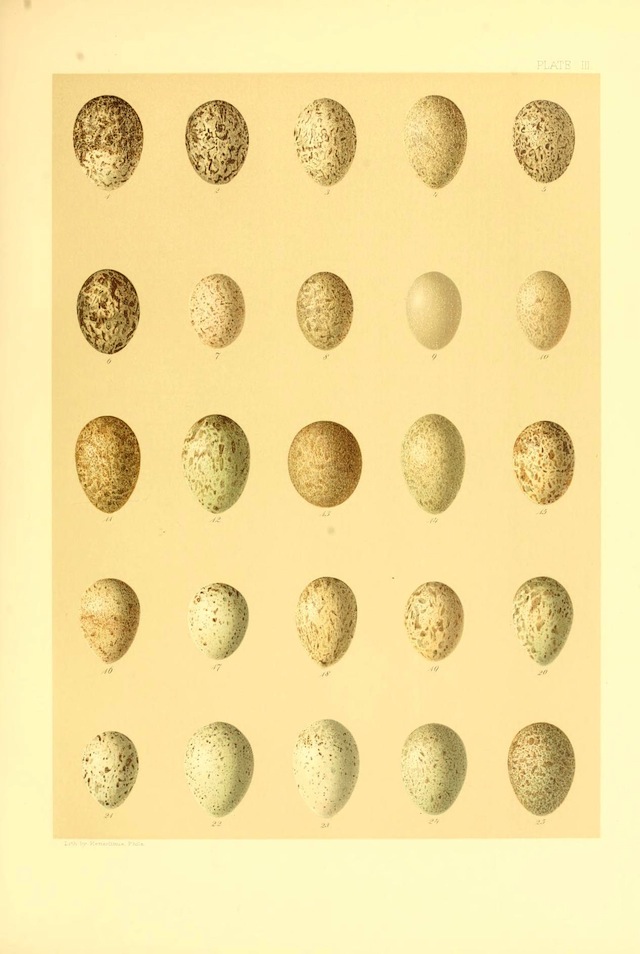
Harris adds his own assessment of the egg plates, “the outstanding and pre-eminent achievement in the entire field of oological illustration.” He may well be right, as a look at Ridgway’s paintings of the eggs (numbers 1-6) of the Common Nighthawk shows.

lifehistoriesofn00bend_0541

Bendire calls “the egg of the Nighthawk one of the most difficult ones known to [him] to describe satisfactorily.” The eggs differ “endlessly” in shape, ground color, and markings, a range of variation Ridgway’s painting captures very well indeed — and probably better than his more famous brother could have done.

Share