The Degenerate Dove

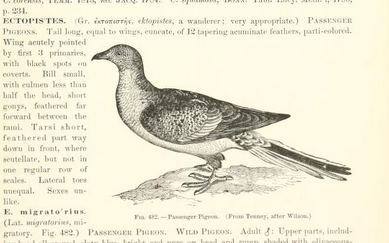
The Count de Buffon died 226 years ago today, making this as good a day as any to see what he had to say about what was over his long lifetime the most abundant bird in North America, the Passenger Pigeon.

In the Histoire naturelle des oiseaux, Buffon dedicates an entire chapter to “Exotic Birds Related to the Pigeon.” The natural historian wastes no time in proclaiming his theory:

There are few species as widespread as the pigeon; as it has strong wings and the capacity for sustained flight, it can easily make long voyages: and most of the races, wild or domestic, are found in all climates; from Egypt to Norway, people raise pigeons in aviaries, and while they do thrive better in hot climates, they do not fail to prosper in colder regions, too, depending on the care given them, all of which proves that this species in general fears neither heat nor cold, and the Rock Pigeon is found in almost all the countries on both continents [Europe and America].

As usual, it is not at first clear just what Buffon means in speaking of “species” and “races,” but he removes all doubt in the accounts that follow. Doves from Mexico, Guyana, and the Far East are here identified as “belonging to the espèce of our European Rock Pigeon.” Unable to resist the poke at his contemporary and competitor, Buffon dismisses Mathurin Brisson’s Violet Pigeon of Martinique as “a very slight variation on our common pigeon.”

And the same, he writes, obtains in the case of

the pigeon of America given by Catesby under the name Passenger Pigeon and by Frisch under the name Columba Americana, which differs from our feral pigeons only in its colors and in the longer feathers of the tail, which makes it seem to resemble our Turtle Dove. But those differences do not seem to us sufficient to make of this bird a distinct species separate from that of our pigeons.

Nowadays, if most people know anything about Buffon, it is his bizarre insistence that “foreign” organisms were the “degenerate” derivatives of European species — which were after, all, the real species. In this year of sad commemoration, it surprises me that no one has pointed out the good Count’s disparagement of the Passenger Pigeon — and the hint, d’outre-tombe, that we could recover that long-lost bird simply by selectively breeding feral pigeons for long tails and subtle colors.

 

Share

The Wisdom of the Ibis

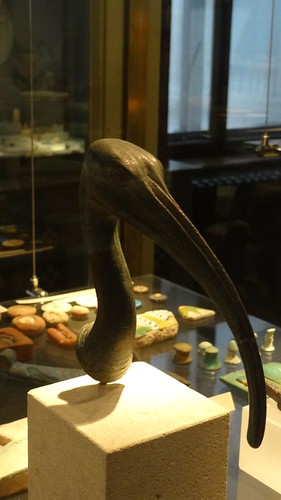
ibis

I miss the days when every paper, every journal, every mimeographed newsletter had a motto proclaiming its approach to the subject at hand. In long-lived periodicals, those catchy phrases drawn from classical authors — sometimes (the horror!) even copied out in the original languages — often served the purpose of reassuring readers of the publication’s philosophical or ideological consistency: authors and reporters may come and go, but the Tagesspiegel, for example, is still happily going to go on seeking the causas rerum.

And so I was surprised in leafing through old issues of the Ibis to discover that for many decades, that venerable ornithological journal went through mottos at exactly the same rate as it changed editors. Here’s a selection, from the beginnings to the end of the First World War:

Ibimus indomiti venerantes Ibida sacram, / Ibimus incolumes qua prior Ibis adest. “We shall go undaunted, worshiping the sacred ibis; we shall go safely where the ibis awaits.” Apparently an original composition, this pompous distich met with jocular criticism at the learned hand of Alexander Goodman More.

Ibidis interea tu quoque nomen habe! Ovid, “The Ibis”: “You meanwhile must bear the name of ibis.” Given the ferocity of that poem, it’s hard to believe that Alfred Newton was overly happy at having agreed to take over the journal.

Ibidis auspicio novus incipit Ibidis ordo! “Under the good auspices of the ibis, a new order begins for the Ibis.” That’s Osbert Salvin looking forward to the future.

Ibis avis robusta et multos vivit in annos. “The ibis is a sturdy bird and lives for many years.” Obviously from a natural history encyclopedia, but I can’t quite pin it down; I’d assumed it was Isidor, but it seems not to be. In any event, a nice sentiment for the journal.

Cognovi omnia volatilia coeli. Psalm 50: “I know all the things that fly under heaven.” A little on the far side of the blasphemy line, if you ask me.

Non moriar, sed vivam, et narrabo opera Domini. Psalm 117: “I shall not die, but live, and I shall tell of the works of the Lord.” Sclater writes that he “commenced the Editorship of the Seventh Series of ‘The Ibis’ with a light heart.”

Quam magnificata sunt opera tua, Domine. Psalm 91: “How great are your works, oh Lord.”

Delectasti me, Domine, in operibus manuum tuarum. Psalm 92: “You have delighted me, Lord, with the works of your hands.”

He prayeth well, who loveth well / Both man and bird and beast. Coleridge, “Rime.” Ornithology was sadder and wiser in the year 1919, I suppose.

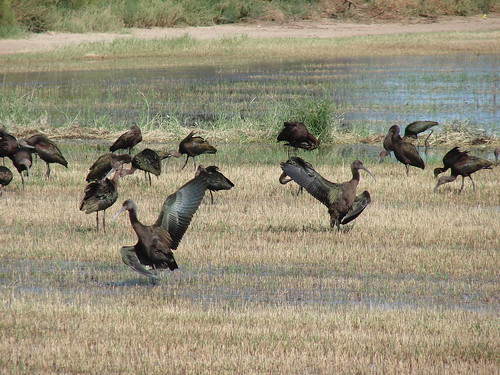
White-faced Ibis

Share

Brookdale Park Birding

Hairy Woodpecker

A warm spring morning — at long last — in Brookdale Park, and Helen, Mollie, Gary, and I ran into a couple of arrivals during our leisurely walk around the edges of the park.

Blue-gray Gnatcatchers whined and buzzed here and there, and a Ruby-crowned Kinglet, even tinier, was the first of what should soon be the regulid onslaught.

The arrival of the kinglets usually coincides with the earliest warblers. Though I did have a couple of Myrtle Warblers early on, I was beginning to worry that that would be it for the morning. But no: a creeping sprite in the dead wood below the tennis courts turned into a glorious male Black-and-white Warbler, my first this spring in our area.

We were just as excited to see the local Red-tailed Hawks still in residence and acting decidedly broody. One bird slunk around quietly in a tall pine, as if hoping to get onto a nest without being seen, while the other soared overhead with a rat in its feet. I was impressed once again by what good hunters these birds are: I could look for rats all day and not find one. (Not complaining about that, of course.)

Winter isn’t that far behind us, though. White-throated Sparrows were just as abundant and as conspicuous as Chipping Sparrows, and a lone Slate-colored Junco was still lurking around the stream, perhaps taking her last bath before heading into the Adirondacks to breed.

Best of all, perhaps, was a pair of Hairy Woodpeckers quietly feeding together on large snags on the west side of the park. Fingers crossed that these birds stick around and breed: a little bit of wilderness in Bloomfield.

Join the Brookdale Conservancy and me for May bird walks in the park: schedule is here under “Upcoming Events.” 

Share

A Passenger Pigeon from the Collection of Elliott Coues

Screenshot 2014-04-12 20.30.16

In his Birds of the Northwest of 1874, Elliott Coues recalled that

Some years since a great flight of Pigeons occurred near Washington, where for several days, in the fall, the woods were filled with the birds…. I once killed a specimen so newly from the nest as to cause me to believe that it had been hatched in the vicinity.

Coues does not tell his reader where that specimen ended up, but I think I know.

Photograph courtesy of National Museums Liverpool, Zoology, World Museum.

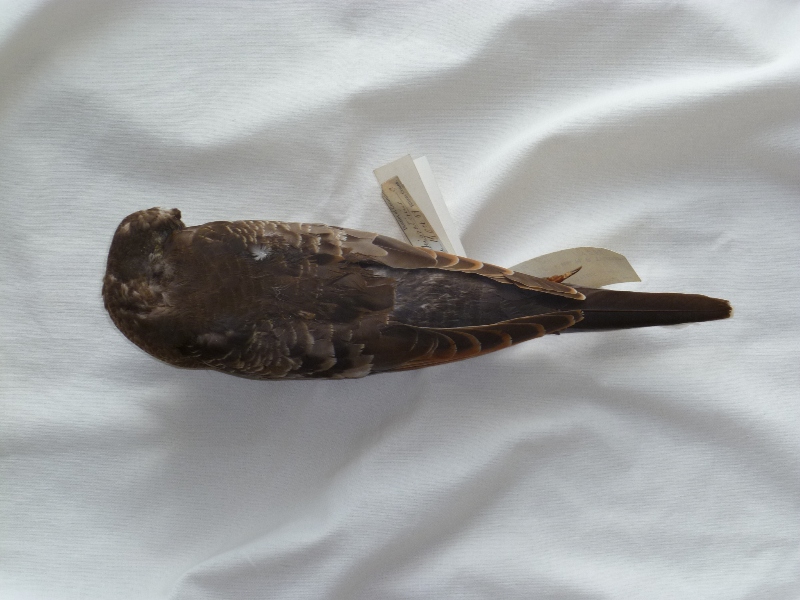
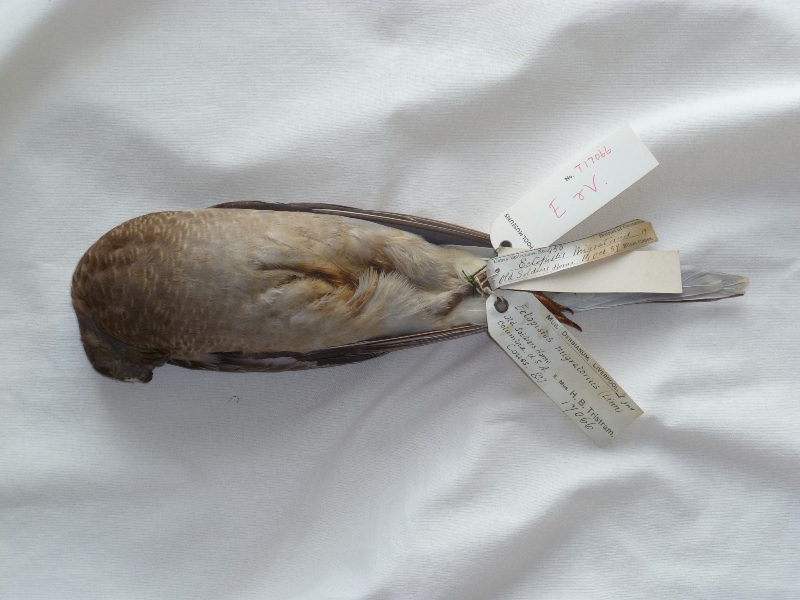
Coues collected this fresh juvenile Passenger Pigeon, aged by the “white crescentic edges of the feathers, especially on back and wings,” at the Old Soldiers’ Home in Washington on October 14, 1859. A quarter of a century later, Coues and his old field companion Webster Prentiss would recall that autumn as “the last large flight we remember” in the area.

The skin bore the number 450 in Coues’s personal cabinet, but somehow made its way into the famously vast collections of H.B. Tristram, where it was assigned the label 17066. It is not clear when Tristram acquired the skin, as the specimen is not identifiably listed in his 1889 Catalogue.

Tristram’s collection was purchased by the Liverpool Museum in 1896, and Coues’s pigeon resides there still.

Photograph courtesy of National Museums Liverpool, Zoology, World Museum.


Share

The New Big Sibley

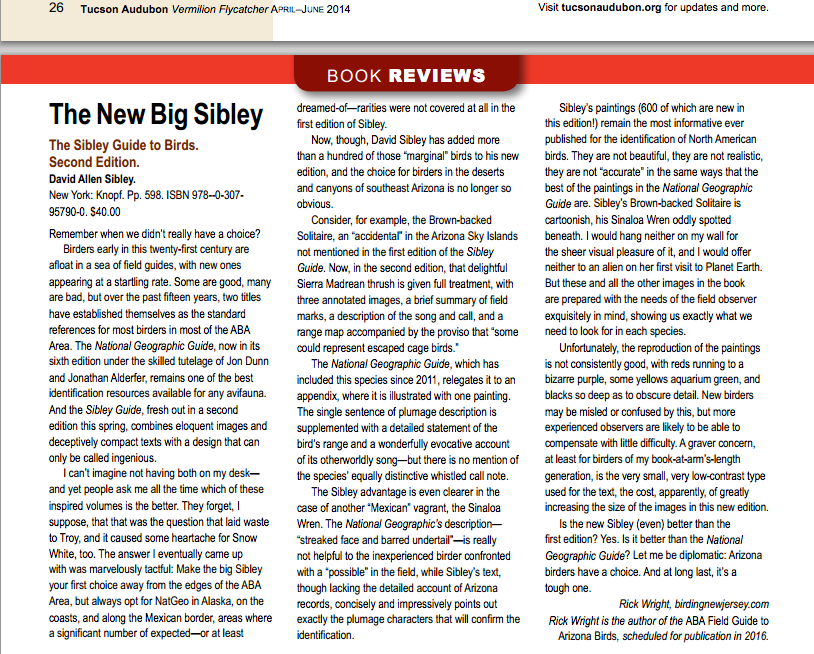
Is there anything that hasn’t already been said about the new, second edition of the Sibley Guide

Probably not, if we consider the book in its larger geographical context — but how does it hold up in your particular region?

Here are some recent thoughts on the new big Sibley and birding in southeast Arizona: (click on the text to see the full review)


Screenshot 2014-04-10 09.18.34

Share