Archive for 2009

Dec
14

Peace on Earth

Posted by: Rick Wright | Comments (0)

This American Coot and this Common Moorhen were in the holiday spirit Saturday on the Santa Cruz Flats, sharing the rush-lined pond at Evergreen Sod with nary a squawk or shove.

  • Share/Bookmark
Comments (0)
Dec
13

Passerines on the Flats

Posted by: Rick Wright | Comments (0)

It’s easy to think of the lower Santa Cruz in winter as “just” a raptor playground. But all those falcons and buteos and birdhawks and owls wouldn’t be out there if there weren’t a lot of food on the fields. Large insects, small mammals, and the odd insomniac lizard keep our wintertime birds of prey well fed. And some of those tasty prey items have feathers, too.

There are several “specialty” passerines to be looked for on a December visit to the Santa Cruz Flats. This is perhaps the best place and the best season for the local and possibly declining Bendire’s Thrasher, a bird that can be hard to find otherwise.

Brown, shy, and usually intensely terrestrial, Bendire’s appears to be no great fan of tradition: good sites on the Flats seem to be occupied for two or three years, then abandoned for reasons known only to their toxostomate tenants.

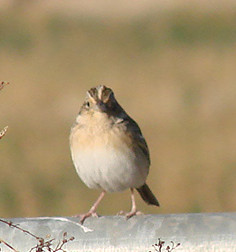
It’s the sparrows, of course, that excite birders most–and help the small falcons sleep warm at night. Gambel’s White-crowned Sparrow outnumbers all other emberizids combined this time of year, but there are good numbers of many other species, among them the demure Vesper Sparrow.

This is a typical wintertime pose, perched on the concrete lining of an irrigation ditch; less typical, fortunately, is the wind, which was blowing steadily yesterday.

The one sparrow everybody wants to see is Interior Sage Sparrow. Just as over most of its breeding range, the wintering grounds are strangely devoid of these birds even where habitat looks, to human eyes, just fine. Yesterday we saw a total of only 6 or 7, the first in a ditch while we were watching Crested Caracaras, the others part of a small flock that has set up hibernal housekeeping in the middle of the Flats. I took this photo there last weekend:

Not only are these gray beauties sparsely distributed and shy, but they don’t stay with us long: obviously eager to get the worm, they’re already moving to the breeding grounds, in northeast Arizona and north, as early as February. Get ‘em now while they’re cold….

  • Share/Bookmark
Comments (0)
Dec
12

Caracaras–and an American Crow!

Posted by: Rick Wright | Comments (0)

It’s been a while since the Marana Pecan Grove, once such a hot and happenin’ site in southeast Arizona birding, delivered the bird of the day. But today it gave me two birds of the day. As Gellert and I pulled up, we stopped to admire a Prairie Falcon perched high in a dead pecan.

When I stopped the car, a gang of Common Ravens flew up out of the field into the tree–followed by a small, short-tailed, small-headed black bird. It was an American Crow, my first ever in southeast Arizona. The bird was shy, as might be expected in such intimidating company, but gave a few good close views perched in the trees before it took off to another part of the grove. Large numbers of crows have been reported this autumn from the Sulphur Springs Valley, and I’d been hoping to run across them sometime this winter; finding my first one in Pima County was a nice bonus!

When the crow left us, I noticed a bird high in the pecans moving more slowly than the abundant Audubon’s Warblers. Bird of the day number two: an American Goldfinch. Surprisingly enough, it (I think it was a female, with relatively dull wings and no black visible on the head) seemed to be alone; small flocks are pretty much annual at the pecan grove, though this was the first of the species I’d seen this fall.

Encouraged and excited, we moved on to Red Rock, where a juvenile Crested Caracara was on the ground, and an adult Ferruginous Hawk perched on a pole actually in the feedlot.

We moved on out onto the Santa Cruz Flats, where another two Crested Caracaras were in attendance on a dried out carcass near the Pinal Gypsum Tank, no doubt two of the five we’d seen there last weekend. But the caracara jackpot, as reported all this past week, was at the corner of Baumgartner and Picacho Highway, where a dry and dusty corn field is being disked under.

Red-tailed Hawks, Common Ravens, Northern Harriers, and Crested Caracaras were all over the place. I counted 19 caracaras at once here, though later I ran into a birding group who claimed to have seen 50. They may have been right: counts were said to be approaching 40 mid-week, and with all those bugs and bunnies being turned up by the machines, I wouldn’t think any of the raptors would be at all inclined to leave.

Good views were had by driving slowly out onto the tracks through the fields and waiting for the dust to settle (which it did mostly into the car).

When the tractors turned at the end of a row, the caracaras got up and followed, turning the field into a flash of black and white.

Very exciting–but you know you’re birding southeast Arizona when caracaras take second place to American Crow and American Goldfinch!

  • Share/Bookmark
Comments (0)
Dec
09

Killer Koots

Posted by: Rick Wright | Comments (3)

At first glance, American Coots are just kind of goofy, fat bumbly birds with funny toes that we get past as quickly as possible in the search for “better” birds out on the water.

But watch ‘em for a while and you’ll discover that this drab plumage conceals some real avian personality. And not necessarily the kind of personality you want to get too close to.

Both American and European Coots are notably fractious, their constant clucking and groaning often accompanying some earnest efforts to inflict real harm on their conspecifics–sometimes going so far as to commit the evolutionarily suspect crime of infanticide.

“Talons” locked and red eyes ablaze, the pair above went at it violently for a quarter hour before one was finally able to slink away. I stood safely on shore, but I can certainly understand the wary look in the eye of the American Wigeon looking on.

You can see a short and shaky video by clicking on the photo below. Other coots, like curious schoolkids, come in to watch–and then hightail it, with discretion and dispatch, to safer waters.

  • Share/Bookmark
Comments (3)
Dec
09

10,000 Birds Conservation Club

Posted by: Rick Wright | Comments (2)

One of the recurrent eruptions among North American birders is whether birding has any necessary connection–and whether it should have any connection–to conservation work. The answer seems perfectly obvious to me, given that we won’t have anything to look at if we don’t do something to keep birds and their habitats safe.

My friends at 10,000 Birds have a new project that makes the point forcefully and effectively. Join the new Conservation Club and help save habitats around the world. And if you don’t believe that virtue is its own reward, you can win some fine prizes indeed.

Do something for the birds.

  • Share/Bookmark
Categories : Information
Comments (2)

 Subscribe in a reader

Nature Blog Network