X-Treme Wigeon

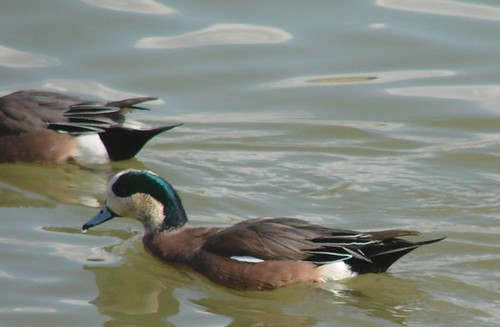
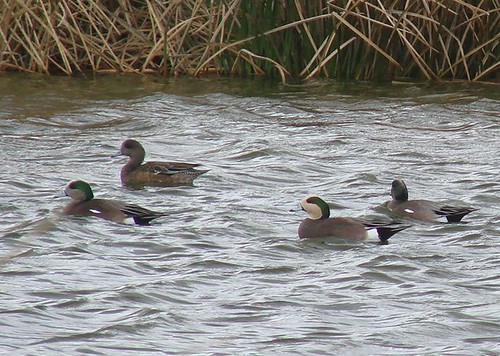
Look at enough birds, and you’ll quickly figure out that no two individuals are the same. Even puddle ducks, with their simple, blocky plumages, show plenty of variation from one to the next, some brighter, some duller. Drake American Wigeon are no exception: some have very broad, very extensive green face-stripes, others less so. And a few drakes have startlingly creamy white heads, with very little of the streaking and mottling that makes “normal” wigeon so gray-headed.

I saw two such birds over the long Thanksgiving weekend, one at Willcox and one at Tucson’s Lakeside Park.

The Willcox bird was very striking even at a distance, with a notable yellowish tint to the face and quite extensive green. Sunday’s Tucson bird was a little more freckly, but still obviously different from his companions.

This individual also had a little bit less green on the head than the Willcox bird, creating a bizarre pattern when it rolled and preened.

A quick glance through some of the standard resources doesn’t turn much up about variation in American Wigeon’s head pattern; BNA does illustrate a reasonably pale-headed bird (still a bit more spotted than the Lakeside bird).

How often do you see American Wigeon of this type? Looking for them in big wigeon flocks can be more rewarding than looking for Eurasian Wigeon!

Share

Thanksgiving Weekend Raptors

As hawk migration in the East slows to the final trickle of Rough-legs, Red-tails, and Golden Eagles, things are just getting good here in southeast Arizona. Between a visit to the Lower Santa Cruz and a short day yesterday in the Sulphur Springs Valley, I saw eleven species of hawks and allies, including Osprey, Ferruginous Hawk, and Bald Eagle, plus Burrowing and Great Horned Owls.

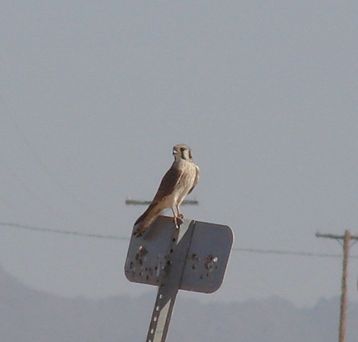
Here as at many of the other great winter raptor sites, the falcons are an especially fine part of the show. American Kestrels are common everywhere right now, from city streets to empty desert.

The majority, like this one on the Santa Cruz Flats Friday, are females–presumably more able to handle December’s cold days than the smaller, more strictly insectivorous males.

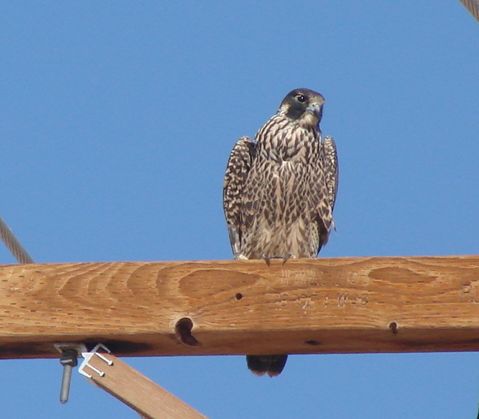
Equally catholic in their habitat choices are Peregrine Falcons. One particularly large adult has set up housekeeping on the corner of Oracle Road, where a male American Kestrel has made it his task to keep his larger cousin from getting any rest at all. Apparent migrants are still passing through, too, among them this savage-looking and obviously well-fed juvenile at the Marana Pecan Grove on Friday.

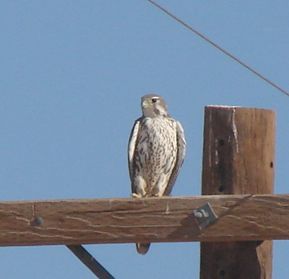
No winter raptor spoils us more than Prairie Falcon, deceptively–even dangerously–common in the cool season. This bird is globally anything but abundant, but it’s a slender winter’s day afield indeed when we don’t see three or four. There are already several installed on their winter territories in town, and dusty agricultural roads are carefully watched over by this shy and spectacular species.

This one was eying the sparrows in a brushy row of mesquites–even as a Bendire’s Thrasher sang from the wire above.

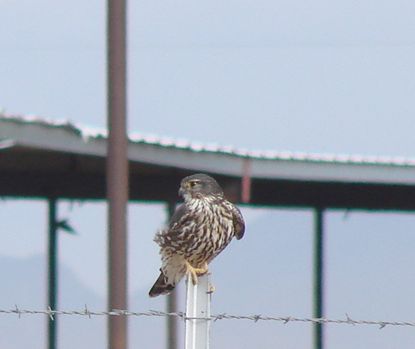
The scarcest of our winter falcons (well, unless you count genuine wild Aplomados, which may not occur at all) is the dashing little Merlin, certainly the model for the cartoons’ Chicken Hawk (remember him?). I couldn’t find a one on the Flats on Friday, but Darlene and I had great luck yesterday, with a pale Richardson’s Merlin north of Willcox and a fine columbarius-type male near Elfrida.

This bird, perched at a dairy feedlot, must have thought he’d found paradise: hundreds of White-crowned Sparrows, thousands of icterids, and no doubt many metric tons of mice to keep him hale and happy through the winter–and thus to keep the birders hale and happy who are lucky enough to see him.

Share

Winter Arrivals on the Flats

The Santa Cruz Flats, along the river downstream from Tucson, are a great place for a peaceful day afield this time of year. Raptors, today including Ferruginous Hawk, are starting to pour in, and sparrow numbers are slowly building.

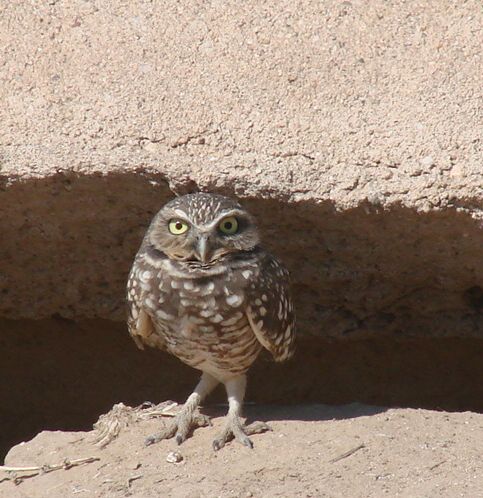
The resident birds aren’t bad, either. This was one of eight Burrowing Owls we ran across in the course of the day.

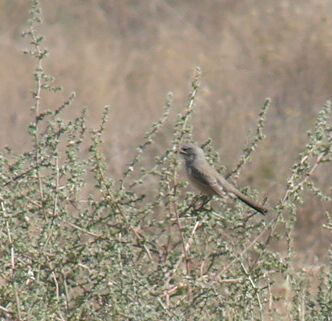
But it’s the new arrivals that quicken the heart. Sage Sparrows are uncommon anywhere in southeast Arizona, so a count of 15 or more was a very happy surprise.

The birds were remarkably shy, probably in part the result of the constant presence of American Kestrels and Loggerhead Shrikes. But patience gave us some fine views of the sparrows, and watching them I learned a lot about  bird I really don’t know that well. I was impressed with how sturdy their flight notes are, almost junco-like in pitch and insistence. I knew about the typical Amphispiza tail flicking (a great way to pick them out when they perch high in the saltbush they favor), but I hadn’t known, or at least hadn’t remembered, how expressive that long, narrow tail is in flight. And it was great fun to watch them drop from a low perch to hit the ground running, like tiny thrashers or roadrunners.

The day’s other exciting arrival was Mountain Bluebird. We’d run across a few Western Bluebirds in pecan groves along the way, but true to form, the half dozen Mountain Bluebirds we saw, all females, were out in the bleakest of harvested and disked cottonfields.

They’ve been scarce so far this autumn, but perhaps these few individuals–and the other scattered birds reported over the past week–are the vanguard of an invastion. We’re due, after a couple of winters without these lovely, gentle little chats.

Share

Alessandro Croseri: The Pigeoneers

Towards the end of his reminiscences, the 103-year-old narrator of Al Croseri’s new documentary grows wistful as he reflects on the need to cull the homing pigeon flocks that were for decades at the center of his life. You can’t keep the losers, he says, or the winners will suffer.

Croseri’s film, a lengthy and detailed monologue by the last surviving “pigeoneer,” faces a similar problem–but one that can’t be solved. For, simply put, there are no losers among the anecdotes and images compiled by the director of the splendid The Flight. As a result, Pigeoneers, for all the fascinating material it assembles, will strike many viewers as a little on the long side, better perhaps for dipping into than for consuming at a single sitting.

The film begins with a dramatic, and dramatically scored, montage of vintage photos and film clips depicting the activities of the Army Pigeon Corps. “Culling” some of these elements might have made the entry of Colonel Clifford A. Poutre more effective, but they do provide a visual context for the stories that fill the rest of Poutre’s monologue.

Not all of those stories are specifically about his work with pigeons. We learn, for example, that the later colonel slept on the floor as a toddler because he knew even then that he wanted to be a soldier, and that his career as an army bugler was cut short when he found himself moved one evening to offer an unwanted encore. For the most part tightly narrated, sometimes charming, some of these anecdotes can also wander, and much or all, for instance, of the rather pointless story of the weedy ballfield could easily have been cut.

Poutre’s entry into military pigeoneering turns out to have been a whimsical, even an arbitrary choice. The affection with which he relates his subsequent experiences, from New Jersey to Hawaii, is constantly obvious, though, and birders and other viewers without, perhaps, a consuming interest in domestic pigeons as such will nonetheless learn something here and there. Pigeons released at sea, for example, will fly up to 100 miles back to their Pacific island homes, even at night, but reveal a notable reluctance to cross mountains. Pigeons returning to their lofts through the dark skies of the Hawaiian islands could attain speeds of up to 60 miles an hour, while the bright lights of metropolitan New York slowed their progress considerably–an observation of manifest relevance to the behavior of wild migratory birds.

Among the carefully chosen images are some very disturbing ones showing the relationship between pigeons, their handlers, and native raptors. I leave it to the reader to guess which of those parties is represented in the vintage photos by proudly displayed corpses.

His long career as an Army pigeoneer brought Colonel Poutre into contact with a number of well-known figures in the 1940s and 1950s. For example, he knew Ding Darling–but unfortunately, the account of that acquaintance trails off into the anecdote of a bizarre publicity stunt, with no further mention of the great conservationist.

Most fascinating of all is Poutre’s friendship with Nikola Tesla, an impassioned pigeon handler in the last years of his life. For reasons inscrutable, though, rather than simply allowing Poutre to tell the story of this strange relationship, the director introduces this segment of his film with nearly fifteen minutes (!) of Fiorello Laguardia’s radio tribute to the great inventor; by the time the colonel’s own reminiscences commence, the viewer may wonder whether she has somehow stepped into a different film. A careful cull here would have worked wonders for the film’s coherence.

In general, one gets the impression, perhaps unfairly, that Croseri found himself, understandably enough, incapable of reducing the mass of fine material he had assembled for his film. But the viewer who sticks with the documentary will all the same be richly rewarded–and will inevitably come to share the director’s obvious affection for his centenarian narrator, whose death not long after the completion of filming marked the end of a fascinating phase in the relationship between birds and those who love them.

Share

AOU Check-list Supplement

The Fiftieth Supplement to the AOU Check-list has been posted to the AOU website. The changes will be incorporated soon into the online version of the Check-list.

Summaries have been circulating on the web for a couple of weeks now, but there’s nothing like the horse’s mouth. And it’s always great fun to see one’s friends and colleagues cited in the Supplement. Jon Dunn, of course, is a greatly valued member of the Committee, and Jake Mohlmann and Paul Lehman are both credited here with recent additions to the North American list: Jake (along with John Yerger) the astounding first Brown Hawk-Owl for the region, and Paul the 2007 Gambell Sedge Warbler  and the nearly as surprising Yellow-browed Bunting from the same location the same year.

There’s much more in there, of course, and I’ll be spending as much time as I can over the next busy days teasing out the fascinating bits of buried material. Who’d have guessed, for example, that Linnaeus had unknowingly predicted the presence of a wild Graylag Goose in North America when he described the species 251 years ago?

Share