Wild Wigeon Wonderings

n302_w1150

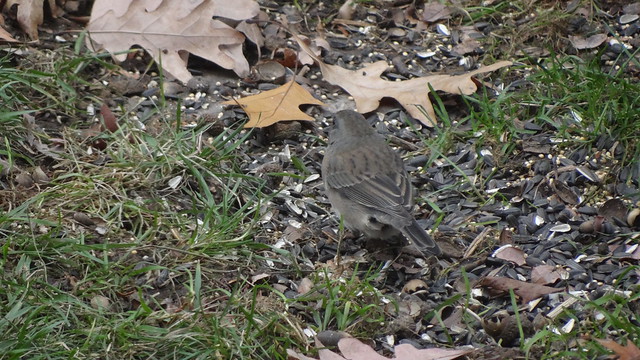
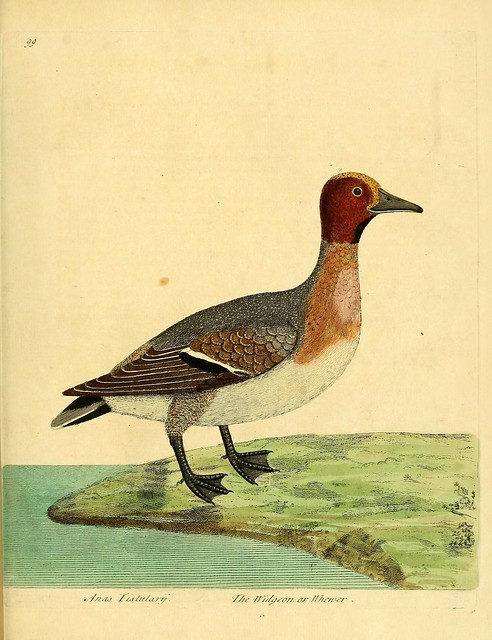
Eleazar Albin gives three different names for the bird we know as the Eurasian wigeon: the more or less expected “Widgeon,” the lovely and onomatopoetic “Whewer,” and the puzzling Latin “Anas Fistularii.”

“Fistularis,” of course, is an ancient name for this species, going back beyond Gesner, and the source — or perhaps the reflex — of such vernacular names as “Pfeifente” and “siffleur,” all of which, like Albin’s “Whewer,” refer to the drake’s voice. Charleton says the bird

is so named for the rather sharp sound that it makes, like that of a shepherd’s pipe (fistula),

an explanation that makes perfect sense.

But Albin changes it, on his plate and in the caption to his short text. Instead of “the piping duck,” his wigeon is “the piper’s duck,” and I wonder whether there is not a meaning behind his emendation.

Ducks have been taken over live decoys, “call ducks,” since the first human noticed how tasty they were under all those feathers and down. To increase the attractiveness of their spread, fowlers — as they still do today — imitated the vocalizations of their quarry.

Might Albin be using “fistularius” here to refer to the whistling wildfowler, and might the anas be “his” in the sense that it was a frequent or a favored decoy species? We know from Albin himself that the bird was not of high culinary repute, so perhaps local hunters were more likely to use it as a decoy than a meal.

Plausible enough, isn’t it? Now all we need is an attestation of “fistularius” in that context, and some evidence that wigeons were used preferentially as lures.

Yeah, that’s all. Simple.


Share

Wild Goose, Chased

n211_w1150

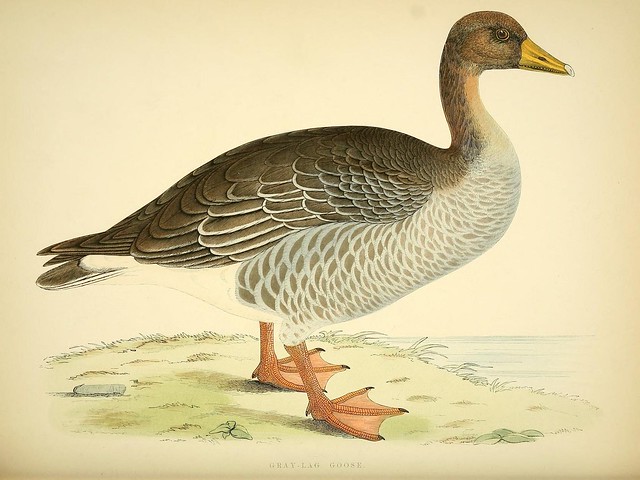
On December 2, 1932, “following some heavy gales and a spell of zero weather,” Stuyvesant Morris Pell discovered a gray goose “floundering” on the ice of the Housatonic River in western Massachusetts. Pell captured the bird alive, and took it to New York City, where he showed it to John Todd Zimmer, who “positively identified it” as a graylag goose.

When found, the bird showed bullet marks on the primaries of one wing, its feet were a bright pink, showing no signs of recent captivity, and its behavior was that of a wild bird.

Pell modestly observes that his had been preceded by other reports in North America, but he hints broadly that this seems to be the first “authentic record” of this Old World goose in the New.

Pell, it would appear, was given to enthusiasms, and in the excitement of discovery, he neglected in the initial report to mention a couple of critical facts about his wild goose:

Later Mr. Pell became convinced that the bird had escaped from captivity, since it could not fly and was too heavy for a wild bird. This was also the opinion of Bartlett Hendricks, who saw the bird, examined the skin, and obtained this information.

The retraction, a sensible one, was issued not by Pell but by Dorothy E. Snyder, curator of natural history at the Peabody Museum, who published it “at the suggestion of Dr. Alexander Wetmore.”

The published record for this bird totals less than two pages in the Auk, but what a rich real-life story must have lurked behind it all: Pell slipping and sliding on the frozen river, then transporting the huge and no doubt cantankerous bird to New York; Zimmer looking up from his desk at the honking noise so different from that heard every day on Central Park West; Pell gleefully trumpeting the identification but ignoring the most important evidence of provenance; Wetmore raising an eyebrow and sending Hendricks out to have a look at the now-dead bird; Hendricks and Snyder deciding how to proceed without offending their colleague….

All very tangled and touchy, I’m sure. How nice that American birding is so much more straightforward nowadays!

Share

An Odd Sparrow

unidentified apparent hybrid sparrow

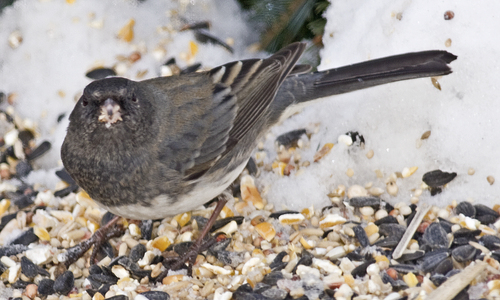
A cool day in late November — especially a cool day in late November with cold and big snows predicted for the next day — is perfect for spending a little time with the backyard sparrows. The roster Tuesday morning was pretty much what was expected in northern New Jersey: lots of slate-colored juncos and white-throated sparrows, with the odd chipping, song, and fox sparrow to liven things up.

One bird, this bird, stood out in the feeder flock.
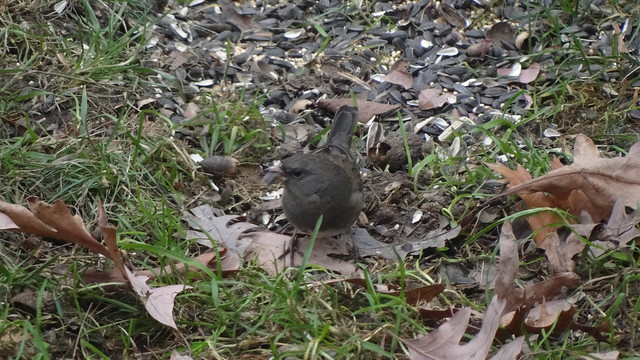
unidentified apparent hybrid sparrow

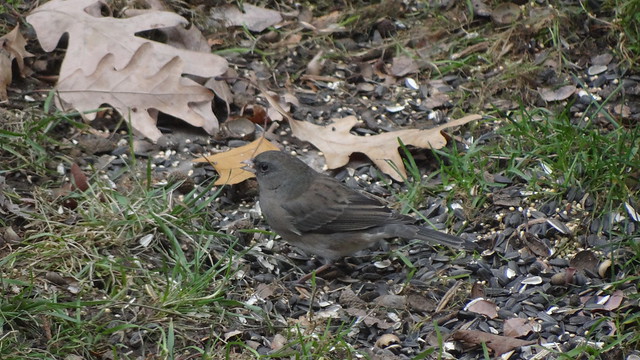
It was more than superficially junco-like, with a dull gray hood, white belly, and pink bill, but the pattern and color of the underparts were off. The dull olive-tan of the breast sides and flanks seemed wrong for not just for a slate-colored but for any junco, and the color reached quite far in towards the vent in a wide band, almost isolating the white undertail coverts. At some angles, the bird seemed to show a “color corner” between the hood and the breast sides, but at others just the usual smudgy blend shown by brown, immature or female, slate-colored juncos. Some of the rear flank feathers seemed to have very fine, just barely visible dark shaft streaks.
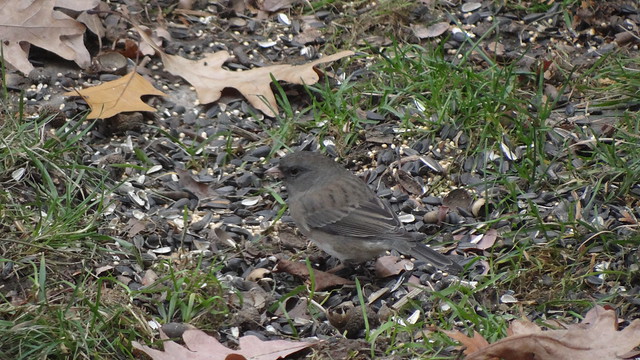
unidentified apparent hybrid sparrow

A closer look revealed a couple of other oddities. The ground color of the back seemed unexceptional, but its neat pattern of prominent but fine black streaks was worth a second look.
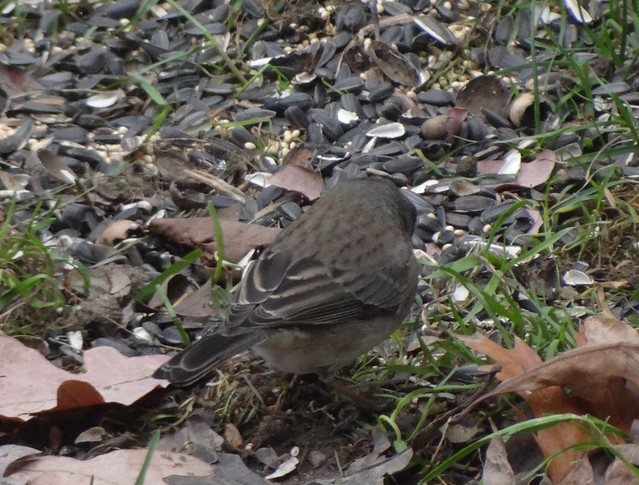
unidentified apparent hybrid sparrow

A bit of faint, diffuse streaking isn’t all that unusual in brown juncos this time of year, but these markings — darker in life than in the photos I took through my dirty window — struck me as beyond the pale.
unidentified apparent hybrid sparrow

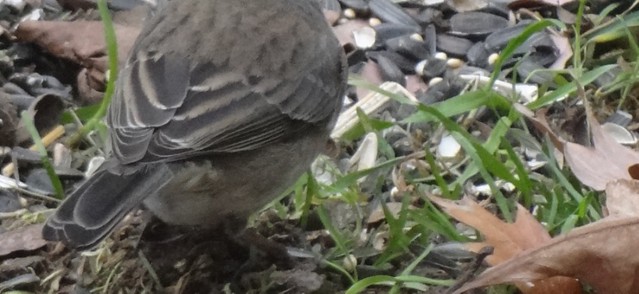
I have no good, tightly-focused images of the wing pattern, but the one above at least gives a hint of the inconspicuous dotted wing bars; the tips of the median coverts weren’t always even this visible, but several of the greaters on each wing showed very small white triangular tips, creating a short, jagged “droplet” wing bar on the gray wing.
unidentified apparent hybrid sparrow

The bird’s tertials seemed more or less normal, with the typical broad buffy edgings of brown slate-colored juncos, if perhaps just a little more white towards the tip of the outer web than most.

While the other juncos were setting off their feathered flash bulbs all around the yard, this bird kept its tail resolutely folded. Though I could never contort myself into a position from which I could see the underside of the tail, I eventually had several reasonable if brief looks at the bird in flight, when it showed no white in the outer rectrices. Given my split-second view of the bird as it dashed into the arborvitae, I’d be hard pressed to prove that it actually even had all of its rectrices, but the ones I could see were dark.

With the growing suspicion that this might be a bird of mixed ancestry (put that way, which bird is not?), I worked hard to imagine the shadow of a face or throat pattern. The hood seemed unremarkably gray, with some dull rusty shading and streaking at some angles. There was an occasionally noticeable paler patch on each side of the neck beneath the auriculars, a feature shown by many brown slate-colored juncos.

The strangest thing about the bird’s head plumage was the area around the eye. The lore was decidedly blacker than the rest of the already dark head, no big deal in a slate-colored junco, but that color continued back to surround the eye and to end in an odd broad point behind it.

The bird was minutely larger than some of the other juncos in the flock, but still obviously much smaller than the white-throated sparrows.

If this is not just an even weirder than usual junco, what might it be? There are numerous records and reports of apparent hybrids between slate-colored juncos and white-throated sparrows, among them the winter birds well photographed and well described by Mark Szantyr a few years ago in Connecticut.

Nearly all of the documented individuals assigned to this hybrid combination are obviously, conspicuously intermediate in appearance, combining a white throat and lore with a gray breast and head. Some are more subtly marked, such as the one photographed by Szantyr and almost entirely junco-like but for a single brown, white-tipped greater covert. And surely others, perhaps the majority of them, are even more cryptically clad, indiscernible to humans and maybe even to their flock mates.

If in fact this odd sparrow was a hybrid or introgressant, I’m not sure we can tell with any real certainty which species might be lurking in its family tree. To my eye, the very fine back pattern and incomplete vent strap immediately suggested not a Zonotrichia but rather a Lincoln’s sparrow, but we will probably never know.

We’ll probably never know. But it’s always fun to look close; if it weren’t, we wouldn’t bother looking at all.

Share

Follow Your Nose

I have nothing but admiration, verging indeed on awe, for those birders out there on the frontiers of identification by sound. Distinguishing the nocturnal calls of the Spizella sparrows or sorting through the flight notes of the warblers, there’s nothing these pioneers aren’t working out.

Predictably, some birders are already looking for the next cutting edge. Maybe they’ll find inspiration in a story from a long-ago autumn day on New York’s Jones Beach:

On November 7, 1948, walking along the high water line at Jones Beach, a rather large (14.75 inches) primary feather was noticed.* Picked up and passed close to the nostrils it appeared to have the characteristic odor of the Tubinares.

The feather made its way to the desk of Robert Cushman Murphy at the American Museum, who wrote on November 26 to say that the feather was “beyond any shadow of doubt that of an albatross…. It most closely resembles Diomedea chlororhynchus,” the bird we now know as the Atlantic yellow-nosed albatross.

The finder, David G. Nichols, drew the obvious lesson:

When one considers that the strong odor is the only reason that this feather was originally collected and identified, one is moved to speculate that similarly interesting plumage may occur along the beaches more frequently than is supposed. Drifted feathers might be worth some attention.

Just follow your nose.

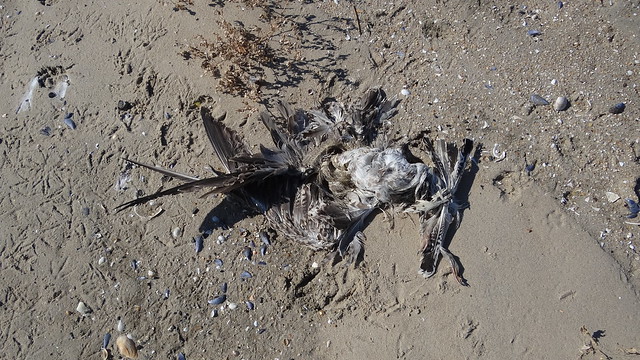
Great black-backed gull

Just a great black-backed gull this time, and no, I didn’t stop to sniff.

* Apparently the feather walked to Long Island.

Share