Birds and War: A Hundred Years Ago Today

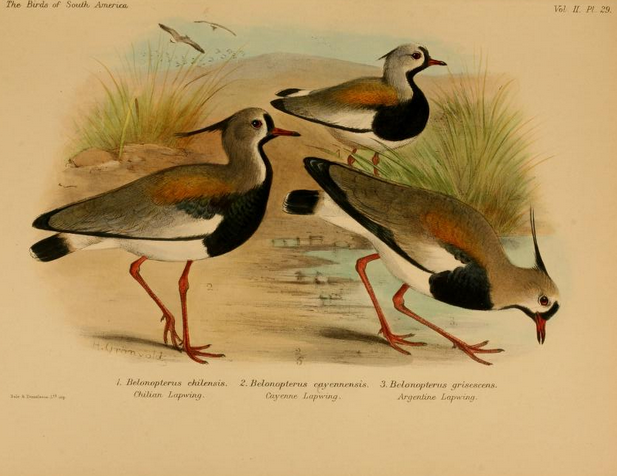
Grönvold lapwings

There is a vast, entirely unmanageable literature by and about ornithologists in the First World War. Even that heap of letters and books and articles and memoirs, though, cannot possibly make mention of all the millions who died while the larks trilled above the trenches and nightingales chanted from forests stripped bare.

Instead, we’re left to remember only the famous, among them Wyndham Knatchbull-Hugessen, killed in action at the age of 29, early in the course of the British offensive at Neuve-Chapelle.

Knatchbull-Hugessen had rejoined the Grenadier Guards on returning from a collecting trip to the Neotropics, part of his work with Charles Chubb on what was to have been a monumental, 16-volume survey of the birds of South America.

The first volume appeared in 1912, but on Knatchbull-Hugessen’s death three years later,

so little text had … been completed, and the work as projected was so extensive and costly, that nothing could be done in the way of completing even a second volume….

As often happens, however, the preparation of the text and the painting of the illustrations had proceeded at different rates. The artist, Henrik Grönvold, had made somewhat better progress, and in 1915, the publishers determined that the finished images should be issued even in the absence of the intended text. H. Kirke Swann provided brief descriptions for each of the 38 plates, which included ratites, tinamous, cracids, and a selection of water birds and waders.

Those plates would not be the only ornithological monument to Knatchbull-Hugessen. In 1916, Chubb proposed a new genus name for the spot-throated hummingbird, Brabournea. The name — later shown to be invalid — honored his late co-author, Knatchbull-Hugessen, the baron of Brabourne, killed in France a hundred years ago today.   

Share

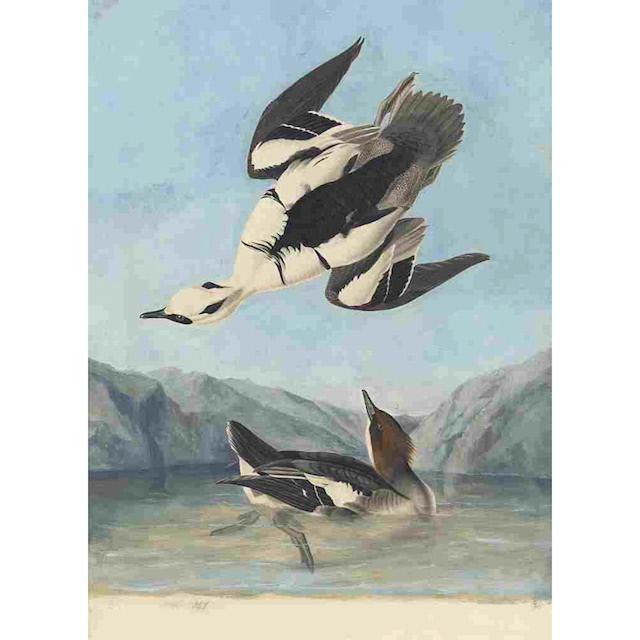
White Nun

1863_17_347

Did John James Audubon shoot a female smew on Louisiana’s Lake Barataria in the winter of 1819? He says so:

It was an adult female in fine plumage…. I have taken the liberty to add one of the other sex from an equally fine specimen.

Of course, nobody believes it.

Audubon’s oedipal anxieties about the Father of American ornithology came out clearly in his prose introduction to the species, nearly half of which he devotes to his “strong misgivings” about the records reported by Wilson, who “was in all probability misinformed.” Rarely content just to let his great predecessor simply be wrong, Audubon goes on to accuse Wilson of having deceived his readers:

it is my opinion that his figure was made from a stuffed European specimen which was then in Peale’s Museum in Philadelphia,

a proceeding clearly and tendentiously distinguished from Audubon’s own. “Having found it,” Audubon “made a drawing of [the Louisiana bird] on the spot.”

I didn’t believe it either. But somehow, the aura of the original watercolor, which Alison and I were fortunate enough to see yesterday, is powerful enough to make me wonder.

Even in Audubon’s lifetime, even his friends had reservations about the Louisiana smew. Thomas Nuttall does not even cite the account, mentioning only that “the indefatigable Audubon” had not encountered the species on his tour of Labrador — and neither had Vieillot, Richardson, or Nuttall himself; Wilson, he says, accounted the bird an American species “probably on mere report.” Nuttall concludes that

As a native of America this appears to be a very doubtful species.

A few years after Audubon’s death, Thomas Brewer decided to “retain the smew among the birds of North America,” though “with no small degree of hesitation.” That formulation contrasts somewhat with his apparently unequivocal acceptance of the New Orleans record:

But one specimen has ever actually been known to have been obtained here. This was by Mr. Audubon, in Louisiana….

Spencer Baird was more circumspect, but no less self-contradictory, a short while later. Though he says of Audubon’s plate that the “female [was] figured from Am. specimen, male from European,” he also weighs the possibility that

Mr. Audubon may have even been mistaken.

By 1884, Baird was speaking with open skepticism about “the claim of Audubon to have obtained a single specimen, and that a female, on Lake Barataria,” and he writes that the specimen in Audubon’s painting was “said to have been” taken in the United States. In that same year, Elliott Coues — who had once admitted that the smew “could very possibly occur” in the region — deleted the species entirely from the second edition of his Key.

Now that someone had come out and more or less said it, and particularly since that someone was Coues, the American smew drifted over the ornithological horizon for a while. Neither the first nor the second edition of the young AOU’s Check-list mentions the species. In 1897, though, the committee — Brewster, Allen, Coues, Merriam, and Ridgway — revived the bird for the American list, not, though, from Audubon’s “claim,” but on the basis of a specimen “from northern North America” in the collections of the British Museum.

That specimen, the sternum of an adult female, was purchased from the Hudson’s Bay Company, one or another representative of which had collected it on an unknown date at an unknown locality in North America. For the time being, that was good enough for the AOU, and good enough for Coues, who had “not hitherto admitted [the species] to the Key.”

It wasn’t good enough for Daniel Giraud Elliot, though, who waxed downright snide in 1899:

 It is, so to speak, rather stretching a point, to include this beautiful species among the North American Water Fowl, with only an example of a female in the British Museum, purchased from the Hudson Bay Company, to prove the propriety of such a course. But I have always observed that ornithological committees are most lenient when the admission of a handsome bird (which under the most favorable circumstance can be regard[ed] as the merest exception straggler from foreign lands) into their native avi-fauna is to be considered.

One could make much of Elliot’s observation on the “pattern” of claimed vagrant smews in America:

At all events one cannot fail to notice that, up to this time, the male has rigorously and successfully avoided our shores.

Ouch.

Elliot’s view soon enough prevailed. Both the fourth and the fifth editions of the Check-list relegated the smew to the “hypothetical” list:

Audubon’s sight record of this Old World species, and several other alleged occurrences in America, are unsatisfactory.

That’s pretty sloppy. We know that Audubon shot the bird in Louisiana, whatever it might have been; and it would have been helpful indeed to have a citation or two to those “other alleged occurrences.”

One of them was certainly the British Museum sternum, which may no longer exist or be clearly labeled. Another was probably the female (Elliot was right!) obtained by Tristram from Lord Walsingham, the famous entomologist. (Did that specimen enter the BM in 1896 with the rest of the Tristram birds?)

And another was the earliest American report of the species I know of.

In 1785, when Audubon was just a mewling infant, Thomas Pennant published his account of the “smew merganser.” That page in the Arctic Zoology is most noticeable for laying the ghost of the “red-headed duck,” which Pennant now recognized as the female of the smew. But more to our purposes, he writes that

this species was sent to Mrs. Blackburn from New York, I think as a winter bird.

Ashton Blackburne, the man to whom we owe the first mid-Atlantic specimens of so many birds — from the red-shouldered hawk to his sister’s warbler — may also have collected North America’s first smew. (And just because he shipped that now lost specimen from New York doesn’t mean it wasn’t taken in New Jersey.)

All this was moot by 1960, at which point the regular occurrence of smews in Alaska was recognized; meanwhile, there have been good records (males — take that, D.G. Elliot) from scattered sites across the continent, though not, if rightly I recall, from Louisiana.

And so, ultimately, it doesn’t matter that Alexander Wilson didn’t know his buffleheads any too well, or that Audubon may, just may, have told a lie (gasp of amazement).

But I’d like to think he was telling the truth, and that the pretty little “redhead” in his so fine watercolor really did fall to lead shot on a Louisiana lakeshore — whence she entered into immortality.
Share

Brookdale Park: It’s Spring

Maybe it doesn’t look like it. Even after a day and a half of afternoon melting, the snow still lies heavy on all but the most open of southern exposures, and the sidewalks still have their treacherous stretches for those like me who don’t pay much attention to their feet.

Brookdale Park sunrise in March

It was wonderful to step out of the car just before sunrise this morning and find that I could do without a hat — and that the red-bellied woodpeckers and tufted titmice were already tuning up for the morning song. A few herring and ring-billed gulls passed over on their way to feed inland, and American robins were chuckling and tsleeting from the tree tops.

Then spring arrived. A distant ascending wheeze announced the arrival of a small flock of male common grackles, followed by another, followed by another…. My total in just over an hour was only about 60 birds, hardly massive numbers judged by what is to come, but 60 more than had been hanging out in the neighborhood for the last several months.

It’s harder to know whether the noisy blue jays were arrivals or still some of the many that spent the winter with us this year. I followed one little flock through the park, hoping for a glimpse of an owl or raccoon or yeti, but all I saw was the local red-tailed hawk pair, looking pained as they kept their heads down and their profiles low.

DSC02279

A couple of weeks from now, a morning’s list of 20 species will be a disappointment. Today, though, it’s a happy sign of things just around the corner.

Grackles now, blackpolls soon!

DSC02253

Share

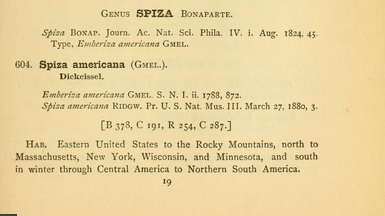
What Kind of a Name Is “Dickcissel”?

Dickcissel, Louisian

If you think about the English names of American birds, they fall neatly into two groups: folk names and book names.

Mourning Dove in yard

“Turtle dove” for Zenaida macroura is a familiar and still current example of the first, “northern rough-winged swallow” an obvious instance of the second.

Northern Rough-winged Swallow

Some birds, like the Henslow’s sparrow, have only book names, while others have both. In the case of a few common and conspicuous birds, the book name is identical to one of the folk names; think “blue jay.”

Blue Jay

When I was a young birder, I assumed that “dickcissel” was one of those, too, a name of “the people” taken over into the books when they finally came to be written.

I think I was wrong.

My suspicion now is that “dickcissel” is a book name and only a book name, invented not by a farm boy in a hot summer hayfield but by an ornithologist in his study.

And I think I know who.

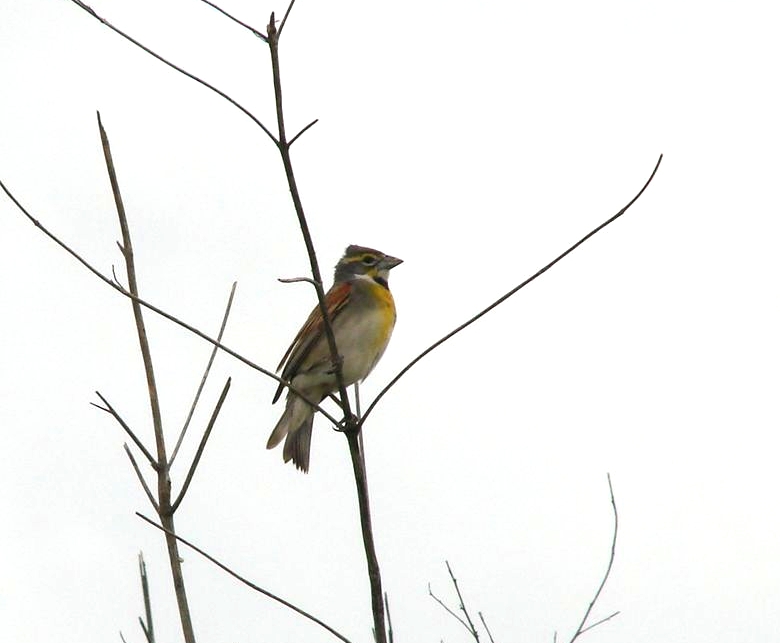
I spent the first nineteen years of my life living in dickcissel country, and would later pass another nine in the very heart of that species’ abundance. Neither in southeast Nebraska nor in east-central Illinois did I ever hear a non-birder refer to the little brown sparrowy thing on the wire as a “dickcissel” — or, tellingly, by any name at all. This bird is just not big enough or colorful enough or conspicuous enough to have intruded on the visual and aural horizon of the non-specialist.

In fact, a search of the usual suspects turns up very few certain folk names for the dickcissel at all. Wilson tells us that Bartram’s “May bird” refers to this species, but presents no evidence (“Of this bird I have but little to say”!), and Bartram himself appears never to have prepared a description, simply listing “Calandra pratensis, the May bird” as occurring within the regions covered in his Travels.

Writing about the bird’s status and habits in Illinois, Alfred O. Gross claimed that “dickcissel” was “the bird’s common name,” without, however, explaining just what a “common” name might be.
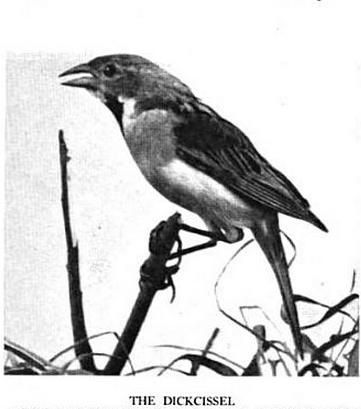
Dickcissel photo by Mumford

He also, more interestingly, wrote in 1921 that

in the Middle West it is popularly and generally known as the “Little Meadowlark,” a name that has arisen because of its resemblance in miniature to the common Meadowlark. Indeed, some very intelligent farmers believe the Dickcissels to be merely small individuals of the larger and well known bird.

That name dates to at least 1860, when J.M. Wheaton reported that in Ohio the bird was known as the “little field lark.” This notion survived into Roger Tory Peterson’s field guides, where the dickcissel was said from the very start to be “suggestive of a tiny Meadowlark.”

I remember asking the old folks about that forty years ago — and getting nothing but blank stares in reply from people who still unselfconsciously used names like “rain crow,” “chimney bat,” “wild canary,” “brown thrush,” and “turtle dove.”
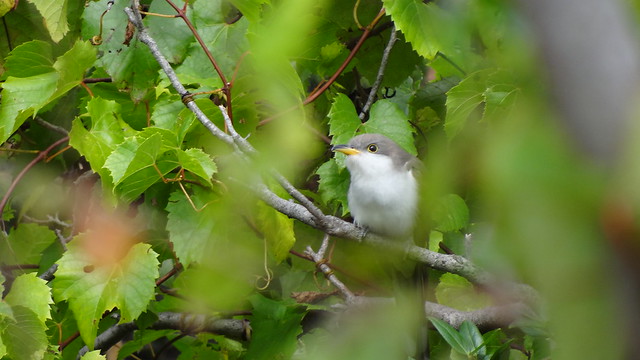
Yellow-billed Cuckoo

Deep down, I doubt that the dickcissel — small, brown, and flighty — ever had a widespread folk name; but if it did, then I’ll believe Wheaton and Gross that it was something like “little meadowlark.”

Book names, by their very nature, are much easier to trace.
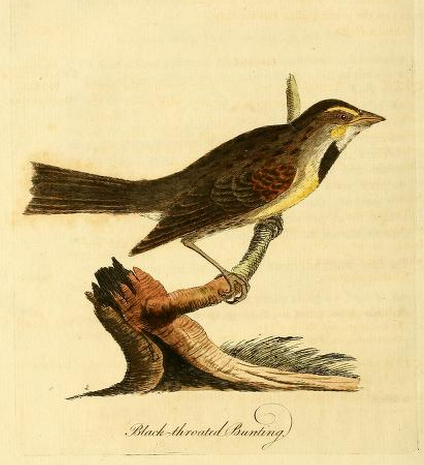
Latham, General Synopsis 2 part 1

In 1783, John Latham’s General Synopsisthe basis for Gmelin’s description and naming of the species, uses the straightforward name “black-throated bunting,” the English moniker retained by Gmelin, Thomas Pennant, Wilson, BonaparteAudubon (including the Synopsis and the octavo edition), Thomas Nuttall (both editions), Baird, Cassin, George Lawrence, Thomas BrewerT.S. Roberts, C.J. Maynard, and Elliott Coues — the last from at least 1861 to (d’outre tombe) 1903.
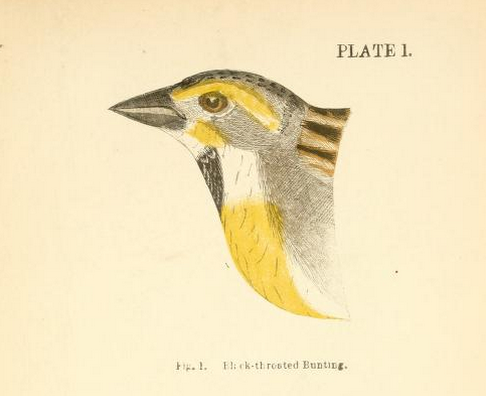
Maynard, dickcissel

Other naturalists not native speakers of English gave the bird similar names. Maximilian von Wied-Neuwied adhered to the Latham pattern when he called it “schwarzkehliger Ammer [“Ammer” is consistently masculine for the prince] mit gelber Brust,” the black-throated bunting with a yellow breast. Vieillot, too, names the bird “black-throated,” “la passerine à cou noir, Passerina Nigricollis.”

The first seeds of change were sown in 1874. The History of Baird, Brewer, and Ridgway still called it “black-throated bunting,” but in that same year, the junior author of that work reported that in Illinois the bird was known as the “Judas bird” and — at long last — “dickcissel.”

The replacement of the older name was slow in coming. The bird was still the black-throated bunting in the Auk as late as 1885. Even Ridgway himself would not adopt “dickcissel” as the species’ formal name for some time. In 1881, he was still calling it the black-throated bunting in the Nomenclature

AOU I dickcissel

In 1886, though, it was over. Ridgway apparently managed to persuade his fellow committee members to assign our prairie thick-bill the English name “dickcissel” in the new Check-list of the young AOU. Almost immediately, almost everyone — with the signal exception of Elliott Coues — fell into nomenclatural line. Ridgway’s Manual of 1887 uses only “dickcissel,” as would henceforth the Auk. Wells Cooke compromised in 1888 by using both names, but it was just plain “dickcissel” for him, too, soon enough.

Well before the turn of the twentieth century, the name “black-throated bunting” was almost gone. Perley Milton Silloway could write in 1897 that this bird had once

received a book name suggested by the distinctive markings … the black-throated bunting; but so few knew him by that title and so many of his friends were familiar with his earnest exhortation, that he was given the name sounded in the notes he utters, and is now Dickcissel.

So it has remained — and that explanation, that the name “dickcissel” is echoic of the bird’s song, remains current, too. The only problem is — you knew there had to be a problem — that the transliteration of the song as “dick, dick – cissel” appears to postdate Ridgway’s name. In other words, I do not believe that the name “dickcissel” comes from the bird’s song, but rather that the claim that those syllables are heard in the song is the imaginative and retroactive justification for the bird’s odd name. Seriously: do you hear “dickcissel” in that song?

Elliott Coues didn’t either. You’ll remember that he alone among the great American ornithologists of the period after 1886 held on to the old name “black-throated bunting.” His entry in the Century Dictionary s.v. “dickcissel” tells us subtly why: that name is

said to be imitative.

“Said to be.” Coues didn’t believe it either, and a look at the pre-Ridgway literature on this species reveals that no one had come up with anything remotely like “dickcissel” in discussing the song. Here is Wilson in 1808:
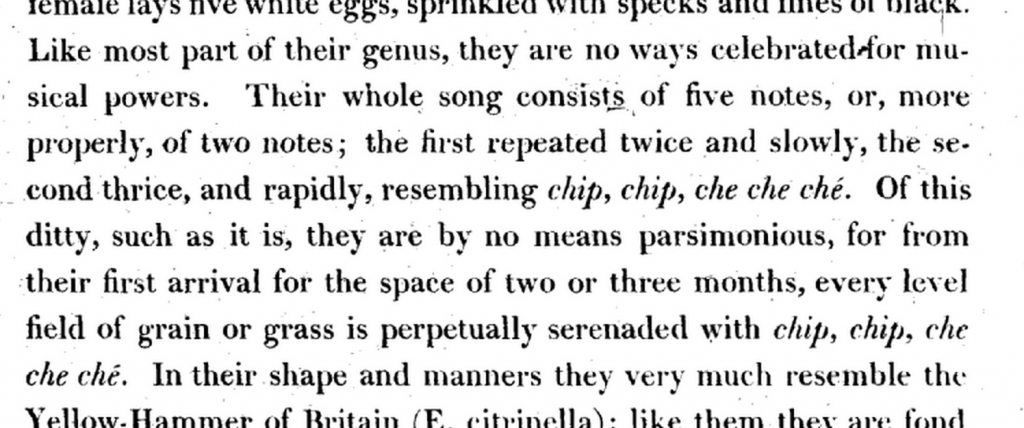
Screen Shot 2015-03-02 at 7.54.21 PM

Vieillot, who may or may not have known the bird in life, says exactly the same thing:

The song of the male seems to express the syllables chip, ché; the first is repeated twice in a row, slowly; the second is repeated three times and very quickly.

This “chip, chip, che-che-che” persisted at least a hundred years, from Wilson into the days of Chester Reed.
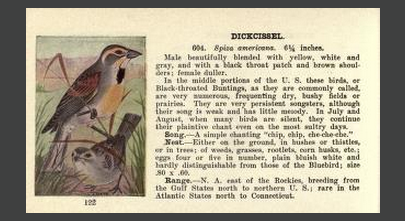
Chester Reed dickcissel

Audubon, too, comes up with nothing remotely resembling the bird’s modern name:

Screen Shot 2015-03-02 at 8.03.42 PM

(I doubt that Audubon is describing the right bird here at all; corn bunting song much more closely resembles the long warbled song of a grasshopper sparrow than the buzzy stutter of a dickcissel.)

I’d be very happy for earlier attestations, of course, but the first time I run into the song of Spiza transliterated in the modern way is 1893, 20 years after Ridgway first sprang the name on the ornithoworld:

While some other birds are equally numerous, there are few that announce their presence as persistently…. All day long, in spring and summer, the males… perch upon the summits of tall weed-stalks or fence-stakes, at short intervals crying out: See, see,-Dick-cissel, cissel….

And the author of those words? Robert Ridgway.
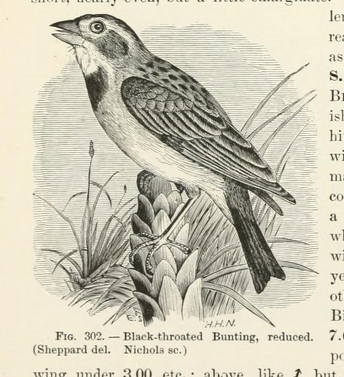
Coues Key 5 dickcissel

I suspect that Ridgway himself, dissatisfied for whatever reason with the business-like “black-throated bunting,” invented the name “dickcissel,” which appears to be unattested before he communicated it to Coues in 1874. I think, too, that Ridgway — perhaps, just remotely perhaps spurred by Coues’s rejection of the name over the next quarter of a century — came up with the tendentious transliteration of the bird’s song to justify his name, a proceeding that has given rise to a whole short chapter of “fakelore” about the dickcissel’s place in American folk culture at the end of the nineteenth century.

Sadly, sadly, this is the sort of thing that can be argued only ex silentio. But until the shade of Robert Ridgway (or of one of those very intelligent Illinois farmers) tells me otherwise, I think I know what kind of name “dickcissel” is.

A contrived one. And I’m pretty sure I know who did it.

Share

Tucson Museum Workshop

Museum Birding: From the Specimen Drawer to the Field

Thursday, August 13

10:30 am

Register here

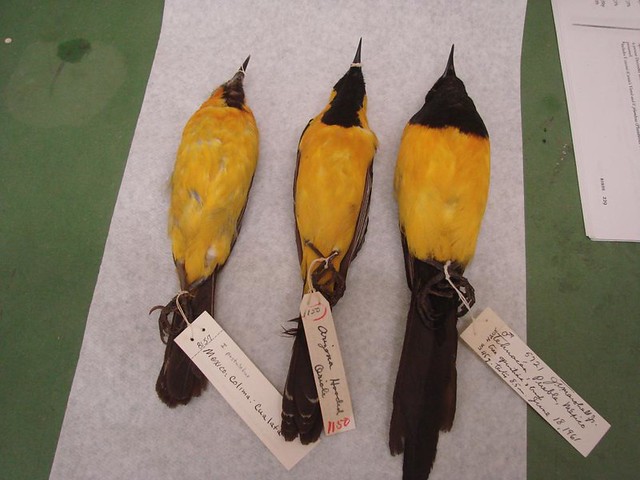
How do we birders know the things we think we know? Where do “field marks” come from? And what on earth do all those dead birds on their backs have to do with our hobby as we practice it in the 21st century?

orioles West Mexican Birds, museum skins 093

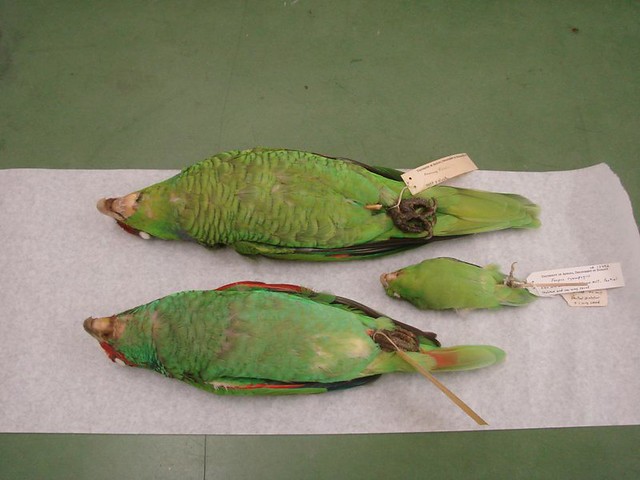
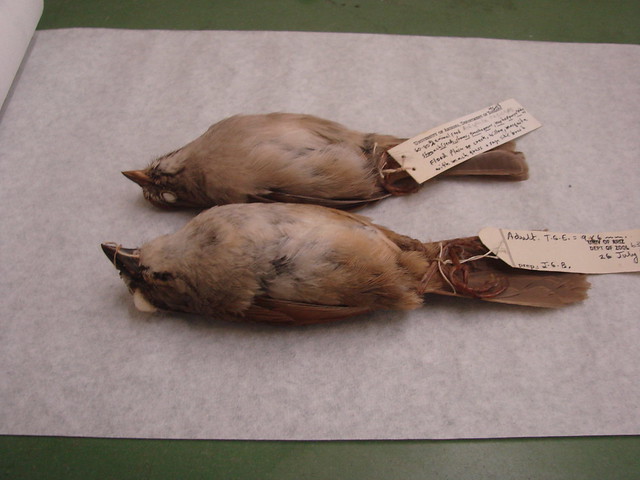
Join me on August 13 for a two-hour workshop exploring the intimate connections between museum specimens and conservation, research, and even recreational birding. We will discover how collections are formed and maintained, and learn about the sometimes surprising results when old specimens are brought to bear on new problems.

whtie fronted front and lilac crowned back parrots West Mexican Birds, museum skins 025

After an introduction to the enduring value of natural history collections, we will discuss a number of the Southwest’s rarest and most challenging birds, illustrated with representative specimens from among the more than 18,000 held by the University of Arizona.

Along with stories of collecting adventure, daring, and even foolishness, we will all come away with new knowledge we can use in the field—and a new respect for the sources of that knowledge, sources lying quietly on their backs in wooden drawers.

West Mexican Birds, museum skins 087

You can find out more, and sign up to participate, on the website of the Tucson Bird and Wildlife Festival. See you there!

Share