How About the Genus Pipilo … Back Then?

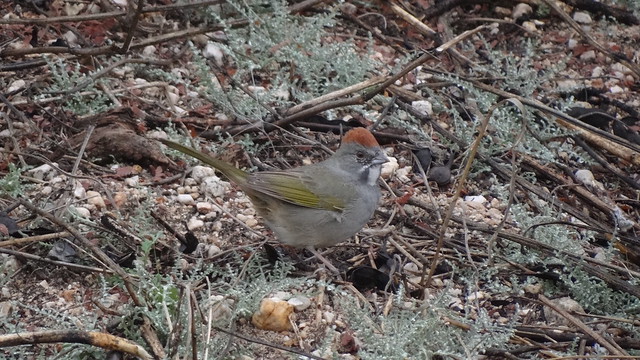
Green-tailed Towhee

In 1896, Robert Ridgway proposed to make of the green-tailed towhee

the type of a new genus, Oreospiza, whose characters are intermediate between, or rather a combination of, those of Pipilo and Zonotrichia.

Sensible enough, given the bird’s wing structure and head pattern, and the AOU adopted the new name in the next year’s Supplement to the Check-list. 

Thereupon roared forth, in a manic mood, Elliott Coues.
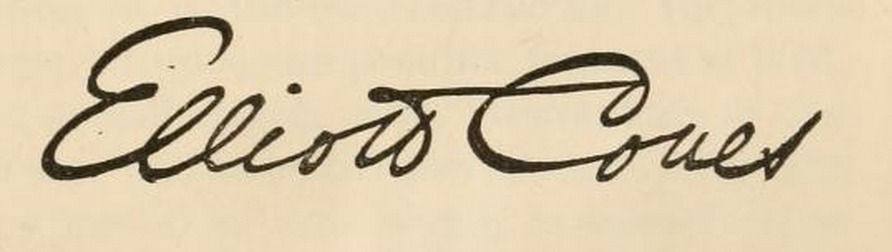
Coues signature

In a short and malignant letter to the editor of the Auk, Coues confessed himself inclined to agree that the green-tailed was generically distinct from other towhees, but at the same time felt the need to point out that

I could produce some manuscript, in my own handwriting, of date 1862, in which I took the bird entirely out of the genus Pipilo; though I never published that screed, chiefly because my mentor at that time, Professor Baird, was vexed at something I did with Bonaparte’s genus Kieneria.

Resentment piles up atop 35-year-old resentment. But Coues’s real difficulty is the sequence of the towhees: the AOU has, in both editions of its list, “interjected forcibly” the green-tailed towhee

in the middle of its supposed genus, with the black or green and white Towhees in front of it, and the brown Towhees behind it; with the interesting result, that Oreospiza, the heterogeneous element or unconformable factor in the case, now splits Pipilo apart!

Coues is not to blame, though, as he hastens to add:

I gladly leave this case to the tender grace of any one who will admit his responsibility for putting “Pipilo” chlorurus in that fix. I decline to assume any responsibility myself; the bird will be found in several of my works since 1872 in what I took to be its proper position.

Indeed, in all the successive editions of the Key, published in 1872, 1884, 1887, 1890, and — posthumously — 1903, the green-tailed is placed at the end of the towhees. Starting with the second edition, Coues included a note about the bird’s affinities: it is, he writes,

of no intimate relations with any other; it has long been placed conventionally in Pipilo, for want of a better location; it is not easy to see how it differs in form from Zonotrichia or Embernagra.

If I’ve kept track correctly, this short letter efficiently sideswipes Robert Ridgway — for failing to acknowledge Coues’s intellectual priority — Spencer Baird — for disagreeing with Coues’s treatment of Kieneria — Charles Bonaparte — for raising the genus in the first place — and the rest of the AOU’s checklist committee — for forcing the green-tailed into an unnatural position in the tally.

Baird and Bonaparte were dead, and Ridgway, apparently declining to respond to Coues’s outburst, simply pointed out that he had himself been pondering the distinctness of the green-tailed towhee for some time.

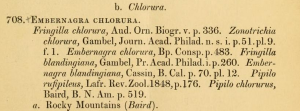
The AOU, however, was still restive. In 1915, Charles Richmond pointed out that Ridgway’s Oreospiza was pre-occupied, having already been used (and more appropriately, at that) by the specimen dealer G.T. Keitel for the snowfinches. Richmond coined the new genus name Oberholseria for the green-tailed towhee, and that name was used in the fourth edition of the Check-list.
Screen Shot 2015-05-30 at 2.39.58 PM

In 1947, on the determination that Chlorura was available and predated Richmond’s name — it had first been published, as a subgenus name, for the towhee in 1862 — the twenty-second supplement assigned the bird to yet another genus, making it Chlorura chlorura, the green-tailed greentail, in the fifth edition of the Check-list.

And it wasn’t over yet. Things came full circle in 1955, when Charles Sibley argued cogently that the green-tailed towhee was best assigned to the same genus as the spotted and collared towhees — namely, Pipilo, the genus from which it had been removed it in 1896.

No response so far from Elliott Coues.

Pipilo plate

Share

The Pygmy of Fort Whipple

One hundred fifty years ago today, on May 29, 1865, Elliott Coues wrote to the editor of the Ibis from his posting at Fort Whipple, near Prescott, Arizona.

It’s a delightful letter, humorous and good-natured, the source of the famous Couesian line about feeling “a sort of charitable pity for the rest of the poor world, who are not ornithologists, and have not the chance of pursuing the science in Arizona.”

Coues reports on the habits of the avian inhabitants of northern Arizona’s pine forests, then tentatively reports an apparent novum,

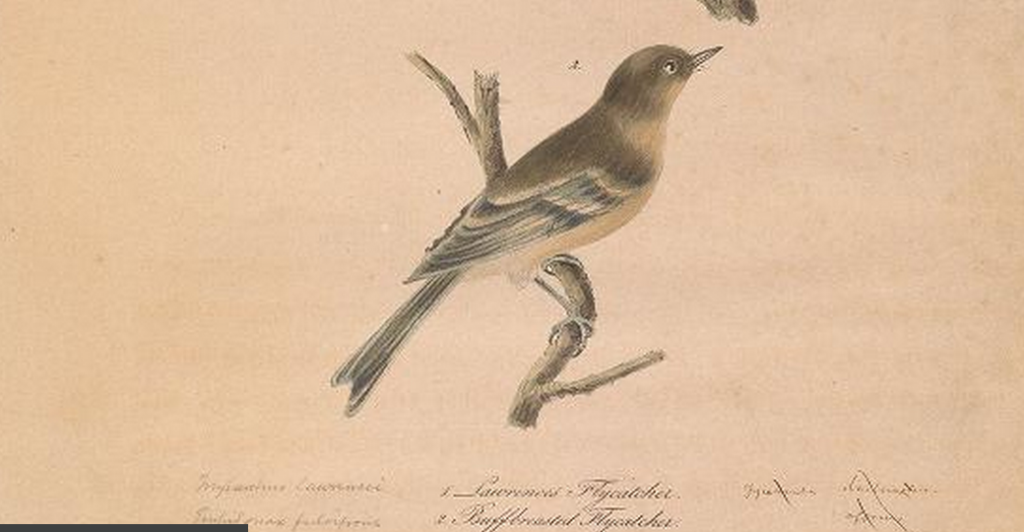
another new one among the host of [difficult] Empidonaces … already on record …. nothing like any northern one. It is considerably smaller than E. minimus — a veritable little pygmy, so that I thought it was a Regulus [kinglet] when I shot at it…. I have distinguished it in my notes and letters as E. pygmaeus.

This turns out to be the first record of the buff-breasted flycatcher from Arizona, and the type description of the subspecies pygmaeus (which Coues later attempted to rename pallescens). 

Coues was right, though, in wondering whether the bird might not have been described before: J.P. Giraud had in fact named the bird in 1841, describing it from a specimen said to be from Texas but most likely from somewhere south of the United States. Giraud called it the “buff breasted fly catcher, Muscicapa fulvifrons,” the names it still — mutating the mutanda — bears.

Screen Shot 2015-05-26 at 7.53.04 PM

The great historical curiosity attending this species is that it does not occur with any regularity in either of its type localities: there are hardly ten records of the bird in Texas, and in Arizona this sweetest-faced of the Empidonax no longer ranges north to anywhere near Prescott.

Coues’s Fort Whipple pygmies were more special even than he suspected.

Share

The Pious Vulpanser

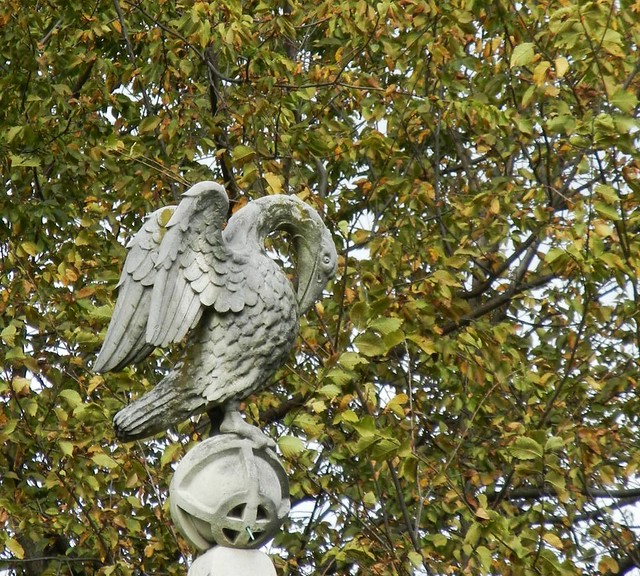
Pelican, Princeton University Chapel

Even if, like Augustine, we’re not certain whether to believe it or not, everyone has at least heard of the sacrifice of the mother pelican, who opens her own breast to nourish her young with the blood.

We may be less familiar, however, with the story of the generous vulpanser, another remarkable example of selfless love in the bird world.

According to the Italian iconographer and emblematist Ioannes Pierius Valerianus,

when the Egyptian priests wished to denote parents’ love for their children, they used the hieroglyph of the vulpanser.

He reports that

this bird attends to its offspring with so great a love that should it ever happen that it encounters hunters and finds that it and its chicks have been spotted, both father and mother rush to surrender themselves to the hunters and to draw their attention away from the young…. And so it seemed to the Egyptians that an animal of such piety should be regarded with great veneration.

The British, Pierius tells us, once considered this bird the finest of foods, but by the time of Caesar, they too had decided that it was a sacred creature not to be eaten.

But what is it, this vulpanser, this “fox-goose”?

Buffon knows:

one can readily see, thanks to one of the natural attributes of the bird — more decisively than by any erudite conjecture — that the name belongs exclusively to … the only species in which one can discover a unique and singular similarity to the fox, namely, its finding shelter, like the fox, in a burrow.

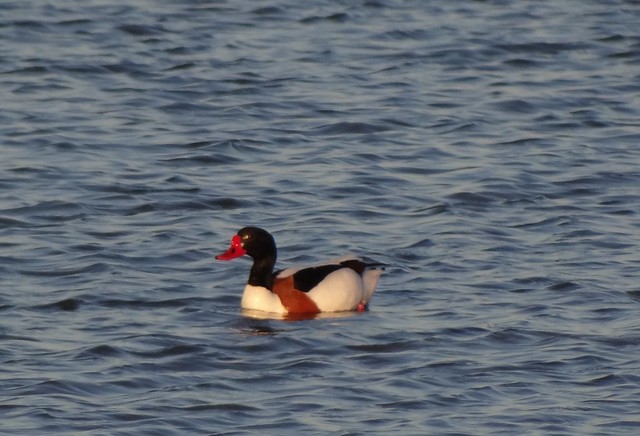
Common Shelduck

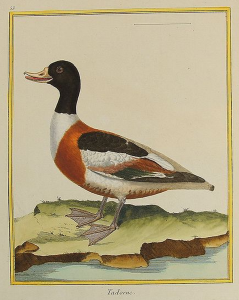
The vulpanser of the ancients and the not-so-ancients is the common shelduck,

first designated by the name “renard-oie”; not only does this bird shelter itself like a fox, but it nests and lays its eggs in holes which it normally expropriates from rabbits.

Not very nice to the rabbits — but at least they love their offspring.

Screen Shot 2015-05-27 at 4.47.47 PM

Share

A Birds and Art Tour from 1840

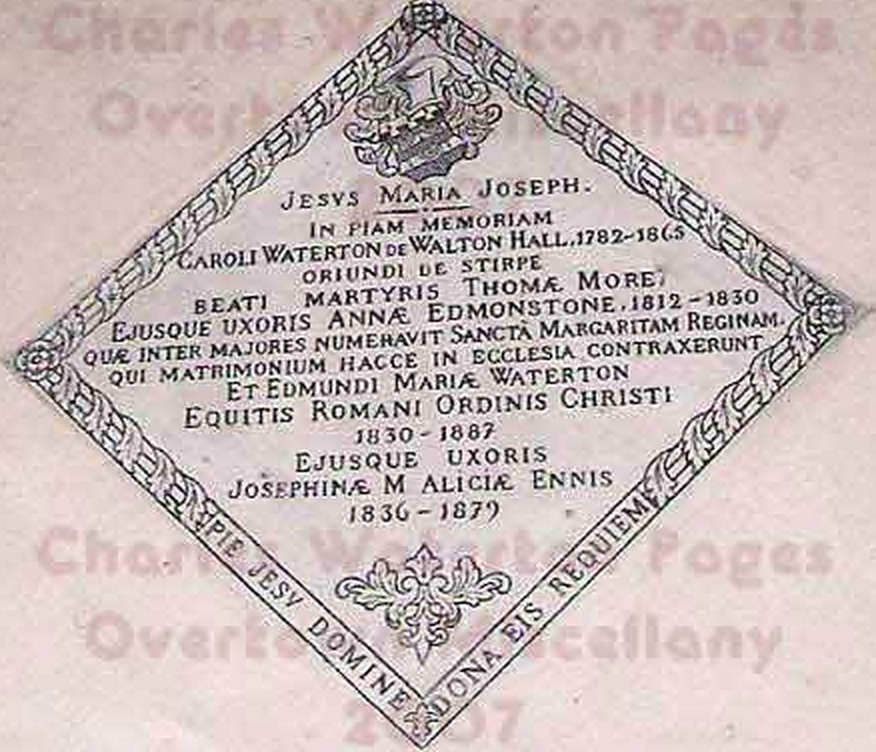
One hundred eighty-five years ago, the recently widowered Charles Waterton set off for the continent, in search of warmer climes in the south of Italy.

On the way, accompanied by his sisters-in-law and his tiny son, Waterton stopped in the “fine old city” of Bruges, where he had married his late wife in the convent school where she had been educated.

Screen Shot 2015-05-26 at 2.41.10 PM

Waterton, the premier taxidermist of his day, naturally spent much of his time in the natural history collections — most of them, he reports, old-fashioned and full of horribly prepared, misshapen specimens — but he also devoted himself to the artistic treasures of that loveliest of medieval cities.

He singled out for praise one of the convent’s paintings,

a picture of a boy laughing at his own performance on the fiddle. So true is this to nature, that you can never keep your eyes from gazing on it when you are sitting there.

Waterton liked the painting so much, in fact, that he light-heartedly fantasized about stealing it, “were thieving innocent, and the act injurious to none.”

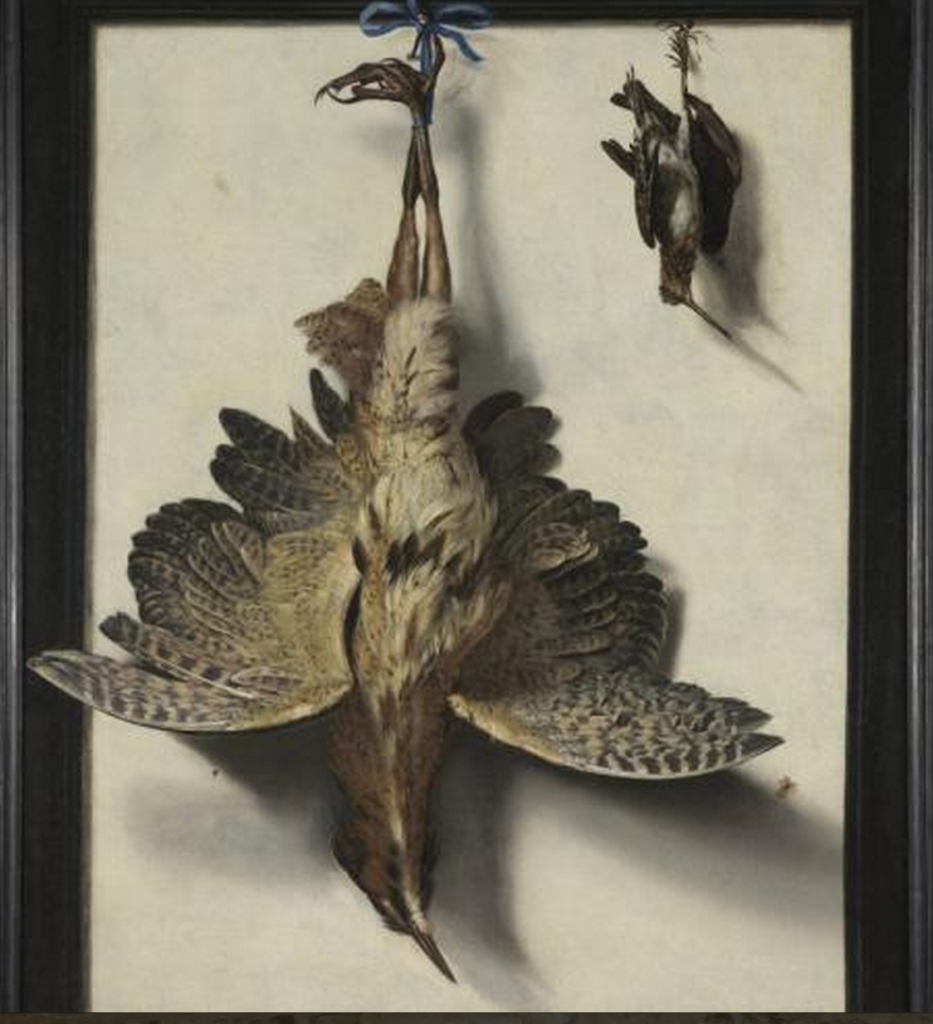
His other favorite in Bruges was a still life by Frans Cuyck van Myerop, featuring “a dead bittern suspended by the leg.”

Van Myerop, Stilleven met dode vogels

Beautiful indeed, and a fitting reminder of transitoriness today, on this 150th anniversary of Waterton’s death.

Share

Two Ships That Should Have Passed In the Night

Do you ever get the feeling that the nineteenth-century world was so small that anyone who was anybody inevitably bumped into everyone who was somebody? In the ornitho-realm, think of Alexander Wilson and John Greenleaf Whittier — or John James Audubon and virtually every single one of his notable contemporaries.

Charles Waterton

Most such meetings were felicitous encounters, but late the night of June 17, 1841, two ornithologists bumped into each other in the worst possible way. As The Tablet reported, that afternoon

the Pollux, a new and very pretty steamer, left Civita-Vecchia with every promise of a most delightful passage to Leghorn. As evening closed in the daylight failed, but the night was pleasant, the sky serene and starry, the sea calm and smooth. These circumstances had fortunately induced many of the passengers to sleep on deck. About an hour before midnight, some one being still awake noticed a vessel approaching, and already so near as to cause alarm. It was some time before any one could be found to look to the danger — and when perceived, the vessel was only just turned with its broadside forward when the other vessel, also a steamer, ran into her amidships, with a shock that threatened instant destruction to both.

The Yorkshire naturalist, ornithologist, and taxidermist Charles Waterton was on board the Pollux with his sisters-in-law and young son:

it was evident that she had but a very little time to float. I found my family all around me; and having slipped on and inflated my life preserver, I entreated them to be cool and temperate, and they all obeyed me most implicitly. My little boy had gone down on his knees, and was praying fervently to the blessed Virgin to take us under her protection, while Miss Edmonstone kept crying out in a tone of deep anxiety, “Oh, save the precious boy, and never mind me!”

Bonaparte Charles Lucien 1803-1857.png

Waterton and his family, and indeed all but one of the passengers on the Pollux, were indeed rescued. Credit for averting total destruction went to — get this! — Charles Bonaparte, who just happened to be on the Mongibello when that ship so quickly sank the Pollux:

Had it not been for Prince Canino, Charles Buonaparte, it is more than probable not a single soul would have been saved. The Pollux would have been literally cut in two had he not had the paddles of the Mongibello reversed; the Mongibello could not have got the passengers to her deck in time had not he seized her helm, and brought her alongside the sinking vessel, which, within fifteen minutes after the first shock, had disappeared.

According to Waterton, his princely colleague’s ministrations continued even after the Mongibello and its shipwrecked passengers reached the harbor at Livorno:

Prince Canino pleaded our cause with uncommon fervor. He informed [the port officials] that we had had nothing to eat that morning…. He described the absolute state of nudity to which many of the sufferers had been reduced, he urged the total loss of our property, and he described in feeling terms the bruises and wounds which had been received at the collision…. The council of Leghorn relented, and graciously allowed us to go ashore.

Waterton would never forget the bravery and generosity of the Franco-Italian ornithologist, and neither should we.

Share