Meanwhile, Audubon

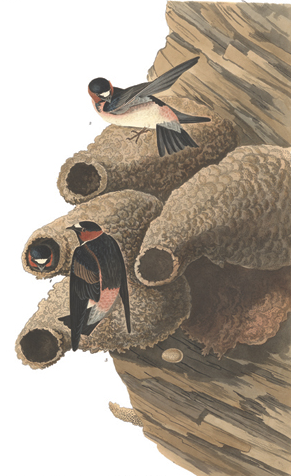
Audubon, cliff swallow

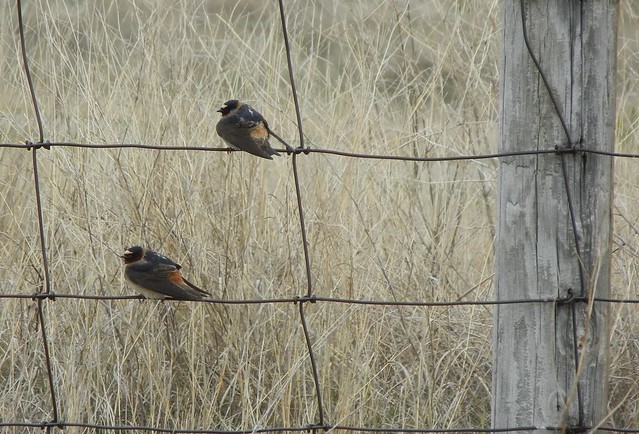
The history of the discovery and naming of the cliff swallow is as full of twists and turns as, well, a swallow’s flight.

And inevitably, John James Audubon had to get mixed up in it.

In 1824 — rather late in a game already won by Say and Rafinesque and Vieillot — Audubon submitted to the Lyceum of Natural History of New York a paper in which he, fairly unsubtly, claimed his own priority.

In the spring of 1815, I saw a few of these birds for the first time at Henderson, 120 miles below the falls of the Ohio, on the banks of that river. It was an excessively cold morning in the month of March, and nearly all were killed by the severity of the weather. I drew up at the time a description under the name of H[irundo] Republicana, Republican swallow, in allusion to their mode of association for the purposes of building and rearing their young.

Sadly enough, though,

the specimens, through the carelessness of my assistant [who?], were lost, and I despaired for years of meeting with them again,

and so Audubon’s name, which would otherwise have enjoyed priority, went unpublished.

Now things get interesting.

In the spring of 1819, Robert Best, the curator of the Western Cincinnati Museum, told Audubon about “a strange species of bird … building nests in clusters affixed to walls.”

In consequence of this information, I immediately crossed the Ohio, to Newport in Kentucky, where [Best] had seen those nests the preceding season [that is to say, 1818], and no sooner were we landed, than the chirrups of my long-lost little strangers saluted my ear.

Without so much as mentioning him, Audubon here pulls the rug out completely from under poor Rafinesque, who had described his Hirundo albifrons in February of 1822 — from specimens in the Museum of Cincinnati, taken “near Newport in Kentucky” or Madison, Ohio.

What Audubon’s account boils down to is the claim that he, Audubon, had been there first — in Henderson in 1815, in Newport and Cincinnati in 1819 — and most significantly, well before the famous meeting with Rafinesque in 1820. Audubon does not come out and exactly say that he introduced Rafinesque to the bird, but the implication is clear.
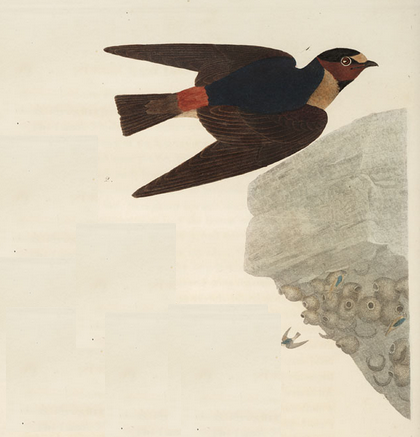
Bonaparte, America, cliff swallow

Audubon saved his explicit vitriol for another European colleague, Charles Bonaparte. In the addendum to his account of the species in the Ornithological Biography, he writes

Although the Prince of Musignano [Bonaparte] saw my original drawing, and read the account of the habits of this species in my Journal, as written on the spot, both at Henderson in Kentucky, in the spring of 1815, and again in the same state opposite Cincinnati, in the spring of 1819, and concocted his article on this bird from these sources, he has refrained from making any mention of these circumstances.

That’s not entirely fair: though Bonaparte fails to distinguish those places where he is copying Audubon verbatim from the passages based on his own observation, he does acknowledge his sources at the beginning of the account:

Mr. Dewitt Clinton has recently published a paper on the same subject, accompanied by some observations from Mr. Audubon. Combining what these gentlemen have made known with the information previously given by Vieillot and Say, we can present a tolerably complete history of the Cliff Swallow.

Justified or not, Audubon’s peevishness here is eloquent testimony to just how tangled the naming of the cliff swallow was — and how much it mattered to those involved.

 

Share

Crescent Swallows

cliff swallow

Beautiful birds, such as these most indisputably are, deserve beautiful names, and it’s hard to imagine a label lovelier than Hirundo lunifrons, the crescent-fronted swallow.

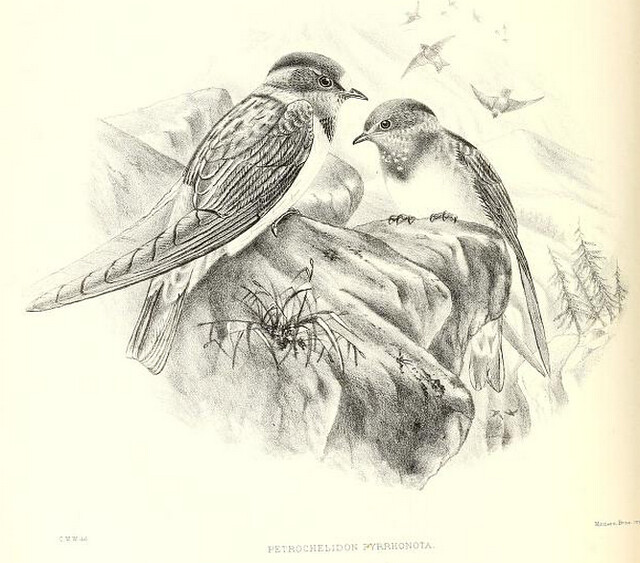
Alas, we’re stuck nowadays with the prosaic cliff swallow and the hardly more evocative Petrochelidon pyrrhonota (“red-rumped rock swallow”). But it took us a good long time to get there.

It isn’t at all clear when this abundant and widespread swallow was first “discovered” by European science. According to Elliott Coues, this is the bird Forster published in 1772 as “Swallow No. 35,”

which answers in some particulars to the description of the Martin, Hirundo Urbica, Linn. but seems to be smaller and has no white on the rump.

Forster does report that these swallows nest under eaves and on riverside cliffs, but there is little else here to indicate that he is writing of the bird we know as the cliff swallow; you’d think he might have mentioned some of the salient plumage features of this well-marked species. As it is, I suspect, contra Coues, that the skin Forster received was that of a tree swallow. In any event, Forster goes on to note — tongue perhaps ever so slightly in cheek — that

the Indians say, they were never found torpid under water, probably because they have no large nets to fish with under the ice.

More than half a century later, in 1823, Thomas Say, working with specimens from near Canyon City, Colorado, gave the cliff swallow a detailed formal description and the Linnaean name Hirundo lunifrons, commemorating the bird’s “large white frontal lunule.”

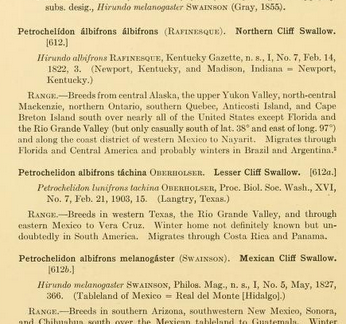
That species name, lunifrons, “crescent-fronted,” made its way into the AOU Check-list in 1886, and persisted in that authoritative work for decades. In 1912, though, Samuel Rhoads obtained copies of two items published in the Kentucky Gazette by Samuel Rafinesque, one of them dated — fatally — February 14, 1822, a year earlier than the publication of Say’s account. Rafinesque reports that

There are two species of Swallows in Kentucky…. The second species I shall now describe and call it the Blue Bank-Swallow. I have given it the scientific name of Hirundo albifrons which means the Swallow with a white forehead. It is very remarkable by its unforked tail…. Its face or the space surrounding the bill is black, the forehead white, the top of the head blue; the cheeks, throat and upper part of the rump of a reddish chestnut colour, or rufous…. This bird is to be seen preserved with its nest in the Museum of Cincinnati.

Rhoads, obviously in fine fettle, comments:

it seems a bit humiliating for [the scientific name of the species] to be snatched from the laurel crown of Thomas Say and transferred, by the rights of priority, to a man whom he undoubtedly despised and certainly ignored. Say was one of the coterie of Philadelphia naturalists that eventually drove Rafinesque and his literary contributions from any recognition by the Academy of Natural Sciences…. That eccentric naturalist [Rafinesque] had stolen the march on all his contemporaries by a little squib in the Kentucky Gazette.

Five years after Rhoads’s discovery, the proposal was made to change the scientific name of the swallow to Petrochelidon albifrons albifrons, “since Rafinesque’s name is clearly identifiable as Hirundo (= Petrochelidon) lunifrons Say and is of earlier date.”

AOU 1931

The proposal was accepted, and the 1931 edition of the Check-list was the first to use the new old name.

And the last.

Beginning as early as the 1840s, beginning, it seems, with George Edward Gray’s Genera of BirdsEuropean ornithology had begun to use yet another name, Petrichelidon pyrrhonota. When in 1894 that name was preferred in Richard Bowdler Sharpe and Clyde E. Wyatt’s Monograph of the Hirundinidae, it was time — one might think — for the Americans to react.

Sharpe and Wyatt, Mon.Hir.

Not so fast.

In 1902, the AOU committee dismissed the name pyrrhonota, finding no “evidence to show that the change is necessary.” Not until 1944, fully fifty years after the name had been ratified by Sharpe and Wyatt, did the AOU finally accept pyrrhonota as both applying to this species and enjoying priority over lunifrons and albifrons alike.

What changed their mind was Charles Hellmayr’s footnote in the eighth volume of his Catalogue of Birds of the Americas. It was Louis Pierre Vieillot who coined the name pyrrhonota in 1817, taking his description from the Sonnini translation of Azara’s Apuntamientos. Hellmayr explains that

with the exception of the blackish lower belly [“le bas-ventre noir”] which may easily be construed as referring to the dusky under tail coverts, Azara’s description, upon which Vieillot’s name was based, is quite accurate.

Quite why it took so long to reach this conclusion is a mystery. Had no American ornithologist looked seriously at Azara and Vieillot? That seems hardly likely: we know, for example, that Robert Ridgway knew the 1817 description, and nevertheless accounted it “doubtful.” We can assume, too, that the AOU committees from 1886 to 1944 were conscientious bibliographers.

However it happened, I’m sorry in a way that we’re stuck — apparently for good this time — with the boring pyrrhonota. Say’s name lunifrons is evocative, romantic, beautiful.

Almost as much so as the bird itself.

Share

Poor Thekla

theklae

Wage Du, zu irren und zu träumen….

Ted’s finally done it. Read (and enjoy) his “Big Night” carefully, and you’ll discover that he’s finally carried through on the threat to eliminate the possessive ‘s in the English names of birds.

I like it.

Of course, he’s not the first resident of Boulder to have an opinion about such things. In 1907, Junius Henderson (who seems to have had no objection to barbarous capitalization) posed the rhetorical question

why on earth should it be Baird’s Sparrow? In many such cases, the man whose name is given to the bird has never even seen the species, has had nothing to do with its discovery…. Baird is as much honored by speaking of the Baird Sparrow as by using the possessive.

Six years earlier, Richard C. McGregor had argued more soberly for the practice of dropping the offending ‘s: he quotes a letter from C. Hart Merriam in which it is pointed out that

the species are not in any way the property of the persons whose names they bear, but are merely named in honor of these persons…. the National Board on Geographical Names has for many years abandoned the use of possessives in all geographical names…. the Forestry people in their catalogue and checklist of forest trees of the United States have dropped the possessive….

Joseph Grinnell summed it all up in his review of the 1910 edition of the AOU Check-list:

We are disappointed to observe that the useless possessive is retained in personal names,

a matter noted expressly in the Supplement immediately preceding the new list’s publication.

It took forty-three years (!), but W.L. McAtee responded specifically and, as usual, confidently to all the current arguments:

the English possessive is equivalent to the Latin genitive…. It is true that the United States Geographic Board has abandoned the use of the possessive… but… those names are not based on Latinized genitives…. The most common objection to the use of the possessive case is that the bird does not actually belong to the man… a puerile [argument] at best.

McAtee also took up an argument Gerald H. Thayer had offered as early as 1910: such common surnames as Black, White, Moor, Fish, and so on are

as likely to belong to naturalists as to anybody else. Surely this is a sufficient rebuttal of the arguments in favor of dropping the possessive ‘s and apostrophe from the common names of birds and beasts named for men.

Apparently it was sufficient — if specious — and the AOU, and most English-language lists, have retained the possessive ‘s ever since.

There is one persistent and incomprehensible exception, though.

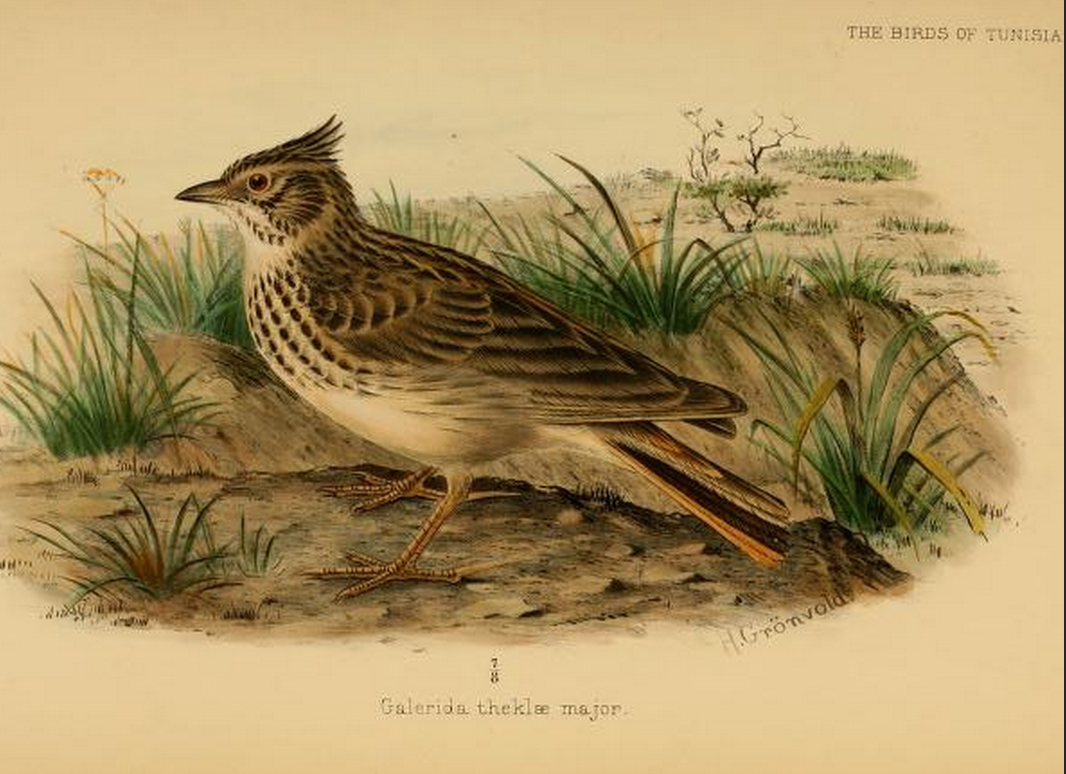
When Christian Ludwig Brehm received a series of larks his sons had collected in Spain, he found that the birds

differ on even the very first glance so much from all the other crested larks that there can really be no dispute about the validity of this new species,

a species he named Galerita Theklae, “Thekla’s Haubenlerche.”

We have named this lark for our unforgettable daughter, who died on July 6, 1858, in her twenty-fifth year.

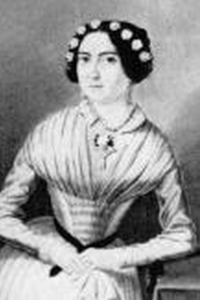
Thekla Klothilde Bertha Brehm

Touching indeed — especially given that the bereaved father was writing no more than three weeks after the young woman’s death.

Touching, but largely ignored in English-speaking ornithology, which almost with one voice calls this bird the Thekla lark, flouting the otherwise carefully preserved rule of the possessive ‘s.

I suspect that a misunderstanding of the German “Theklalerche” is behind this lapse — that someone at some time failed to recognize a personal name in “Thekla” and read it instead as, say, a geographic label.

And that is an injustice to both Brehms, father and daughter. If we’re going to have “Baird’s sparrow,” let’s also have Thekla’s lark — or better still, let’s lose all those possessives consistently.

Share

Bizarre Blackbird Behavior

The wildlife watching declines once you leave the state highways for the interstates, but it’s still easy enough to pick out the big showy things, from pronghorn to grackles.

Day before yesterday, as we were crossing southern Minnesota on Interstate 90, I spied a white-tailed deer standing in the ditch.

No big deal, as long as it stays off the road. But I did a 70-mph double-take when I realized that there was a male red-winged blackbird perched on the animal. The bird was reaching forward as if to take something from the deer’s back.

It’s not unusual to see cowbirds riding the eponymous livestock, but I can’t remember having seen red-wings on a wild ungulate. Have you?

Share

A Towhee Type

We’ve been a bit far north these past couple of weeks to have a real chance at green-tailed towhees, but we’ve been keeping eyes and ears open just in case one of those lovely sparrows — some say the loveliest — should happen to “overshoot” on its way to the breeding grounds.

As yesterday’s entry here pointed out, the generic affinities of the species were matter for discussion and debate for a long time. Beyond that question, though, there was another, more material: For twenty years after the species’ first description, we just didn’t know exactly what a green-tailed towhee was.

The species was first published by Audubon, as the green-tailed sparrow, in the last volume of the Ornithological Biography. Audubon never saw the bird himself, and never painted it; he bases his description of this “true Fringilla” instead on what seem to be two separate letters from John K. Townsend, who shot a “new and singularly marked Sparrow” on July 12, 1834. Townsend informed Audubon that

the specimen is, however, unfortunately young, and the plumage is not fully developed. I feel in great hopes of finding the adult….

In what appears to have been a subsequent letter, Townsend is forced to report that

In this I was, however, disappointed: I never saw it afterwards.

In fact, it was not until September 1842 that the towhee seems to have been encountered again — encountered, but not recognized. Somewhere in the Rockies, “about half way between New Mexico and the Colorado of the west,” William Gambel collected a single male of a bird that he named Fringilla Blandingiana, in honor of the discoverer of the turtle. Gambel was almost certainly aware of Audubon’s publication of the green-tailed towhee, but his bird, unlike Audubon’s, was an adult, and neither Gambel nor his colleagues at the Philadelphia Academy put the two together.

Six years later, in 1848, Baron de Lafresnaye received an adult bird in a shipment of Mexican and South American specimens sent by a M. Salé to his mother. Obviously unaware of Gambel’s description, and apparently likewise failing to compare it to Audubon’s, Lafresnaye described this “touit à coiffe rousse” as a new species, Pipilo rufo-pileus — thus assigning the species for the first time to the genus Pipilo.

It did not help that the original Townsend/Audubon specimen had somehow slipped into obscurity. John Cassin in 1855 asserted expressis verbis that there had never been such a skin — in spite of Townsend’s clear claim to have taken the specimen.

What gives?

It would take a few years to figure it all out, but clarity shone forth with the publication in 1859 of the ornithological volume of the Pacific railroad surveys. While Spencer Baird was still using the name blandingiana in 1852, seven years later he, with Cassin and George Lawrence, was able to determine that blandingiana and rufopileus were mere synonyms of the Audubonian chlorurus.

And they were able to do so because the Townsend specimen had turned up — in Baird’s own cabinet, whence it passed into the collections of the Smithsonian as number 1896. Comparison of that skin with a slightly older male specimen and a series of adults led them to conclude that the Townsend skin

is unmistakeably the Pipilo here described, and settles the question in favor of the priority of the name chlorurus.

The odd outlier aside (Ridgway cites blandingiana as late as 1868), that has been the bird’s specific epithet ever since. And if anyone doubts that it should be so, Townsend’s bird from July 1834 still lies peaceful on its back in Washington.

Screen Shot 2015-05-31 at 1.10.03 PM


Share