Other People’s Bird Books, Again

Mark Catesby’s Natural History enjoyed a surprisingly vigorous Nachleben in the eighteenth century. Among its many continental reflexes was this Dutch work, published in the 1770s and incorporating Catesby’s work into a whole vast kaleidoscope of “foreign and curious” birds.

Screenshot 2015-07-23 11.34.06

This copy, available on line at the wonderful Biodiversity Heritage Library, now lives in the Smithsonian Library. I know nothing about its provenance, but I do know that one user treated the book with rather less respect than it deserves.

Screenshot 2015-07-23 11.29.05

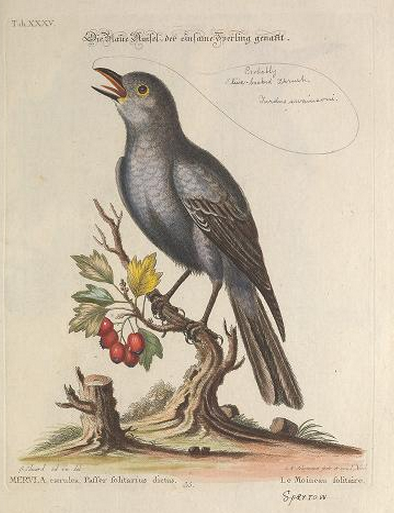
Plate 35 is, well, exactly what the captions, German, Latin, and French, say it is: “the blue thrush called the solitary sparrow.” (The top caption is in German because Houttuyn was working from Seligmann’s translation.) The “solitary sparrow” is an old name for the blue rock thrush, as all Italian schoolchildren know. But our not so pius commentator didn’t get it.

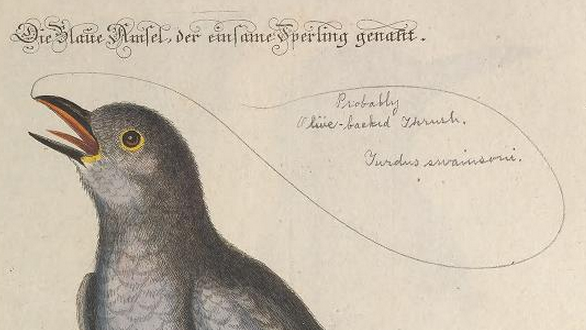
After helpfully translating the French “moineau” at the bottom of the leaf, he then drew a speech bubble coming out of the bird’s open bill.

Screenshot 2015-07-23 11.29.25

The bird itself speaks its identity, “probably olive-backed thrush, Turdus swainsoni” — our Swainson’s thrush.

If you’re going to deface a book, at least get it right.

Share

Ecclesiastical Tanagers

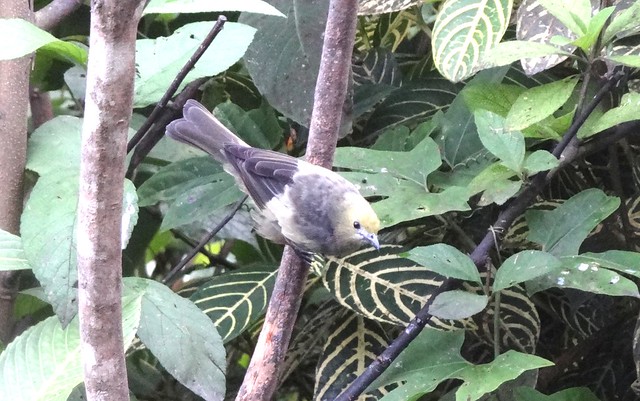
Palm Tanager

Among the birds discovered by Freyreiss and Maximilian in Brazil was a glossy gray-green tanager, a lively bird encountered in almost every dense tangle of palm fronds along the coast.  

But back up. “Discovered” may be saying too much.
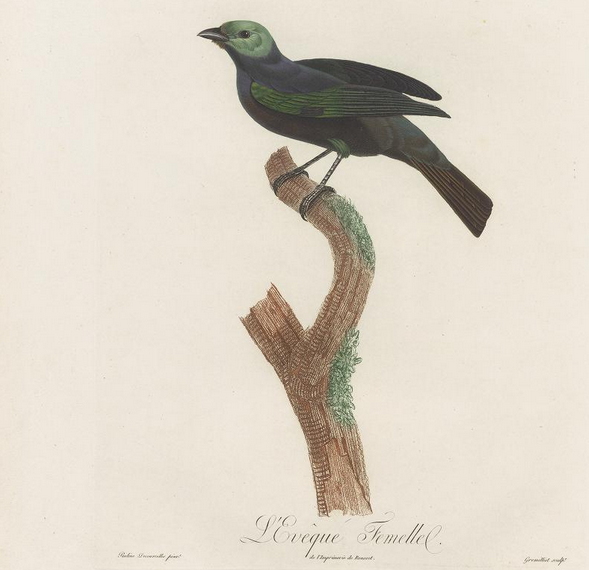
Desmarest, T episcopus = palmarum

As Maximilian himself pointed out, the palm tanager was already known to European science, just misidentified:

This bird has hitherto been treated as the female of the Tanagra Episcopus, and it is depicted as such in Desmarest. This is an error, however, as Tanagra Episcopus, or Sayaca (the Sanyaçú of the Brazilians of the east coast), is very different from this supposed female, a bird of which we have often received both sexes, which resemble each other quite closely. This latter bird, formerly thought to be the female, is entirely different from the Sanyaçú even in its very soft, twittering voice. Because it is constantly found among the cocoa palms, I name this bird Tanagra palmarum.

I have to confess that before I read this passage this morning, I’d forgot that the blue-gray tanager was named “bishop.” And now I’m wondering why.
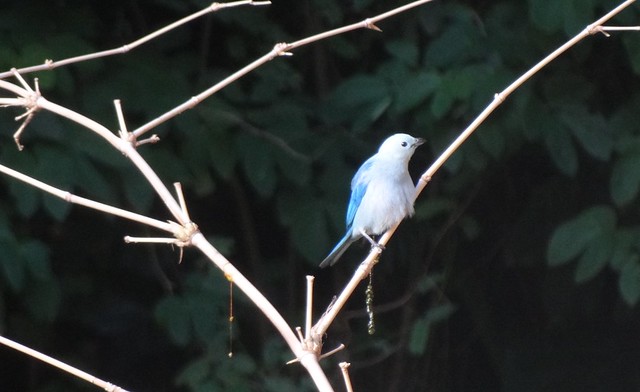
Blue-gray Tanager, Tobago

This pretty and familiar tropical thraupid barely escaped being called virens, a name — meaning “greenish” — that would have made less sense even than most tanager names. Instead, thanks to some timely intervention by the ICZN, it still, again, bears the Linnaean epithet episcopus, making it one of those almost innumerable birds named for churchmen and churchwomen, from popes all the way down to nunlets and monklets. So how did Linnaeus come to name this tanager in particular episcopus, the bishop bird?

Screenshot 2015-07-15 14.04.56

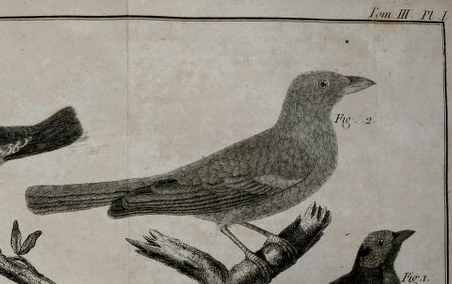
The short answer: It wasn’t his idea in the first place. We tend to credit (or more often to blame) the Swedish nomenclator for all the scientific names with his initial after them, but in fact, a goodly number — anybody know offhand just how many? — of the names in the Systema were not coined by Linnaeus but adopted from his many sources. This is one of them. Linnaeus called the tanager episcopus because Mathurin Brisson had done it first.
Screenshot 2015-07-15 14.24.10

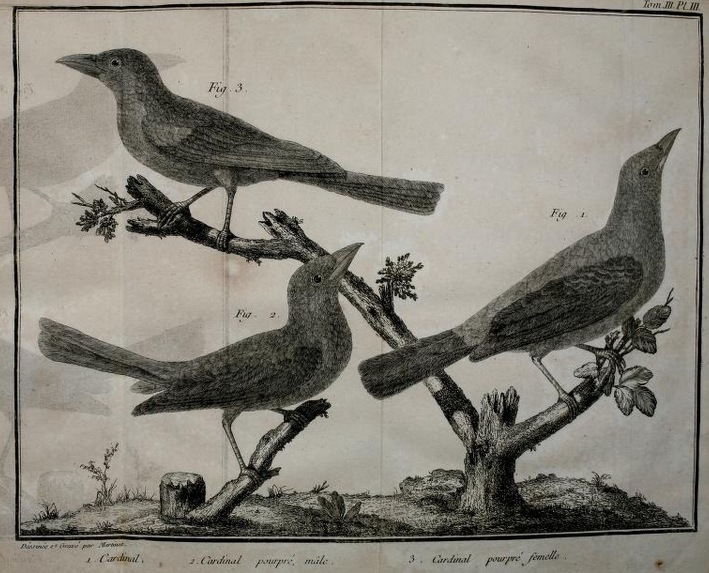
Brisson gives a very detailed description of the specimen in Réaumur’s cabinet, sent from Brazil by two French collectors; but he offers no clue as to why it should have been appointed bishop among the birds. Perhaps it was the episcopal hue of the lesser coverts, “grayish white with a hint of violet,” though that seems a bit of a stretch. More likely, I think, this was Brisson’s witty way of easing the transition between his accounts of the various tanager species and those that immediately follow in his Ornithologie.
Screenshot 2015-07-15 14.42.07

What better way to introduce the full suite of cardinals than with a bishop?

Brisson’s gentle joke had, as they say, legs. Not only did Linnaeus immortalize the name episcopus, but his successors found in it the inspiration to create an entire little curia of ecclesiastical tanagers.
Desmarest, L'´vêque

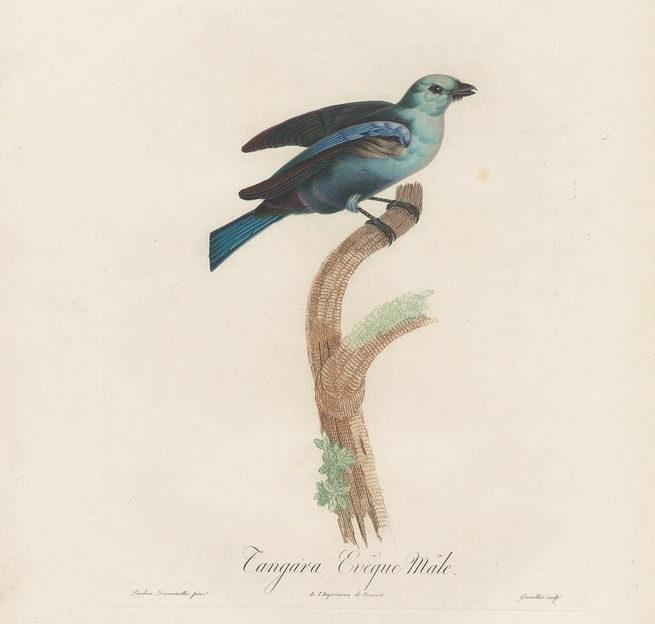
Desmarest, in his 1805 Histoire naturelle des tangaras, des manakins et des todiersretained what he thought were both sexes of the “tangara évêque,” and added to the ranks a Peruvian bird brought to the Paris museum by a French collector, a bird he named Tangara archiepiscopus, the archbishop tanager.

yellow-wigned tanager, Desmarest

Desmarest had access to specimens of both sexes of this species, resulting in the odd caption “the female archbishop” — surely something that led to a little bemused head-shaking even in Napoleonic France.
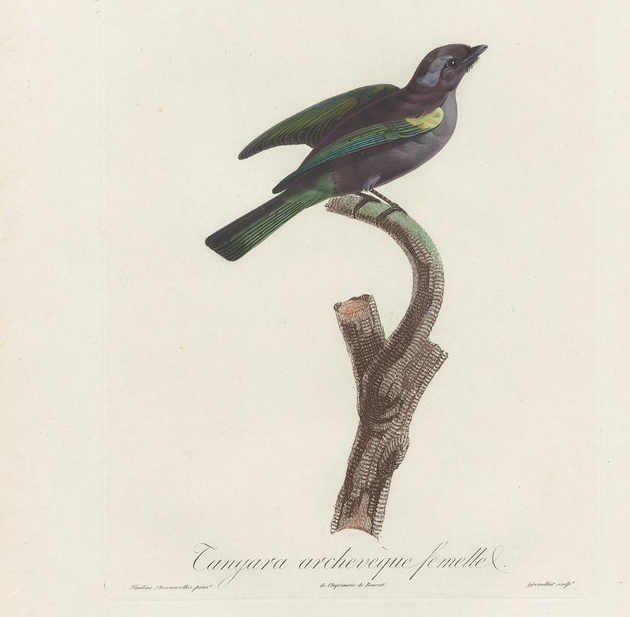
Desmarest, female archbishop tanager

Unfortunately for Desmarest, this species, known today as the golden-chevroned tanager, had already been described by Anders Sparrman a generation earlier, from a specimen the Swedish naturalist thought had been collected somewhere in the East Indies.
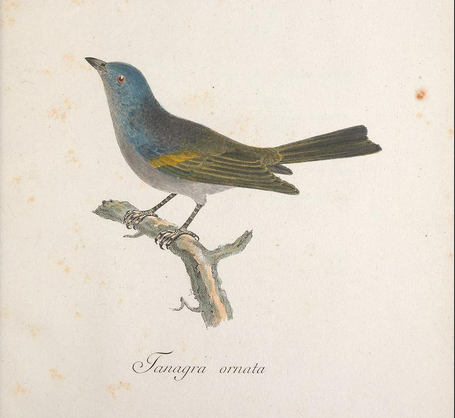
Golden-chevroned tanager, in Sparrman, Mus Carl

Today, the bird is stuck, and we are stuck, with the accurate but not very evocative name Sparrman gave it: ornata.

Accuracy and priority proved only a minor setback to tradition, however.

In 1830, Hinrich Lichtenstein prepared a list of specimens sent back to Berlin by the German collectors Deppe and Schiede; those skins representing species already held in the Berlin museum were offered to private collectors “for cash payment in Prussian courants.” Some of those specimens represented still undescribed species, making Lichtenstein’s Preis-Verzeichniss the location of original publication. Among the nova: a yellow-green, blue-headed tanager with black wings with a yellow panel. Lichtenstein named it Tangara Abbas, the abbot.
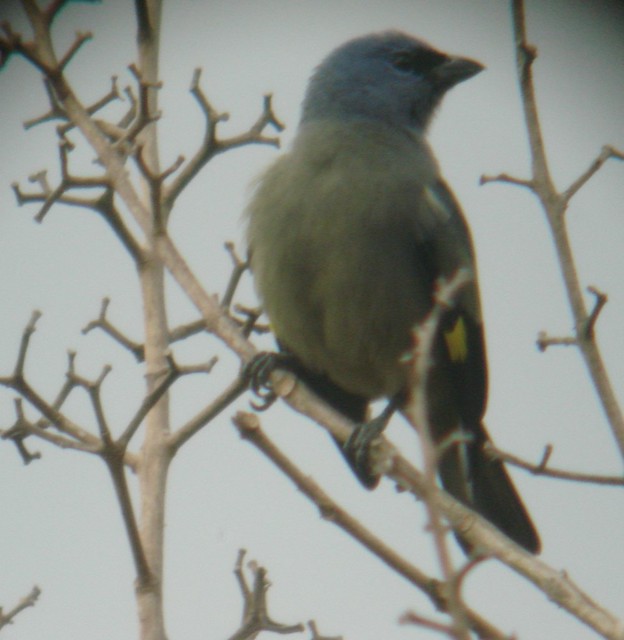
Yellow-winged Tanager

It has been suggested, with no contemporary documentation, that “abbas” refers in a roundabout way to the given name of a man, Abbot Lawrence, who may or may not have met one or the other of the Deppe brothers sometime or another.

As far as I can discover, no one else has ever come close to believing that, and when this lovely little bird of Mexico and northern Central America hasn’t been called the yellow-winged tanager, it’s gone by the English name abbot tanager — not “Abbot’s,” as one would otherwise expect.

Apart from that slender shred, there’s an additional bit of far more convincing evidence that places this tanager, too, firmly in the tradition of ecclesiastical names.
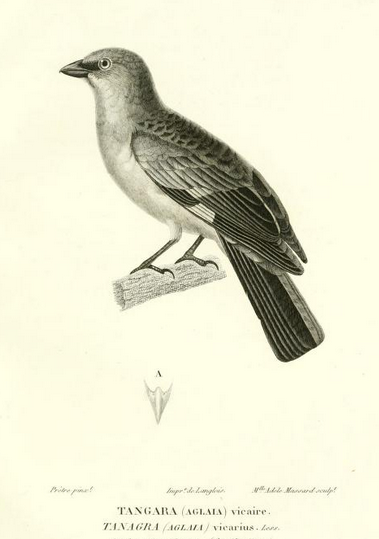
Lesson, Cent Zoo, drawing Prêtre

For all his great merits, René-Primevère Lesson was notorious — is still notorious — for the utter lack of respect he showed for other ornithologists’ nomenclatural acts. When Lesson turned to this species in 1831, which he found represented by several skins that had been shipped from Mexico to Paris (take that, Prussians), he simply renamed it, calling it Tanagra vicarius, “le tangara vicaire,” the vicar. Lest his reader overlook the clerical connection, Lesson compares the vicar to two other tanager species — the bishop (our blue-gray) and Tangara prelatus, the prelate tanager (Lesson’s name for the palm tanager).
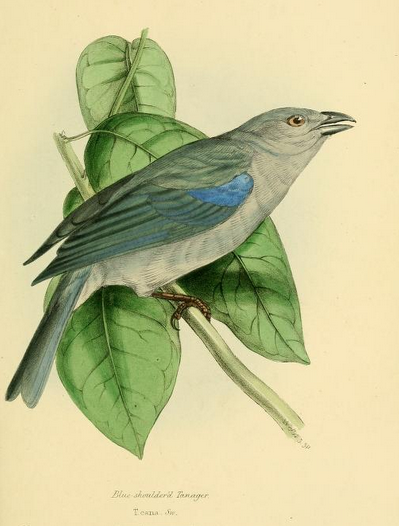
Swainson, cana blue-gray tanager

Lesson was at it again in 1842. Eight years earlier, William Swainson had published a new bird he called the blue-shouldered tanager, Tangara cana; if I’ve kept up, this is now considered a subspecies of the blue-gray tanager (and I think it was this race that was introduced into Florida).

Lesson gave this taxon, too, a brand new name, Tangara diaconus, the deacon tanager. Could the theme be any clearer?

The synonymy of the tanagers is nearly as complicated as that of the hummingbirds, and has been so for more than 150 years. In the very middle of the nineteenth century, three ornithologists — Cabanis, Sclater, and Bonaparte — all set out, independently, to work out the relationships among the known species and to give them clear names, with the predictable result that not a few tanagers suddenly had three new names to go along with whatever old ones might have been attached to them before.

The eventual clearing up of the taxonomic mess, to the extent it was possible, was obviously a consummation devoutly to be wished; but it cost us those Lessonian tanager names, and with them a glimpse into what just may have been the longest-running gag in ornithological history.
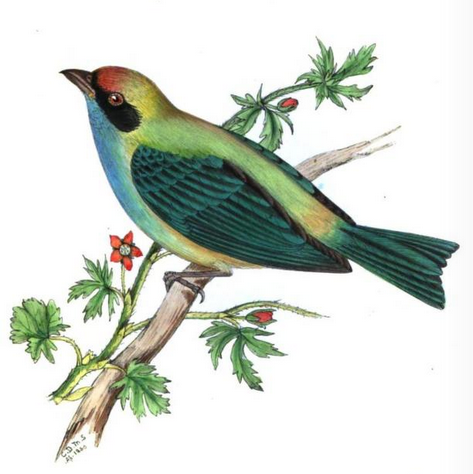
Screenshot 2015-07-15 20.31.46

Share

Max’s Musical Jungle Thrush

Levaillant, HistNat d'une partie 1801

After all that, Prince Maximilian and his companions were mighty glad to be on terra firma again, and they spent the next nearly two years exploring the wildernesses of Brazil.

Thanks largely to the expatriate ornithologist Georg Wilhelm Freyreiss, Maximilian was able to record something along the lines of 400 bird species — as then understood — during his time in South America: 30 diurnal raptors, 8 or 9 owls, two dozen parrots, 5 toucans, 3 trogons, 11 cuckoos and barbets, 9 or 10 woodpeckers, 4 kingfishers, a jacamar, about 16 hummingbirds, about 10 woodcreepers, 2 xenopes, 9 orioles and caciques, 6 thrushes, 23 tanagers, and on and on.

Some of these birds, Maximilian writes, are also known from North America or even Europe, but others seemed to be unknown altogether, including this familiar bird of the tropical forest:

In a wild untouched forest of tall, tangled trunks we were startled by the odd choral singing of a bird that was new to us. The whole jungle echoed with its extremely weird, loud whistling, composed of five or six penetrating notes. These noisy forest dwellers had gathered here in whole flocks, and whenever one let its voice ring out, all the others joined in immediately.

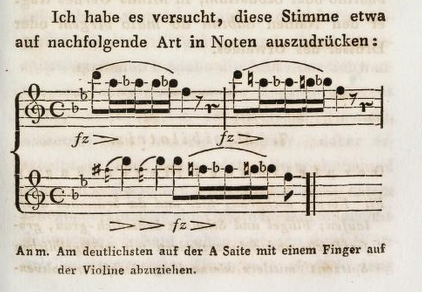
Figured it out? Maximilian actually described this species twice, the second time including a helpful recording, à la 1830, of its voice:

Beitrr zur NatGesch Brasiliens

The effect is most realistic, he says, if the phrases are played glissando on the A string of a violin. (The brace joining the two staves is an engraver’s error.)

Not to take anything away from Maximilian, Freyreiss, and their collectors, but the screaming piha wasn’t really quite as unknown as they thought.

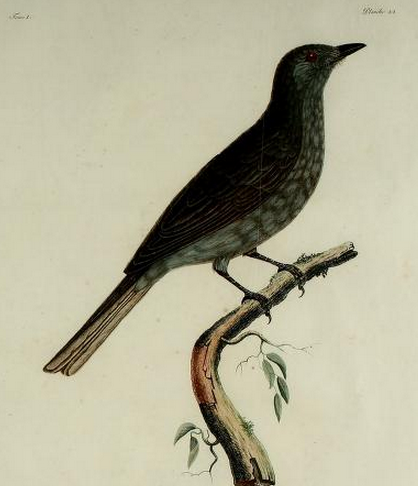
Fifteen years before the prince and his party had set foot on Brazilian soil, François Levaillant described a bird he called the ashy cotinga. The Frenchman had never seen it in life, only as a skin in the collection of Louis Dufrêne, taxidermist at the MNHN; Levaillant admitted that he was fairly unimpressed.

Nature, who has shown herself so munificent towards the cotingas in general, seems to have forgot that this bird even belongs to the family; for there is nothing more humble and less varied than its plumage.

Be that as it may, Louis Pierre Vieillot gave the bird a scientific name in 1817, simply translating Levaillant’s as Ampelis cinerea; he would repeat the name, this time altered to cineracea, in 1822. Unfortunately for Vieillot, Ampelis cinerea was pre-occupied by another cotinga, the lovely Pompadour, and cineracea, obviously, must yield to Maximilian’s name by simple priority.

The prince called it vociferans, and if you’ve ever stood in the jungle and been deafened, you’ll agree that it’s the best possible name for the noisiest possible bird.


Share

Maximilian in Brazil — Almost

Screenshot 2015-07-11 11.03.33

Two hundred years ago today, after seventy-two days at sea that were anything but pleasant, Maximilian zu Wied-Neuwied thought he might finally set foot on the continent of South America.

It didn’t happen.

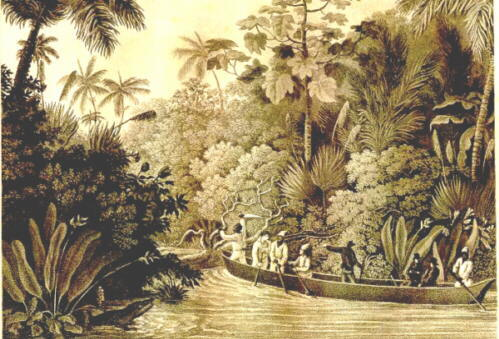
As an almost imperceptible wind had arisen around 11:00, our ship’s progress was barely noticeable, even with the help of all the sails. We decided to use this time of forced inactivity to make our first acquaintance with the soil of Brazil by exploring one of the rocky islands.

The prince, the captain, a few sailors, and two other paying passengers climbed into the boat and set out.

The sailors rowed ahead, but without noticing that our boat was taking on a great deal of water: it had been secured at the back of the ship, and had dried out severely in the heat of the sun. When we’d been working our way through the high swells for half an hour, we found ourselves obliged to bale the water that had seeped in; but we had nothing to do it with, so we had no choice but to take off our shoes and use them.

It got worse. When the boat finally reached the island they’d chosen, the little party discovered that its shores were steep and rugged, covered with an impenetrable tangle of roots and branches.

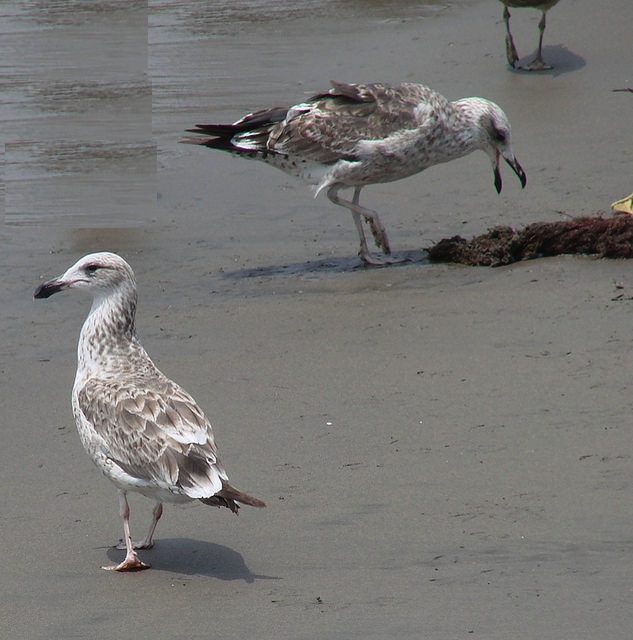
The enormous surf, crashing into white foam, raged so violent that we had to be respectfully content with admiring the beautiful vegetation of the island from a distance, finding pleasure in the song of the birds that showered down on us…. Great numbers of gulls, white with black backs, stood in pairs atop the cliffs…. we shot at them over and over, without securing a single one.

Kelp gulls, Peru
Kelp gulls, Peru

After an hour or so, the boat turned around to rejoin the ship.

But it was no longer to be seen. Now our situation was troubling. The entrance to the Rio harbor is dominated by ocean currents that cause ships to drift away from their course without the crew’s noticing, and more than a few have been wrecked that way. Our sailors pulled hard against the high swell, without knowing what direction our ship was in.

Finally they saw the masts of the Janus in the distance, and all spent that night aboard, in eager anticipation of their first visit ashore — the next morning, July 17, 1815.


Share