Smith’s Painted Buntling

There are but few things I miss from those long-ago years in Urbana, and this clown-faced calcariid is one of them.
Like clockwork, end of March every year we would get out and walk the foxtail-choked stubble of last year’s corn, and there they were — the first northbound Smith longspurs of the spring.
There was an extra piquancy to finding these birds in our neighborhood, as the first individuals ever met with by western scientists in the US had been found not all that far away, in southern Illinois, in April 1843, as Audubon’s last expedition was preparing to leave St. Louis for the upper Missouri.

Edward Harris and John G. Bell, Audubon’s New Jersey patron and his hired preparator, respectively, had left the old man in the city and set off for the prairies to the northeast, where they busied themselves for two weeks exploring and collecting. Bell reported that they had found an unfamiliar bird “very abundant,”

generally in large flocks, and when on the ground began at once to scatter and divide themselves, rendering it difficult for us to shoot more than two at one shot; they run very nimbly….

Harris and Bell were up to the challenge, though, and eventually secured “several specimens,” two of which made their way into the Smithsonian collections (first, it seems, as personal gifts from Audubon to Spencer Baird) and one of which apparently remains there (it is impossible to reconcile the locality and age information provided in the electronic specimen record with what Baird says of the skin).

Audubon did not recognize the little dead finches, either, and he published them as representing a new species, the Smith lark-bunting, Plectrophanes Smithii. The name honored his “good friend Gideon B. Smith, Esq., M.D.,” the entrepreneurial entomologist whom Audubon had visited in Baltimore at the start of his 1843 voyage.

The practiced eye will have noticed in that last paragraph that while Smith is still commemorated in the bird’s official English name, he goes unmentioned in the current scientific name, Calcarius pictus (“painted spur-bird“). This not uncommon circumstance — have a look at the hawk and the sparrow named for Edward Harris, to take two well-known examples — typically arises when a competing scientific name is found to have priority only after the English name has attained currency; it’s no surprise in North American ornithology that Audubon, a powerful voice and a not always careful bibliographer, is so often prominent in these stories.

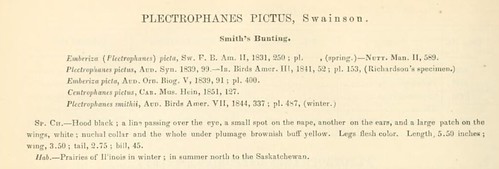
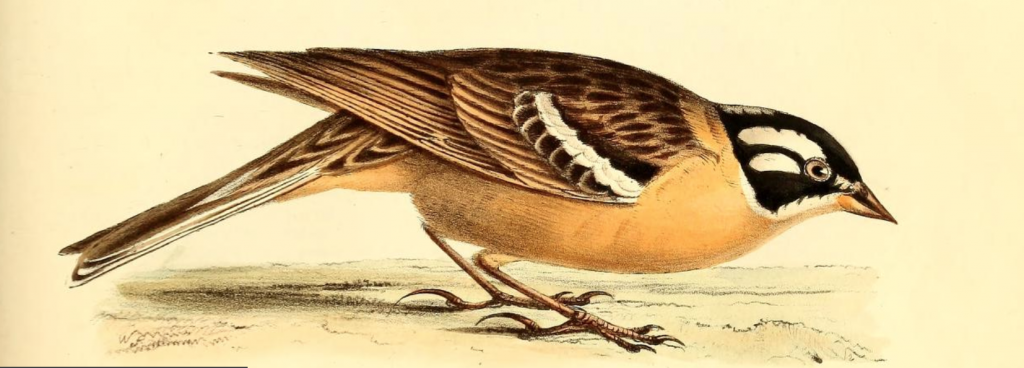
In the case of the longspur, it is entirely understandable that Audubon and his companions in St. Louis overlooked the fact that the species had been published and named more than a decade earlier. William Swainson’s handsome lithograph of a single male shot on the banks of the Saskatchewan River in April 1827  (the specimen once in the collections of the Zoological Society of London, but now apparently lost) was completed in 1829; the formal description and name, Emberiza picta, were published in the volume dated 1831 of the Fauna boreali-americana.
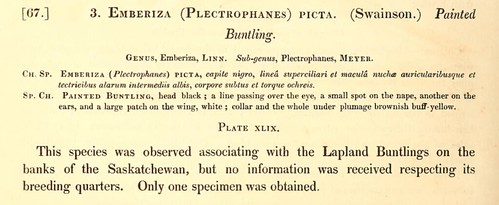
Smith longspur 1827 specimen

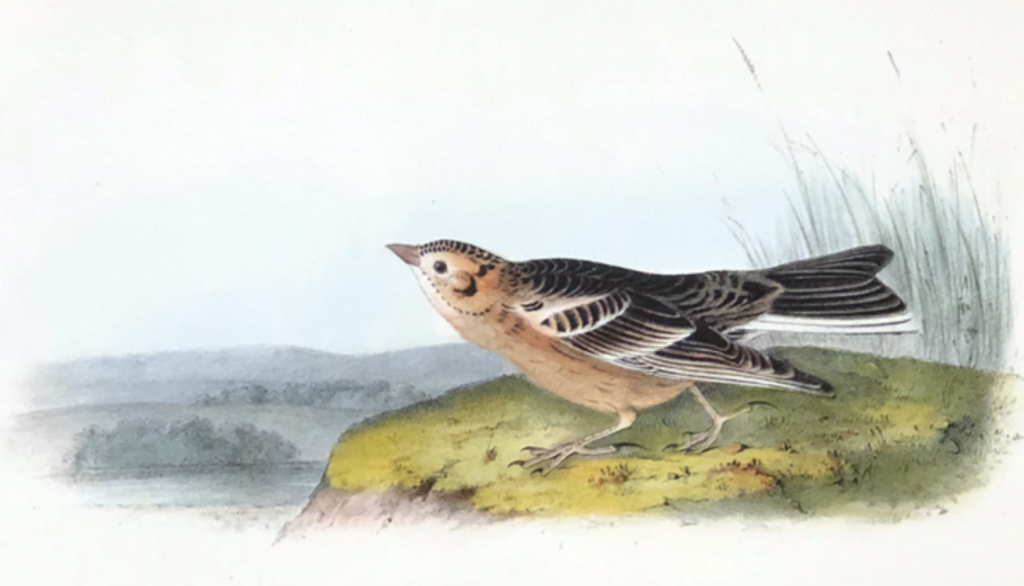
Swainson’s lithograph, the first image above, shows the bird in all its springtime glory, but Bell and Harris were less fortunate. Though these longspurs can be quite bright indeed as they pass through Illinois, Audubon’s plate, the second above, shows that his companions encountered, or at least shot, only females or males still early in their pre-alternate molt. Though Audubon’s use of the name “lark-bunting” suggests that he may have recognized the novum as somehow longspurrish, there is really no reason to expect that he, Harris, and Bell should have recognized their smudgy brown birds as identical to the dapper badger-faced creature from Carlton House.
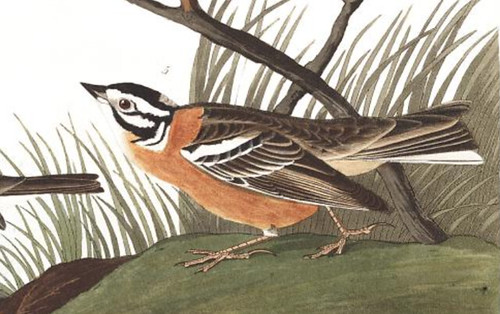
Audubon painted bunting Smith longspur plate 400

And that in spite of the fact that Audubon himself had experience, in the field and in the hand, with Swainson’s “painted buntling.” (Extra credit, by the way, if without benefit of google you can identify the tail in Audubon’s image.) To prepare his plate for the Birds of America, Audubon borrowed the original Saskatchewan skin of “this handsome species” from the Zoological Society. Examining the specimen in the 1830s, he was reminded of something he had seen himself on the wintertime prairies:

That the Painted Bunting at times retires far southward, probably accompanying the Lapland Longspur, is a fact for which I can vouch, having seen one on the shore of the Mississippi in December 1820, which however I missed on wing after having viewed it about two minutes, as it lay flat on the ground.

Though is not entirely unheard of for male Smith longspurs to appear in breeding aspect in early winter, Audubon was certainly fortunate to witness the phenomenon — and to remember it so clearly nearly two decades later.

The phantom from Illinois survived in the scientific literature for the better part of a decade, listed on Audubon’s authority as distinct from the Swainsonian picta by no less than George Robert GrayJean Cabanis and Charles Bonaparte.

Baird et al. 1858 Smith longspur

Sometime in the 1850s, it was somehow determined that Audubon’s Illinois bird — the longspur he named for Smith — was in fact simply the “immaturely marked” plumage of Swainson’s painted buntling. Whatever debate and discussion may have taken place seems to have gone on behind the published scenes, but the ever so slight broadening of the specimen record available to Baird, Brewer, and Ridgway may have helped: the two Robert Kennicott skins (neither of which I can find in an NMNH search) bracket the migration of the species through the Mississippi Valley, and I assume (dangerous thing, that) that they provided the points of triangulation to finally confirm the identity of the earlier Illinois specimens.
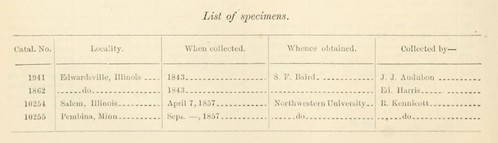
Smithsonian Smith longspur 1858 specimens

It was Baird and his collaborators who struck the nomenclatural compromise by recognizing the priority of Swainson’s picta/us but retaining Audubon’s vernacular tribute to Gideon Smith. We should continue to think of the good doctor whenever we see this species, but I hope that next time we run into one — on the breeding grounds or on migration through a chilly midwestern field — we try to remember, too, that it took years of effort by some of the century’s most important ornithologists to figure out that two species were in fact only one.

 

Share

The Aromatic Oriole

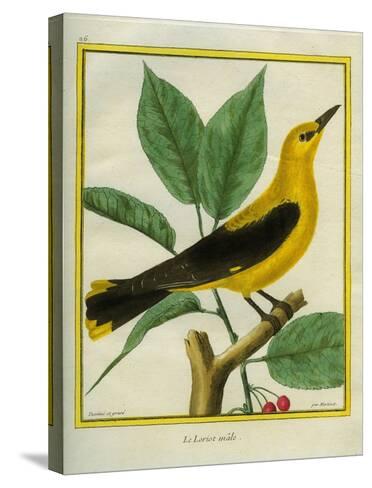
Golden Oriole

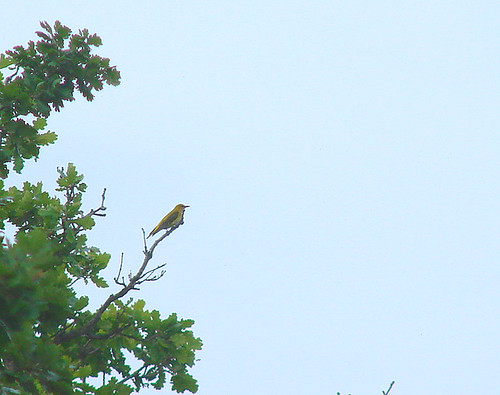
Wow. Yes, this seems to be the best photograph I have of a golden oriole, taken a few years ago in the days leading up to our Birds and Art tour of Burgundy.

But what I’m concerned about this morning is not my photographic aptitude but one of the odder names assigned this lovely bird, the German “Weihrauch.”

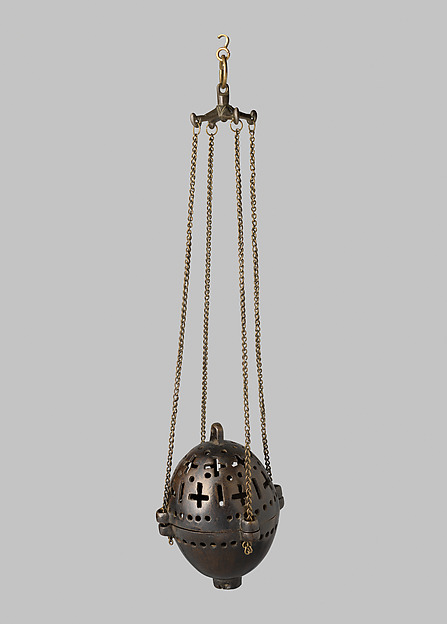
A twelfth-century copper alloy censer, Germany; now in the Met.

“Weihrauch,” literally “holy smoke,” just means “incense.” It’s not impossible that oriolids are fragrant in the hand — plenty of other birds are, from auklets to shrikes. In this case, though, that theory would throw us off the scent, so to speak; instead, “Weihrauch” is the product of that familiar linguistic process called folk etymology.

Folk etymology is not the same as fake etymology, the pseudo-scholarly fabrication of connections between words that are in fact not historically related. Want to see some fakes? Just spend a little time on the internet, or even, if you can bear it, talking to people.

Fake etymology is a process of explanation. Folk etymology is a process of creation, in which an unfamiliar word or form is altered to resemble a familiar one. One of my favorite examples: the name “tiger meat” for the spicy midwestern bar food arose, I suspect, from “beef tartare,” when the incomprehensible “tartare” was humorously transformed into an animal name. Good ol’ google turns up plenty of other specimens.

It turns out that among the many, many echoic names given the bird with the golden voice is the German “wîrôk.” (I don’t hear it, myself, but Suolahti tells us so.) Johann Leonhard Frisch fills in the rest of the story:

The two final notes of the bird’s song sound like “i” and “o,” and so “i” and “o” occur in all of its names…. Some have assumed that the name Wyrock, with the long “i” and “o,” must be Low German, and so mispronounce it “Weihrauch,”

self-consciously and hypercorrectly running the name through a High German diphthongization to make it more comfortingly familiar, if semantically a bit bizarre.

Folk etymology becomes especially interesting when its products inspire sometimes fantastic “back stories” to explain them. I haven’t run across any narratives contrived to explain “Weihrauch” (not yet, at least), but the ecclesiastical association may be behind another folk name for the species listed by Naumann — “Bruder Wyrauch,” “Brother Incense.” I plan to use that one from now on myself.


Share

Parrot of the Month

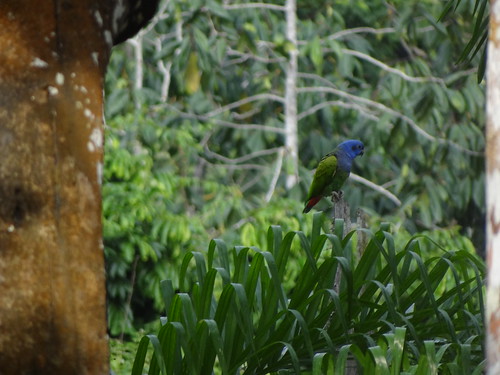
blue-headed parrot, orange-cheeked parrot

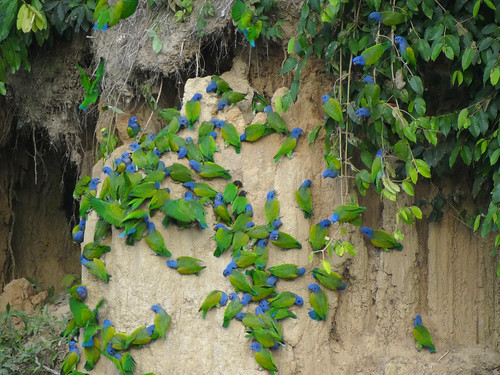
Of all the breathtaking lot of parrots, few are as likely to leave the birder agulp as the stunning blue-headed parrot, a widespread and common bird from southern Central America to Bolivia and Brazil.

The dazzling swarm in the photo above was at one of the famous clay licks of Peru, but this species burned its way into my memory years before I saw them there, when a single individual flew beneath me as I was perched high on a tower in Panama, its head out-bluing the tropical sky.

And being who and what and as I am, at the very same moment a question pierced my mind, one that has nagged me ever since: What’s so menstruous about Pionus menstruus?

blue-headed parrot

Nowadays, questions about the scientific names of birds are easily answered. We have James Jobling’s considerable store of erudition at our fingertips, and in the few cases where that doesn’t help, all the wealth of the Biodiversity Heritage Library is there for the mining.

But I’m stymied.

The name is Linnaean, appearing first in the twelfth edition of 1766.

1766 Syst nam Psittacus menstruus blue-headed parrot

The Archiater’s Latin diagnosis of the newly named parrot is quite thorough, beginning with the fact that Dr. Petrus Bierchen reports from Suriname that the bird has a voice like a jackdaw.

The body is the size of a turtle dove’s. The head and neck are bluish, the feathers dusky but blue at the tip. The back and wings are green. The wing coverts are yellowish green. The belly is greenish, the feathers bluish at their tips. The remiges are green, dusky on the inner vane. The rectrices are green, becoming blue at their tips, but numbers 1, 2, and 3 are blood-red on the inner vane, from their base halfway out; the outer vane is entirely blue. The crissum is red, the tips of the feathers yellowish blue. The bill is horn-colored: the upper mandible reddish on the edges. The eyes are black. The eye rings are bluish grayish.

No real onomastic clues here, and neither of the authorities Linnaeus cites — George Edwards’s 1758 Gleanings and the fourth volume of Mathurin Brisson’s Ornithologie — offers any hints. It is notable — if purely incidental to my question — that all three of the scientists relied on different sources for their knowledge of the bird: Linnaeus’s type had been supplied from Suriname, Edwards was working from a live individual in London, and Brisson had access to a specimen labeled as originating in Martinique.

Buffon and his collaborators likewise seem to know nothing about the odd Linnaean name. The OED and the Century are of no use, and we’re stuck with the prospect of a systematic search through “the older literature,” which in North American ornithology tends to mean anything before the publication of Ridgway, a scant century ago.

Johann August Donndorf’s Zoologische Beyträge, a commentary on Gmelin’s edition of the Systema, is one source Ridgway overlooked or declined to exploit for his North and Middle America (he would not have been the first to rail against Donndorf’s sloppiness as a bibliographer), but it is often productive of otherwise obscure eighteenth-century names and publications. In this case, it sends us to Statius Müller’s translation of Linnaeus, where the German systematist coins the name “Blauhals” (“blueneck”) for this species — and incidentally asks himself the same question that occurred to me more than 200 years later in Panama.

We have named it the Blauhals because we are unable to explain the name “menstruus.” I suspect that in the case of many names Linnaeus did not even intend that their meaning be understood, as otherwise he would have explained the more obscure among them himself, or assigned clearer names.

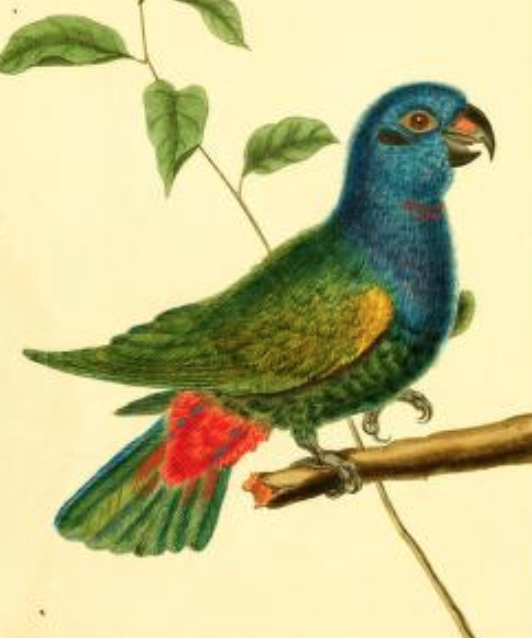
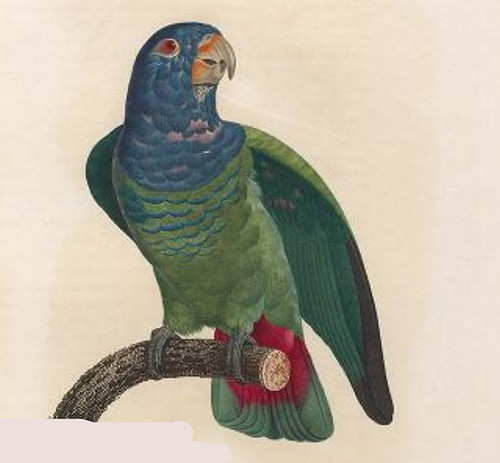
Vieillot, usually a bright light in the otherwise dim bibliographic jungle, has no comment on “menstruus,” but to make up for it, he tells us that in Paraguay the bird is called “siy,” an echoic name. Levaillant likewise says nothing about the Linnaean name; his two accounts of the species, though, are a really fine example of this explorer and ornithologist at his best, addressing everything from sex and molt to land use changes in coastal South America.

Barraband blue-headed parrot, Levaillant 1805 pl 114

And so it continues, right up to today: as far as I can find, no one seems to have known Linnaeus’s motivation, or even to have speculated about it in print. Time to widen the search, perhaps.

If I google correctly, the blue-headed parrot is the only bird in the world currently in possession of a species or subspecies epithet “menstruum/a/us.” In 1786, though, Giovanni Antonio Scopoli gave a formal diagnosis and Linnaean binomial to a woodpecker that had been collected in the Philippines by Pierre Sonnerat a decade earlier. Sonnerat described his bird:

… the green woodpecker of the Isle of Luzon [has] the entire body a somewhat dirty green; the top of the head is faintly spotted with gray; the flight feathers of wing and tail are blackish; the upper tail coverts are very bright scarlet red, forming a large patch; the feet and bill are blackish.

Sonnerat Nouvelle Guinée pl 36

Scopoli assigned this bird the name Picus menstruus, like Linnaeus before him offering no hint of an explanation. What do the two birds have in common, the parrot and the picid? Linnaeus distinguishes his parrot from the one that precedes it on the page by undertail color: he writes that the latter is “similar to P. menstruus, but its undertail is not red.” Scopoli adds to his summary of Sonnerat’s woodpecker account that “the rump and undertail are red” (my emphasis to show the addition).

Can it be that “menstruus” here means not simply “monthly” but “catamenial”? Entomology provides what may be a significant parallel: the sarcophagid name Syctomedes menstrua is a junior synonym of Syctomedes haemorrhoidalis, both names alluding to the red genitals, as if colored by flowing blood.

I know very little about Scopoli, the namer of the Luzon woodpecker and the eponym of a shearwater and a drug that helps when looking for the shearwater. Linnaeus, though, was more than capable of ignoring the blue-headed parrot’s blue head to reach for a more scurrilous name. His own contemporaries reproached him for the poor taste of some of his inventions, that notorious

Linnaean obscenity [and] licentiousness…. Science should be chaste and delicate. Ribaldry at times has been passed for wit; but Linnaeus alone passes it for terms of science.

Psittacus menstruus appears to be yet another example.


Share

The Maw of a Kite

red kite

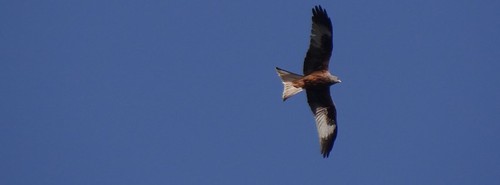
The dashing and dramatic red kite was famous in the ancient and medieval world for its boldness: snatching the caps off people’s heads and, no doubt, pestering them for French fries in proto-parking lots.

red kite

At times, that audacity served the cause of justice, as Gregory of Tours tells us in his sixth-century Glories of the Saints Confessor:

A wine merchant in Lyon decided to inflate his profits by mixing his wares with water. He succeeded to no small extent, as he was selling water for wine. Once a boatman came down the Saône to market, his purse full of coins. To pay for a purchase, he took a coin out of the purse, which was made of unscraped leather. A kite flying overhead saw the purse and because it was still covered in hair, mistook it for a prey animal and flew down and grabbed it. The kite carried it high into the sky, but when it found that it would have no food from it — for kites eat meat, not air — it dropped its prey, which disappeared into the river where it could not be seen. The cheating wine merchant found this instructive, and acknowledging his guilt said tearfully, “I have sinned and now suffer for it; I accumulated wealth from water, but I see now that all wealth falls into the water and disappears.”

red kite

The kite went away hungry, the sailor impoverished — but the merchant was saved.

Share