The Avipope

It’s funny to think that of all the tens of thousands of birds names published over the years, there was a first.

But it’s true. At the very head of the chronological list stands Linnaeus’s Vultur Gryphus, the great Andean Condor, followed by an equally impressive creature, the Harpy Eagle. And then, third on the page and third in the history of the ornithological binomial, comes this bird:

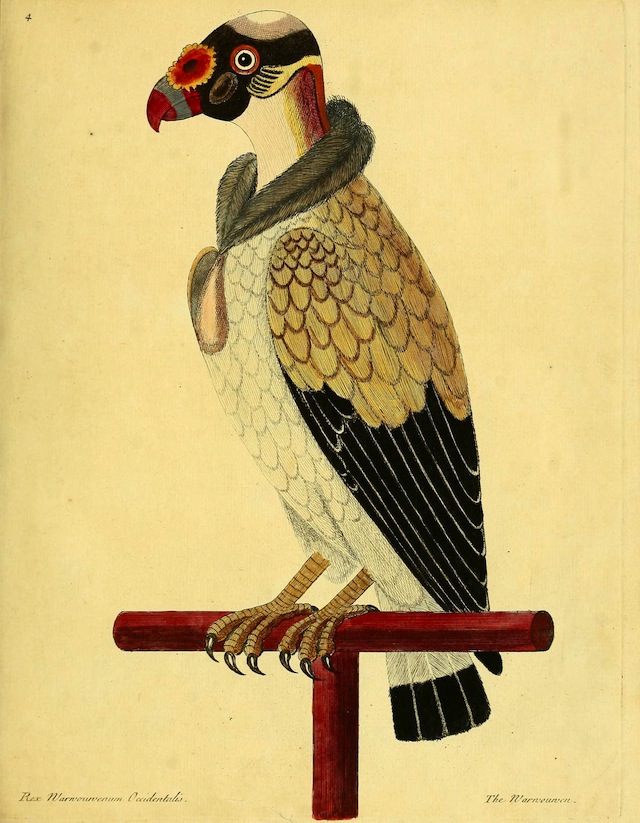
naturalhistoryof02albi_0027

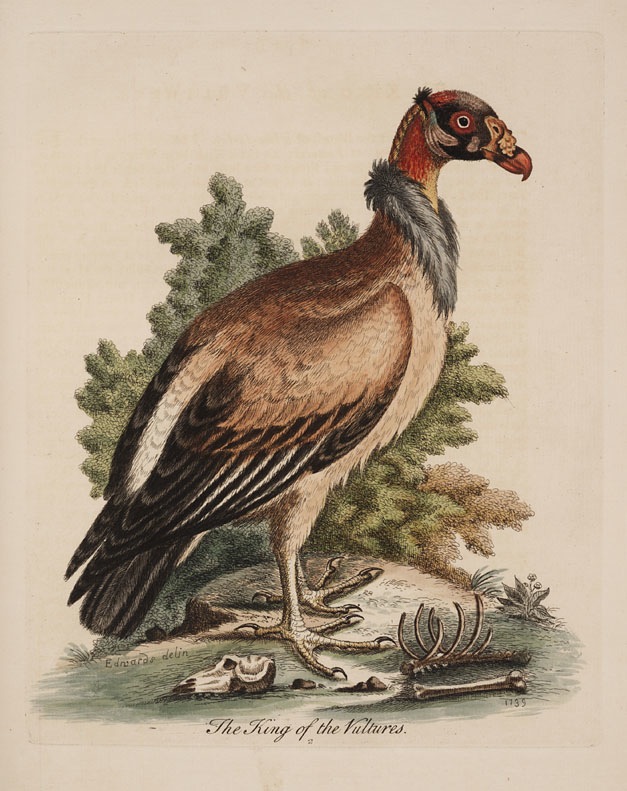
Linnaeus based his description in part on this painting in Eleazar Albin’s Natural History of Birds. Albin had encountered this specimen in the 1720s or early ’30s, “at the George Tavern at Charing-Cross, with the Cassowares,” and he adopted the name given by the bird’s “keepers” there, the Western King of the VulturesRex Warwouwerum Occidentalis. George Edwards, too, though he complains about the inaccuracies in Albin’s painting, takes over his predecessor’s name, calling the bird The King of the Vultures in his own work a decade later.

0043

The Archiater cites both men as he names the Vultur in 1758, but he declines to follow either in his choice of epithet for his “new” species. Instead of christening the bird V. rex, Linnaeus (perhaps, if I read Jobling right, inspired by a manuscript note in his copy of Edwards) looked to another form of monarchy and called it Vultur papa, the Pope Vulture.

I don’t think he meant it as a compliment.

The 1758 edition of the Systema marks the beginning of modern taxonomic history, but that same fateful year was also when all of Linnaeus’s published writings were placed on the Index and condemned to be burnt as dangerous and immoral. It’s not clear whether the Vatican’s censors had objected to Linnaeus’s graphic descriptions of the salacious lives of plants or had discovered in the Systema some hint of an attack on the “fixity” of species — but whatever the reason, I’d be surprised if the son of a Lutheran vicar took it well.

Screen Shot 2013-03-15 at 4.35.29 PM

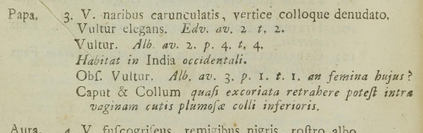
There’s no flattery, and maybe much of its opposite, in the way those terse Latin words lie on the page:

The pope (3) is a vulture with nostrils covered by warts and a naked crown and neck.

That end of the bird is further described in unappealingly suggestive terms:

He can draw the head and neck, which look as if they had been skinned, back into the sheath of the lower neck’s downy skin.

Linnaeus’s Pope Vulture — we’ve gone back to calling it the King Vulture in English, but it retains the epithet papa — stands at the head of a long line of clerical birds, cardinals and monklets and nunlets and maybe even prothonotaries, and I’m sure that some of those names, too, are meant to poke fun at their human namesakes — none of them, though, with quite the same ferocity that I think shines through here.

Screen Shot 2013-03-15 at 5.29.31 PM


Share

The Prothonotary Warbler: You Sure About That?

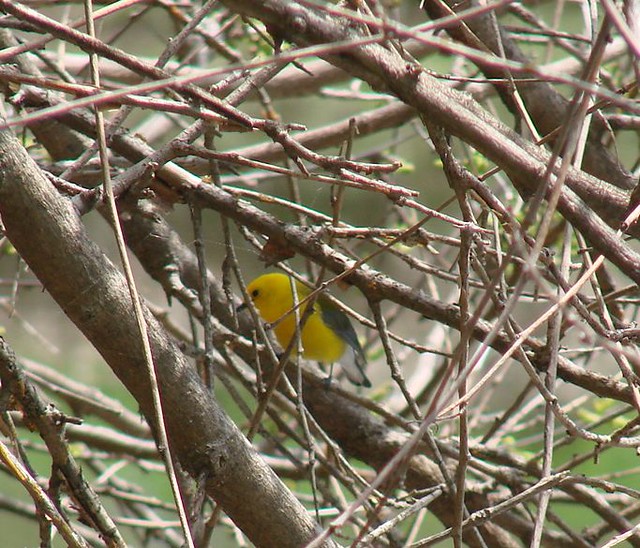
It’s the secret etymological handshake of the North American birding community: Do you know where the Prothonotary Warbler gets its name?

Knowing smiles all around; of course we do! The name alludes to the golden vestments worn by lawyers in the Roman Catholic Church, right? That’s what I’ve heard and read for all my birding life, and even Wikipedia agrees, so it must be true.

Right?

Maybe.

In birding as in all else, common knowledge is usually common — but only sometimes knowledge. Often enough, the stories we tell each other are contrived well after the fact, explanations cleverly thunk up to rationalize a set of circumstances we just don’t understand. And precisely that seems to be the case with this warbler story, a neat and often repeated solution to the problem of a name whose real origins we’ll likely never know.

Suspicion rises immediately when we see that even the most authoritative of modern accounts of this name differ significantly. Gotch, as good a first stop as any, tells us that Protonotaria 

refers to the Chief Secretary of the Chancery at Rome, who wears yellow robes.

The almost unfailingly reliable Jobling moves things to the Eastern Empire, deriving the genus name from the

late L[atin] protonotarius protonotary, a Byzantine court notary who wore golden yellow robes.

The popular literature may not be as trustworthy, but it does tend to codify received birderly wisdom. Diana Wells, in her 100 Birds, informs us that the bird’s

common name comes from its yellow plumage, the color of robes worn by papal clerks, or prothonotaries, when they met to confirm beatifications, canonizations, or other weighty matters.

Rome. Byzantium. The papal curia. Three different places, three different eras, three different bureaucratic hierarchies. Somebody’s making something up.

None of the three authors quoted offers any citation to an original source, so we have to do the work ourselves.
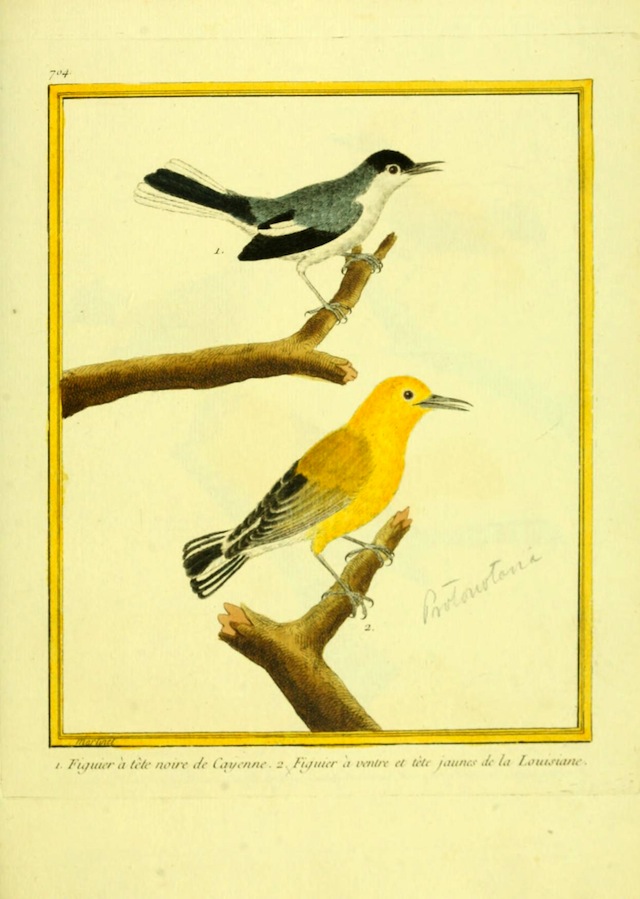
planchesenlumin08mart_0015

The name Protonotaria entered Linnaean taxonomy by way of Gmelin, who in his edition of the Systema naturae called the bird Motacilla Protonotarius, following the vernacular names given in Buffon, Latham, and Pennant. Says the last, in 1785: the Prothonotary Warbler

inhabits Louisiana. Called there le Protonotaire; but the reason has not reached us.

“The reason has not reached us.” Science was just as innocent twenty years later, when in 1807 Vieillot wrote that the name

“prothonotary” that one has retained for this bird is that imposed on it by the inhabitants of Louisiana; but no author has provided any etymology for this unusual designation.

Neither Wilson nor Audubon could offer any speculation about the origin of the name, and Bonaparte too seems to have passed over it in silence. Not even Cabanis, whose footnotes reveal such a fondness for etymologies, ventures a guess. Likewise, Baird, in elevating the name Protonotaria to generic rank, says nothing of its origins.

The reason for all this silence is simple: even the most learned, even the best-informed ornithologists of the eighteenth and nineteenth centuries did not know why the French-speaking inhabitants of the lower Mississippi had christened their “golden bird of the wooded swamps” Prothonotary. Elliott Coues, the greatest ornithological lexicographer who ever lived, could do no more than quote Pennant in the second edition of his Check List; twenty years later, the etymology offered in the final, definitive edition of the Key ends with a simple question: “Why?”
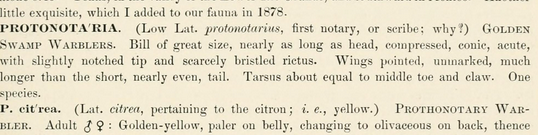
Screen Shot 2013-03-07 at 10.29.57 AM

Neither is there any attempt at an explanation in Coues’s entry for the species in the Century Dictionary; it simply follows on the definitions of “prothonotary,” without etymological comment.

I hope that my point is obvious: if those who received and described the first specimens, and those who knew the bird in life in the earliest years of American ornithology, and those whose mastery of ornithological bibliography, lexicography, and etymology was unrivaled — if none of those men could draw a connection between the cavity-nesting warbler of “wonderful orange cadmium hue” and the berobed functionaries of some exotic court, then the connection must be a recent discovery or, more likely, a recent fiction. Who’s responsible?

As far as I’ve been able to determine without devoting entire days to the search, the earliest printed attestation of the story is in Bagg and Eliot’s 1937 Birds of the Connecticut Valley, later quoted in Bent:

We understand that Protonotarius is the title of papal officials whose robes are bright yellow….

This “we understand” is a bit hard to parse: are Bagg and Eliot adding something original to the discussion, or are they conceding the likelihood of what others have told them? In any event, those authors — writing more than a century and a half after Pennant first recorded the name — provide no authority for the “fact” that the papal lawyers wore yellow, a notion that I cannot find confirmed, either, in the standard ecclesiological reference; another site (reliability unknown) suggests that at least today the vestments of the prothonotary are … purple.

Perhaps it is best at this point to go back to Pennant’s source, the Francophone inhabitants of eighteenth-century Louisiana. It doesn’t seem very probable that the Cajun residents of swamp and bayou would have known much about the sartorial traditions of the Vatican, and indeed, the Catholic Encyclopedia tells us that the office of Prothonotary “had almost entirely disappeared” by the late eighteenth century (it was revived in 1838). Could the Louisianans have known the word in a different context?

It would please me no end to think that there is a legal historian reading this right now. In French-speaking America — in Canada and Louisiana — the notarial system was well developed and important in the eighteenth and nineteenth centuries.

An institution that would be called on to play a critical role in the economic and political life of the future state, the notariat was transferred to Louisiana from France at the beginning of the eighteenth century. Indeed, it was with the royal decree of 1717 establishing the first civil government in Louisiana that the powers and functions of the French notary were transplanted in the new colony. From that point on, all parties involved in a real estate transaction were obliged to record the contract in the presence of a notary.

In Quebec, and presumably in Louisiana, too, notaries, who became “an essential component in Louisiana’s civil legal system,” were required to deposit copies of all notarized documents and transactions in a central depot — overseen by a protonotary. The protonotaire would thus have been a significant and well-known figure in the Francophone community.

I suspect that this was the home-grown Prothonotary who gave the name of his office to a bird, not golden-clad monsignors, Roman clerks, Byzantine officials, or “the chief clerk of the English court system.”

It’s harder to say what the bird and the legal official had in common, but Robert Ridgway, in the 1905 re-issue of Baird’s History, adds an interesting note: he says that the species is not at all “noisy and vociferous, as its name would seem to imply.”

Like rural busybodies the world over, Louisiana’s protonotaires were no doubt self-important buttonholers, given to saying the same thing over and over just to hear themselves talk. And there is no bird anywhere whose song is more monotonous than the tweet-tweet-tweet-tweet of a Prothonotary Warbler, holding endlessly forth from the depths of the hot swamp like the small-town functionary from his store-front office — the man who, I suspect, gave his name to the bird.

Share

Separated By a Common Language

Ducks are strong flyers, and large bodies of water shouldn’t pose much of an obstacle to them in any case, so it’s no real surprise that so many northern hemisphere species are found in both the Old World and the New.

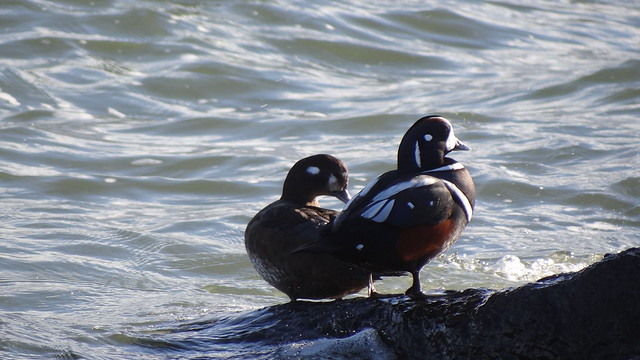
Some of those shared ducks are more abundant on one continent than on the other, of course. Think of the lovely and bizarre little Harlequin Duck, a vanishingly rare bird in western Europe, but common enough in parts of North America.

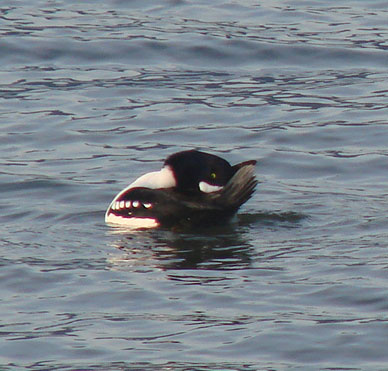
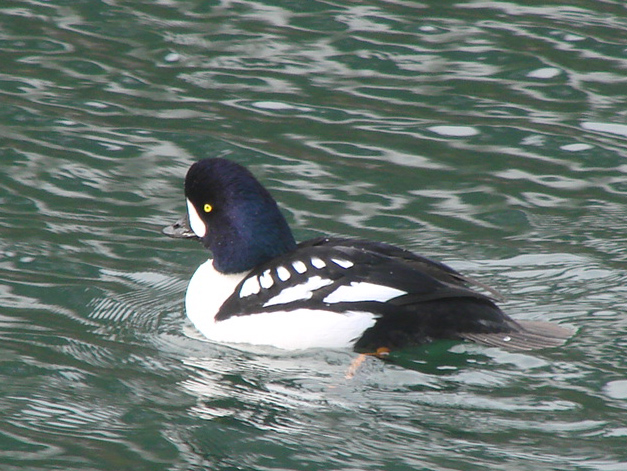
In one of those coincidences of distribution that birders so much love to ponder, the harlequin’s range is nearly identical to that of another chubby duck of rocky seacoasts, the bird named in Gmelin’s 1789 edition of the Systema naturae Anas islandica — a bird that we now know in English, most of us, usually, most places, as the Barrow’s Goldeneye.

Gmelin’s text is really nothing more than a simple translation of that in John Latham’s Synopsis:

General colour black. Head crested: fore part of the neck, breast, and belly, white: legs saffron-colour. Inhabits Iceland. Called by the inhabitants Hrafn-ond.

“Raven duck” didn’t make much sense to Latham, so he gave the bird an English name that reflected its range as then understood: the Iceland Duck. Gmelin was happy to adopt the same name in Latin, Anas islandica, which in turn provided most of the national languages in Europe with a vernacular name for this rare visitor from the land of the Vikings.

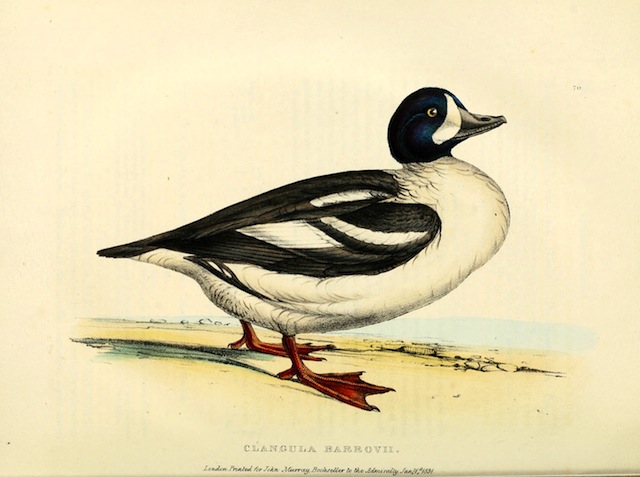
faunaborealiamer02rich_0700
Baird (RR Pac., 1858) says that the specimen depicted here was probably given to John Gould, from whom it was later obtained by John James Audubon. 

In the course of one of the Franklin Expeditions of the 1820s, John Richardson killed an unfamiliar duck “on the Rocky Mountains” of America. Unaware, it seems, of Gmelin’s Anas islandica, he described it as new and named it Clangula barrovii, the Rocky Mountain Garrot, the scientific name honoring Sir John Barrow and his “unwearied exertions for the promotion of science.” (In a footnote, William Swainson, Richardson’s prim-and-properer co-author, warns against naming birds after people, but admits that Barrow deserves such a tribute if ever anyone did, for his discoveries in “Arctic America, Southern Africa, and China; … high benefits conferred upon the State; and … the possession and encouragement of zoological knowledge.”)

That Richardson’s garrot was, in fact, the same goldeneye species that occurred as a vagrant in northern Europe was first recognized by Charles Lucian Bonaparte.

Screen Shot 2013-02-26 at 3.23.54 PM

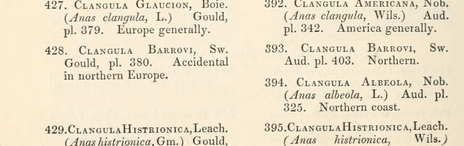
His Geographical and Comparative List of 1838 arrays the birds of Europe and America in parallel tallies; our little black and white duck occupies the same position in each column, but Bonaparte (unbound by the ICZN, obviously) opts for Richardson’s species name barrovi. The List does without English names, but the clear suggestion, of course, is that the bird would be known in the vernacular as “Barrow’s Duck” — precisely the name used by John Gould on the plate Bonaparte cites to from his Birds of Europe.

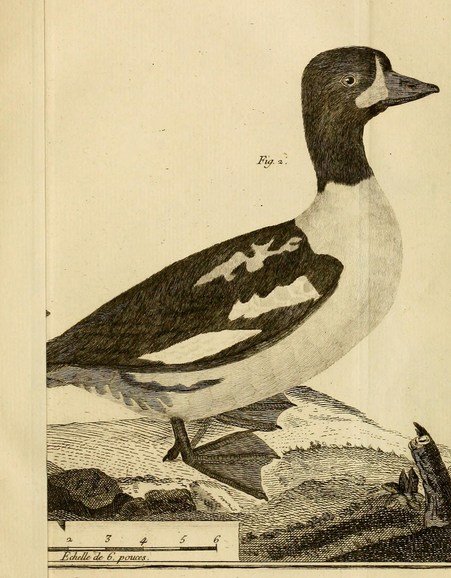
The extraordinary scarcity of this species in Europe is neatly attested by Eyton, in that same year of 1838: the author of the Monograph on the Anatidae knew of a grand total of three Old World specimens of Barrow’s Duck — one in his own collection, a recent specimen from Iceland, and a mount of unknown origin once in the collection of Réaumur and illustrated seventy years earlier in Brisson.

Screen Shot 2013-02-26 at 3.59.27 PM

By 1842, Bonaparte at least had rediscovered Gmelin’s name, and was calling the duck islandica in his Catalogo metodico. In the English-speaking world, though, where the species was thought of as thoroughly Nearctic, and where the name of Barrow (he would live to 1848) was so celebrated, there was no reason to revive Latham’s old vernacular name — and plenty of cause to retain Richardson’s.

Thanks to Anders for asking — 

 Barrow’s and an apparent hybrid goldeneye

Share

Other People’s Bird Books: J. D’Arcy Northwood

Of the making of many books there is no end — and in my case at least, of the reading of many of them there is no beginning. My mind is full of the dimly remembered names of all those “minor” writers I’ve wanted to read, or should have read, or — when it comes to so many of my high school English assignments — claim to have read.

Every once in a while I try to make it up.

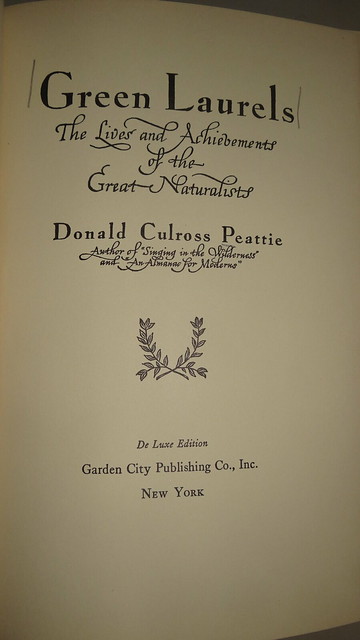
Donald Culross Peattie was a famous name well before I was born, one encountered again and again in all that sturdy, workman-like prose we read mid-century. For some reason, though, in spite of the praise heaped on him by my favorite naturalist authors, I never actually bothered to take up anything he’d written.

In this Wilson year, though, and in preparation for my August tour, I’ve been trying to read everything I can about the Father of American Ornithology; and I vaguely recalled that Peattie had somewhere published a brief biography.

It doesn’t take long in these days of internet wonders to put flesh on the bones of memory, and soon enough I had downloaded Green Laurels onto my trusty little kindle.

It will surprise some of you (wasn’t I called “an old fogey luddite” in a letter to the editor of Birding a couple of years ago?), but I don’t always mind reading books on line. In this case, though, I decided that I’d want to make some notes, an activity that I still find physically more comfortable with a pad and pencil and a “hard copy” of the book on the desk. So off trundled Alison to the library for me.

I was surprised that the book was available, and more surprised when I opened the clunky green-bound volume, its dust jacket long gone. The accession date penciled onto the flyleaf was nearly forty years later than the publication date: this book had been bought used. And whoever bought it had also purchased the original owner’s bookmarks.

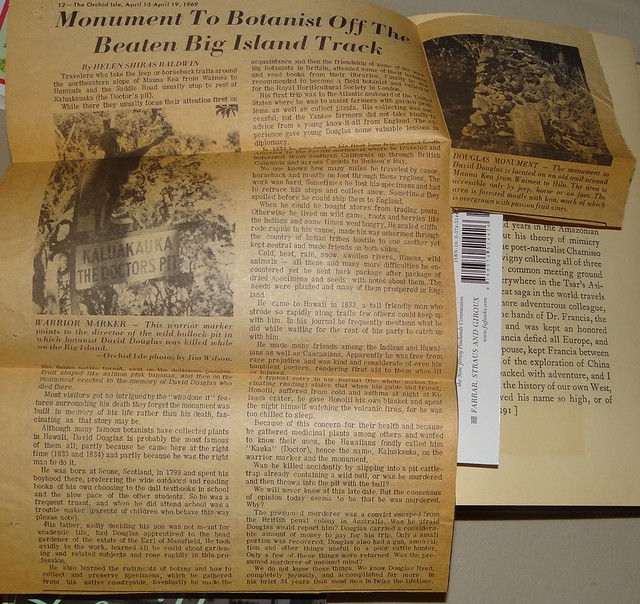
Here, from July 1942, the receipt for something called “295 American Birds,” sold for $2.15 cash in Honolulu, Hawaii; and here, dated some 27 years later, a newspaper clipping observing the erection of a monument on Mauna Kea to the great botanist and explorer David Douglas.

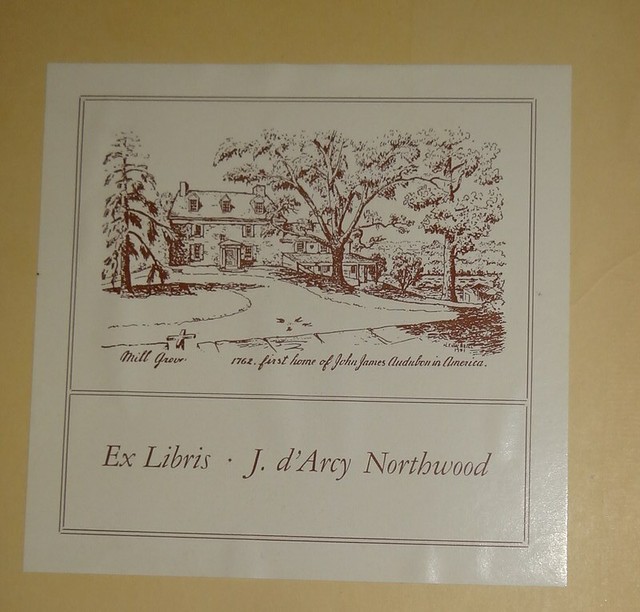
The Hawaii-Montclair connection, puzzling at first, came clear with a look at the bookplate on the front pastedown.

The volume was bought in January 1973 ex libris J. d’Arcy Northwood, a much-traveled figure in the history of twentieth-century birding, in New Jersey and across North America and its most far-flung islands, right up to his death in March 1972. Choate’s Cassinia obituary has Northwood — a British pilot during World War I, then a California-based sailor — landing in Hawaii, where he supervised plantations, served as a police chief, and in 1939 founded the Hawaii Audubon Society. A year later, he published his Familiar Hawaiian Birds

Then came Florida, where Northwood worked as an Audubon warden, and then Ithaca, where he studied ornithology. Montclair must have come into the picture during his tenure (“short,” says Choate, and not abundantly documented — thereby must hang a tale) as Executive Director of the New Jersey Audubon Society; we know he was living there in 1951, when he published a pretty trivial note in The Auk about swimming yellowlegses.

Northwood’s bookplate is adorned with a sketch of John James Audubon’s Mill Grove, where he was curator of the “Audubon Shrine” until his retirement. According to Clay and Pat Sutton, Northwood, “a character in his own right,” moved with his new wife, the writer and artist Anne Ardrey, to Cape May; their “ramshackle cottage” there is now the Northwood Center of the Cape May Bird Observatory on Lily Lake.

It will be an easy matter to find out which others of the books from Northwood’s Montclair library stayed in town after his death; meanwhile, this volume serves as a direct line from a twenty-first-century reader to a twentieth-century personality I might otherwise never have bothered to look up.

And I highly recommend Green Laurels, by the way.


Share