Unexpected Guests?

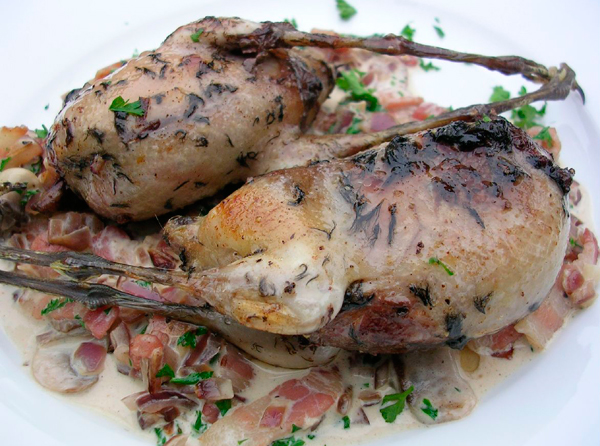
Here’s an inspiration for a quick, easy dish you can stir up with nothing more than the ingredients you’re sure to have ready to hand:

Two servants came in, singing all the while, and started to rummage through the straw. They dug out some peacock eggs and passed them around. Our host turned to us and said, “My friends, I gave some peacock eggs to a hen, and by Hercules, I hope they haven’t started to hatch; let’s see whether they’re still good.” We picked up our heavy silver utensils and broke into the eggs, which turned out to be made of heavy flour crust. I was going to give mine up, since I thought it had been fertilized and the embryo was advanced, but then I heard someone say, “This ought to be good,” and looked closer: and I discovered a very fat figbird inside, resting on a bed of peppery baked egg yolk.

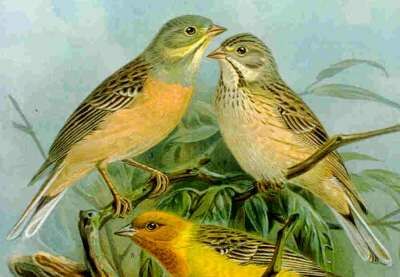
Petronius’s meal was probably fictional, but Buffon, seventeen centuries later, assures us that Ortolan Buntings can still be prepared in the same way:

Well-fattened ortolans are very easy to cook, whether in a double boiler or in a bed of hot sand or ash; and they can also be prepared very nicely indeed inside a large eggshell, real or artificial, the way they used to cook figbirds.

Naumann
Share

A Man, a Bridge, a Hummingbird: Panama

Eighty-six years ago today, George Washington Goethals died in New York City.


Here in our part of the world, he is best known as the eponym of the great bridge that spans the Arthur Kill to connect New Jersey and Staten Island.

A few people with longer memories recall Goethals’s heroic role as Chief Engineer for the Panama Canal, completed under his supervision a hundred years ago this year.

But very, very few of us remember Goethals’s Hummingbird.

Edward A. Goldman — the famous collector whose own name is borne by so many Central American birds — took the first specimens of this new hummingbird in March 1912, in the Darien region of eastern Panama. Goldman sent the Smithsonian three skins, a female shot on March 6, a male shot ten days later, and a second male taken in May; Edward Nelson chose to describe the species using the first male, “slightly immature,” as the type.

Nelson’s analysis determined that the new hummingbird was closely related to the Violet-capped Hummingbird, but differed from the birds of his genus Goldmania in certain characters of the wing, most notably the apparently “normal,” unmodified shape of the outermost primary. He deemed that difference sufficient for the erection of a new genus, which Nelson named Goethalsia,

in honor of Colonel George W. Goethals, head of the Panama Canal Commission, to whom the scientific workers of the Biological Canal Zone are deeply indebted for prompt and courteous assistance in prosecuting their work.

The species epithet Nelson assigned the bird, bella, is just the flattering icing on the cake.

The genus Goethalsia is still valid and still monotypic, including only Nelson’s species bella.

The English name, unfortunately, has been changed to Pirre Hummingbird, commemorating the locality where Goldman collected two of his three skins. But that shouldn’t stop us from thinking of Goethals once in a while, and the persistent connection between American science and our — shall we say — activities abroad.


Share

Birds of the Tropics

Red-billed Tropicbird

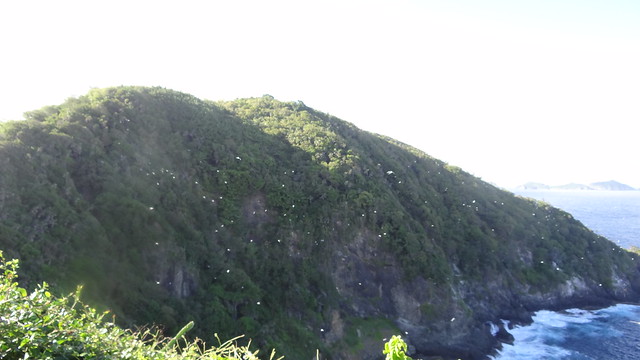
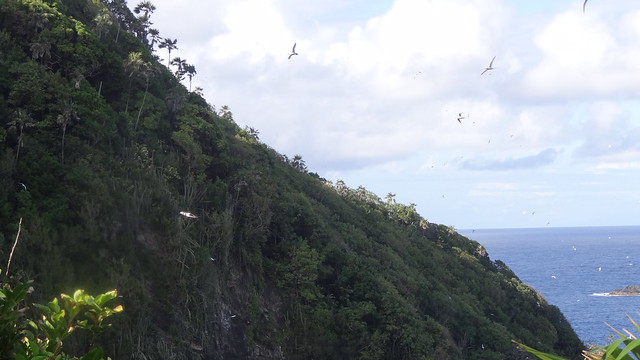
Not far off the coast of Tobago lies a smaller, even more intensely green island, Little Tobago. Even from the shores of Tobago, eager eyes can pick out the swirling white dots that can mean only thing: Tropicbirds.

Of all the many things to look forward to on last month’s visit to Trinidad and Tobago, I anticipated none more eagerly than the chance to finally see my first wild phaethontids, like bright white feathered suns against a tropical sky.

Red-billed Tropicbird

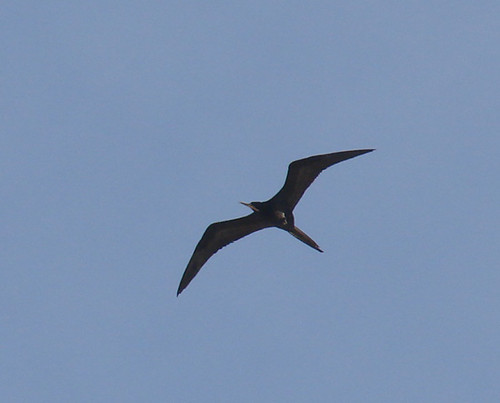
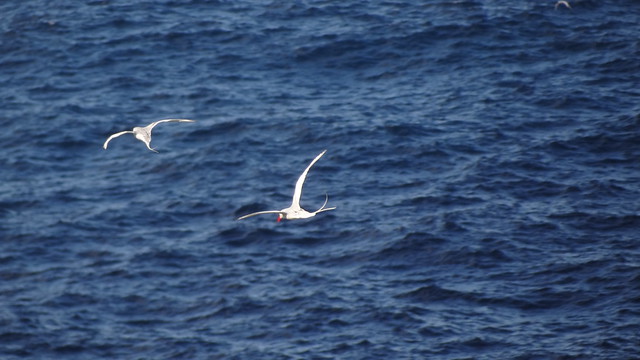
The Red-billed Tropicbirds of Little Tobago were busy indeed during our visit, hunting the open sea and flying in and out of their nesting cliffs — all the while working hard to avoid the depredations of the sinister-looking Magnificent Frigatebirds.

Magnificent Frigatebird

The frigates were remarkably good at hazing the tropicbirds into dropping their meal. The most dramatic episode was when a frigatebird swooped in to grab a tropicbird by the long tail; for several seconds, the pirate twisted the smaller bird’s feathers until finally it defecated — and the frigatebird dropped to partake of the stream in flight. Not overly appetizing, but still something no birder would want to have missed.

Red-billed Tropicbird

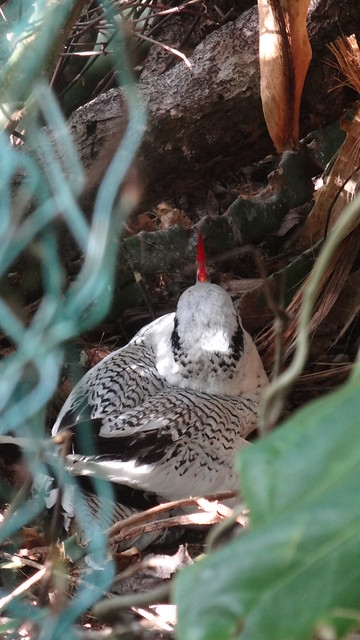
With so much bustle everywhere, it was obvious that the tropicbirds were in fact breeding, an assumption quickly borne out by the discovery of incubating birds right at our chosen overlook.

Red-billed Tropicbird

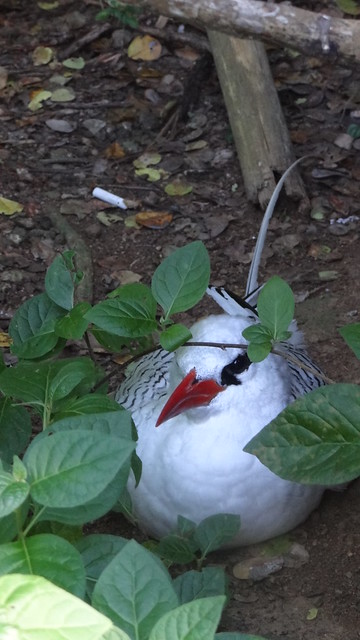
This individual was sufficiently nonplussed as to get up and turn its back to us, but the others simply faced us down, confident, I suppose, in the intimidation factor provided by that sharp, blood-red bill.

Red-billed Tropicbird

Only a frigatebird would mess with a face like that.

Share

Yummy Snipe

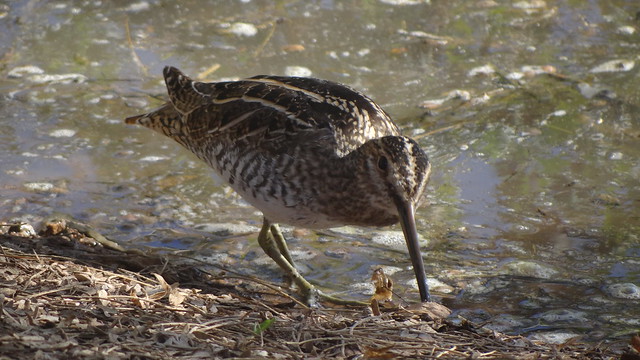
Wilson's Snipe

One more, and then I need to quit shooting fishiness in a barrel.

That same otherwise exemplary work notes that the specific epithet of the Wilson’s Snipe is delicata, which it translates as

paramour or favorite; unclear why the name was applied to this species.

This one’s easy. Alexander Wilson himself, the eponym of our common North American snipe, tells us that these birds

when in good order are accounted excellent eating.

Audubon records, approvingly,

that richness of flavour and juicy tenderness, for which it is so deservedly renowned.

We could go backward and forward, in the ornithological tradition and in the hunting literature, piling up testimonies to the tastiness of the snipe. But perhaps the easiest thing to do is simply to turn to the dictionaries.

The late Latin “delicatus” mean “exquisite.” It means “fine.” It means “delicious.”

Share