See you there!



The Experience of Birding
See you there!
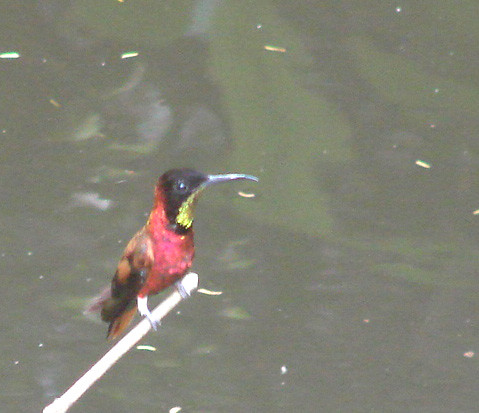
It’s 150 years this year since William Charles Linnaeus Martin left this earth, but his vast corpus of writings continues even now to open a window on Victorian agriculture and natural history.
One of the most popular and prolific authors of his day in such subjects, Martin moved in good circles, and had access to the finest collections in Britain, including the birds belonging to his “obliging friend” John Gould, which and whom he consulted liberally in preparing his General History of Hummingbirds.
One day, Gould had a surprise waiting for his literary colleague,
a very petrel-like species [of hummingbird]…. Its short tarsi, its peculiar structure of wing, and its dull plumage, were, at a glance, apparent; but that decided oleaginous odour which is exhaled from the skin of the Petrels and other allied oceanic birds, was what most surprised us; it was perceptible as soon as the specimen was taken from the box, and had we not used the sense of vision, as well as that of smell, we should have said, this is a small Petrel….
Martin neglects to identify that peculiar trochilid for his reader, but he does offer some speculation on its habits:
It is not improbable that it may feed on minute Mollusks, semi-microscopic Crustaceans, and the larvae of aquatic insects….
Gould himself debunked that idea, dismissing the hummingbird’s musky aroma as “merely a coincidence.” But with August just around the calendar corner, the southbound hummingbirds will be thronging our feeders soon enough. I’ll be out there this year with my mind open and nostrils flared.

This time of year, as we wait (this time a little longer than usual) for the now-annual Supplement to the AOU Check-list, I always recall the jocular complaint published in The Oologist more than 90 years ago: We birders, wrote that long-ago correspondent,
have to stand by and see Oberholser stick his knife through all our historical and time-tried nomenclature and cannot do a thing about it.
The reference, of course, is to Harry C. Oberholser’s long series of “Notes on North American Birds,” published in the Auk beginning in 1917 and ultimately preparing the way for the third edition of the Check-list, which finally appeared in 1931.
But who was the author of the complaint? He signed himself thus:
Your best friend, Pedioecetes.
If you know, fill me in. Otherwise I might have to figure it out myself.
Hot, humid. Heavy skies and sluggish afternoons. Alison and Gellert and I decided to slip the surly bond of a New Jersey summer’s day with a walk in the Meadowlands, hoping to run across a shorebird or two or maybe even the American white pelican that has been lingering there the past week or so.
We were surprised when we got out of the car to find a nice, almost coolish breeze, and the stroll out the dike was as pleasant as it could be. Birding was disappointingly slow, though close views of two adult spotted sandpipers were worth lingering over.
We lingered. We lingered too long. That nice, almost coolish breeze was driving a black wall of water our way, and by the time we looked away from the scope it was too late. A fast walk turned into a slow run turned into an out-and-out dash to the car, interrupted every few seconds when Gellert paused to shake himself — in vain. We were soaked, all three of us.
But at least we’d gone outside.
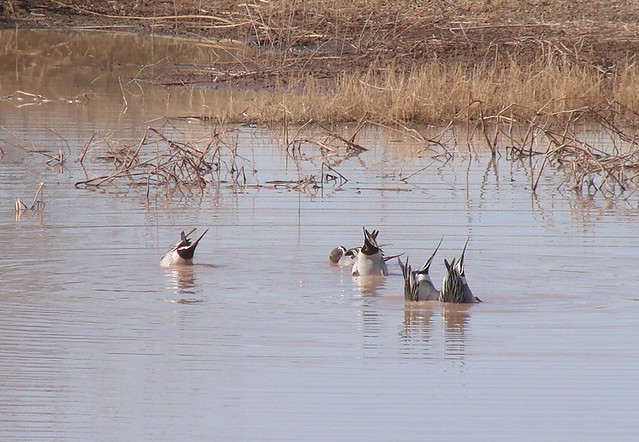
There’s nothing like a flock of ducks to warm the homesick birder’s heart. Almost anywhere in the northern hemisphere, that flock is likely to include a familiar species or two, and the pleasure of recognition far outweighs the disappointment of discovering “just” a mallard or a gadwall or a scaup.
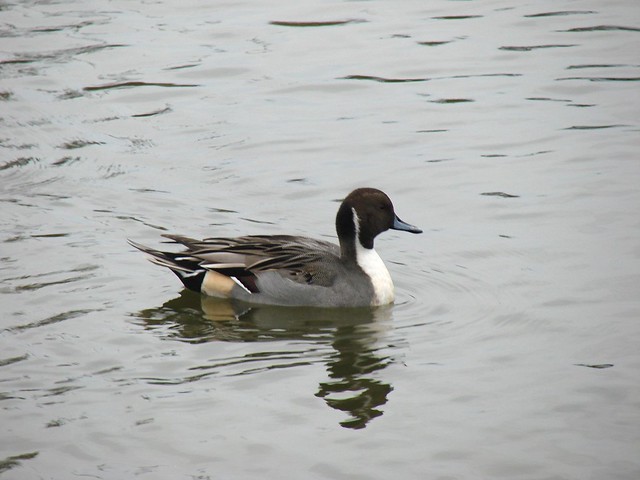
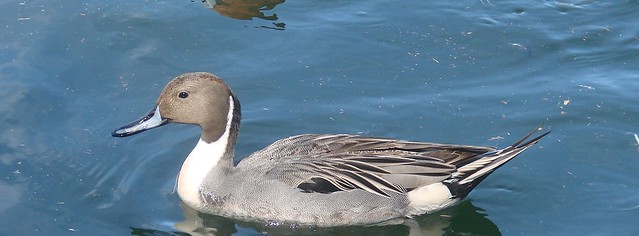
The northern pintail of Eurasia and America is now generally considered monotypic: that is to say, the populations of that species in the Old World and those in the New are said not to exhibit any consistent differences that would allow or require the naming of any subspecies. They are all simply Anas acuta, the “sharp-tailed duck.” It hasn’t always been so, however. At various times, various authors have split the Nearctic and the Palearctic birds into two races, the nominate form of Eurasia and the subspecies tzitzihoa of America.
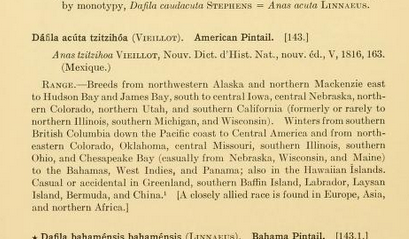
As the entry in the Fourth Edition of the AOU Check-list notes, that name was formally published for the first time by Vieillot, who described Anas tzitzihoa as a full species distinct from the European pintail with which it had been identified by Ray, Buffon and Latham.
Vieillot’s knowledge of his new species derived entirely from Francisco Hernández’s sixteenth-century account, published in the Thesaurus of 1651 — the first full description of a northern pintail ever from North America.
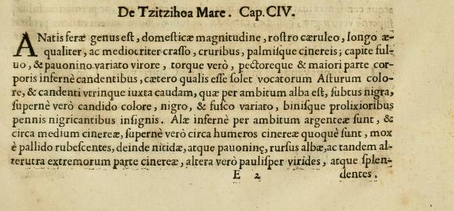
On the male tzitzihoa. Chapter 104.
This is a type of wild duck, of the size of the domestic bird, with a blue bill of even length and moderate thickness, and with gray legs and webs; the head is fulvous and flecked with peacock green, but the necklace, breast, and the greater part of the body beneath are whitish, while the rest of the bird is of the color typically shown by goshawks, and whitish on each side next to the tail, which is white on the edges and black beneath, mottled with white, black, and fuscous above. The tail has two noticeably longer blackish feathers. The wings are silver-colored on the edges beneath and ashy in the center; they are also ashy above towards the shoulder, shimmering reddish, bright white, and peacock green. The hind wings are partly ashy, partly light green, and iridescent. The female is no different.
The tzitzihoa didn’t last long in systematic ornithology: first demoted to a subspecies, then synonymized out of existence when the northern pintail was finally deemed monotypic. But every once in a while, when a drake swims past with its goshawkly barring and the peacockish highlights glinting in its chocolate head, I like to whisper a single word.
Tzitzihoa.