Little Bird, Big Name

Black-throated Green Warbler

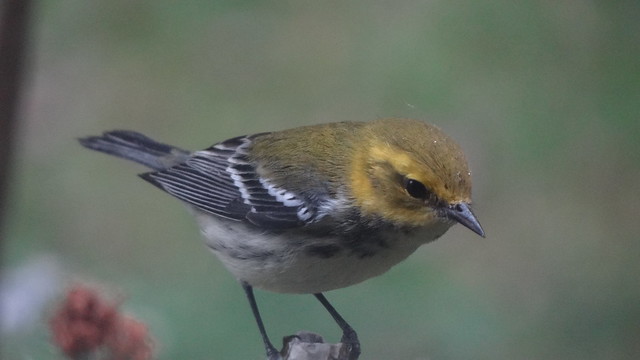
This charming black-throated green warbler — an adult female, I believe — was busily picking nearly invisible bugs from Alison’s aster bed this morning.

The species ultimately owes its long English name to none other than William Bartram, who listed it in the Travels as

P[arus] viridis gutture nigro, the green black throated flycatcher.

In June 1756, the very young Bartram had sent skins of this species and of the black-and-white warbler from “the province of Pensilvania” to George Edwards, who described and painted them in the Gleanings of 1760.
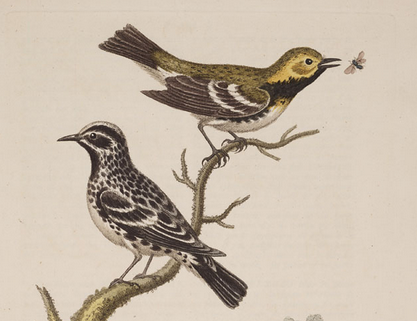
Edwards, Gl 2, black-throated green warbler

Edwards called our bird the black-throated green flycatcher, and it was his account that Gmelin drew on to assign the species its formal Linnaean name, Motacilla [later Sylvia, then Dendroica, now Setophagavirens.

Interestingly, it seems that in the later eighteenth century there was resistance to the unwieldy English name adopted by Edwards. In France, both Buffon and Brisson called this bird simply “black-throated,” while across the Channel Pennant, Turton, and Latham all preferred to emphasize the color of the upperparts by calling it the “green warbler.”
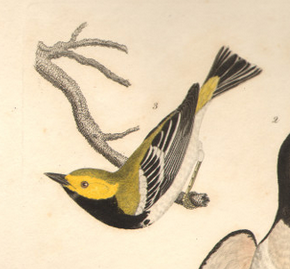
wilson, Plate 17, green black-throated warbler

It was up to Alexander Wilson, Bartram’s grateful friend, to restore his master’s English name, which he did in only imperfect faithfulness to the original: the charming bird in the upper lefthand corner of Wilson’s plate 17 is labeled “Green black-throated Warbler,” as in Bartram, though his text reads — the first instance of the modern English name in print — “black-throated green warbler.”

Audubon, who was the first to depict the female of the species, followed Edwards and Wilson’s letterpress in using the sequence “black-throated green” rather than the more logical “green black-throated”:
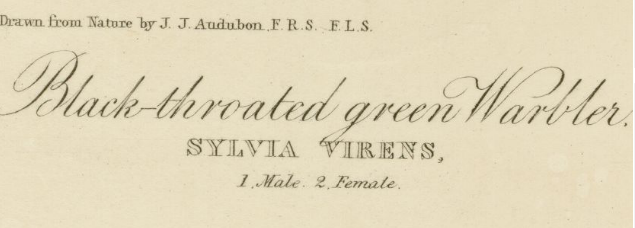
Screenshot 2014-10-01 18.03.21

And so it has remained ever since, a long name for a tiny bird.

Share

Do You Hear Hoofbeats?

Gellert and I are used to running into interesting birds on his walks: in just the past couple of weeks, we’ve seen a fine peregrine falcon, a common raven, and a smattering of the commoner southbound warblers. This morning, though, we came across something totally unexpected.

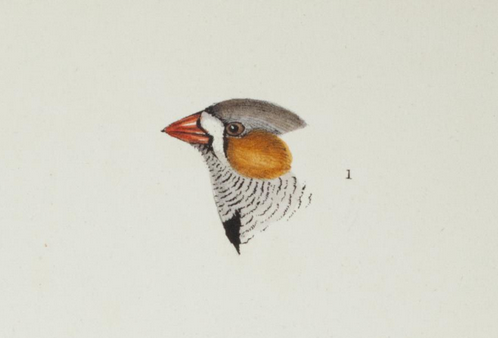
Gould, SynAust, Zebra Finch

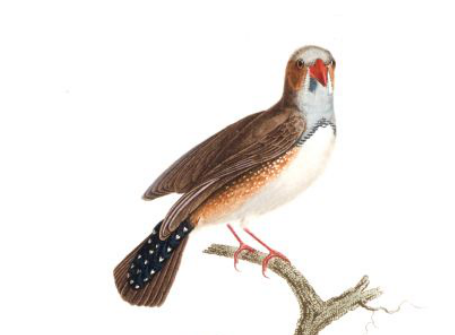
We screeched to a halt when a tiny, short-tailed gray thing flushed from the roadside into a low tree, and were startled to see a little zebra finch looking back at us.

It was a long flight on those short wings from this species’ native range. Or do you suppose — just suppose — that somebody left a window open last night?

Vieillot, OisChant, Zebra Finch

Share

Cape May

Yes, we arrived a day late for the whiskered tern and we left a day early for the zone-tailed hawk: but my latest tour had a great time at Cape May last week all the same. A few photos:

Birding birders Cape May

The view from the hotel balcony at dawn.

Birding birders Cape May

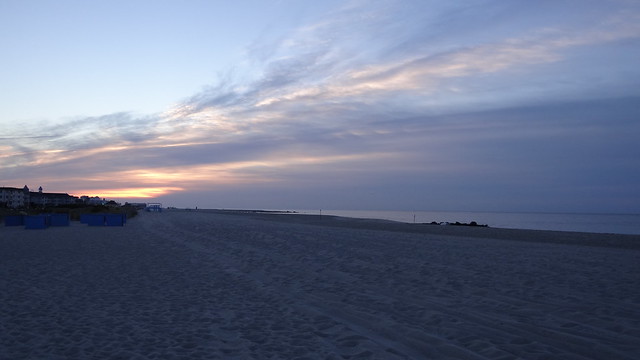
Sunrise over the beach.

Birding birders Cape May

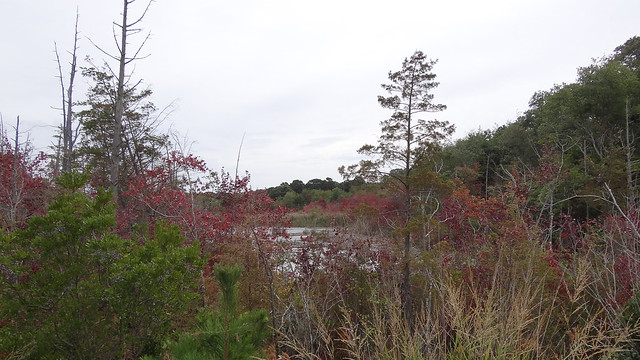
Some autumn color in Atlantic County.

Birding birders Cape May

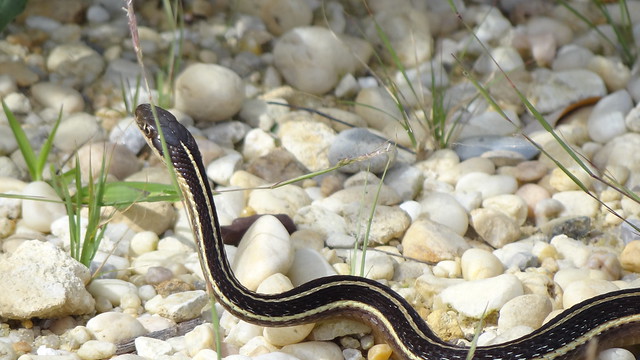
An eastern ribbon snake in the Meadows (or some Thamnophis or another).

Brown Thrasher

One of many, many, many brown thrashers at Higbee Beach.

Birding birders Cape May

If you get a chance to bird with this genial gang, do it!

Birding birders Cape May

The beach scene across from our hotel.

Birding birders Cape May

Black skimmers and a nice variety of gulls and terns, there for the picking just steps from our door.

Birding birders Cape May

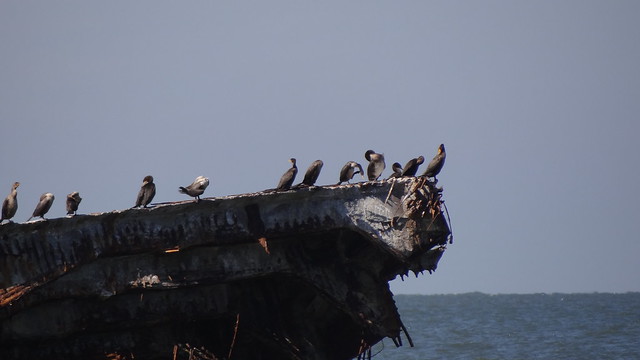
A great cormorant joins its smaller cousins on the concrete ship.

Birding birders Cape May

We’ll be back.

Share

Not Your Everyday Feeder Bird

Black-throated Blue Warbler

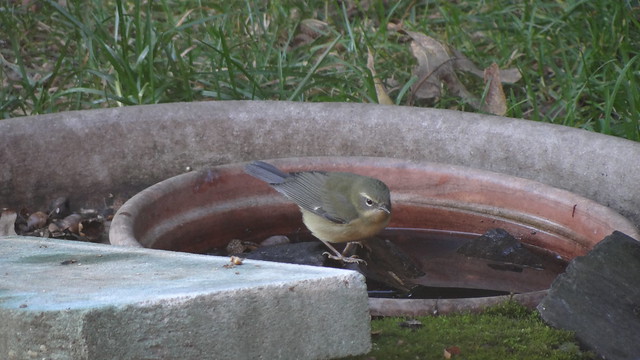
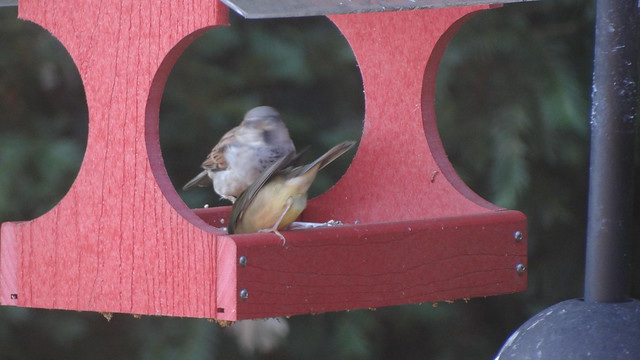
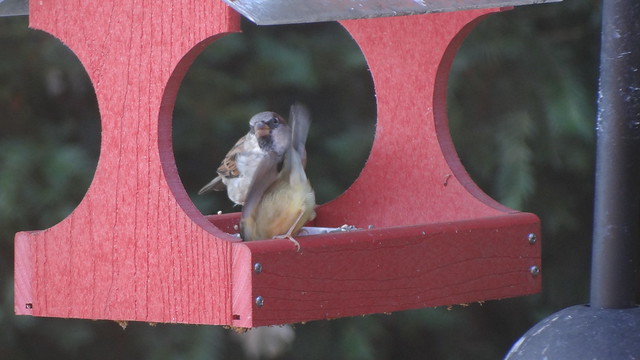
This pretty little black-throated blue warbler was a welcome but not unexpected guest at the bird bath this morning.

But — as they say on the internet — watch what she does next.

Black-throated Blue Warbler

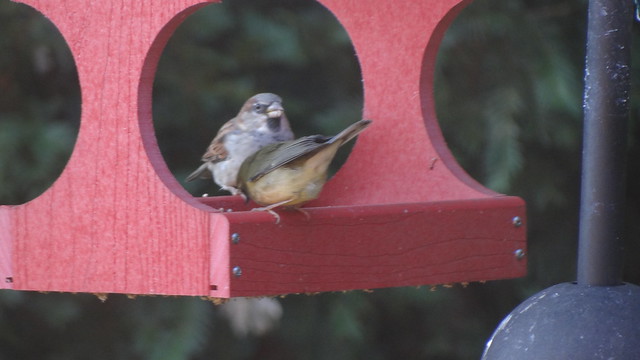
I think the house sparrow was as surprised as I was when the warbler flew up to the newly filled tray feeder.

She obviously liked what she found in there.

Black-throated Blue Warbler

I should explain that she wasn’t sharing the house sparrow’s millet: I’d put the remnants of a chunk of suet in there earlier this morning. Still, this isn’t your everyday feeder bird, is it?

Black-throated Blue Warbler

Share

Slapping Soras

Trigger alert!

Wilson
Wilson

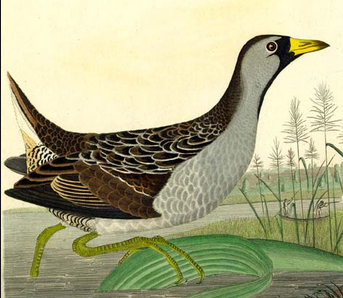
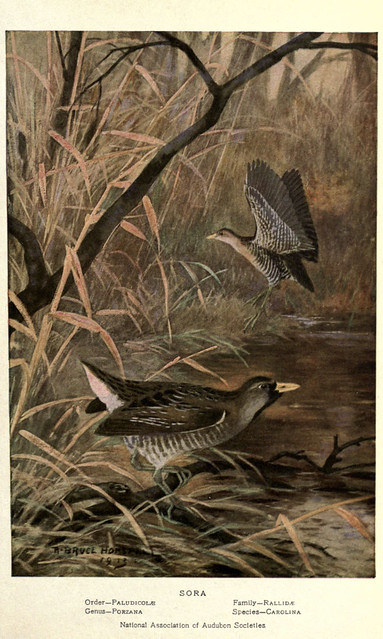
Last September, pondering the abundance of the lovely little sora in autumn marshes, we wondered what it meant that so many had once been “paddled” in Virginia’s Curl’s Neck Marsh. I even managed to make contact with a couple of outfitters who specialize in rail hunting. But the response was everywhere the same: It just meant that the rails had been taken from a boat.

Everywhere the same, and everywhere unsatisfactory. Here’s the real answer, from the Richmond Dispatch at the turn of the last century:

It is a saying often heard in the country, if not in the city, that “slapped” birds are much better than “shot” ones. This is to say that market hunters, of course, do not shoot their game, but kill them with a long paddle — eighteen feet long — with which they shove their boats through the marshes…. A slight blow from the heavy paddle “settles his hash forever,” as the country boy says…. The bird is not bruised, and is much to be preferred to the shot bird….

Not a very pretty picture, but at least now we know. And we know, too, what the witty rail hunter called himself a century ago: a “soracer.”

He stands [in the boat] and slaps the poor little things until his arms are tired. Such a night as this he is apt to kill fifteen or twenty dozen.

Our reporter goes on to tell us that a dozen soras fetch 50 cents at the market, and that “the good soracer” earns 50 to 75 dollars in September and October. Do the math: That’s 24 birds to the dollar, or 1200 to 1800 rails a season for the skilled paddler.

I can only repeat what I said last year at this time: That’s a lot of soras.

Share