My clumsy footprints are a boon to hungry animals, with all this snow still lying deep on the ground.


No doubt this was how the first squirrel became a ground-squirrel, way back when.


The Experience of Birding
My clumsy footprints are a boon to hungry animals, with all this snow still lying deep on the ground.
No doubt this was how the first squirrel became a ground-squirrel, way back when.

As a young birder, just after the days of Hesperornis, I was puzzled by the claim in all the books that the Song Sparrow was abundant, familiar, ubiquitous. Though the species has greatly increased in eastern Nebraska over the decades since, back then it was an uncommonish bird, and it took me a couple of seasons before I felt that I had something like a handle on it.
Fast forward to our years in southeast Arizona. There, we quickly found, the local Song Sparrows looked nothing like what I had learned as a boy and grown so familiar with in Massachusetts and New Jersey and Illinois. Indeed, these birds of damp desert thickets and ponds are so different from what the historical eastern bias of American birding has styled “the typical” that many first-time visitors to the Southwest refuse at first to believe that they are Song Sparrows at all.
When Spencer Baird saw the first specimens of this new form in 1854, he found it distinctive enough to merit description as a new species. Compared with the “normal” Song Sparrow,
the bill is considerably smaller and the tail longer. The plumage above is more ashy, the streaks on the back not so distinct, the spots are more crowded about the breast, but fewer on the sides; their color more uniformly chestnut brown.
All that said, though,
this species bears a very close resemblance to Z. melodia,
and so Baird gave it the name Zonotrichia fallax, the “deceptive sparrow.”
Four years later, in the great report of the Pacific Railroad Explorations, Baird wondered whether he might not have been the one deceived:
Although this species is very similar to the M. melodia, yet, when specimesn are compared with an extensive series, of the last mentioned species, an impression of difference will at once be conveyed…. I do not, however, feel sure that this species will stand as perfectly satisfactory… At any rate, I consider it as less strongly established than any of the others before me.
By 1874, Baird and the distinguished co-authors of the History of North American Birds had rethought the whole thing. Their deliberations largely anticipate the notion of the Rassenkreis, a concept that would be explicitly applied to the Song Sparrows by Patten and Pruett 135 years later. Writes Baird in 1874,
Spread over the whole of North America, and familiar to every one, we find each region to possess a special from [of Song Sparrow] (to which a specific name has been given, and yet these passing into each other by such insensible gradations as to render it quite impossible to define them as species. Between M. melodia of the Atlantic States and M. insignis of Kodiak the difference seems wide; but the connecting links in the intermediate regions bridge this over so completely that, with a series of hundreds of specimens before us, we abandon the attempt at specific separation, and unite into one no less than eight species previously recognized.
Baird’s old fallax was one of those eight, listed in the History as Melospiza melodia var. fallax.
Unfortunately, however, Baird extended his name fallax to comprise two very different birds, the pale, reddish, sparsely marked Song Sparrows of the southwestern deserts and the darker, more richly colored birds of the Great Basin and adjoining Rocky Mountains. Henry Henshaw corrected that error in the very first volume of the Auk, restricting the name fallax to
the older though least known form … inhabiting our southern border — Arizona and New Mexico.
The more northerly birds received their own, new name, montana.
The AOU Check-list, back in those happy days when it provided a full accounting of each species’ recognized subspecies, called fallax in its strict sense the Desert Song Sparrow, from 1886 up to the Fourth Edition of 1931, when the fallacious one pulled another of its tricks.
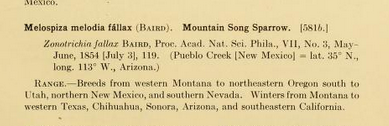
Following Oberholser in rejecting Henshaw’s identification of Baird’s type specimen, the committee responsible for this, the weakest edition of the Check-list voided the name montana and re-allocated fallax to the northerly populations covered by Baird’s early description, using Grinnell’s name saltonis for the southern birds. As a result, fallax was called in English the “Mountain” Song Sparrow, and the English name “Desert” was shifted to saltonis, generating a quarter century’s worth of confusion that must have had our trickster sparrow laughing its pale rusty head off.
Not even the sneakiest sparrow was a match for Allan Phillips, though. Phillips, writing midway between the publication of the Fourth and the Fifth editions of the Check-list, re-asserted the validity and the identity of Henshaw’s montana, once again calling it in English the Mountain Song Sparrow, and effectively splitting the pale southern birds into three races — fallax (northern Arizona), saltonis (southwestern Arizona and California), and his new bendirei (central and southern Arizona and Sonora).
More recent authorities tend to synonymize all three of those Phillipsian races under fallax in Henshaw’s sense, leaving us with just one Desert Song Sparrow, a tricky little bird that no doubt still relishes the almost endless confusion it has caused over the years.
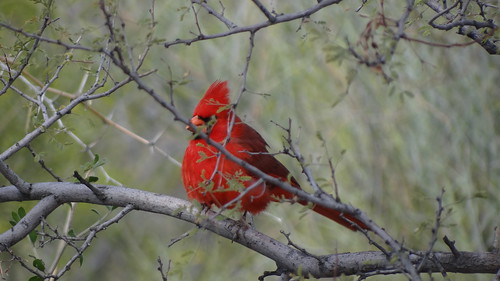
Ho hum, thinks the birder from eastern North America: just another Northern Cardinal.
But as our Linnaean Society field trip to Phoenix this past week reminded us, a close look at that bird in the southwestern US and northern Mexico reveals a bird a little less contemptibly familiar than we might expect.
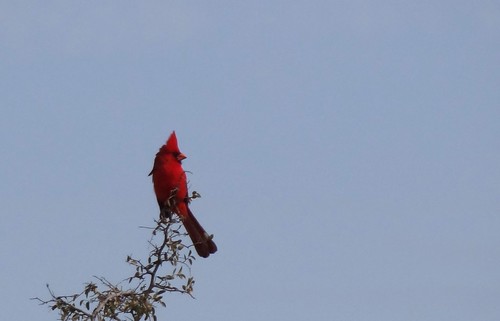
The red cardinals of Arizona are startling and striking, big and long-tailed and long-crested. The species’ best-known field mark, the black mask surrounding the bill, is noticeably reduced compared to the same patch in eastern birds, often not quite meeting across the forehead, making that brilliant red helmet stand even taller.
It’s no wonder that Robert Ridgway found these birds “easily distinguishable.” In 1885, he described a series of specimens from Arizona as belonging to a new subspecies, which he named Cardinalis cardinalis superbus.
In the 70 years after Ridgway’s description of the bird, this distinctive race — one of sixteen most authorities still recognize across the Northern Cardinal’s extensive range in North and Middle America — went by the sensible and straightforward English name of the Arizona Cardinal, a name lost, like so many others, when the 1957 edition of the AOU Check-list created standardized vernacular names for North America’s birds at the species level.

More and more, I think, American birders are returning to the English subspecies names propounded in earlier editions of the Check-list. In this case, though, there’s an alternative better even than “Arizona Cardinal.”
Though Ridgway provided no etymology when he named his new cardinal, it seems likely that he understood superbus to mean simply “superb, outstanding, excellent.” But in real Latin, as opposed to scientifiquese, the word is much richer. From the vaunting ambition of Turnus in the Aeneid to the traditional mortal sins of the medieval church, “superbus” and “superbia” referred to one’s own hubristic estimation of oneself as superb or outstanding or excellent.
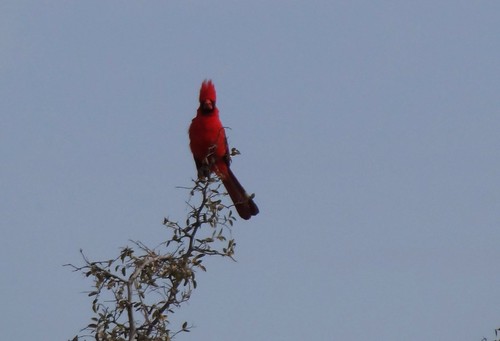
Doesn’t this bird look superbus? We could do worse than to call these Arizona birds Prideful Cardinals, glowing as they do in the certainty of their own superbness.
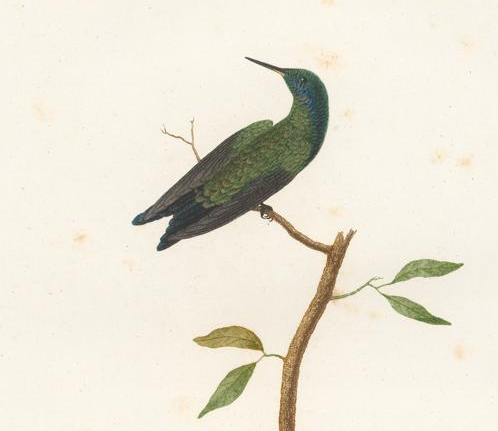
In 1801, Louis Jean Pierre Vieillot described the Puerto Rican Emerald, a bird he named Trochilus magaeus in honor of René Maugé de Cely,
the first to make this bird known …. This naturalist, moved by his zeal for the subject, has just undertaken a new voyage with Captain Baudin to New Holland and the islands of the Pacific Ocean; ornithologists hope that he will return with notes about the birds of those regions, almost all of them still unknown — notes that will be the more precious for having been made on site by an enlightened observer. The Museum expects that his efforts will result in new, well-preserved skins as perfect as those he brought us from the Spanish island of Puerto Rico.
Vieillot, of course, could not know how that voyage would end for Maugé.
Lesson, writing of the bird in his Histoire naturelle des oiseaux-mouches, would (incorrectly) chastise his predecessor for not recognizing it as the same species already depicted and described under different names in Edwards, Brisson, and Buffon.
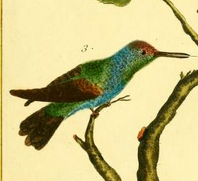
Nevertheless, says Lesson,
we have retained the name of Maugé for this species out of respect for the memory of that zealous and estimable traveler, who died the victim of his own zeal on the expedition to southern lands commanded by Baudin.
Two hundred twelve years ago today, on February 21, 1802, Maugé succumbed, barely 40, to dysentery.
As near as the history of calendar reform lets us tell, today is the 400th anniversary of the birth of Christopher Merrett, author of the first complete list of the birds of Britain.
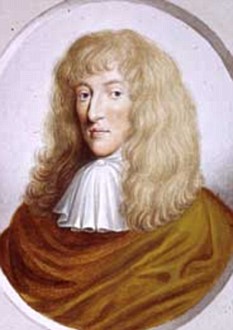
His Pinax rerum naturalium britannicarum, first published in the annus mirabilis/horribilis of 1666, covered all the plants, animals, and fossils known from the island.
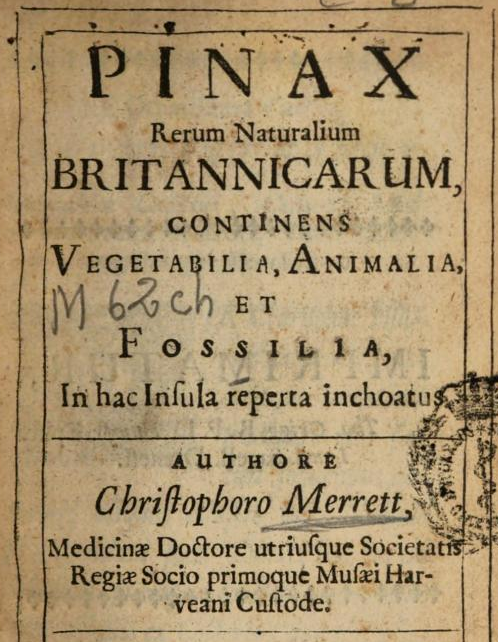
As a physician, Merrett was naturally most well-versed in botany, agreeing with his predecessors that
plants were of greatest use in helping the human race, in so far as they sustain human life and protect and restore human health.
As to the birds, he tells the reader in his Introduction that he consulted in large part
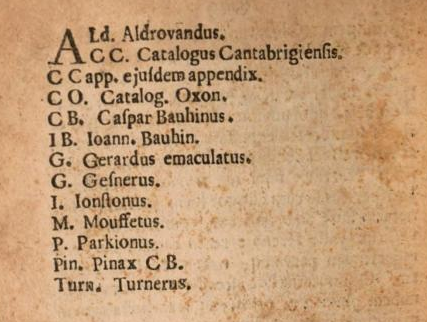
Gesner, Aldrovandi, and Johnston, who have all treated them quite fully; and in some cases, our Turner, that most industrious researcher of his day, who published a book on birds that, though light in weight, was substantial in good judgment.
Merrett cites other sources passim in the list itself, among them
that noble man Dr. Willoughby, the most diligent and most intelligent investigator of nature not just throughout Britain but over the greater part of Europe.
Most of the catalogue of birds relies on records published by those authorities, but Merrett also includes a few of his own sightings, including that of “a Skreck,” also known, he says, as “the Butcher, or murdering Bird”:
I have seen it three or four times in the summer near Kingsland.

Of the Nightjar, he notes that a Sir Cole collected one on Hampton Heath in 1664, “quite a rare bird.”
Merrett also offers his clarifications of the reports of others:
Cornix aquatica. Turner saw this bird on the river banks…. I tend to believe that it is the murre of Cornwall.
Some of those corrections, including this one, are nothing but Verschlimmbesserungen. As Mullens points out,
this is the Water-Ouzel, or Dipper. Merrett has been misled by Turner’s use of the Northumbrian name “Watercraw” … and has placed it among the Corvidae. He has further confused the matter by suspecting it to be the Cornish “Mur” … the Razor-Bill.
Merrett also passes on some facts that strike the modern eye as unlikely.

Barn Swallows, he says, spend the winter in marshes and seashore cliffs in Cornwall, and it is a shame that in between the Eurasian Oystercatcher and the Crossbill Merrett — not unlike so many of his contemporaries — should have listed the “Bat, Flittermouse, Rearmouse,” a bird that appears on summer evenings and spends the winter hidden away in cellars.
One source Merrett relied on that is no longer available to most of us was the ornithopolae of London — the bird sellers. It was from them that he had his knowledge of several species, especially of certain less common waterfowl.

The “Gaddel” — our Gadwall —
is known by that name to our birdcatchers; it is a bird of the size of a Mallard, its bill very like that of a teal, but somewhat more bluish.
A Mr. Hutchinson, bird merchant in London, informed Merrett about three species that he claimed to have seen on the plains around Lincoln.
The Nun [the Smew] is a water bird, slightly smaller than a teal; it has a round, thin, narrow bill, a bit curved on the upper mandible, and it is whitish on all its underparts, blackish above. The head is crested, whence it may well have its name, that is a say, from a nun wearing a hood.
Hutchinson and Merrett’s “Crickaleel” appears to be the Garganey, described as a small duck with blue on the upper wing. Their “Gossander” is more mysterious. This is a bird
with webbed feet and a crest. Its belly is yellow, its bill long and narrow. The flesh, fully cooked, turns yellow and then is transformed into oil; it is not edible. From the fields of Lincoln. This seems to be a type of “puphinus.”
It’s not clear at all whether this bird is a duck, an auk, or a shearwater, though its origin in Lincoln suggests that it may in fact have been simply a Goosander in the modern sense, a Common Merganser, with an overlay of characters from another species or two.

Obviously, Merrett’s list is of little value today to anyone hoping for an up-to-the-minute assessment of the avifauna of Great Britain. But it remains, 400 years after its author’s birth, an invaluable document of the process of ornithology at the turn of an era, when the corpses hanging in birdcatchers’s stalls, the traditional hearsay of medieval natural historians, and observations recorded by the first empiricists could all find their place in an authoritative avifauna.