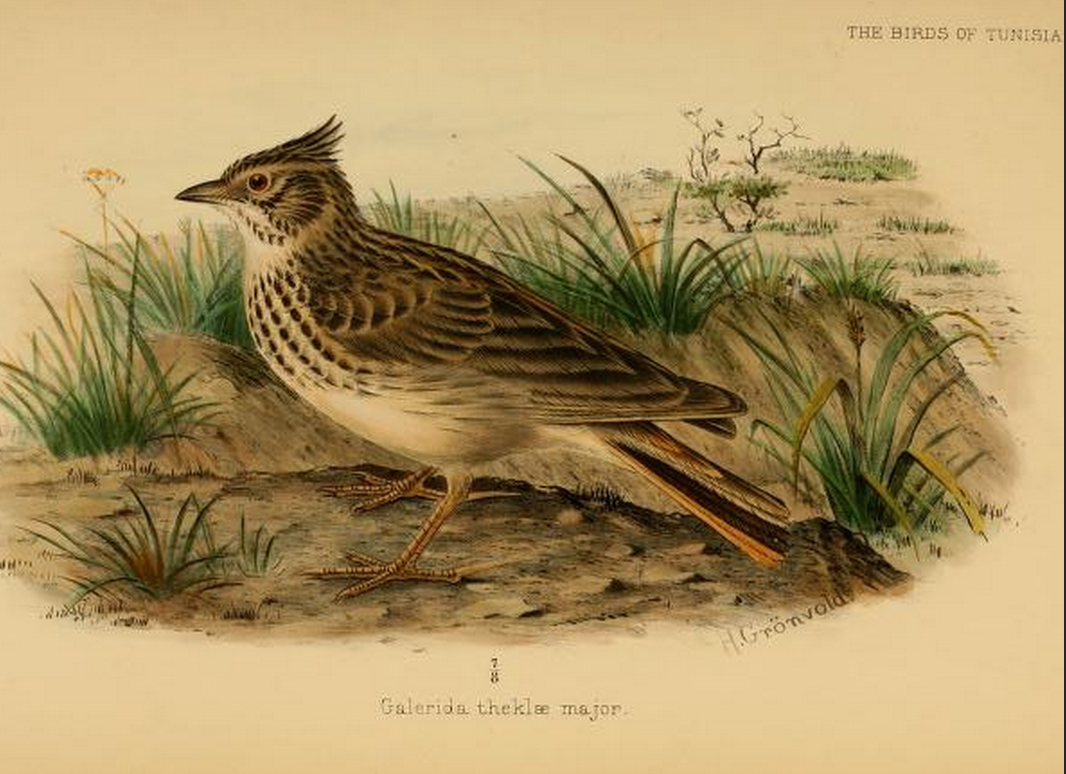
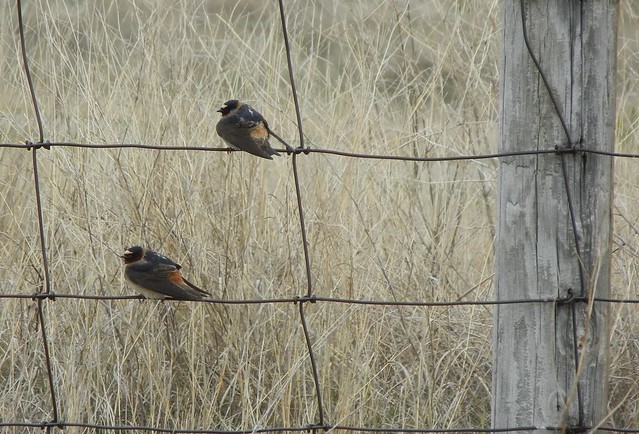
Beautiful birds, such as these most indisputably are, deserve beautiful names, and it’s hard to imagine a label lovelier than Hirundo lunifrons, the crescent-fronted swallow.
Alas, we’re stuck nowadays with the prosaic cliff swallow and the hardly more evocative Petrochelidon pyrrhonota (“red-rumped rock swallow”). But it took us a good long time to get there.
It isn’t at all clear when this abundant and widespread swallow was first “discovered” by European science. According to Elliott Coues, this is the bird Forster published in 1772 as “Swallow No. 35,”
which answers in some particulars to the description of the Martin, Hirundo Urbica, Linn. but seems to be smaller and has no white on the rump.
Forster does report that these swallows nest under eaves and on riverside cliffs, but there is little else here to indicate that he is writing of the bird we know as the cliff swallow; you’d think he might have mentioned some of the salient plumage features of this well-marked species. As it is, I suspect, contra Coues, that the skin Forster received was that of a tree swallow. In any event, Forster goes on to note — tongue perhaps ever so slightly in cheek — that
the Indians say, they were never found torpid under water, probably because they have no large nets to fish with under the ice.
More than half a century later, in 1823, Thomas Say, working with specimens from near Canyon City, Colorado, gave the cliff swallow a detailed formal description and the Linnaean name Hirundo lunifrons, commemorating the bird’s “large white frontal lunule.”
That species name, lunifrons, “crescent-fronted,” made its way into the AOU Check-list in 1886, and persisted in that authoritative work for decades. In 1912, though, Samuel Rhoads obtained copies of two items published in the Kentucky Gazette by Samuel Rafinesque, one of them dated — fatally — February 14, 1822, a year earlier than the publication of Say’s account. Rafinesque reports that
There are two species of Swallows in Kentucky…. The second species I shall now describe and call it the Blue Bank-Swallow. I have given it the scientific name of Hirundo albifrons which means the Swallow with a white forehead. It is very remarkable by its unforked tail…. Its face or the space surrounding the bill is black, the forehead white, the top of the head blue; the cheeks, throat and upper part of the rump of a reddish chestnut colour, or rufous…. This bird is to be seen preserved with its nest in the Museum of Cincinnati.
Rhoads, obviously in fine fettle, comments:
it seems a bit humiliating for [the scientific name of the species] to be snatched from the laurel crown of Thomas Say and transferred, by the rights of priority, to a man whom he undoubtedly despised and certainly ignored. Say was one of the coterie of Philadelphia naturalists that eventually drove Rafinesque and his literary contributions from any recognition by the Academy of Natural Sciences…. That eccentric naturalist [Rafinesque] had stolen the march on all his contemporaries by a little squib in the Kentucky Gazette.
Five years after Rhoads’s discovery, the proposal was made to change the scientific name of the swallow to Petrochelidon albifrons albifrons, “since Rafinesque’s name is clearly identifiable as Hirundo (= Petrochelidon) lunifrons Say and is of earlier date.”
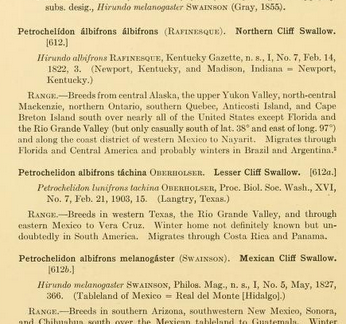
The proposal was accepted, and the 1931 edition of the Check-list was the first to use the new old name.
And the last.
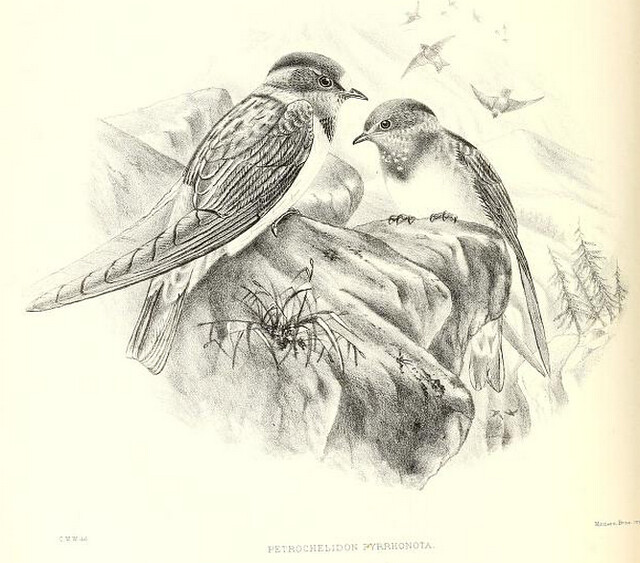
Beginning as early as the 1840s, beginning, it seems, with George Edward Gray’s Genera of Birds, European ornithology had begun to use yet another name, Petrichelidon pyrrhonota. When in 1894 that name was preferred in Richard Bowdler Sharpe and Clyde E. Wyatt’s Monograph of the Hirundinidae, it was time — one might think — for the Americans to react.
Not so fast.
In 1902, the AOU committee dismissed the name pyrrhonota, finding no “evidence to show that the change is necessary.” Not until 1944, fully fifty years after the name had been ratified by Sharpe and Wyatt, did the AOU finally accept pyrrhonota as both applying to this species and enjoying priority over lunifrons and albifrons alike.
What changed their mind was Charles Hellmayr’s footnote in the eighth volume of his Catalogue of Birds of the Americas. It was Louis Pierre Vieillot who coined the name pyrrhonota in 1817, taking his description from the Sonnini translation of Azara’s Apuntamientos. Hellmayr explains that
with the exception of the blackish lower belly [“le bas-ventre noir”] which may easily be construed as referring to the dusky under tail coverts, Azara’s description, upon which Vieillot’s name was based, is quite accurate.
Quite why it took so long to reach this conclusion is a mystery. Had no American ornithologist looked seriously at Azara and Vieillot? That seems hardly likely: we know, for example, that Robert Ridgway knew the 1817 description, and nevertheless accounted it “doubtful.” We can assume, too, that the AOU committees from 1886 to 1944 were conscientious bibliographers.
However it happened, I’m sorry in a way that we’re stuck — apparently for good this time — with the boring pyrrhonota. Say’s name lunifrons is evocative, romantic, beautiful.
Almost as much so as the bird itself.