Buying Prince Masséna’s Birds

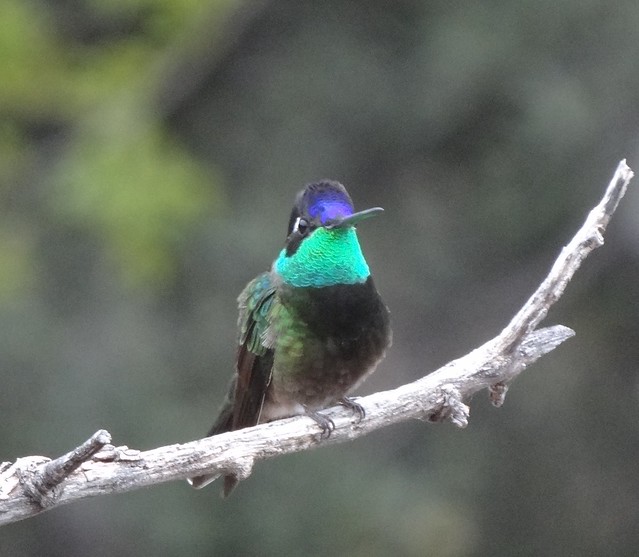
magnificent hummingbird

In 1846, Dr. Thomas B. Wilson, one of the great early benefactors of the Academy of Natural Sciences, asked his brother in England “to make a collection of birds” for the Philadelphia institution. Edward Wilson set about the task with his usual industry, and soon came to J.E. Grey at the British Museum.

Grey suggested, sensibly enough, that rather than assemble specimens piecemeal from dealers, Wilson purchase one of the several complete collections then on the market.

I mentioned two or three, among the others Prince Masséna’s collection in Paris…. I said that I intended to go to Paris in a very short time, and that, if he liked it, I would see what could be done.

Wilson, fearing that that famous cabinet would be beyond even his lavish budget, hesitated, but a few days later agreed to give it a try. Grey arrived in Paris,

and immediately sent a note to the Prince Masséna, saying that I was willing to purchase the collection of birds … and that I was prepared to pay for it in ready money. While sitting at dinner at the table d’hôte, an aide-de-camp came in, all green and gold, with a cocked hat and a large white feather, to inquire for me, with a message from the Prince to inquire what I intended by ready money, and … if I was ready to pay the sum that evening.

The banks were already closed, but the next morning, Wilson

gave his highness a cheque … and he gave me a receipt and handed me the keys of the cases, and I sealed them up, the affair being settled in a few minutes.

Wilson was “much pleased with the purchase,” as one might imagine, and the collection, “a very large and good one,” is now one of the greatest treasures held in any American museum.

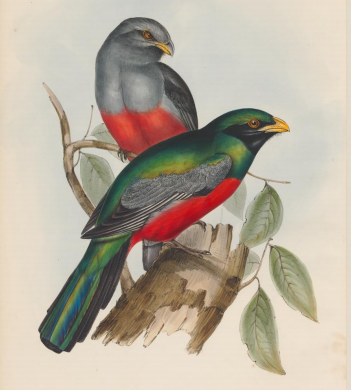
Gould, Massena trogon 1838

Share

Other People’s Bird Books: The Hendersons of Press

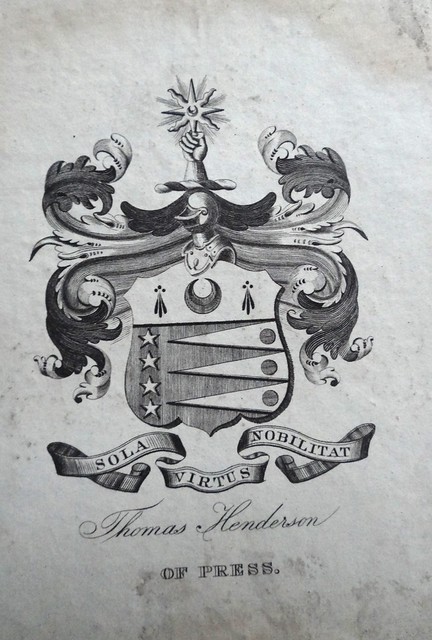
Thomas Henderson of Press, Wilson 1825

Thanks to the great generosity of our friend Judy, we are the trustees of eight volumes of Alexander Wilson‘s American Ornithology.

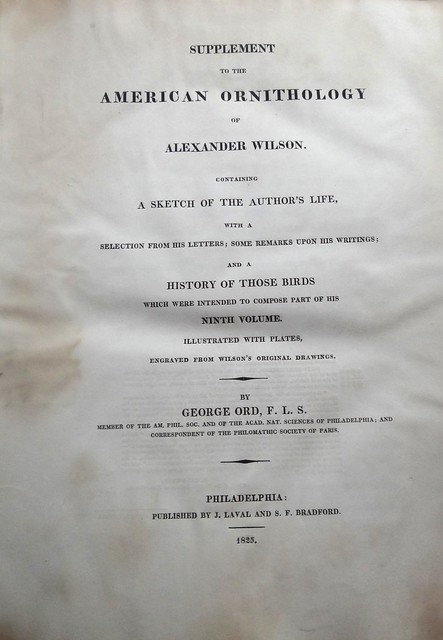
Wilson 1825


The first volume is dated 1808, but thanks to the bibliographic scholarship of Walter Faxon, we know that the this set in fact represents the “Ord reprint” 1824, plus the Supplement (Volume Nine) of 1825, which contains the first complete biography of the Father of American Ornithology.

All of the volumes are adorned with the bookplate of one Thomas Henderson of Press Castle. Thomas came from an Edinburgh banking family, and held the position of land tax commissioner in the 1830s; he seems to have devoted much of his attention to matters horticultural, and at one point supported a scheme for the “speedy increase” of beekeeping in Scotland.

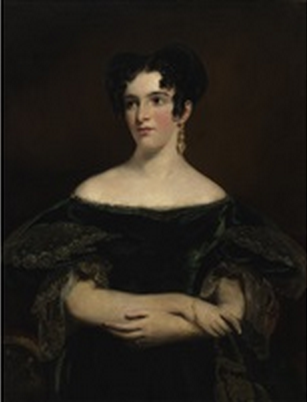
Henderson married Elizabeth Mack on September 14, 1830. (And was obviously very forgiving of her severely malformed arms and hands.)

Screenshot 2015-06-17 18.02.23

Their son, Alexander Henderson (1831-1913), emigrated to eastern Canada in 1855, where he became a professional photographer. His equipment spent the forty years after Alexander’s death in a basement, until in the early 1950s

his grandson Thomas Greenshields Henderson, the only surviving descendant, spent a day carrying the boxes of negatives to the alley for the garbage collectors.

Happily for us, Wilson’s volumes did not share the same fate.

Share

What Good Is a Green Heron?

Green Heron 1

It enlivens our summertime marshes with its dark beauty and its comical calls, but the green heron — the 2015 ABA Bird of the Year — has also been put to more practical use.

According to John Brickell, writing in his 1737 Natural History of North Carolina,

The Skin and Feathers calcin’d, stop Bleeding. The Grease eases pain of the Gout, helps Deafness, clears the sight, and is excellent bait to catch Fish with.

Economic ornithology at its finest.

Share

Get A Load o’This!

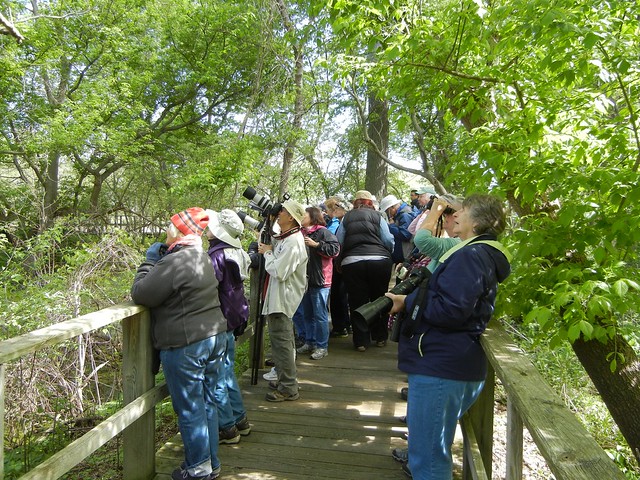
Magee Marsh boardwalk

One of the biggest things about the Biggest Week is getting to run into old friends and new at every turn. Among many others, it was fun to get to see our Nebraska friend Phil, with whom I’d last birded in Arizona last summer.

Not much of a coincidence, of course, running into a birder at a birding site like Magee Marsh — but get this.

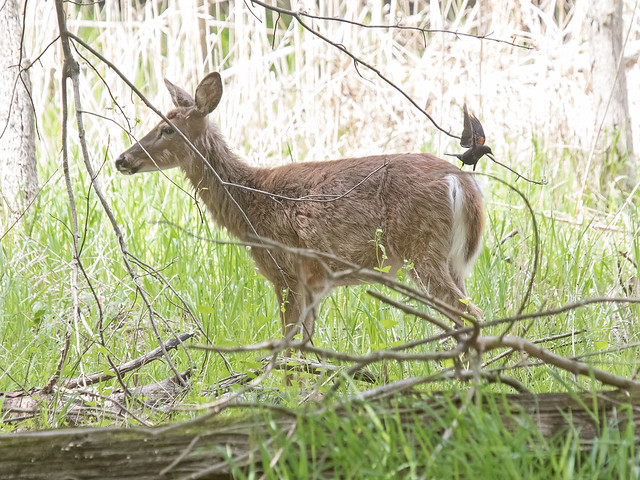
A few days ago, as we drove across Minnesota, I saw a red-winged blackbird perched on the back of a white-tailed deer. That struck me then, and strikes me now, as an unusual sight, and I asked whether anyone else had witnessed such a thing.

In response, an e-mail from Phil.

I saw your blog about a RWBB on the back of a [deer]…. Anyway, I have never seen this………until this year at Magee Marsh. When walking the boardwalk by the Maumee Bay Hotel, I saw a RWBB on the back of a deer. Got a photo of it just as it was taking off. Interesting that all the combined years that we have been birding that we would both have this first time experience at the same time. I assume that this might be somewhat regular behavior.

PHOTO BY PHIL SWANSON magee marsh, may 2015

Photograph: Phil Swanson

Astonishing. Thanks, Phil!

Share

Meanwhile, Audubon

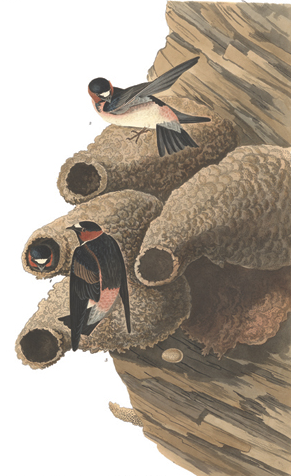
Audubon, cliff swallow

The history of the discovery and naming of the cliff swallow is as full of twists and turns as, well, a swallow’s flight.

And inevitably, John James Audubon had to get mixed up in it.

In 1824 — rather late in a game already won by Say and Rafinesque and Vieillot — Audubon submitted to the Lyceum of Natural History of New York a paper in which he, fairly unsubtly, claimed his own priority.

In the spring of 1815, I saw a few of these birds for the first time at Henderson, 120 miles below the falls of the Ohio, on the banks of that river. It was an excessively cold morning in the month of March, and nearly all were killed by the severity of the weather. I drew up at the time a description under the name of H[irundo] Republicana, Republican swallow, in allusion to their mode of association for the purposes of building and rearing their young.

Sadly enough, though,

the specimens, through the carelessness of my assistant [who?], were lost, and I despaired for years of meeting with them again,

and so Audubon’s name, which would otherwise have enjoyed priority, went unpublished.

Now things get interesting.

In the spring of 1819, Robert Best, the curator of the Western Cincinnati Museum, told Audubon about “a strange species of bird … building nests in clusters affixed to walls.”

In consequence of this information, I immediately crossed the Ohio, to Newport in Kentucky, where [Best] had seen those nests the preceding season [that is to say, 1818], and no sooner were we landed, than the chirrups of my long-lost little strangers saluted my ear.

Without so much as mentioning him, Audubon here pulls the rug out completely from under poor Rafinesque, who had described his Hirundo albifrons in February of 1822 — from specimens in the Museum of Cincinnati, taken “near Newport in Kentucky” or Madison, Ohio.

What Audubon’s account boils down to is the claim that he, Audubon, had been there first — in Henderson in 1815, in Newport and Cincinnati in 1819 — and most significantly, well before the famous meeting with Rafinesque in 1820. Audubon does not come out and exactly say that he introduced Rafinesque to the bird, but the implication is clear.
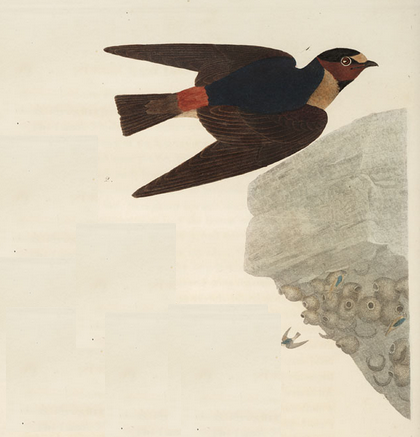
Bonaparte, America, cliff swallow

Audubon saved his explicit vitriol for another European colleague, Charles Bonaparte. In the addendum to his account of the species in the Ornithological Biography, he writes

Although the Prince of Musignano [Bonaparte] saw my original drawing, and read the account of the habits of this species in my Journal, as written on the spot, both at Henderson in Kentucky, in the spring of 1815, and again in the same state opposite Cincinnati, in the spring of 1819, and concocted his article on this bird from these sources, he has refrained from making any mention of these circumstances.

That’s not entirely fair: though Bonaparte fails to distinguish those places where he is copying Audubon verbatim from the passages based on his own observation, he does acknowledge his sources at the beginning of the account:

Mr. Dewitt Clinton has recently published a paper on the same subject, accompanied by some observations from Mr. Audubon. Combining what these gentlemen have made known with the information previously given by Vieillot and Say, we can present a tolerably complete history of the Cliff Swallow.

Justified or not, Audubon’s peevishness here is eloquent testimony to just how tangled the naming of the cliff swallow was — and how much it mattered to those involved.

 

Share