As a young birder, just after the days of Hesperornis, I was puzzled by the claim in all the books that the Song Sparrow was abundant, familiar, ubiquitous. Though the species has greatly increased in eastern Nebraska over the decades since, back then it was an uncommonish bird, and it took me a couple of seasons before I felt that I had something like a handle on it.
Fast forward to our years in southeast Arizona. There, we quickly found, the local Song Sparrows looked nothing like what I had learned as a boy and grown so familiar with in Massachusetts and New Jersey and Illinois. Indeed, these birds of damp desert thickets and ponds are so different from what the historical eastern bias of American birding has styled “the typical” that many first-time visitors to the Southwest refuse at first to believe that they are Song Sparrows at all.
When Spencer Baird saw the first specimens of this new form in 1854, he found it distinctive enough to merit description as a new species. Compared with the “normal” Song Sparrow,
the bill is considerably smaller and the tail longer. The plumage above is more ashy, the streaks on the back not so distinct, the spots are more crowded about the breast, but fewer on the sides; their color more uniformly chestnut brown.
All that said, though,
this species bears a very close resemblance to Z. melodia,
and so Baird gave it the name Zonotrichia fallax, the “deceptive sparrow.”
Four years later, in the great report of the Pacific Railroad Explorations, Baird wondered whether he might not have been the one deceived:
Although this species is very similar to the M. melodia, yet, when specimesn are compared with an extensive series, of the last mentioned species, an impression of difference will at once be conveyed…. I do not, however, feel sure that this species will stand as perfectly satisfactory… At any rate, I consider it as less strongly established than any of the others before me.
By 1874, Baird and the distinguished co-authors of the History of North American Birds had rethought the whole thing. Their deliberations largely anticipate the notion of the Rassenkreis, a concept that would be explicitly applied to the Song Sparrows by Patten and Pruett 135 years later. Writes Baird in 1874,
Spread over the whole of North America, and familiar to every one, we find each region to possess a special from [of Song Sparrow] (to which a specific name has been given, and yet these passing into each other by such insensible gradations as to render it quite impossible to define them as species. Between M. melodia of the Atlantic States and M. insignis of Kodiak the difference seems wide; but the connecting links in the intermediate regions bridge this over so completely that, with a series of hundreds of specimens before us, we abandon the attempt at specific separation, and unite into one no less than eight species previously recognized.
Baird’s old fallax was one of those eight, listed in the History as Melospiza melodia var. fallax.
Unfortunately, however, Baird extended his name fallax to comprise two very different birds, the pale, reddish, sparsely marked Song Sparrows of the southwestern deserts and the darker, more richly colored birds of the Great Basin and adjoining Rocky Mountains. Henry Henshaw corrected that error in the very first volume of the Auk, restricting the name fallax to
the older though least known form … inhabiting our southern border — Arizona and New Mexico.
The more northerly birds received their own, new name, montana.
The AOU Check-list, back in those happy days when it provided a full accounting of each species’ recognized subspecies, called fallax in its strict sense the Desert Song Sparrow, from 1886 up to the Fourth Edition of 1931, when the fallacious one pulled another of its tricks.
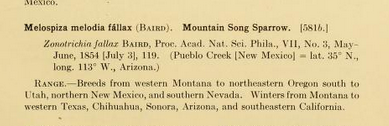
Following Oberholser in rejecting Henshaw’s identification of Baird’s type specimen, the committee responsible for this, the weakest edition of the Check-list voided the name montana and re-allocated fallax to the northerly populations covered by Baird’s early description, using Grinnell’s name saltonis for the southern birds. As a result, fallax was called in English the “Mountain” Song Sparrow, and the English name “Desert” was shifted to saltonis, generating a quarter century’s worth of confusion that must have had our trickster sparrow laughing its pale rusty head off.
Not even the sneakiest sparrow was a match for Allan Phillips, though. Phillips, writing midway between the publication of the Fourth and the Fifth editions of the Check-list, re-asserted the validity and the identity of Henshaw’s montana, once again calling it in English the Mountain Song Sparrow, and effectively splitting the pale southern birds into three races — fallax (northern Arizona), saltonis (southwestern Arizona and California), and his new bendirei (central and southern Arizona and Sonora).
More recent authorities tend to synonymize all three of those Phillipsian races under fallax in Henshaw’s sense, leaving us with just one Desert Song Sparrow, a tricky little bird that no doubt still relishes the almost endless confusion it has caused over the years.