

The Experience of Birding
The Originals: Reading the First Descriptions of North American Birds
Thanks to the magic of the internet, the original descriptions of most of the world’s birds — long buried in the stacks of far-flung libraries — are now at our fingertips. Some are just as dusty and dry as you might expect, but many provide answers to questions we might not even have thought to ask. Join me for a tour of the fascinating, often surprising stories hidden in the first descriptions of some of our most familiar birds.
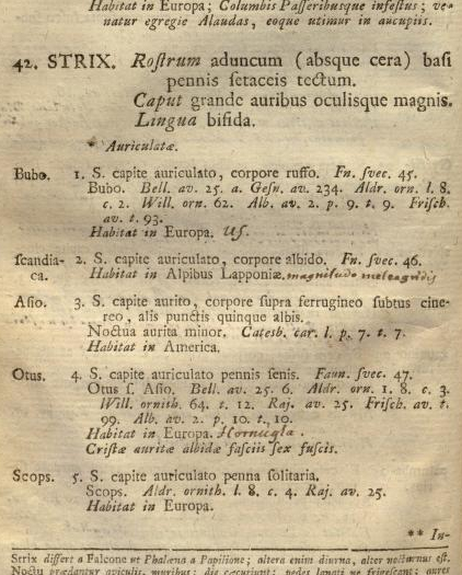
And yes, I considered an entire evening of just Linnaean footnotes.This one is among my all-time favorites:
The genus Strix differs from the genus Falco in the same way a moth differs from a butterfly: the one is diurnal, the other nocturnal.
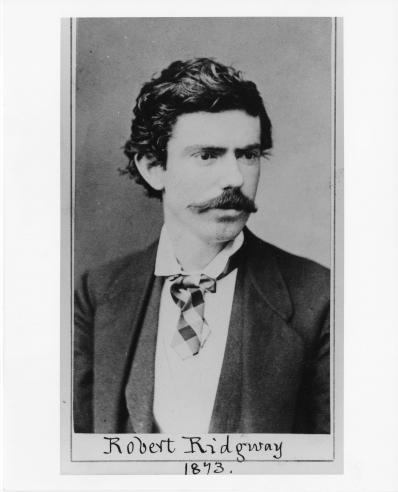
I’m as big a fan of Robert Ridgway as anybody, and I couldn’t be more delighted that at long last, decades after we all learned to say “buff-collared nightjar,” the man is once again commemorated in the English name of a US bird.
The Smithsonian ornithologist was just 24 years old when he described this bird — not, mark well, as a new species but rather as a new race, obsoletus, of the king rail.The type specimen, A 6444 in the collections of the National Museum of Natural History, was sent east from San Francisco, California, where it had been obtained in March 1857 by George Suckley. Obtained, but not exactly collected: as Suckley reported in 1859,
The king rail [= today’s Ridgway’s rail] is very common in the San Francisco market…. A fine specimen was presented to me in San Francisco by F. Gruber, an excellent practical taxidermist of that city.
Edward William Nelson fills us in:
F[erdinand] Gruber was a German taxidermist, in San Francisco, who was well known in the ’70’s and ’80’s of the [nineteenth] century. He had a shop for a long time on California Street… a small gruff man, rather repellant at first contact but … under the crust was a most friendly person to any young naturalist interested in birds.
Crusty or not, Gruber would be named the first curator of ornithology at the California Academy of Sciences. His place in ornithological history was assured in 1870, when Robert Ridgway (who else?) described a new species of hawk from California, which he named Onychotes gruberi for that
zealous naturalist and accomplished taxidermist of San Francisco, having added much to our knowledge of the birds of California, through the frequent contribution of valuable specimens.
The honor was hardly diminished 15 years later when Ridgway re-examined the specimen and determined that it was, in fact, a Hawaiian hawk that had made its way — no doubt already a skin — into Gruber’s store.
George Suckley, too, was the beneficiary of Ridgway’s gratitude when it came time to name a small sooty falcon from Washington Territory. Ridgway gave his new subspecies from “the northwest coast region of heavy rains and dense forests” the scientific name suckleyi. We knew it for a while as Suckley’s pigeon hawk, but now it is, more blandly, just the black merlin.
I’m glad that Ridgway has his rail. But we mustn’t forget, it seems to me, that he got it from Suckley, who got it from Gruber, who got it from an unknown rail hunter in the long-ago market stalls of San Francisco.
Even bird skins have their stories.
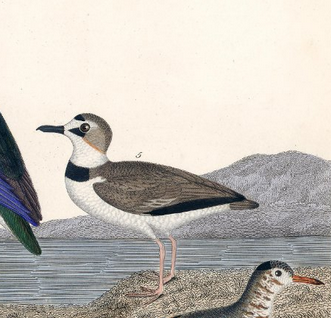
It was two centuries ago this summer, just a year after the death of his “ever-regretted friend,” that George Ord published the first scientific description of the bird he honored with the name of the Wilson’s plover.
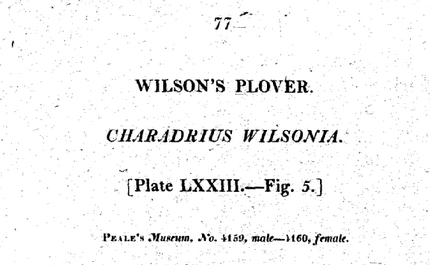
Ord commemorated his late colleague in both the English name and the scientific name of the new species, assigning it the Linnaean binomial Charadrius wilsonia. Ten years later, he changed his mind. Not about Alexander Wilson’s considerable merit, and not about the suitability of “this neat and prettily marked species” as a monument to the American Ornithologist; but rather about the proper form of the bird’s scientific name. In the second edition of Volume Nine, and then in the three-volume edition of Wilson’s work published in 1829, Ord — accepting without comment a change first made by Vieillot in 1818 — alters the epithet, from his original wilsonia to wilsonius.
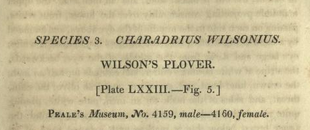
Alters and corrects, I should think: Charadrius is a masculine noun, and so any adjective modifying the genus name — from vociferus to nivosus, from thoracicus to modestus — should itself be masculine — and thus, Charadrius wilsonius it is. Sometimes. And sometimes not. The currently recognized scientific name of the Wilson’s plover is — if we follow the AOU, the SACC, Clements, the IOC, Howard and Moore — Charadrius wilsonia, just as it was in Ord’s 1814 description. Why? It all started, I think, in 1944, when the Committee responsible for the preparation of the fifth edition of the AOU Check-List — long delayed, “in part due to the war” and the attendant shortage of good paper — published a preliminary digest of the changes to be expected whenever that edition might appear. Among the principles propounded: where in the fourth, 1931 edition any “obviously” adjectival specific names were made to agree in gender with the genus name, in the new edition
original spellings will be used in all scientific names.
When the fifth edition was published, in 1957, that pronouncement was furnished with an important exception:
specific and subspecific names used as adjectives have been made to agree with the gender of the genus,
just as had been the case before 1944. Oddly, though, that exception was not applied to the plover, which on being returned after some decades of exile to the grammatically masculine genus Charadrius, nevertheless retained, and retains today, the grammatically feminine epithet wilsonia.
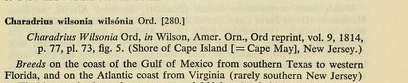
This combination, officially sanctioned though it be, is not only barbarous, but contravenes the ICZN, whose principles and decisions the AOU expressly follows in matters of naming. While priority remains the highest of principles, the Code tells us that
a species-group name, if it is or ends in a Latin or latinized adjective or participle in the nominative singular, must agree in gender with the generic name with which it is at any time combined (31.2)
and that
if the gender ending is incorrect it must be changed accordingly (34.2).
If I read this correctly, then the name of the Wilson’s plover should rightly be Charadrius wilsonius Ord 1814; wilsonia should be rejected as improperly formed. Unless, of course, the ICZN has issued a special dispensation permitting the retention of the ungrammatical name. I can’t find such a document, but maybe it’s out there — or maybe I’ve missed something obvious.
I do not, by the way, buy the explanation offered by some — most recently endorsed in the new Howard and Moore — that Ord’s “wilsonia” was not adjectival. The change to “wilsonius” in 1824 (and earlier in Vieillot) is proof enough that Ord understood the word to be a first-and-second declension adjective — and that obviously renders inapplicable the ICZN’s provision (31.2.2) covering equivocal species epithets:
Where the author of a species-group name did not indicate whether he or she regarded it as a noun or as an adjective, and where it may be regarded as either and the evidence of usage is not decisive, it is to be treated as a noun in apposition to the name of its genus.
Does anyone know who decided, when and on what basis, “wilsonia” was a noun? What am I overlooking here?
Fill me in.
On the 201st anniversary of the death of Alexander Wilson — with thanks to David and Ted for good discussions.
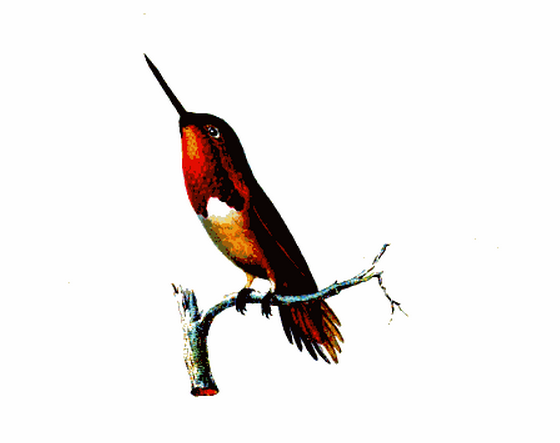 We asked the other day what the quickest set of connections was between the Allen’s hummingbird and the imperial court of Napoleon’s France. Twitter and Facebook produced a few plausible responses, but nothing can match Shannon’s response in the comments on this b-log:
I’m guessing one of the degrees is Napoleon’s ornithologist nephew, Charles Bonaparte (son of Napoleon’s brother Lucien), who lived in Bordentown, New Jersey in the 1820s at his father-in-law’s (Napoleon’s brother Joseph’s) estate called Point Breeze. As Allen’s hummingbird is a west coast bird, and Charles never ventured that far west, the second degree is probably Adolphe Mailliard, son of Joseph Bonaparte’s long-time secretary Louis Mailliard. Adolphe moved to California and died there in 1890. He (or his descendants) perhaps knew Allen?
Yep, that’s exactly the chain I had in mind.
Adolphe Mailliard‘s sons, John and Joseph, both born in Bordentown, met Charles A. Allen in California in 1874; in the early 1880s, the Mailliards gave Allen a house on their Rancho San Geronimo, where he was still living as late as 1927. Robert T. Orr’s obituary of John Mailliard credits the collector and taxidermist with having in large part inspired the brothers’ natural historical interests.
In 1877, Henry Henshaw named what he thought was a new hummingbird for Allen,
but for whose efforts in obtaining the specimens necessary for comparison, and careful field-notes, the species might have remained for a long time still unrecognized.
So there it is: the hummingbird – Allen – the Mailliard brothers – their father and grandfather – Joseph Bonaparte – and the First Empire.
Well done, Shannon!
“What he t h o u g h t was a new hummingbird”? For a quick entrée into the muddle that is the history of the Allen’s hummingbird, have a look here.