Whenever we’re invited to a wedding out of town, the second thing we check is the bridal registry.
And the first?
Do you have to ask?
Nowadays we just pull a field guide off the shelf or call up an eBird map or two—luxuries that were not available to Auguste von Leuchtenberg when, in August 1829, he left Munich to escort his younger sister Amélie to a wedding in Rio de Janeiro. The wedding was hers: the seventeen-year-old princess had been married by proxy three months earlier to Dom Pedro I and was now the empress of Brazil.
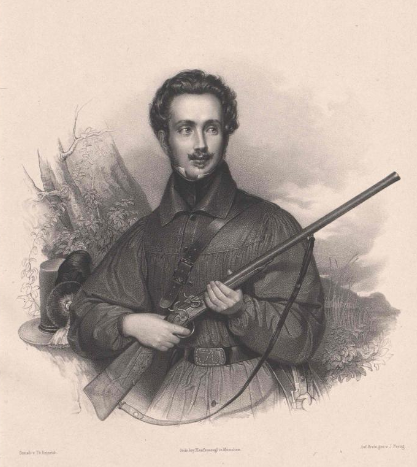
Auguste—at that time still just the duke of Leuchtenberg and prince of Eichstätt, but the future prince consort of Portugal—spent much of his time in Brazil birding. Who wouldn’t?
In April 1831, Johann Georg Wagler reported on some of the natural history specimens Auguste had brought back from his journey. Wagler was greatly impressed by the duke’s haul of insects:
The insect collection is remarkably rich, and the dazzling beauty of certain of them exceeds any splendor that the entomologist’s eye has ever beheld in the world of these wondrous little creatures. Brazil has not entrusted its gold and gemstones to the depths of the earth alone: No, it has also lavishly adorned its insects with it, and radiant with such glitter, or clad in the deepest purple or in the purest most ethereal blue, they may remind the traveler of that great menagerie described in the most ancient of all books or of the enchanted gardens of the Hesperides.
Among the many noteworthy mammals brought back to Eichstätt were two howler monkeys and a vampire bat with a wingspan approaching two feet, that last captured by the duke himself “in his bedroom, where, harpy-like, it was fluttering about him eerily.” The party even brought a few mammals back alive, including agoutis, white-lipped peccaries, and “an extremely sweet and confiding” golden marmoset, which Auguste installed in a greenhouse for the northern winter.
If Wagler’s account of the Brazilian insects is a bit florid, he waxes ecstatic about the birds of South America.
No other continent can match the feathered wildlife of Brazil in its—I might almost say—extravagantly magnificent colors…. Shall I remind you of the great throng of hummingbirds, those pygmies among birds, which incline the blazing fires of their heads and their glowing throats toward the calyces of luxuriantly blooming flowers, as if to singe with their flame any blossom that would dare compete with them for the golden apple? Shall I recall to you the toucans with their saffron-colored throats, birds of blood red, azure, and hyacinthine blue?
Wagler found much that he thought was new among the specimens Auguste had returned with. On the duke’s suggestion, he went on to name three of the hummingbirds for members of the noble family: Trochilus Amalia for the newly minted empress, Trochilus Theodolinda for August and Amélie’s sister the countess of Württemberg, Trochilus Maximiliani for their thirteen-year-old brother.
None of those names stuck, of course. Wagler would seem to have figured out—if he didn’t already know— that the skins from Brazil represented species already known and named, and he never proceeded to publish formal descriptions for any of his “new” hummingbirds, some of which may today be in the collections of the Gabrieli Gymnasium in Eichstätt. None of them can be identified with a currently recognized species, making Wagler’s well-intentioned names nomina nuda (or “nomen nudums,” as I recently heard said).
Still, it was a nice thought, and the ducal family must have been grateful.