The Long Way Around

eastern wood-pewee

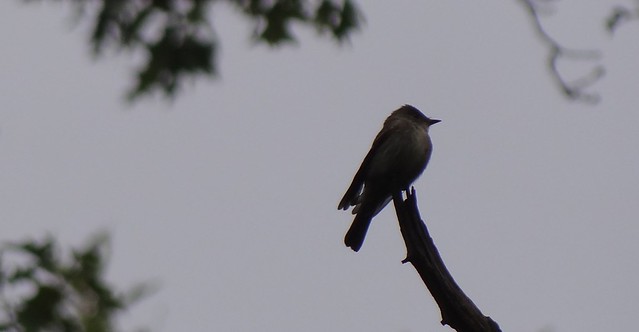
At this season, every eastern wood-pewee — like this on in Brookdale Park early yesterday morning — could be the last of the year at our latitude.

I’ve been birding long enough that the name seems “normal” to me, but new birders and non-birders find it amusing that there is a tiny bird named “pewee.” And so we explain: in the summer, this flycatcher sings its pee-a-wee over and over and over. Aha. Everything’s clear.

This isn’t the only explanation floating around for the name, though. Two hundred years ago, Louis-Pierre Vieillot had another theory:

The name “pewit” given to this bird by the Americans comes from the fact that when it ruffles the feathers of its head, it appears to be adorned with a sort of crest,

a crest distantly recalling that of the original pewit, the northern lapwing.

I suppose.


Share

Being Stupid, Being Wrong

palm warbler

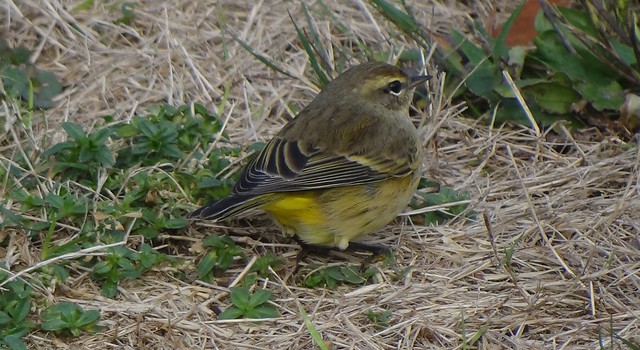
They’re not always the same thing. They’re not even usually the same thing. It’s devastatingly easy to get something wrong in the smartest possible way. Take the name of the pretty little bird in the photograph, for example.

For forty years now (!), I’ve been hearing how stupid the name “palm warbler” is for a bird that breeds in bogs and then paces off lawns and fields on chilly October days.

The name is wrong, maybe, if any member of the category of nouns we call names can be “wrong,” in commemorating only one stage in this warbler’s life history — the six or seven months it spends on the wintering grounds each year, where, yes, palm warblers can once in a while be seen in palms.
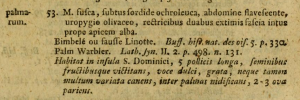
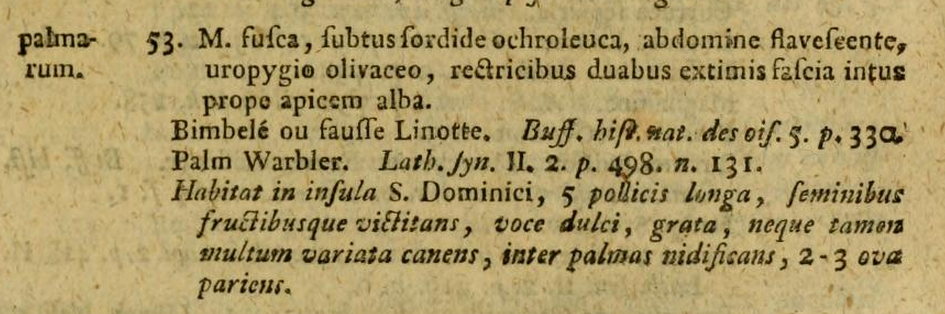
Gmelin 1.2: 951

John Latham coined the English name in reliance on notes submitted to Buffon by the members of the Cercle des Philadelphes in St-Domingue. Etienne Lefevre-Deshayes, the club’s official correspondent, even sent a colored drawing of the new bird, which was known in the colony as the “false linnet” or the “bimbelé.”

The Philadelphians reported that this warbler frequented palm trees, placing its nest atop the broad, flat petioles where they sprouted from the trunk.

That was wrong. But it wasn’t stupid: with no field guides, no binoculars, no preconceptions, the observers of the mid-eighteenth century did their best — and made mistakes.

It was even less stupid for Buffon and his collaborators to take the colonists at their word, and even less stupid for Latham to place his confidence in what he read in Buffon, and even less stupid for Gmelin to assign the bird a latinizing binomial based on what he found in Buffon and Latham.

They were wrong, all of them. But to call any of them stupid would be … not right.

Share

Heermann’s Birds

PUerto P, Sonora, January 24, 2007 126

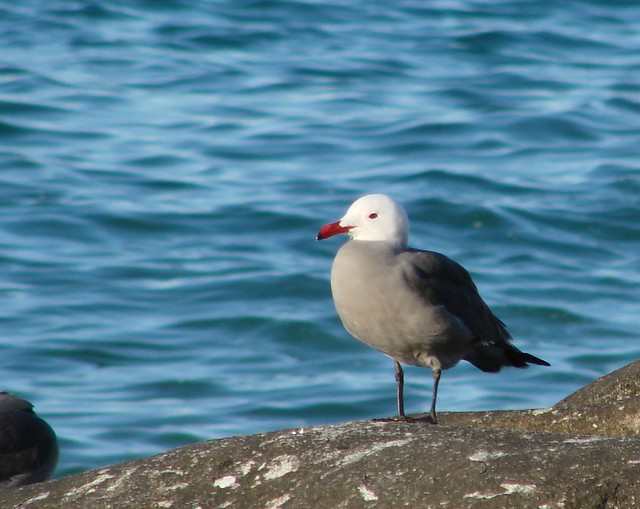
One hundred fifty years ago today, Adolphus L. Heermann was killed, “having evidently stumbled and fallen,” when his collecting gun fired.

John Cassin, who knew him well, said of Heermann in earlier, healthier days that no better man could be had for a collecting expedition. In 1853, Cassin dedicated a “beautiful gull” to his friend, an

acknowledgment due to his accomplishment as a naturalist, and his perseverance and success as a scientific traveller.

In Washington, D.C., Spencer Baird was equally impressed by Heermann and his work in the field. On working through a collection of sparrows from the west, Baird encountered one that Heermann had sent from Tejon Pass, California, resembling a song sparrow but

differing very appreciably from a large number of specimens from Washington and Oregon…. I have come to the conclusion that the species is worthy of specific separation, and have accordingly named it Melospiza heermanni, after its accomplished collector and discoverer.

Today we “know” that that California bird is “just” a subspecies of the song sparrow. But there’s no reason not to call it the Heermann’s song sparrow, especially today.

Share