Baja California Sur: The Bird

Gerardo and Leo picked us up at dawn at our hotel in San José, and three hours later we started our walk in the Sierra de la Laguna above San Antonio.
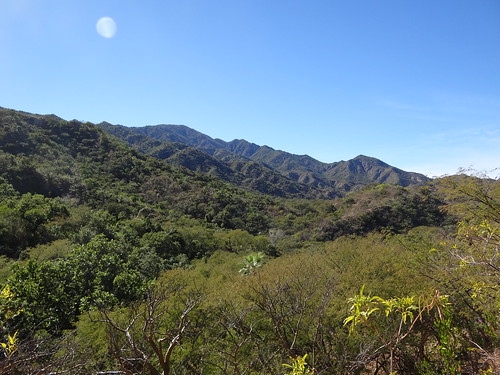
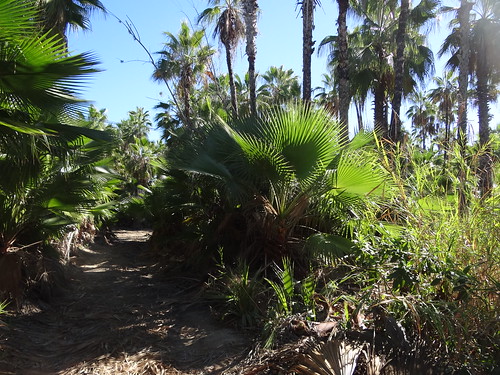
Sierra Laguna

It was a lovely warm morning, and there were birds to be seen along the way, to boot. Single black-throated gray and Townsend’s warblers reminded us that we were in the southwest, and the San Lucas robin made sure we knew that we weren’t just anywhere in the southwest.

San Lucas robin

We also got to see the bizarrely dim-eyed angustifrons acorn woodpecker, and a heavily spotted spotted towhee that was presumably the aptly named umbraticola. A feral hog was a source of momentary puzzlement, and then it was higher, ever higher.

I was embarrassed at having to take three (three!) quick sitting breaks for out-of-breathness, but everyone was kind about it. I’m not used to being The Problem Client, and I’m not used to being Oldest In The Group, but I guess I’d better start resigning myself to it. At least each of my long pauses was another chance at leisurely enjoyment of the stunning desert scenery.
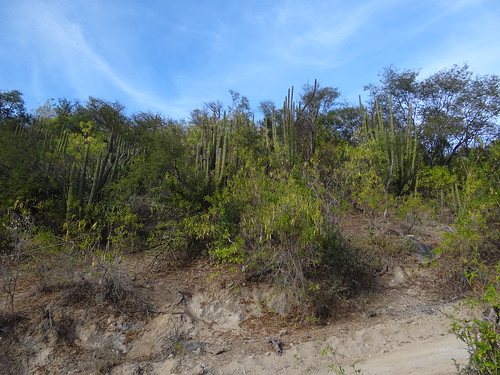
Sierra Laguna

Then, at about 1200 meters, Gerardo mentioned that we were at the lowest spot he’d ever seen the bird. “And there’s one now!”
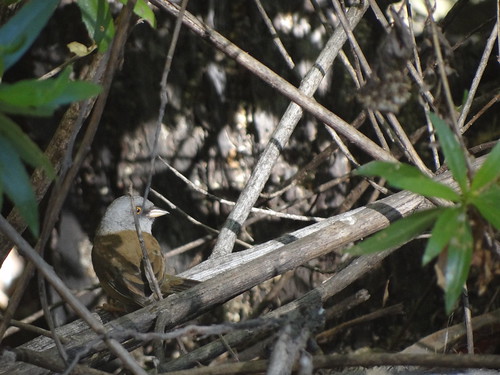
Baird's junco

In early February 1883, when he was exactly my gasping, panting age, Lyman Belding set off alone for the Sierra. Belding found “the trail leading to Laguna … the longest, highest, and possibly the worst” in these mountains, “which were probably never previously explored by any collector.”

The effort paid off handsomely, however, when, on reaching the lower edge of the pines, Belding encountered “a beautiful new Snowbird,” which he dispatched and sent to Robert Ridgway at the Smithsonian for description, specifying that the new bird was to be named for Spencer Baird, “in consideration of [his] valuable ornithological services… in field and office, not the least of such services being his original, full, and accurate descriptions of so many North American birds.” Ridgway, finding the bird “pretty and very distinct,” obliged, concluding his formal description with the observation that the Baird’s Junco “is so markedly distinct… from all its congeners as to really need no comparison with any of them.”

We didn’t have to go anywhere near the pines.
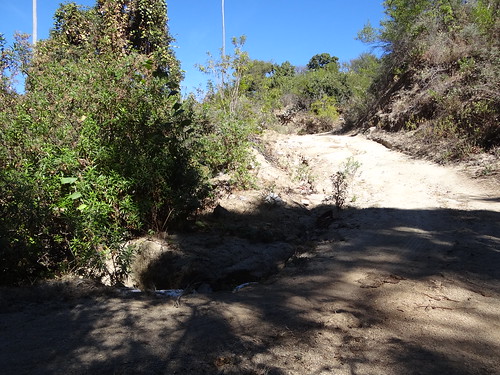
Baird's junco

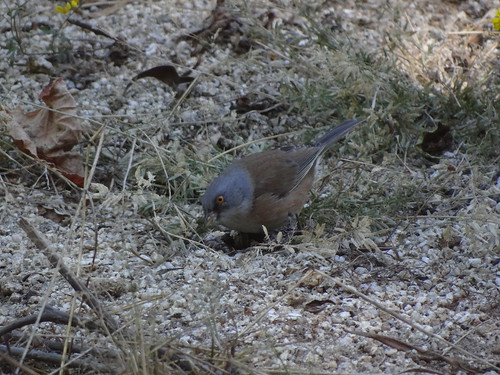
Instead, all we had to do was plop down on the roadside and wait for this most beautiful of the juncos to re-emerge from the shadows to feed in the open.
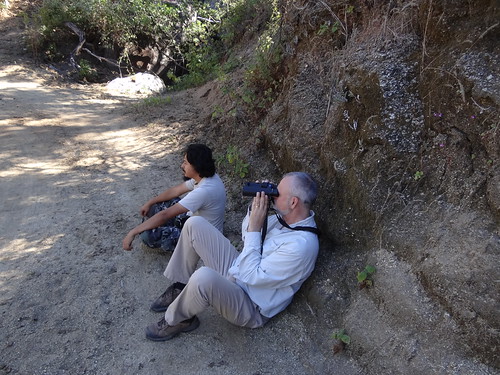
Rick watching Baird's junco

The birds were nervous at first, perching in the bushes and chacking like tiny thrashers.
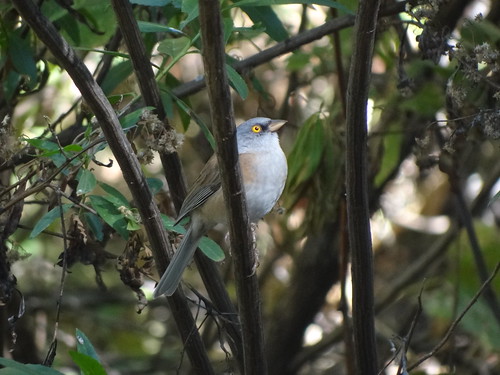
Baird's junco
Soon enough, though, we had three Baird’s juncos on the ground in front of us, busily stripping the seeds from a grama-like grass and daintily plucking petals from low flowers.
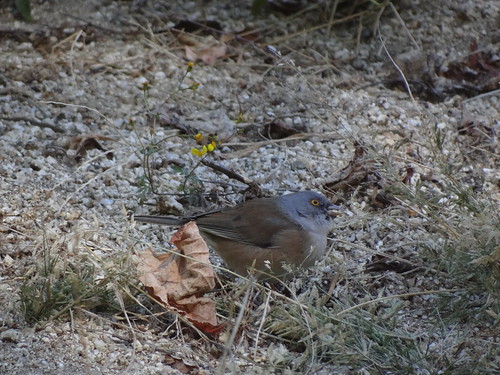
Baird's junco

For the most part, all three were quite stolid, barely shifting their big feet when it came time to reach up to take another bite.
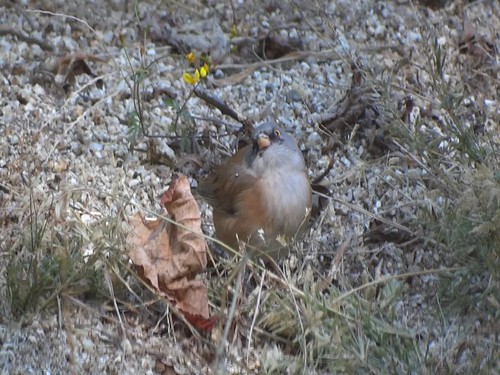
Baird's junco video
video

There was a little bit of occasional and unenthusiastic double-scratching, but never in the hour we watched them did I see the creepy shuffling so typical of Mexican yellow-eyed juncos, just short hops.
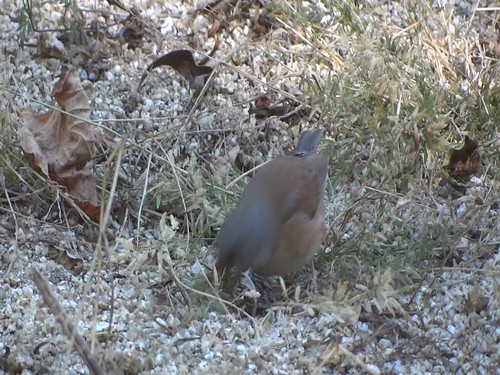
Baird's junco video
video

The birds grew more trusting as time went on, and I was able to repeatedly change my position, getting closer each time, without causing any obvious alarm. They were obviously alert to whatever passed overhead, though, reacting nervously to everything from turkey vultures to a canyon wren, and I suspect it was a flighted threat that finally chased the birds back into the dense, dark vegetation whence they had come.
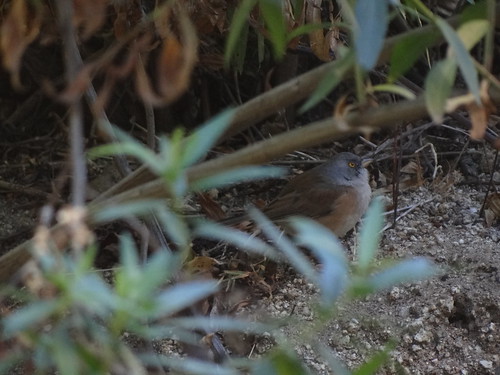
Baird's junco

Our walk back down the mountainside was nothing short of joyous, a dream of decades having finally come true. Minds and memories full of the junco, we paused to look at fruiting burseras
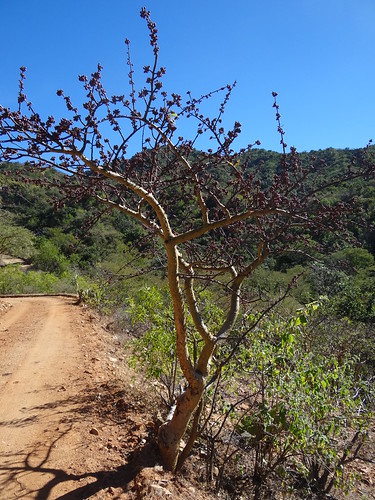
Bursera

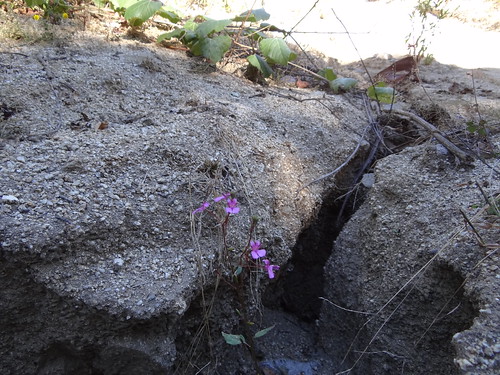
purple flowers

Sierra Laguna flower\

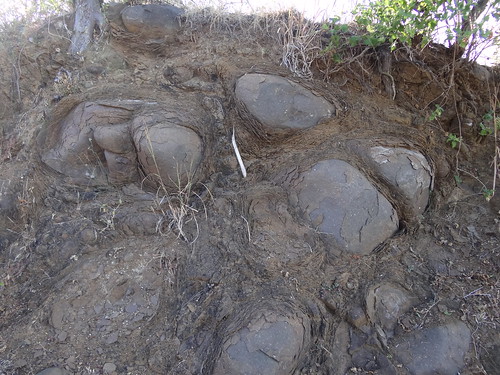
and weirdly exfoliating slopes.

exfoliating rocks, Sierra `laguna

Thanks to Bryan, Gerardo, and Leo for making this day such an astounding success. I can’t image what the rest of 2017 could possibly bring to match it.
Baird's junco

Share

Other People’s Bird Books: A Nuttall Manual

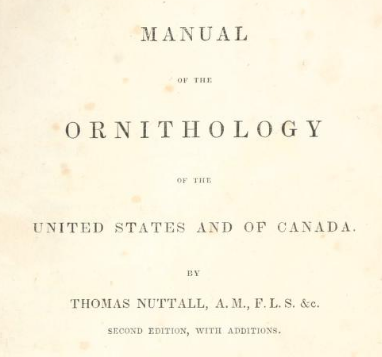
Screenshot 2017-01-16 12.29.53

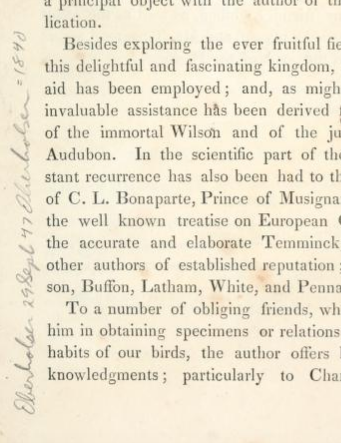
Now in the library of the University of Illinois, this copy of the second, 1840 edition of Thomas Nuttall’s Manual has passed through some very distinguished hands indeed.

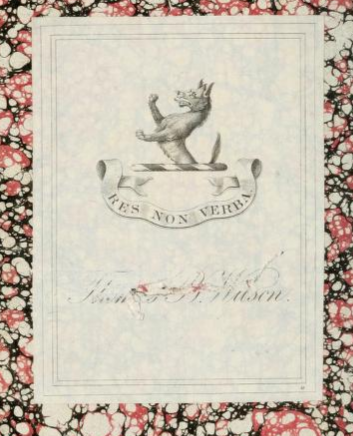
Screenshot 2017-01-16 12.31.30

The rather ferocious bookplate on the inside of the front board identifies it as the property of Thomas B. Wilson, born on this date in 1807. Wilson and his brother Edward, among many other contributions they made to the Academy of Natural Sciences, were instrumental in bringing the collections of Prince Masséna to Philadelphia, a coup that instantly cemented the Academy’s reputation as the best place in America to study birds.

Wilson was one of the greatest benefactors of the Academy’s library, but this volume went its own uncertain ways after his death in 1865. The next station we know about was nearly sixty years later, in September 1923, when the book was presented — a fine present indeed — by Charles Reuben Keyes to Harry C. Oberholser.

Screenshot 2017-01-16 13.12.49

Oberholser is too well known to require biographical comment. Keyes, on the other hand, is virtually forgotten even in Iowa, where he was born in 1871 and where he died eighty years later. His professional career, spent at Cornell College, was devoted to Germanic philology (Keyes’s 1923 Harvard dissertation was on Rist’s Irenaromachia), but his real passions were ornithology and, especially, archaeology.

The two probably met in Iowa, where Oberholser briefly taught at the end of the 1910s and conducted field work in the early 1920s. I do not know exactly what the occasion was for the gift, but someone with access to the principals’ papers should be able to figure it out. In any event, the book obviously remained in Oberholser’s library until 1948, when he sold his collection to the University of Illinois.

Screenshot 2017-01-16 14.43.52

What is puzzling about the book, though, is not its provenance but the mysterious signs of use — or defacement, in a couple of instances — left inside by one or the other of its earlier owners.

Screenshot 2017-01-16 15.09.56

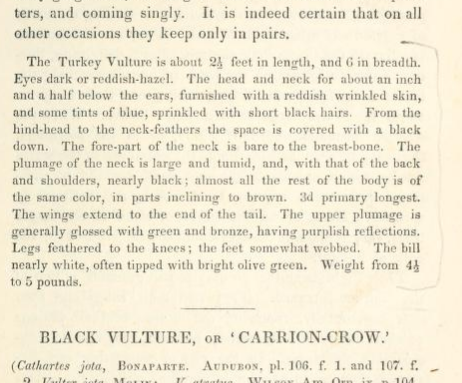
A number of passages, including this diagnosis of the turkey vulture, are marked for excerpting, some of them with the directions “Begin” and “Stop” in the margins.

Screenshot 2017-01-16 15.14.31

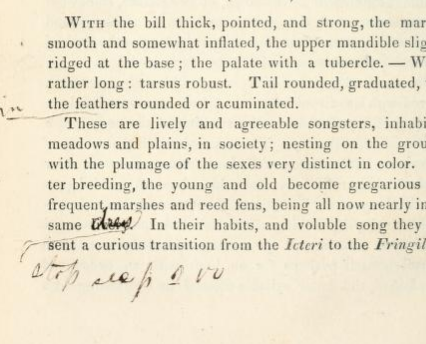
A couple of times our annotator directs that distant passages be combined, as here in the account of the bobolink: “stop, see p. 200,”

Screenshot 2017-01-16 15.16.24

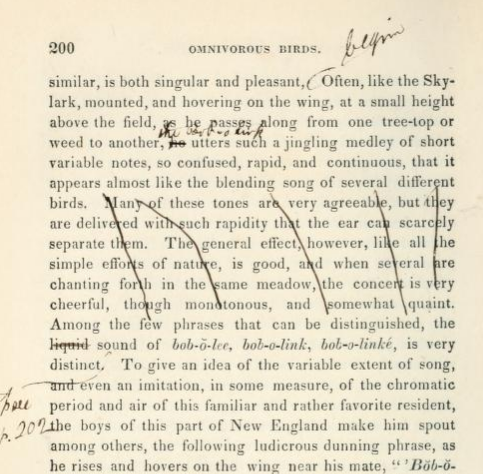
is followed there by “begin” and “stop, see p. 202.”

But these passages aren’t marked just for verbatim quotation. Pius corrector deletes unnecessary words (“liquid sound” becomes simply “sound”), replaces pronouns (“he”) now missing antecedents (“the bobolink”), and even updates Nuttall’s diction (the quaint “livery” changes to “dress”). Similar editorial interventions pop up on the pages Nuttall devoted to the northern bobwhite:

Screenshot 2017-01-16 15.06.29

I am fairly sure, a certainty based on only very limited comparative material, that those lines and notes are Oberholser’s. I can’t find my copy of his Texas (where do all my books get to when I’m on vacation?), and my dear friend google isn’t turning anything up, at best sending me back to Nuttall’s unamended text when I search for the edited versions.

I’ll keep looking in the hopes that I can discover just how Oberholser was using these edited passages. It’s possible, though, that we’ll never know: that he excerpted them for a lecture or for an essay never finished, or that they lurk somewhere in the more than two million (!) unpublished words of the untrimmed Texas manuscript.

Or maybe you know.

Share

Baja California Sur: Todos Santos

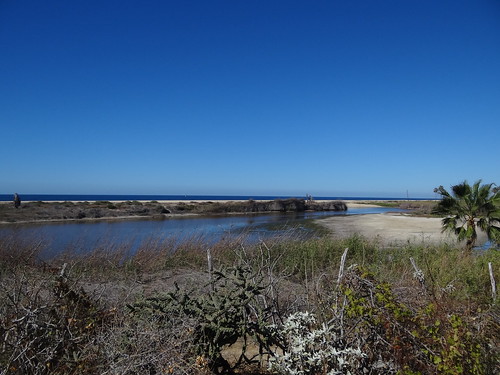
La Poza, Todos Santos

An hour from San José on the Pacific coast of the peninsula, Todos Santos is a large but happily quiet town, a much-needed respite from the touristy bustle of Los Cabos and only relatively slowly being swallowed up by hotels and strip malls. We didn’t really have a target in mind, though I was hoping to find some Savannah-type sparrows out on the beaches. (Didn’t.)

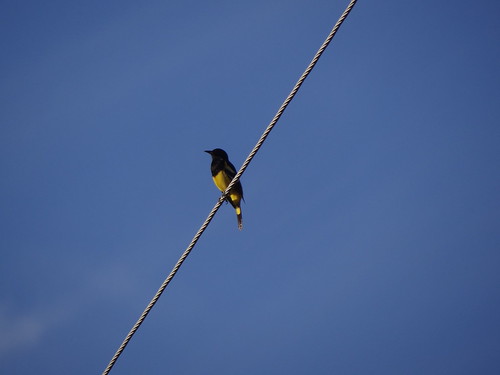
The first challenge came on our arrival above the flat salty pond known as La Poza. Where to park? The signs were everywhere and clear: not here, not here, not here! Rather than drive back up into town and walk the steep dusty streets down to the water (and then walk the steep dusty streets back up to the car), we cleverly made lunch reservations at the Posada La Poza and left our car in their parking lot, watched over by one of eleven (!!) Scott’s orioles we would see on our walk.

Scott's oriole

Among the first birds to pop up as we left the parking area was a gray thrasher, perching briefly on a fence then, for lingering close-range scope views, atop a cactus. Fortunately, we still had some admiration left to bestow on the first-cycle white-crowned sparrow working the gravel nearby, the only Gambel’s sparrow we saw the entire trip.

The pond itself wasn’t exactly crowded with birds. There were black-necked stilts, western and least sandpipers, greater yellowlegs, cinnamon and blue-winged teal, and a few lesser scaup and ruddy ducks; the only mildly notable bird on the water was a lone American white pelican. 

American white pelican

The beach was no birdier, and the only fly-bys were the odd Brandt’s cormorant and California gull. Out in the middle distance, though, there was activity .

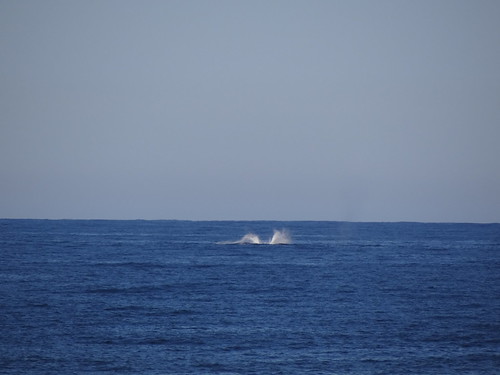
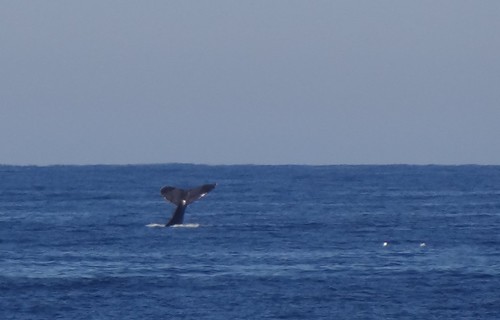
Humpback whales were nearly constantly in sight, splashing with their tails and occasionally flopping a flipper into the water.

humpback whale

We’d been on a whale “watch” from San Lucas a couple of days earlier, with views as close as any I think I’d ever had, but how much more evocative it is to see them like this, wild and wary, out in the same waters that not that long ago would have been slick with blood and grease.

humpback whale

And lunch at Posada La Poza? The food was ok, the service genuinely kind, and the view out over the palms and the water pretty close to perfect.

Todos Santos

Share

Baja California Sur: Las Viudas

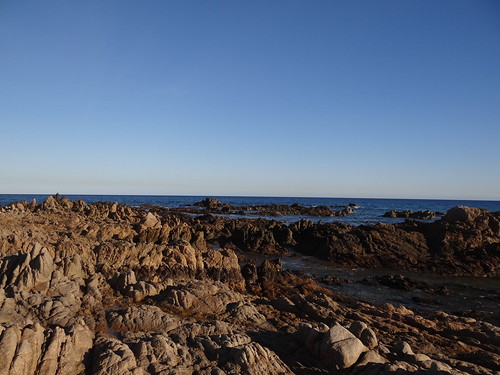
Las Viudas

I never did find out exactly why this little beach near San Lucas should bear such an ominous name, though one look at those jagged rocks suggested at least one explanation.

Rick at Las Viudas

Not traveling by boat, we were undeterred, and visited a couple of times to see what might be hanging out in this blessedly quiet corner of the Sea of Cortez.

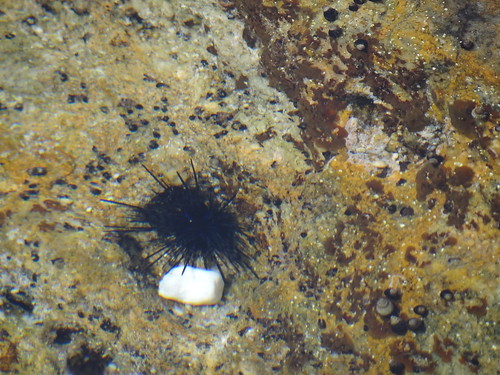
Rocks, of course, mean tide pools, and there were some neat objects to see here.

sea urchin

I didn’t pick this up, but think it was an echinoderm.

This stunning little shell I also left unidentified:

shell

But it’s now here on a shelf if any conchologer wants to see another photo.

We were on surer ground with the birds.

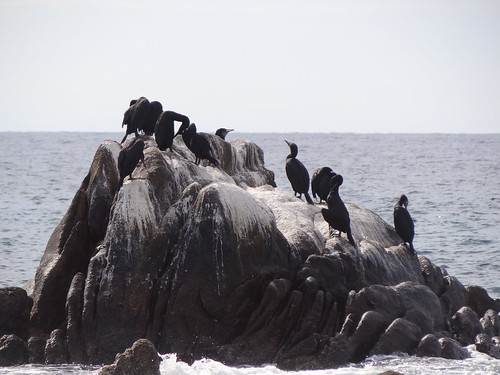
Brandt's cormorant

Brandt’s cormorants were the most abundant representative of their genus during our entire stay; they’ve pretty clearly been using this loafing spot for a while.

(Am I the only one who is always a bit bored by this species? There are so many stunning phalacrocoracids, and these poor creatures — “Bland’s cormorants” — just don’t have much too ’em.)

I’d expected to see some rocky shorebirds, too, maybe a dunlin or ruddy turnstone, but on our first outing all we could find were spotted sandpipers crawling busily around the crevices. Our second visit was more productive.

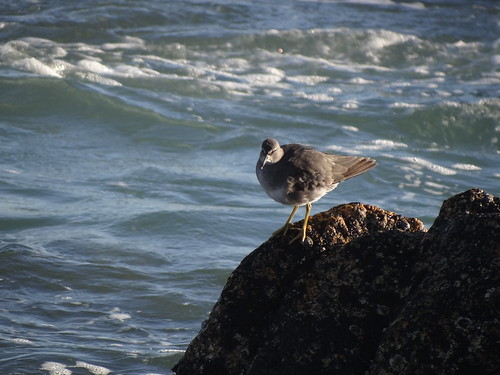
wandering tattler

Heard before it was seen, appropriately enough, this wandering tattler braved the dashing waves to clamber big-footed around the rocks, crouching to explore the barnacle shells

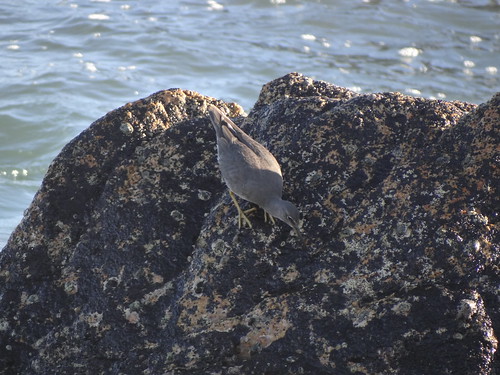
wandering tattler

then leaping high into the air as the water crashed around it.

We finally left the tattler — a life bird for Alison, and certainly the best and most prolonged views of the species I’ve ever had — to explore the desert behind the dunes. There wasn’t much to see beyond the usual ash-throated flycatchers, verdins, and cactus wrens, but I finally saw a lesser goldfinch, a bird we should have been running into every day. And the first time, I think, I’d seen that species and a tattler within five minutes of each other.

Share

Baja California Sur: Santiago

Santiago

An hour’s drive north from San José is the small and pretty town of Santiago, centered on a large and largely inaccessible patchwork of pond, marsh, and pasture, protected by curious dogs and pushy cattle.

Doesn’t sound all that promising. So, inevitably, we had a blast on our morning’s birding there; the only thing that could have made it better was a sewage treatment plant.

We didn’t see any real rarities, but the air was good, the weather warm, and the birding easy. We simply pulled off at a nice weedy ditch and waited.

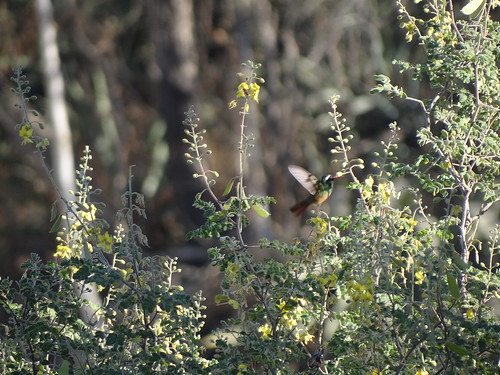
Xantus's hummingbird

Among the first visitors — not counting house pets and livestock — was this gorgeous Xantus’s hummingbird, the most colorful of the species-level endemics of Baja California. We’d seen a few in the days before, and I’d been lucky enough to be introduced to the species a couple of decades ago in the other BC, but this individual returned again and again to feed at eye level just a few feet away from us as we stood on the roadside.

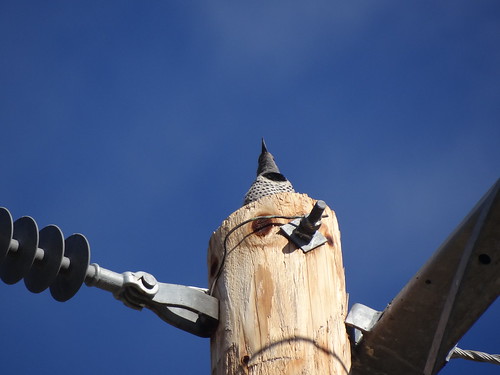
We tore ourselves away to make the circuit of the town, stopping every few yards to listen and look and peer through the fences and the vegetation at the ponds. Common gallinules, snowy and great egrets, ruddy ducks, and spotted sandpipers haunted the edges, while gila woodpeckers and gilded flickers screeched and yelped from the palms and telephone poles.

gilded flicker

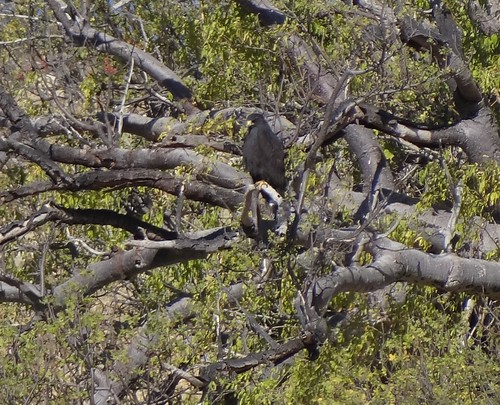
As the morning warmed, raptors became more obvious: first a Cooper’s hawk, then the usual red-tailed hawks, and late on our walk two zone-tailed hawks, obviously a pair and obviously in unchallenged possession of their hillside home.

zone-tailed hawk

It was getting hot, and we were getting hungry, but one last dusty driveway called. It led past a thick hedge with Lincoln’s sparrows and Belding’s yellowthroats skulking inside, into a scruffy pasture where a flock of Cassin’s kingbirds was joined by what were presumably the local pair of vermilion flycatchers and a lovely little gray flycatcher down for the winter.

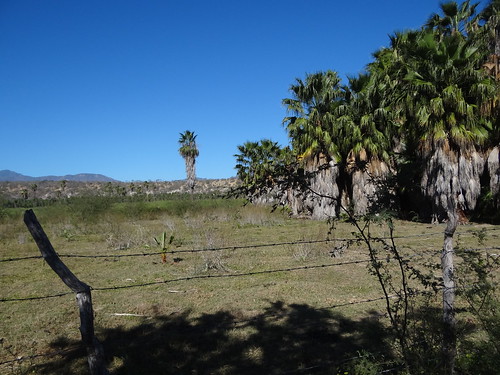
Santiago

It was a pleasant morning’s birding, one worth repeating should you ever find yourself in BCS with some spare time. And don’t worry about the dogs and the cows: they’re friendly.

Share