Everybody’s interested in birds, even if they might not call themselves a birder.
Today started out with a question from a dear friend and former colleague at Princeton University’s Index of Christian Art: just what, she wanted to know, is “bird liming” exactly? (If you don’t know, you probably don’t want to know.)
And on returning from lunch I found an e-mail from the Antiques Roadshow asking for the identification of a bird painted by a famous American bird artist. You’ll have to watch the show to find out yourself, but I was able to pass on the bird’s identity–and, with a little e-sniffing around, the year the painting was likely produced.
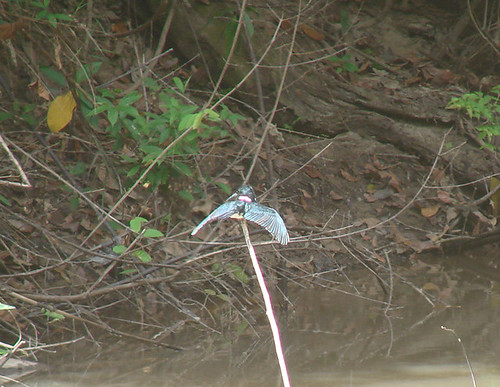
An Amazon Kingfisher suns in Guyana, closely approximating the posture of a limed bird.
It’s not quite what I had in mind when I started the “Birds and Art” tours here at WINGS (Provence this year, Tuscany and Provence in 2010, Provence and Portugal in 2011…), but it’s terrific fun!
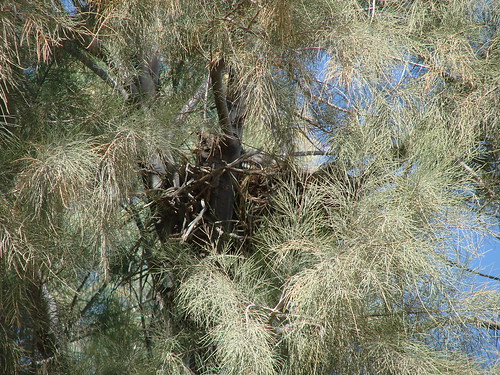
Marion and I spent this gloriously summer-like St. David’s Day along the lower Santa Cruz. It’s not winter down there any more, and the great raptor shows of the cold season are done with; but we still tallied a fine adult Peregrine Falcon, several Harris’s Hawks, four Northern Harriers (including two dazzling silver males), and small numbers of scattered American Kestrels and Red-tailed Hawks. We also saw three owl species, beginning with a saguaro-roosting Western Screech-Owl; the “secret” site in Marana turned up no fewer than six Burrowing Owls, and farther north we discovered a pair of Great Horned Owls at a big stick nest–while the obviously dispossessed Common Ravens were working on a new effort of their own on the other side of the tamarisk!
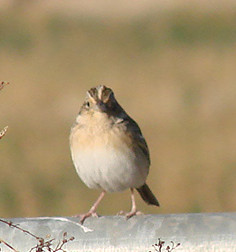
Sparrows were as scarce as raptors, it seemed, but we had a fine surprise in Marana. We were watching Vesper and Savannah Sparrows along a weedy fenceline when suddenly a little buffy blur blew in and perched–a Grasshopper Sparrow, I think the first I’d ever seen in Pima County.
The bird was remarkably obliging, giving us lengthy views of the sort usually to be counted on only from singing individuals.
There’s an interesting conversation going on (as usual) over at Amy’s WildBird blog: Just how many birders are there in North America?
The commonest figures bandied about–77 million, 48 million–are patently absurd, but I suspect that Mike‘s guess of 200,000, though clearly more realistic, might be a little low.
It all sent me scurrying back to my copy of the 2006 NSFHWAR (gesundheit!), where a more interesting number lurks. Table 42, awkwardly entitled “Away-From-Home Wildlife Watchers by Wildlife Observed, Photographed, or Fed and Place,” claims that 20.025 million Americans “observed,” “photographed,” or “fed” birds someplace other than their own yard in 2006. Of those, though, only 8.805 million had watched “other birds”–the catch-all category taking in all but a few big, clunky, popular species such as cardinals, herons, and ducks. And of all those, only 2.657 million left their home state to look at those “other birds.”
Not a bad definition of a birder, is it: Someone who travels to look at birds that aren’t in the kiddy books. Obivously, there are plenty of birders who are content to cultivate their own sheep (or is it return to their own gardens? I can never remember), and are thus excluded by the definition; but I’m guessing that this figure of two and a half million is about as close as we can get.
Is it plausible? Is one out of every 125 Americans a birder? (I’m assuming that my Facebook “friends” roster is not a representative sample.) Pima County, Arizona, where we live, probably has as high a birder population as anywhere in the country; with a population of slightly more than a million (ack), the county should have 8,000 birders. It doesn’t. Bellevue, Nebraska, where I grew up, had a population in my day of 25,000, and so should have had 200 birders. It didn’t. Hamilton, New York, where I commute to during the academic year, has a population of 5,700, and so should have 45 birders. It doesn’t, yet.
Let’s work it backwards. I know, say, 100 birders in Tucson. I knew 25 in Bellevue. We know 5 in Hamilton. That’s 130 birders out of 1.03 million, which would translate to about 40,000 birders in the entire United States. That’s what, 800 in each state: Massachusetts makes it, New Jersey, California, Texas, Florida, maybe Arizona; but Nebraska, Wyoming, North Dakota….?
There’s only one solution. Ask everybody in the country a simple question: Are you a birder? If they respond with anything more than a blank stare, then they count!
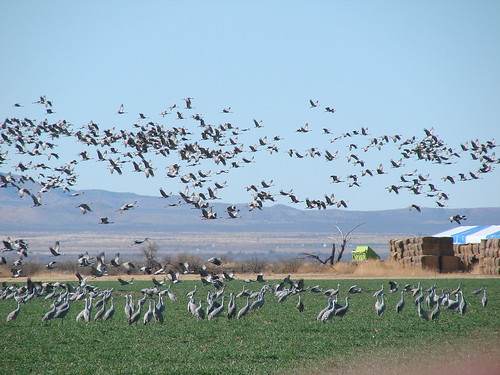
Well, to tell the truth, no moths were involved, but you can’t keep a good phrase down. Saturday’s Sandhill Crane show in Arizona’s Sulphur Springs Valley was one of the most exciting I’d ever seen there. We started with just a few birds loafing at Whitewater Draw, but as the morning wore on, more and more returned from their cornfield breakfasts.
After 30 years of crane-watching, I still can’t get enough of that sound, the first faint growls of the distant flock growing louder and louder until you start to wonder whether there is any other noise anywhere in the world–then, suddenly, the clamor gives way to the conversational mumbles of cranes at the roost.
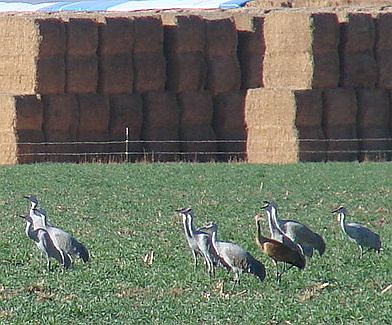
Ambitiously, we were looking for “other” cranes, too; it’s only a matter of time before this ever-increasing flock picks up a Common Crane. Or maybe a Demoiselle. Or even, someday, a Whooping Crane. But Saturday was not to be the day. We did, though, find the brownest Sandhill Crane I’d ever seen in winter.
The birds in this flock were distant (and oddly enough, in alfalfa), but careful cropping gives us this:
Sandhill Cranes are notorious for applying iron-rich mud to their feathers during the breeding season, likely to serve as camouflage during incubation; oxidation–rusting–turns the feathers bright brown. In most birds from migratory Sandhill populations, the pre-basic molt replaces most of those brown feathers with new gray ones, leaving only old remiges and wing coverts to show a brown wash. Who knows what happened to this one–whether it skipped a molt or just found some irresistibly wallowable red mud somewhere on its autumnal way south?
The birds weren’t overwhelming, but the birding was great on the Santa Cruz Flats Saturday morning with Michael. We started out with the largest flock of Eurasian Collared-Doves I’d ever seen in Arizona, 260 birds perched on wires in Marana. It was a puzzling sight at first, but the nearly total absence of that species at Red Rock suggested that the survivors of a recent pigeon-shoot there had merely relocated to safer spaces. They are charming and beautiful birds, and you can’t help admiring the “success” of this exotic, but I find the day troubling when I see more of them than Mourning Doves.
Eurasian Collared-Dove, Bulgaria (where they belong!)
Under the influence of my earliest birding companions, I’ve long espoused the most puritanical of views when it comes to introduced species. I can find them fascinating, admirable, dazzlingly beautiful; but they don’t belong here, and I’ve done my share of, ahem, removal. As I grow older and the world grows more complex, though, I’m finding it all less clear-cut.
In a way, we know where Arizona’s Eurasian Collared-Doves came from. The species was introduced to the Caribbean 30 or 40 years ago now, and taking advantage of that same pioneer spirit that had let it spread, apparently on its own, from the Balkans to Iceland in the 1950s, a few ecdos made the short flight to Florida in the 1970s; from there, adhering to what seems to be a pre-programmed predilection for flying northwest, the species has colonized pretty much all of the continental US outside of New England the Mid-Atlantic, and seems to be looking forward to cozy winters in western Canada and Alaska, too.
Collared-doves reached southeast Arizona with this new century, and have since become abundant around feedlots and rural settlements. I suppose we can’t rule out the possibility of secondary introductions–one possible explanation for the local population explosions we’re still seeing–but even so, it’s almost certain that some of the doves in Arizona are the descendants, 30 or 40 generations removed, of the introduced Bahamas birds: and so ultimately, of course, ours are of introduced origin, but the birds of 2008 have come much farther on their own from that tainted source population than did, for example, the state’s first Inca Doves a hundred years earlier, or the White-winged Doves that are now breeding in the midwest.
I’m not suggesting that any exotic species, plant or animal, be left to thrive just because of the antiquity of its introduction or its self-powered success once it got here; gracious, then we’d have, oh, Norway rats and red foxes eating island seabirds or something! There can be no statute of limitations when an introduced organism starts munching on the habitat and its native denizens; no sign yet that Eurasian Collared-Doves are engaged in anything like that, but introductions of any kind are rarely so benign as they’re thought to be at the start.
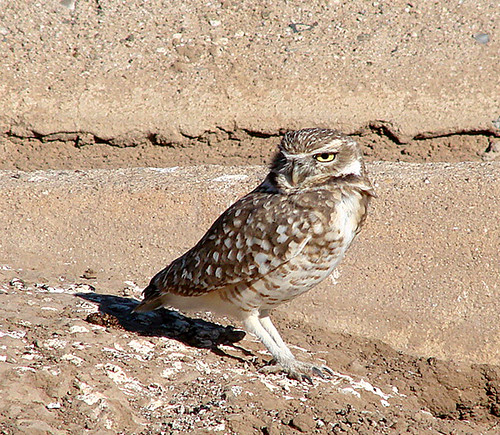
Just around the corner, at one of their “secret” sites on the Flats, Michael and I found a pair of Burrowing Owls, perched up to absorb the morning sunlight.
Both birds were remarkably active, flying up and down the concrete-lined ditches they call home, chirping and bobbing when a car went past. Too bad they don’t eat collared-doves!
We moved on to Red Rock and its endangered feedlot: the signs are up announcing the zoning hearings, and it won’t be long before that bit of flat desert is houses, too (with preternaturally green lawns, I bet). There were massive flocks of icterids: Red-winged, Yellow-headed, and Brewer’s Blackbirds, Great-tailed Grackles, Brown-headed Cowbirds, and a couple of Western Meadowlarks; but no small doves and virtually no large ones. A glorious Prairie Falcon was perched on a telephone pole, but we didn’t find any other of the “special” raptors of the Flats in the couple of hours we spent out there. But it’s good birding, not necessarily good birds, that makes a good day, and we had lots of the first and enough of the second.