Spare Parts, Strange Bedfellows

The Aztec headdress now in Vienna cost hundreds of tropical birds their lives when it was created in the early sixteenth century. Three hundred fifty years later, more birds would die for its restoration — this time, though, not tracked down in the jungles of Meso-America, but purchased on the same market that supplied feathers to the fashionable ladies of Mitteleuropa.

According to Hochstetter in his report of the 1884 restoration, the headdress (which was then thought to be a battle standard or fan) still included 459 quetzal plumes when it was handed over for repair.

But the remains of quills on the back side of the spread let us understand that very many such feathers had broken and fallen out, so it is not too much to assume that the original number can be estimated to have been at least 500. Since the male quetzal generally has only two, or at the most four, of these plumes, several hundred quetzals must have surrendered their feathers for this one object.

Not only were some of the original long feathers missing, but the band of shorter green quetzal feathers (visible against the reddish background in the 1908 photograph above) had been “completely destroyed” by moth and rust. But fortunately, Hochstetter tells us,

the pre-contact peoples of the Americas were not the only ones to use quetzal feathers for ornament and decoration; nowadays fine European ladies also adorn themselves with them, so it wasn’t difficult to obtain genuine quetzal feathers for the restoration. Such feathers were used only to restore the destroyed green band at the base of the fan, however.

Hochstetter goes on to note that long quetzal plumes would have been available from the same sources, but it was decided not to replace the originals:

Those long plumes today cost as much as ostrich plumes or the feathers of New Guinea’s birds of paradise. At today’s prices, 500 such long quetzal plumes would cost about 5,000 Austrian gulden.

The conversion is not straightforward, but it seems that that would be the equivalent of about US $50,000 — and even Imperial Museums had to stay within their budget.

The sky-blue feathers of the inner bands were another problem. These patches were originally made up of feathers from the underparts of the Lovely Cotinga, but, says Hochstetter, they too had deteriorated very badly, and required not just restoration but replacement.

Unfortunately, it was impossible to turn up enough cotinga skins to carry out a truly authentic restoration. As a substitute, we chose the magnificent White-throated Kingfisher (Halcyon smyrnensis) of India, the turquoise back feathers of which most closely approach the turquoise of the cotinga. Restoration required 24 skins of this species.

Hochstetter doesn’t say where those two dozen kingfisher backs came from, but it seems improbable that his colleagues over at K.K. Naturhistorisches Museum would have handed him theirs. More likely, just as in the case of the quetzal feathers, the conservators simply addressed themselves to the great millinery supply houses of Paris or of London.

Availability was no problem: two single-day sales in London twenty years later accounted for a total of more than 35,000 kingfisher skins. And unlike the prohibitively pricey quetzal plumes, whole White-throated Kingfishers could be had in the early twentieth century for somewhere between six and nine cents each. It probably cost the museum more to have them delivered.

Happily for nervous squirrel cuckoos and spoonbills, the rest of the feathers in the headdress were sufficiently well preserved as to require nothing more than routine care.

I’m sure that more details lurk in the files of the Museum für Völkerkunde. For now, though, what we know about this first restoration of this spectacular artifact hints at a fascinating and probably unique collaboration between scientists and plumassiers in nineteenth-century Vienna. I’m looking forward to learning more.

Photos:

1908 photo of the Aztec headdress.

White-throated Kingfisher.

Poached White-throated Kingfishers from Africa.

Share

Aztec Featherwork

This sixteenth-century liturgical headdress is probably the most famous piece of featherwork in the world. Brought to Austria before 1575 by an unknown traveler, who had acquired it from an unknown source in Mexico, it is once again on exhibit — after long years of conservation work — at Vienna’s Museum für Völkerkunde.

The green plumes, of course, are those of 500-year-old Resplendent Quetzals. The blues are the loveliest of Lovely Cotinga feathers, and the headdress is also said to incorporate feathers of Squirrel Cuckoos, kingfishers, and Roseate Spoonbills. Whoever created this object, you can’t fault their taste.

This restoration is at least the second to have been carried out since the headdress came to Vienna.

Brought from Schloss Ambras to the Belvedere in the early nineteenth century, it was “discovered,” apparently in storage, by Ferdinand von Hochstetter in the late 1870s. There was great puzzlement as to just what it was, and the 1878 restoration ordered by Hochstetter proceeded on the belief that these were the remains of a kind of battle standard, an assumption that “resulted in the object’s loss of the three-dimensional shape.”

A century and a half later, that may seem to have been a terrible mistake, but I think it’s more than understandable, given the exotic singularity of the object. In fact, though flattening the headdress did violence to its original form and concealed its original function, it was probably the best thing that could have happened to it from the standpoint of preservation.

The exhibit includes another nine Mexican featherwork objects from the sixteenth century, including a “painting” done in hummingbird feathers, similar to this one in the Imperial Treasury:

Vienna is already my favorite city in the world. And it just got better.

Share

Birds That Glow in the Dark

Did you know — I did not — that the American Bittern glows in the dark?

At least that’s what we’re told by “several gentlemen of undoubted veracity, and especially by Mr. Franklin Peale, the proprietor of the Philadelphia Museum”:

I was much interested with an account I heard the other day of a bird, a species of heron. I believe it is called by Wilson, in his Ornithology, the Great American Bittern; but, what is very extraordinary, he omits to mention a most interesting and remarkable circumstance attending it, which is, that it has the power of emitting a light from its breast, equal to the light of a common torch, which illuminates the water, so as to enable it to discover its prey. As this circumstance is not mentioned by any of the naturalists that I have ever read, I had a difficulty in believing the fact, and took some trouble to ascertain the truth, which has been confirmed to me by several gentlemen….

This account, received by Mrs. C. Hackney from a Philadelphia correspondent in 1828, was deemed sufficiently noteworthy to be published in the Magazine of Natural History, and drew comment the following March from R.A. Bridgewater, who suggested that the light was generated “possibly by some electrical operation.” Lesson, on the other hand, wondered whether it might be produced “de son estomac.”

Not sure why, if that’s true, my photo of the bird above, from Reifel Refuge a couple of years ago, should be so dark and blurry.

Share

Why I Still Say “Re-introduction”

Yesterday morning, as I was writing about the return of the Wild Turkey to New Jersey (and our feeders), I recalled Stacia Novy’s recent rant in Winging It. I smiled when I first read it, but it’s started to rankle, this odd notion that “re-introduction”

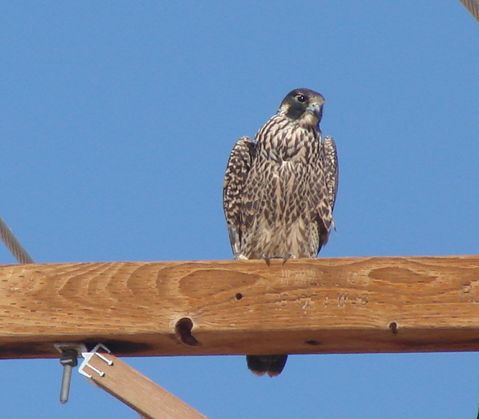
literally means “to introduce something again.” The Peregrine Falcon [for example, or the Wild Turkey] was never introduced to North America at any time in history, nor was the species foreign or alien. Therefore, by definition, the species cannot be reintroduced to that region….

Huh?

Stacia relies for her etymological argument — always dangerous — on the mistaken idea that the prefix “re-” means only “again” or “again and again,” citing an actual dictionary — always dangerous — in support of her case.

Every elementary school teacher and every elementary school pupil knows better. The prefix is polysemic, as reading a little farther on in the dictionary would tell us. “Respond” doesn’t mean “to answer again and again”; it means to answer back. “Rescind” doesn’t mean to “take again and again”; it means to take back. “Reverse” doesn’t mean to “turn again and again”; it means to turn back.

And “re-introduce” doesn’t mean “to introduce again”; it means to introduce back, which is precisely what we have done with condors and falcons and turkeys and otters and elk and on and on. We have “led” them “back” “in” to their original range, if we want to be pedantic and etymological (and right) about it.

Stacia’s recommended alternative, “repatriation,” is silly enough that there’s no danger of its ever catching on. But I still find the arch pedantry of her argument (“It’s hard to expect the general public to use proper terminology on such topics when the experts fail to do so”) troubling, and there is a small risk, I suppose, that less confident souls could be led to worry that they’re not using the term “re-introduction” properly — even though all of us members of “the general public” really are.

I’ve taken a firm resolve to use the word “re-introduction,” in its current and correct meaning, at least once a day for the next week. Says the OED:

To return (a species of animal or plant) to a locality where it was formerly native, with the intention of re-establishing it in the wild.

My dictionary’s better than hers.

And what about that hyphen? Well, I once sat next to someone on a plane who was reading a book titled “Reengineering,” and it took me most of the flight to figure out that it wasn’t Dutch.

Share

Plagues, Birds, and Plague Birds

Have a look at the alerts posted by Dutch Birding, and there among the scattered reports of Red-breasted Geese and Rosy Starlings you’ll find a solid daily mass of Pestvogels.

British Columbia, February 2010

This species — known to English-speaking birders as the Bohemian Waxwing — is having a good winter in western Europe, and so are the Dutch pestvogelspotters, “to the great dismay of local residents,” who find themselves overcome, “terrorized,” by the masses of birders who have descended like a plague onto their neighborhoods:

I’m a big animal lover myself, perhaps even more than that. I understand your interest in the waxwing and that you want to document these numbers with all your gigantic telephoto lenses. But you aren’t entirely seeing the other side. Meanwhile an average of about twenty people are standing here in front of my door from sunrise to sunset. You’re going up and down past all our new cars, with scratches as a result, you’re taking up parking spaces, parking bikes right up against the cars, and so on. All in all you’re creating a big nuisance for the neighbors…. You’ve had a whole week to document the birds and I sincerely hope that both the waxwings and the neighborhood will get some peace now.  [my translation]

And you can imagine how the discussion continues: it’s photographers, not birders; it’s just a few bad apples; it’s a public right of way; your car isn’t all that new, and it isn’t scratched, and it was already scratched when I got there. And on and on in tones familiar from every e-brouhaha to have ever erupted in any birding community.

The situation is even more resonant, though, given the Dutch name of these beautiful birds. “Pestvogel” means “plague bird,” and the association of these winter nomads with the equally unpredictable visitations of pestilence seems to have been historically widespread in western Europe. Suolahti writes of the species’ former German name:

Furthermore, the unexpected occurrence of certain birds in the vicinity of houses or their sudden appearance in a given region inspires uncanny notions. In particular, the occurrence of northern species that travel in great flocks, such as waxwings, bramblings, and redwings, is considered a bad omen, and so they are called “death birds,” “plague birds,” or “war birds.” [my translation]

Suolahti finds the German name “Pestvogel” — plague bird — attested from Austria, Swabia, Switzerland, and Westfalia; he quotes Aitinger‘s 1631 tract on bird catching to the effect that these birds are seen in some areas no oftener than every fourteen years, and that many people are of the “remarkable opinion” that when they do appear, they bring with them “war, pestilence, hunger, and inflation” (watch out, Euro Zone).

The always interesting Philippe Glardon points out that

it was not until the very end of the sixteenth century that Ulisse Aldrovandi first drew the connection between the waxwing’s appearance in unexpected localities and a biological cause for such displacement, even though the concept of certain species’ migrations during the harsher season was already beginning to be perceived, thanks largely to wintertime trips to the southern Mediterranean, on which observers recognized some of the birds present in Europe during the summer. But the mental horizon in which that discovery is rooted means that several different interpretations can still co-exist for one single fact. And for a long time the occurrences of waxwings were related to other exceptional phenomena, among them meteorological or cosmic phenomena, still interpreted as signs or warnings of divine origin. [my translation]

Myself, I would observe that for many of us l’horizon intellectuel hasn’t lifted that much: Who doesn’t shiver when suddenly the feeders are aswarm with a tightly packed, ferociously gobbling flock of Dark-eyed Juncos — or should I say snowbirds?

Many thanks to Kenn for suggesting this topic —

Share