Other People’s Bird Books: Philadelphia Is a Small, Small World

Philadelphia is a big city, larger than any other conurbation on the East Coast than New York, and I’ve never managed to create the sort of mental map required to make me feel genuinely at home on our infrequent visits.
I’m trying.

And I’ve always found that one of the best ways to figure a place out is to select a figure, an event, or an institution and trace it through time and space. For the birder, the obvious choice is the work of Alexander Wilson, the 200th anniversary of whose death we’ll be celebrating in August.
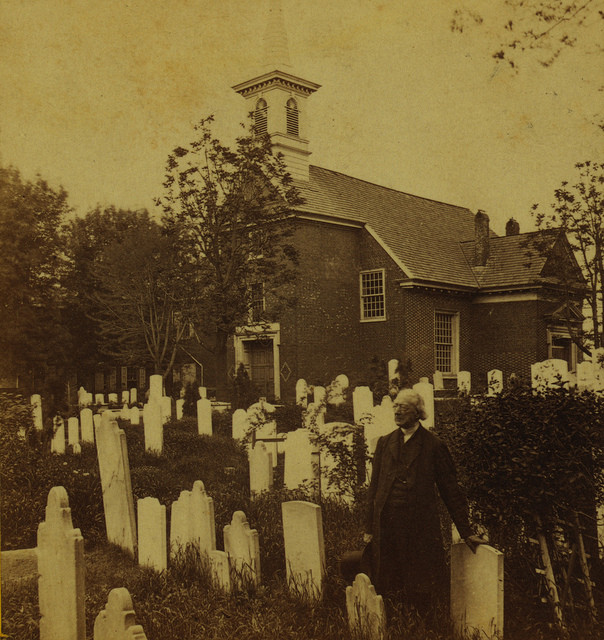
So far, our desultory explorations have had me sniffing out the Wilson specimens that survive in the Academy of Natural Sciences, running across surprise encounters between Wilson and other famous Americans, and watching with caught breath as Wilson risks drowning for an oystercatcher specimen.

But this is one of the weirdest things yet.

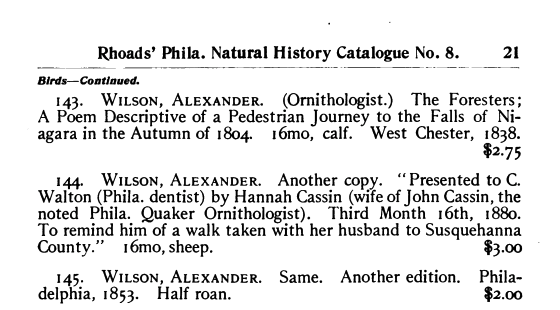
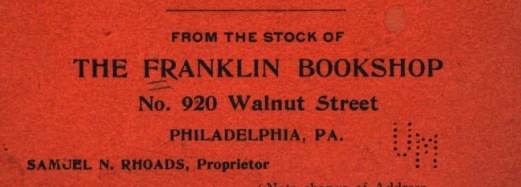
Samuel Rhoads listed in his 1908-1909 catalogue of natural history books three copies of Wilson’s poem “The Foresters.” One of them, for which Rhoads demanded the princely sum of $3.00, was a presentation copy, given to a Philadelphia dentist, C. Walton, in March 1880 by Hannah Wright Cassin, the widow of none other than John Cassin, one of the shining lights of nineteenth century ornithology in Philadelphia and anywhere else.
rhoads


Mrs. Cassin made the gift in memory of a walk along the Susquehannah taken, years before, by her husband and his friend. By choosing precisely this work of Wilson’s — subtitled by the author a “Description of a Pedestrian Journey to the Falls of Niagara” — she made explicit the line of intellectual descent from Wilson, the Father of American Ornithology, to Cassin, the equivalent great of his generation (Cassin was born two weeks after Wilson’s death in 1813). The book eventually made its way into the possession of Rhoads, the Haddonfield collector, ornithologist, and bibliophile book dealer — himself one of the founders of the DVOC.
image

I don’t know where the book is today, but I hope it sits, cared for and appreciated, on a shelf somewhere, still bearing witness a century and a quarter later to the way that ornithological knowledge used to be passed down through the generations, in Philadelphia and wherever birders gathered.

Share

The Other Ridgway — and the 2013 ABA Bird of the Year

As the brother of three immensely talented and enormously capable (and all very different, thankfully) siblings, I know what it’s like to be in the shadows sometimes. Between them, there’s nothing my brother and my two sisters can’t help us out with — generously enough, not one of them has ever come back to me with the request for one of my skills. I’m sure I’ve got some, somewhere.

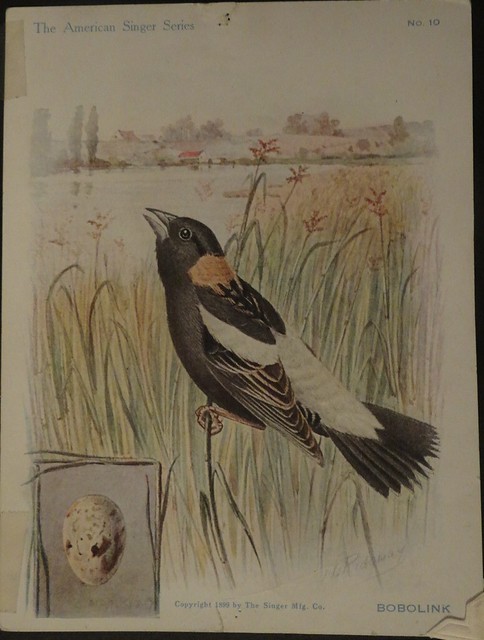
It must have been even tougher for John Ridgway, the younger brother of one of North America’s most famous and most productive ornithologists. An accomplished taxidermist and illustrator, John Ridgway worked at  the National Museum and for the USGS; he is best known today, if at all, for the series of cards he painted for Singer Sewing Machines.

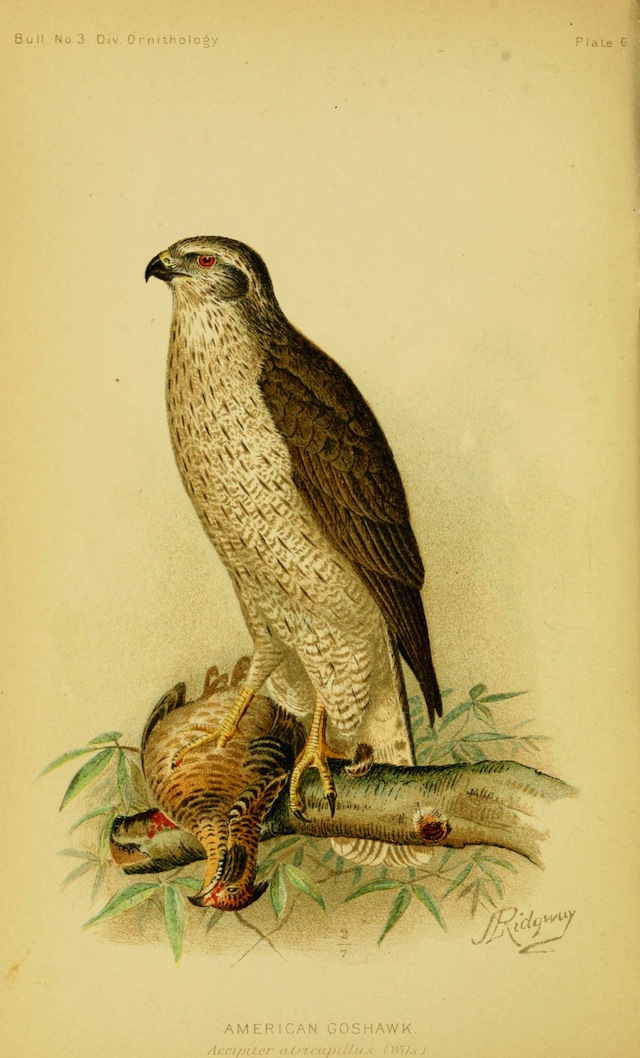
The short obituary that appeared in the Auk — more than six years after Ridgway’s death in 1947 — provides a list of some of the ornithological works that he illustrated. The color plates in Turner’s 1886 Alaska seem to have been a cooperative effort, signed by both John and Robert Ridgway:

Screen Shot 2013-01-12 at 12.13.20 PM


The younger Ridgway alone was responsible for the paintings — old-fashioned but often dramatic — in Fisher’s Hawks and Owls of 1893:

hawksowlsofunite00fish_0070

Oddly enough, Palmer’s obituary leaves unmentioned the one great work for which serious birders still remember Ridgway. Charles Bendire‘s Life Histories began to appear in 1892; the two volumes that were completed and published remained the authoritative work of their kind until Bent (and then, of course, BNA).

The paintings were produced by Ridgway, whom Bendire praises for his “skill and painstaking care.”  Joel A. Allen wrote that the plates were “[un]equalled in artistic effect or in faithfulness of execution,” while J.C. Merrill said simply “no superior work has ever been done.” Those encomia and others were cited by Harry Harris in 1927, in his account of an interview with Ridgway, who was then at the Los Angeles County Museum.

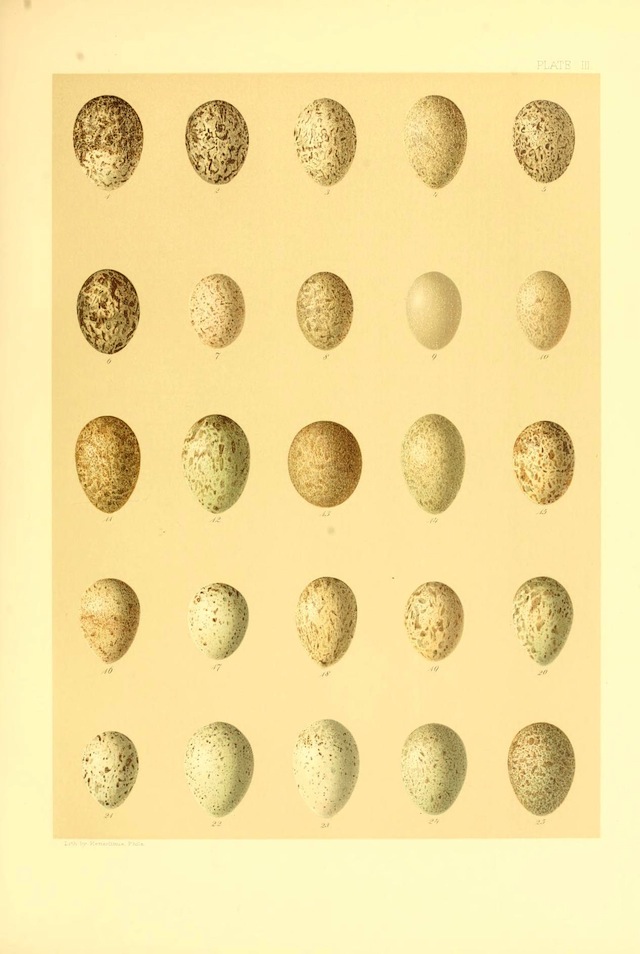
Harris adds his own assessment of the egg plates, “the outstanding and pre-eminent achievement in the entire field of oological illustration.” He may well be right, as a look at Ridgway’s paintings of the eggs (numbers 1-6) of the Common Nighthawk shows.

lifehistoriesofn00bend_0541

Bendire calls “the egg of the Nighthawk one of the most difficult ones known to [him] to describe satisfactorily.” The eggs differ “endlessly” in shape, ground color, and markings, a range of variation Ridgway’s painting captures very well indeed — and probably better than his more famous brother could have done.

Share

Happy 175th Birthday, Small Blackhead!

In January 1842, eighteen-year-old Spencer Fullerton Baird wrote to his brother William with a request:

[J.P.] Giraud here [in New York] has thought that there is a permanent distinction between the large & small Black heads and has commenced a description of the smaller kind as Fuligula Minor…. the small one has the black on the lower abdomen, about the anus finely undulate, while the large one has it in spots, & … the large ones have a white spot at the base of the under mandible on the chin which the other has not. These … two characters I want you to examine those in the Washington markets and let me know.

Before the late 1830s, it doesn’t appear to have occurred to anyone that the New World might in fact have two species of scaup.

In 1835, Audubon, in the Ornithological Biography, went out of his way, as so often he did, to point out the inadequacy of some of Wilson’s earlier work on the species:

The opinion, derived from Wilson’s account of the Scaup Duck, that it is met with only along our sea coasts, in bays, or in the mouths of rivers, as far as the tide extends, is incorrect. Had Wilson resided in the Western Country, or seen our large lakes and broad rivers during late autumn, winter, or early spring, he would have had ample opportunities of observing thousands of this species, on the Ohio, the Missouri, and the Mississippi, from Pittsburg to New Orleans. I have shot a good number of Scaup Ducks on all these rivers….

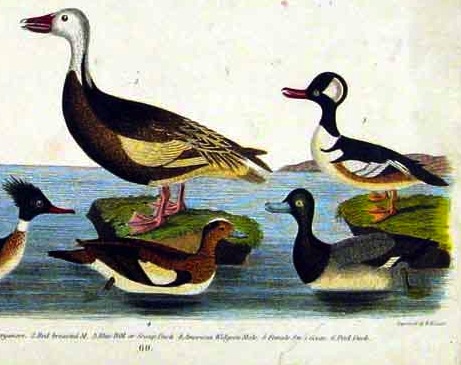
Wilson gave the length of his “blue bill” as 19 inches.

Wilson Scaup

Audubon, thanks to his greater experience, was able to note “that specimens may be procured measuring from sixteen and a half to eighteen, nineteen, or twenty inches in length,” a significant range of variation in a duck — but he assures his reader nonetheless that scaup “seen in various parts presented no such differences as to indicate permanent varieties.”

Just a few years later, Giraud disagreed. In addition to the subtle marks William Baird was to confirm in the market stalls of Washington, D.C., Giraud had discovered that the size difference between the two apparently different species was consistent; he also showed Baird that

in the smaller ones the white band on the wing is distinctly of that color only on the secondaries & not extending to the primaries as on the large one…. the inside of the bill is dark in the small one & whitish in the large…. the small one is most tufted and has a purplish reflection on the head instead of a greenish one.

By 1844, Giraud had convinced himself that these differences rose to the level of a specific distinction, and his famous Birds of Long Island offers a full description of what he names the Lesser Scaup Duck, Fuligula minor.

What Giraud in those pre-internet days did not know was that another ornithologist had got there first. T.C. Eyton admitted in his 1838 Monograph on the Anatidae that he “entertained considerable doubts as to the propriety of making [it] into a species”; but the differences he discovered between this new bird and the familiar Greater Scaup were “constant”:

total length less; bill shorter and not so broad; nail much narrower, and not so much rounded at its sides; tarsi shorter.

And so, 175 years ago this year, Eyton described the “American Scaup” as new, under the weaselly name Fuligula affinis:

similar to the preceding species [the Greater Scaup] but with a shorter bill furnished with a narrower nail.

As late as 1922, Ludlow Griscom included the two scaup among the “birds which it is practically impossible to distinguish in life,” a remark — published in the Auk — that seems very curious indeed when we realize that almost a hundred years earlier both Giraud and Eyton had published precisely those characters birders routinely use today: head shape, bill shape, nail size, wing pattern.

But the real historic irony lurks in Audubon’s painting. There is only one species of scaup, he tells us — and then paints birds that are obviously Lesser Scaup avant la lettre.

The photograph at the top of this entry is of a flock of Aythya ducks at the Jersey shore yesterday. Can you identify them?

Share

Other People’s Bird Books: Samuel Rhoads

Of all the great names from the generation of the DVOC‘s founders, that of Samuel N. Rhoads may be heard the least.

Even in this year of the sesquicentennial of his birth, Rhoads remains for most of us a dimly remembered name, encountered once or twice, perhaps, in Witmer Stone’s Old Cape May and then forgotten. A leading light a century ago in North and Central American ornithology, Rhoads now seems to be little more than a subject for local historians and eccentric “bloggers” who really should be working on something else.

Ironically, Rhoads may be better known today in the west than here in his native mid-Atlantic. His collecting tours of Texas and Arizona in the 1890s resulted in a number of records still cited today, and his pioneering trip to Washington and British Columbia was, until recently, commemorated each year by the late-summer “Rhoads Count” conducted by the Kootenay Naturalists.

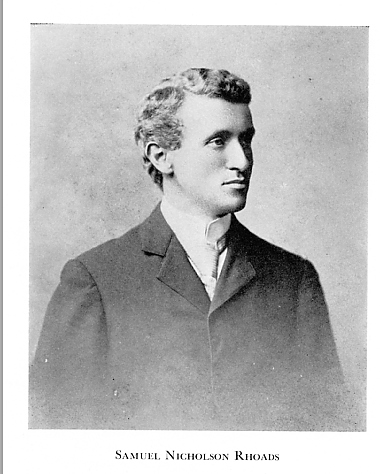
In addition to his attainments as a naturalist, Rhoads was a devoted historian of his field. Writes William Evans Bacon in the Cassinia obituary illustrated by the photograph above

Except for his labors, numerous records of great interest, particularly those pertaining to pioneer days, would have been irretrievably lost …. Rhoads amassed his information by extensive search through the literature, by the examination of museum specimens, … and by personal interviews with naturalists, trappers, trappers, old pioneers, and frontiersmen.

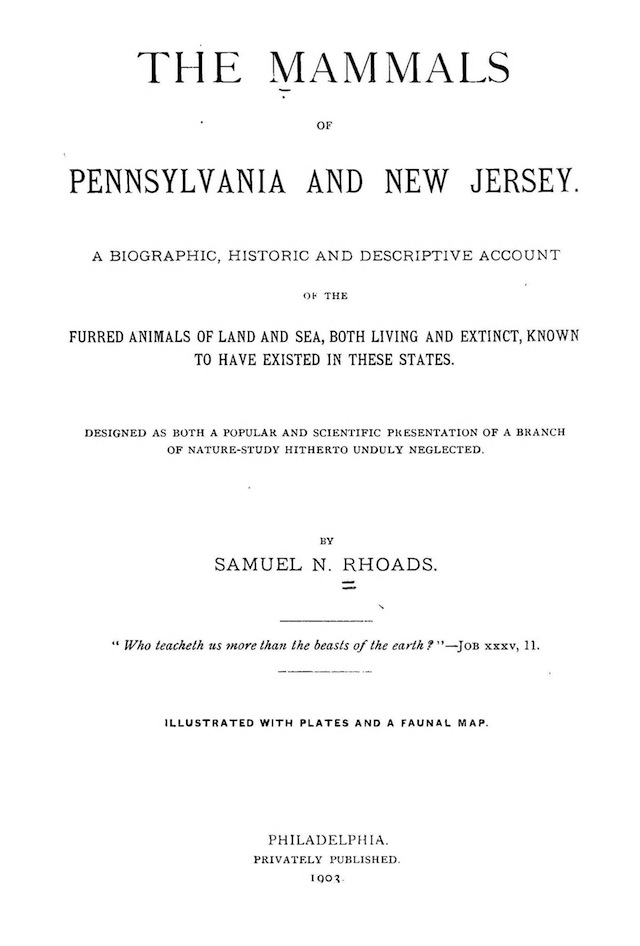
That historical interest was accompanied, inevitably, by the usual bibliophily, and in the first two decades of the last century, Rhoads owned a small Philadelphia bookshop and publishing house, its most notable productions facsimiles and reprints of such regionally important titles as the botanist William Young’s Catalogue and Ord’s American Zoology. In 1903, Rhoads printed his own most important work, The Mammals of Pennsylvania and New Jersey.

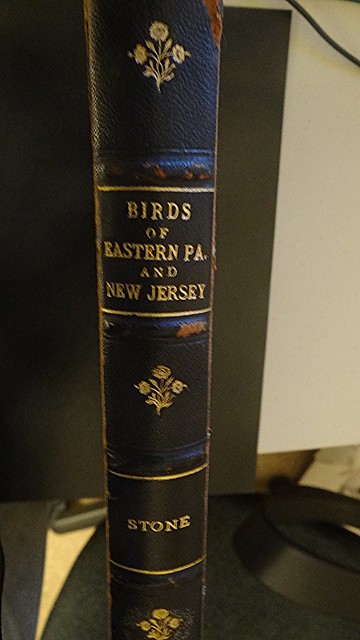
Given these predilections and pre-occupations, it’s no surprise to find that Rhoads’s own library was carefully assembled and, more remarkably, apparently curated with an eye to posterity. I don’t know where the collection ended up after his death, but one of the most interesting volumes, his copy of Witmer Stone’s Birds of Eastern Pennsylvania and New Jersey, is now in Firestone Library.

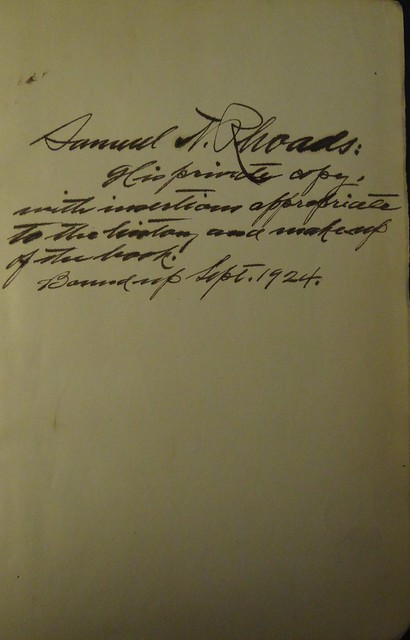
Rhoads was a member of the DVOC committee charged with overseeing the production of this work, and, as he wrote on the second flyleaf in September 1924, he saw his copy as a repository of documents bearing on the history of the Club and its most ambitious publication to date:

Samuel N. Rhoads: / His private copy, / with insertions appropriate / to the history and make-up / of the book. / Bound up Sept. 1924.

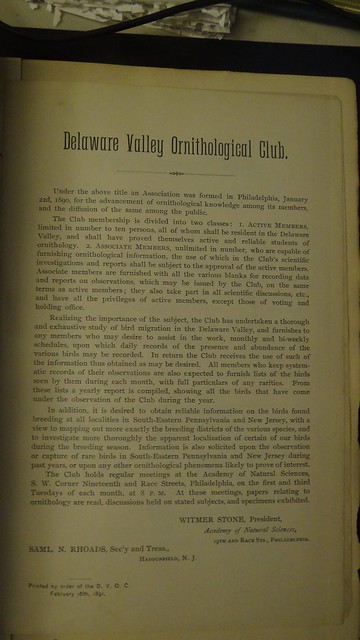
Among the documents inserted into Rhoads’s scrapbook are appeals for phenological information about the birds of the region, directed to the general public

and, no doubt more profitably, to “gunners and sportsmen” who might be able to furnish unusual records.

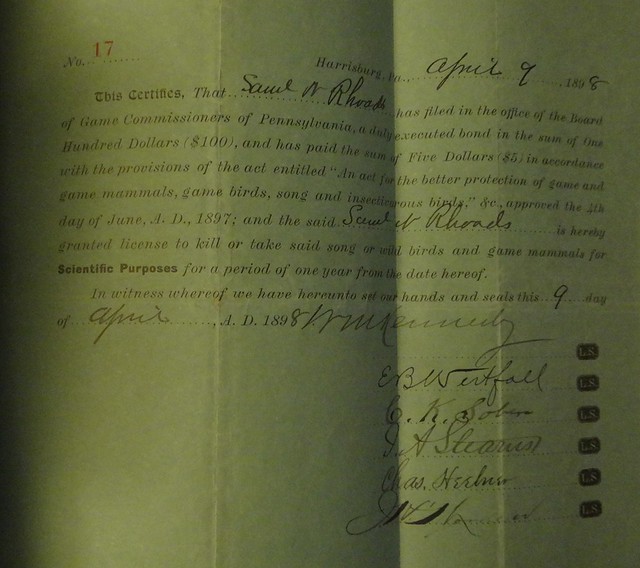
There are also more personal bits of history, including Rhoads’s collecting permit — “license to kill or take said song or wild birds and game mammals” —

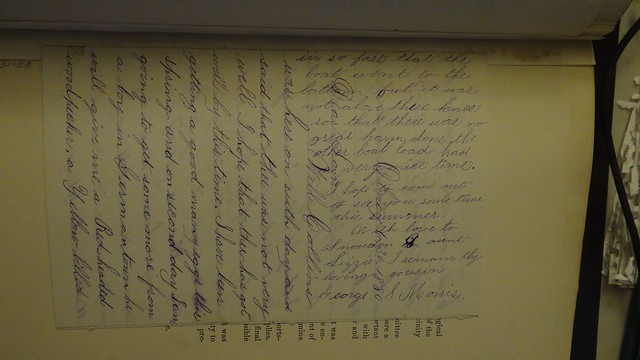
and a delightful letter in pale purple ink from his step-cousin George Morris, full of news of egg collecting and boating mishaps:

The general history of the DVOC is represented by a fine photo of this January 1898 meeting — taken exactly 85 years before the first women were admitted to membership:

Rhoads is number 23, his cousin Morris number 24; Stone, number 28, is seated at the table with the open book. In his handwritten key, Rhoads tells us that this self-same photo was used as “proof” for his 1902 Bird-Lore article and afterwards returned to him by Frank Chapman.

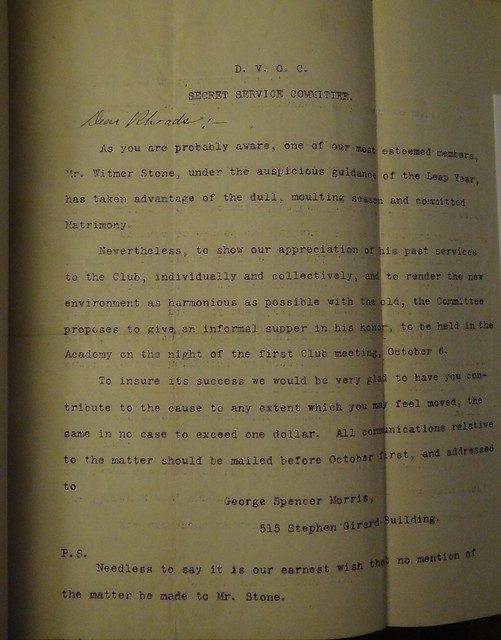
There are postcards and field lists, too, but the most wondrous of the ephemera preserved here is an invitation to a party for Witmer Stone on the occasion of his having “committed Matrimony”:

Two years after Rhoads had his little archive bound, there was an explosion and fire in his Haddonfield house. The books, obviously, survived, but Rhoads’s spirit did not: “conflicting currents of emotion” overwhelmed him, in Evans’s discreet phrase, and he spent the last quarter century of his life in seclusion, sometimes in confinement, until he died, sixty years ago today, leaving us this unique record of the early days of a venerable institution.

Share

The Red-breasted Nuthatch Winter of ’12

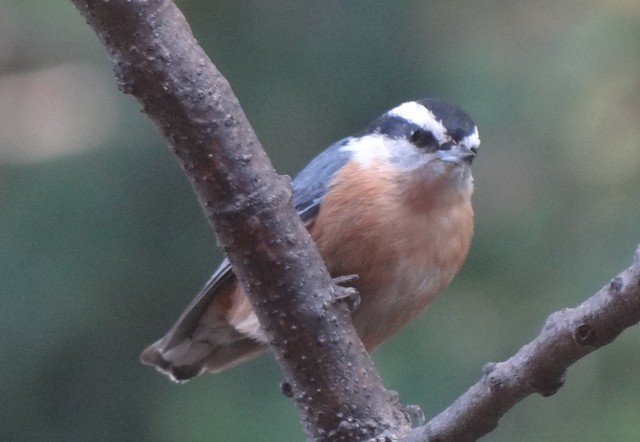
Our insatiable hordes of gobbling Pine Siskins have pretty much moved on, greatly to the relief of our savings account, but we’re still enjoying the sweet little Red-breasted Nuthatches that seem to have settled in for the season. They’re no less ravenous than the streaky finches, and every bit as tame. I can hardly rehang the feeder before one of the little tooters lights on it, and it’s just a matter of time before they start landing on me, too.

Lots of backyard birders in the east have been taking advantage of the birds’ tameness this fall to train them to take food from the hand. I disapprove, in my puritanically strict hands-offitude, but the dozens upon dozens of accounts of hand-feeding I’ve read over the past couple of months got me to wondering: who first figured out that you could coax wild birds to take sunflower seed directly from a human?

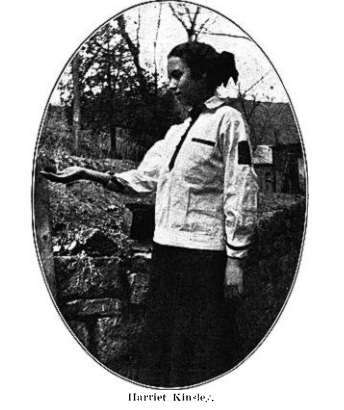
There’s probably no answer to that, at least not until we’ve identified the original domesticator of the chicken. Meanwhile, though, let me introduce you to young Harriet Kinsley of McGregor, Iowa.

Wilson Bulletin 27.2 (1912): 314.

Exactly a hundred years ago this fall, Harriet and her mother discovered a new bird in their yard, one that

took it for granted that he was the sole owner of the feeding table, and it took a great deal of his time trying to keep the other birds away,

among them the numerous “chickadees, downy, hairy and red-bellied woodpeckers,  juncoes, a pair of cardinals, blue jays and the white-breasted nuthatches.” Neither Harriet nor her mother had seen the species before, but they took careful note of the bird’s plumage characters:

a bluish slate-colored back with black stripes running back above each eye and the breast tinged with rufous.

Harriet looked the stranger up in her bird book, and correctly identified it as a Red-breasted Nuthatch. It was her mother’s idea to teach the bird, which was soon burdened with the inevitable nickname “Hatchie,” to eat from her hand:

One day my mother thought she would put a nut meat on her hand and see how near he would come to it. He wanted the nut very much, but was a little shy about coming down to get it ; he scolded, cocking his head first on one side and then on the other. The temptation was too great; he would risk his life: he made a swoop, lighting on her hand, and away he went with the nut. The next day we all tried the same thing and found he would take them after a great deal of scolding. We fed him every day and he gradually grew less timid.
“Less timid” indeed: Harriet’s account, published in the Wilson Bulletin, makes it sound like the family was terrorized by the sharp-billed little beast. He started to demand to be fed — and only butternuts, if you please, no black walnuts — perching on doors and window sills to look into the house.
We had to keep little piles of nuts by several of the windows so we would not have to go so far.
The Kinsley family’s servitude lasted all through the winter, ending only on March 31, 1913, when their importunate guest finally flew north.
And what about Harriet? Even in those more relaxed days a century ago, when the Wilson Ornithological Club was still pronouncedly regional and midwestern in its “flavor,” it was remarkable to find a Campfire Girl publishing in the pages of the Wilson Bulletin. She is still listed as a member of the Club in 1917, but disappears from the rolls by 1920. No doubt the responsibilities of adulthood had set in by then, taking up the time that she had spent as a girl watching the bird tables.
Before life caught up with her (she married Roy Neff, the principal of McGregor High School in 1929), though, Harriet had almost certainly had contact with two of twentieth-century Iowa’s prominent ornithological observers — both of them fellow members of the Wilson Club.
Mary E. Hatch of McGregor was an assiduous collector of migration records and the author of (fairly vapid) articles in the Wilson Bulletin on the Northern Cardinal and the House Wren in northeastern Iowa. In that same cold winter of 1912 when Harriet Kinsley was feeding birds from her hand, Mary (no relation, I’m sure, to Hatchie) also noted several unusual birds — among them Red-bellied Woodpeckers, a Carolina Wren, a Winter Wren, and three “Kentucky Cardinals” — among “the  large  number of pensioners” visiting her family’s “well-filled table.”

I don’t know whether Mary Hatch was also a Campfire Girl, but both young women must have found inspiration in the bird studies of their famous neighbor in National (she received her mail in McGregor), Althea Sherman.

Well known today — better known than in her lifetime, I’d guess — as a champion of the Chimney Swift and an equally fervent enemy of House Wrens and screech-owls, Sherman was also an enthusiastic feeder of the winter birds, particularly fond of the woodpeckers that visited her dooryard to partake of her special mixture of suet, cornmeal, and walnuts. Like Harriet Kinsley and Mary Hatch, she took special note of the Red-bellied Woodpecker,

whose habitat is in deep, wooded ravines, [and is] very rarely … seen upon the prairie. To have one come in mid-winter, find food, even to visit the feeding-stick and linger around for three weeks, was as pleasant as it was unexpected.
Sherman’s mention of “many experiments … made to learn the winter bird boarders’ choice in foods” recalls — and may well have inspired — Harriet Kinsley’s offering her tame nuthatch a choice between butternuts and walnuts. I am still in search of the missing link (nowadays I think we’d call it the missing url) to establish the connection between Harriet, Mary, and Althea Sherman, but their experiences and their writings suggest that McGregor, Iowa, a little town on the Mississippi, was the place to be a hundred years ago, in the nuthatch winter of 1912.
Share