Ladies First? Nope.

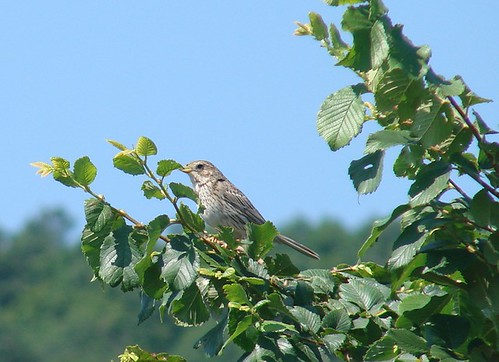
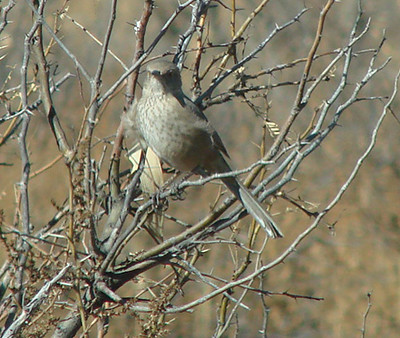
Bendire's Thrasher Sulphur Springs Vallley 2

On this date in 1872, Charles Bendire took the first skin of the long-tailed desert bird that has been known ever since as the Bendire thrasher.

Bendire sent the bird — a female, preserved by “mummification with carbolic acid” — to Elliott Coues, who, “not having then specially studied these birds,” submitted it to Robert Ridgway, who pronounced the specimen a Palmer curve-billed thrasher. Bendire

replied at once that the bird was an entirely distinct species, laying a very different egg [before shooting the adult, Bendire had collected at least six egg sets of the species in June 1872], and having somewhat dissimilar habits; and he finally settled the case by sending [Coues] a male skin, precisely like the original female specimen, together with several of both sexes of … Palmeri, all alike different from the new bird.

Coues doesn’t quite say “I told you so,” but poor Ridgway doesn’t come out looking any too good in this story. The Smithsonian ornithologist’s misidentification, Coues writes,

puzzled me … but presuming, of course, that he knew his own species better than I did, I felt obliged to rest on what he told me, though I was dissatisfied, and in … the Key, with the specimen before me, refrained from alluding to this (supposed) female of … Palmeri….

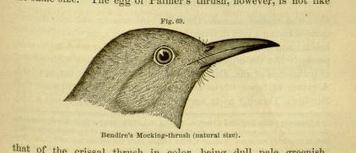
Ridgway having missed his chance, it was left to Coues to name the new species, a task he, no doubt gleefully, performed in the pages of The American Naturalist in June 1873, calling it Harporhynchus Bendirei, the Bendire’s Mocking-Thrush.
Screen Shot 2013-06-26 at 1.58.47 PM

The skins Bendire sent Coues are now in the US National Museum’s collection, where they lie on their backs with red labels identifying them as the co-types of their species.

Coues treated the two specimens slightly, and tellingly, differently. His formal description is based entirely on the male skin, with just a note at the end that the female is “not distinguishable from the male.” And in incorporating the skins into his private collection, he catalogued the male first, before the female, which had been shot more than three months earlier. It’s an old story and often told, ornithology’s consistent treatment of the male bird as the unmarked category, but rarely do we come across such a glaring example as this one.
bendires thrasher Whitewater Draw August 23 2007 086
Male? Female? Yes.

Share

Pigeon Redivivus?

Alexander Wilson, 1766-1813

They’re gone, the hordes of gluttonous Passenger Pigeons that were so startling a part of the eastern North American landscape until the nineteenth century.

But what if we could bring them back?

My friend Nick and I disagree about that notion, a difference of opinion that led to one of the best conversations I’ve had in a long time. Join in the debate here, and let us know what you think.


Share

Huns and Their Beards, Huns and Their Birds

René Primevère Lesson, it seems, was given to bestowing the names of barbarian chieftains on his birds. In 1831, for example, he renamed Gmelin’s Muscicapa spadiceus—first described by Latham as the Yellow-rumped Fly-catcherAtilla, identified rather sensationally by Jobling as the “ruler of the Hunnish tribes that ravaged Europe in the fifth century, who reve[l]ed in the appelation ‘Scourge of God’.”

Attila Spring

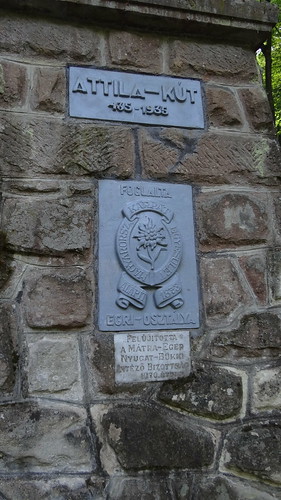
Attila monument in Hungary’s Bükk Hills

As usual, Lesson doesn’t fill us in on his inspiration for this odd name, but if we are to trust the all-knowers of the all-knowing internet, it was simply an allusion to this big tyrannid’s aggressive nature.

Wikimedia Commons, Dominic Sherony.

There’s more to the joke, I think. Long discredited scientifically, one of the great naturalist’s lesser-known works, the Histoire naturelle de l’homme, may still offer a clue to this puzzle. In his discussion of the historical Huns and their putative descendants, the Magyars, Lesson quotes the fifth-century diplomat Priscus, who had served in a Roman delegation to the Hunnish court and who knew Attila personally:

Attila was short, with a broad chest, small eyes, a sparse beard, a flat nose, and a dark complexion.

In his authoritative description of the new avian genus, Lesson remarks on the bird’s bill, “broadened at the base,” its “bristly mouth,” and its “dusky olive-green” plumage. Is it just possible that he imagined a physical resemblance between the Hunnish king and his feathered namesake?

There is another hint in the name Charles Lucien Bonaparte assigned in 1857 to a genus of west African bulbuls. First described by Swainson thirty years before, the type specimen had been acquired from Sierra Leone by William Bullock, whose entire collection Swainson purchased and slowly worked through.

Swainson was excited by Bullock’s bulbul:

  The very remarkable bird we are about to describe is, to the ornithologist, one of the most interesting contained in this volume…. To Dasycephala it is related by its lengthened, straight, and abruptly hooked bill; by a few incurved setaceous feathers and hairs over the nostrils, by the length of the tarsus and of the middle toe; and, by the great inequality between the lateral toes.

Of those characters, Swainson was most impressed by the “feathers and hairs” at the nares, and he gave his skin the English name African Bristle-bill, known today as the Red-tailed Bristlebill.

When Bonaparte came along, he rejected Swainson’s assignment of the species to Dasycephalus, deciding that it was sufficiently distinct to merit its own genus. He named it Bleda,

ainsi nommé du frère d’Attila,

“so called after the brother [and co-regent] of Attila.”

Maybe Lesson wasn’t joking, but Bonaparte most surely was.

Share

Nighthawks: An Identification Trick

Those of us in the east and midwest really have only one Chordeiles to worry about most of the time, the Common Nighthawk. In the deserts of the southwest, however, a second species, the Lesser Nighthawk, flies into the identification ointment.

Everybody knows the subtle plumage distinctions (though beware Henry’s Nighthawk!) and the differences in wing shape and vocalizations — but this time of year there’s another trick.

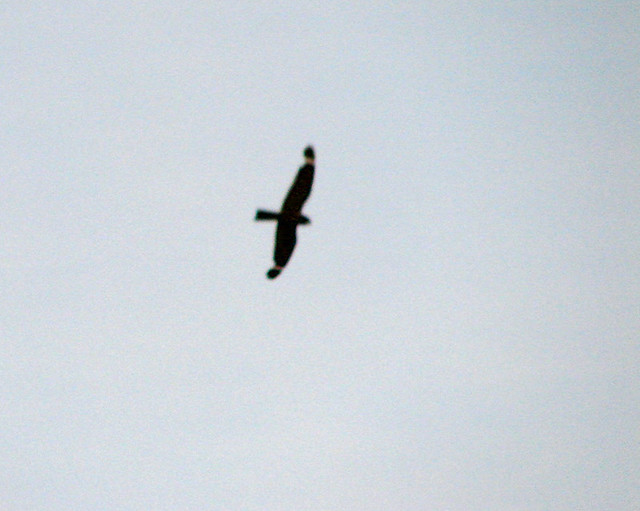
Common Nighthawks molt their flight feathers on the wintering grounds, far south of the US. Adult Lessers, in contrast, are shedding primaries this month, resulting in strange (but symmetrical) gaps and patches in the outer wing, as shown by the blurry bird in the photo. Neat, huh?

The 2013 ABA Bird of the Year


Share

The Prairie Bunting of Provence

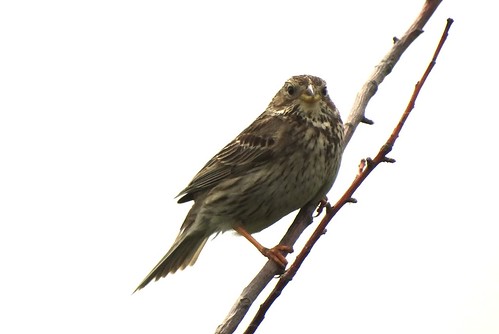
Corn Bunting

Who could not love a face like that?

Gone from much of its northern range, the fist-sized Corn Bunting is still hearteningly common on the roadsides of Provence, where its sizzling buzz penetrates van windows and birders’ hearts alike.

This species’ English names are blander than bland. Long known as the Common Bunting (would that that were still the case in England!), the bird now bears a name reflecting its historical fondness for cropland. More than 2,000 years ago,  the Roman name miliaria was given a similar explanation:

Miliariae have their name from their food, because they grow fat on millet.

In those days, not all bird lovers were content to wait for the “millet buntings” to plump up by their own efforts. Varro writes that he has seen them fed in captivity, along with thrushes and quails, and that thus fattened for the table, they “go for a good price” in the markets. 

Perhaps surprisingly, Jean Crespon, writing in the middle of the nineteenth century in Nîmes, says nothing about eating these birds, probably because, as he notes,

it is difficult to keep them in cages; they break their heads against the bars, and if they survive, it is quite rare to hear them actually sing.

Crespon calls this species the “bruant proyer,” a venerable French name dating to at least the fourteenth century and obviously related to words like pré and prairie (and, ultimately, Latin pratum). Strangely, Buffon derives “proyer” from the bird’s song, and declares himself

surprised that this species was not named “bunting of the fields,” as it rarely leaves the meadows during the warmer time of the year.

Even Buffon dozes, I suppose. The various Provençal names for the species — “térido,” “terlin,” “teri-teri,” “chi-perdris,” “chinchourla” — probably are echoic, though none of them does justice to the hissing sibilance of the real thing, which (I will point out again) you can hear and enjoy this coming April on my Birds and Art tour. Hope to see you then.

Corn Bunting Bulgaria 2007 June 117

Share