“Junco”?

We forget how strange most birding conversation must sound to the occasional eavesdropper of more normal habits and predilections. Many of the words and the names that trip so easily from our tongues sound strange at best, and silly at worst, in mixed company.
sapsucker mix

I don’t mean just the obvious ones, the sapsuckers and the flowerpiercers and the boobies, but even names that seem perfectly usual to “us” — but entirely foreign to “them.”

Nuthatch.

Bittern.

Junco.

Yellow-eyed Junco

Especially this time of year, when fields and feeders are aflutter with those sturdy gray sparrows from the north woods, we birders say “junco” all the time without a second thought.

But if we do think twice, it’s a funny name, isn’t it? English words don’t really look like that, and it’s hard to figure out what on earth this one could mean.

Hard, it turns out, not just for the average birdworder like me, but for just about everyone, it seems. Still our great coryphaeus in such matters, Elliott Coues sets a rare question mark next to the etymology from “juncus, a rush,” and Choate sniffs that this is

a singularly inappropriate name for a genus whose habitat is not among the reeds.

Terres is always good for an often good alternative, but here he offers only the speculation that the name in question refers to the color of reeds. I’m not buying it.

Wikimedia

Not even Johann Georg Wagler, naming this genus in the Isis in 1831, provides a clue as to why he should have chosen the name Junco for the new “Finkammer,” and his promise of a more detailed investigation to come was left unfulfilled when he died, at the age of 32, a year later.

But the  name “junco” was not new in 1831. It had in fact already been applied, in Latin and the vernacular, to birds of the Old World well before Wagler appropriated it for his new genus of Mexican sparrows.

If we go back nearly three centuries before Wagler, we find that the sixteenth-century Saxon poet and antiquarian Georg Fabricius knew “Junco” as a name for one of the wagtails.
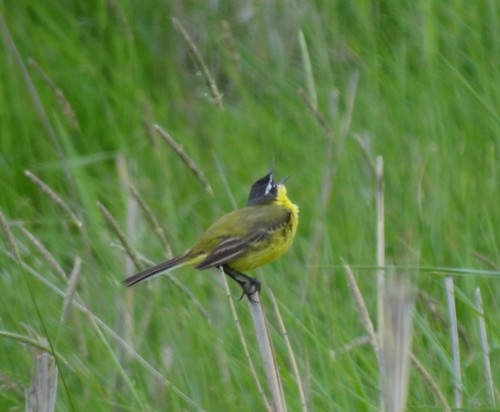
Blue-headed Yellow Wagtail

In 1789, Cornelius Nozeman and Maarten Houttuyn used “junco” as a scientific name — but as a species epithet, not a genus designation. In their Nederlandsche vogelen, those authors named the bird we now know as the Eurasian Reed Warbler Turdus junco, “reed thrush.”
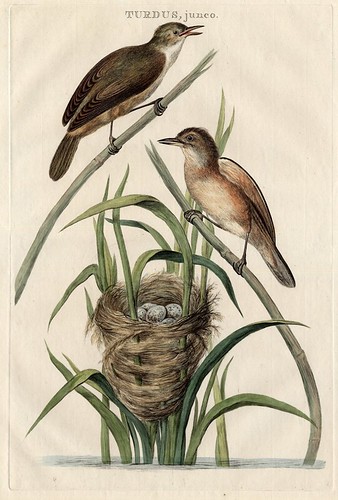
Nederlandsche Vogels 1789

In 1668, Charleton included two entries for the junco in his Onomasticon.

Charleton, Onomasticon

This bird, he so reasonably says, is called the “junco” because it “readily passes its time among the reeds.” The French call it the “sea lark,” the English a “stint.” This junco seems to have been a shorebird.

And, at the same time, a bunting.

Charleton Junco reed-sparrow

That second usage goes back at least to William Turner, who, working from Theodorus Gaza‘s translations of Aristotle, determined that this was what The Philosopher must have meant with his “junco”:

Since I do not know any small bird living in the rushes and reeds other than the one called by the English “rede sparrow,” I believe that that must be the “junco.” It is a small bird, a little smaller than the House Sparrow, with a rather long tail and a black head. The rest is dusky.

Turner’s identification was sufficiently cogent as to be taken over (probably by way of Charleton) into Phillips’s New World of English Words, which — a good century and a quarter before Wagler — defines “junco” as precisely that same “Reed-Sparrow, a Bird” we now call the Reed Bunting. Phillips’s definition, quoted in the OED as well, probably provides the evidence backing James Jobling’s concise entry in the Helm Dictionary: “Junco Med.L. junco Reed Bunting (>L. juncus reed).”

How, though, did the name shift from an emberizid out in those vast Old World beds of juncaceous vegetation to our demure gray sparrow of open woodlands and winter suburbs?
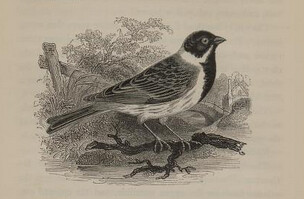
Yarrell Reed Bunting

There is a clue, I think, in one of the alternative names of the Reed Bunting. Swann tells us that this species is also known, misleadingly enough, as the “Black-headed Bunting,”

frequently so called provincially on account of its black head.

For Turner, too, the black head was this bird’s distinctive plumage character — indeed, the only plumage character he mentions at all.

My theory is that Wagler, confronted for the first time with the skin of an unknown dusky-plumed bunting-like bird with a black head, recalled that familiar European bunting. Wagler did not know the habitat preferences of his new bird, and was not thinking of reeds and rushes when he named it. What he did know was that in its most conspicuous plumage mark, the dark-hooded head, it resembled the Reed Bunting  and most importantly, he knew that the slightly odd word “junco” was available for scientific use.

And today, nearly 200 years later, available for the rest of us, too, when we look at the window and wonder what those little gray birds at the feeder could possibly be called.


BAckyard snow

Share

The Prognosticating “Seahawk”

Screenshot 2014-02-03 15.57.05

We didn’t watch or listen to or — heaven help us — attend any football games yesterday. No surprise there, but it seems that we did miss out on one of the most inspired bird misidentifications of the year.

I’m told that the mascot of one of the teams involved is the “Seahawk,” a bird I’d always assumed was the Osprey. But apparently the television graphics showed not that familiar fish-eating kite but an entirely different bird, an Augur Buzzard from Africa.

And that got me thinking. Somewhere in the back of my mind lingered the notion that this species had its name from some association, real or fancied, with the Roman practice of augury. But as so often, a moment’s reflection puts paid to that easy connection: why would the ancient auspices have looked so far afield?

They didn’t.

In his original description of the species he named Falco (Buteo) Augur, Eduard Rüppell explains:

The principal food of this hawk is small birds and mice; it pursues the latter especially when the animals are chased out of their hiding places by the burning of dry grass or the noise of a large troop of people passing by, such that these birds often sail ahead of armies or merchant caravans. That may well be the reason that the Abyssinians credit this bird with a special gift for prognostication….

Years earlier, Henry Salt — not an ornithologist — appears to have witnessed the same behavior, but he told a slightly more complicated story of the locals’ “singular superstition respecting this bird”:

When they set out on a journey and meet with one of them, they watch it very carefully, and draw good or bad omens from its motions. If it sit still, with its breast towards them until they have passed, it is a peculiarly good sign, and every thing is expected to go on well during the course of the journey. If its back be turned towards them, it is considered an unpropitious sign, but not sufficiently so, as to create alarm. But if it should fly away hastily on their approach, some of the most superstitious among them will immediately return back to their homes.

I don’t know who won yesterday. But if I’d had the sense to watch the seahawk before the game, I bet I could have told you before it even started.

Share

The Pictures in the Birdie Books

It’s here, at long last, the second edition of David Sibley’s Birds. Over at Birding, we plan to publish an evaluation next month by one of the best bird illustrators on the continent — but I have a suspicion already that The New Sibley is going to do just fine, thank you, even independent of all the laudatory reviews to come.

I’m too busy enjoying the book to review it myself, but I will note that several of the shortcomings of the first edition are remedied here: most of the images are larger, there is much more information about habits and habitat, and a hundred new species — rarities and local specialties — have been added. The design of the page has been loosened up, with fewer boxes and horizontal lines, and while the ingenious and instructive four-column layout has been retained, it is visually more open, inviting the eye to move more smoothly across the “spread.”

It’s been pointed out already that just as the first edition’s browns sometimes tended to orange, this edition’s blacks and reds are often very deep. I can see that, most strikingly in the jarringly purple Scarlet Tanager in my copy.

But that doesn’t bother me.

It doesn’t bother me because I don’t look for realism and “accuracy” in field guide illustrations, whether paintings or (much less) photographs. I don’t expect “beauty,” either, though Lars Jonsson spoiled us for a while twenty years ago.

The paintings in the Sibley Guide, in either edition, are to my eye neither realistic nor beautiful. I would not, in other words, offer them to a visiting alien seeking to discover exactly what a Blue Jay looks like, and I would not hang them on my wall just for the sheer visual pleasure. But those same paintings, in both editions, are the most informative, the most instructive, the most useful images of North American birds ever put between two covers.

When I open a field guide, I’m looking not for the mimetic but for the diegetic; I want the images to contribute to an educational moment guided by the artist’s or author’s or narrator’s participation.

This is David Sibley’s genius (a word I rarely use). His paintings, “cartoon-like” in the best sense, not bound by any standards of mere representation, are perfectly suited to illustrate, even to exemplify, the identification techniques the guide propounds.

Even a successful nod in the direction of realism would add nothing, and could even compromise the book’s larger purpose — as it certainly does in Arthur Singer’s paintings for the Golden guide, in many of the paintings in earlier editions of the National Geographic guide, and in almost everything Roger Tory Peterson published after 1947.

Birders’ minds and birders’ eyes are nothing if not flexible, and over time, as we grow more familiar with our references, the pictures somehow come to look more and more like the birds. A good field guide makes that process faster — and this is a great one.

Share

Peale’s Water-Witch

Charles Willson Peale was America’s first museum man, and his interests were as wide-ranging as the collections on exhibit in his Philadelphia museum. Birds, though, occupied the highest position among his interests and affections, and as a young man, he spent as much time as possible in woods and fields and marshes, a gun on his shoulder and hope in his heart.

Charles Coleman Sellers reports that Peale’s

very first bird taken in this way, a grebe or ‘water witch’, was an experience never to be forgotten. Out on the water, the bird would dive at the flash of his gun, seeming to elude the shot. Peale outwitted it at last by running nearer to the shore each time it dived and standing still when it came up, thus getting within easy range and ‘pulling the Trigger before the water had run out of its Eyes’.

The mounted bird is probably just out sight in the long cabinet revealed by Peale’s lifting the curtain.

Share