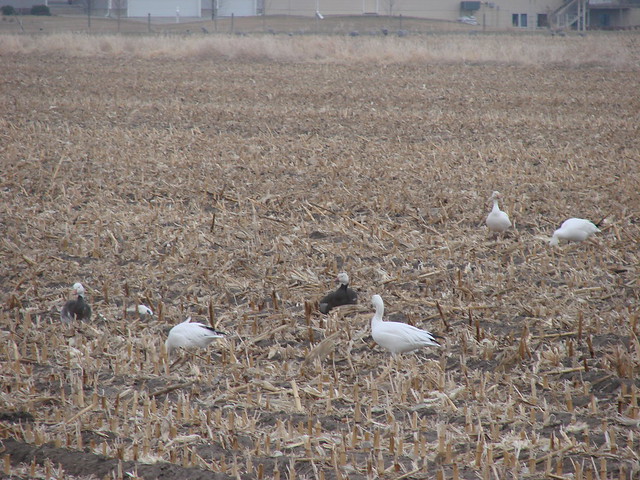
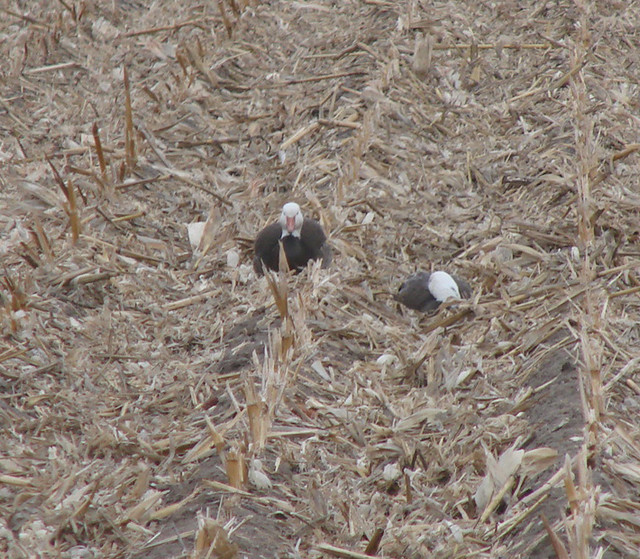
Snow Geese are taken pretty much for granted across most of the continent nowadays, but the dark morph of Lesser Snow Goose remains a Midwestern specialty.
It’s only relatively recently that these handsome white-headed birds were recognized as conspecific with their snowy brethren; my first field guide still listed them as a separate species (which betrays not my age so much as the vintage of my first bird book).
The “lump” came in 1973, and with it one of those delightful onomastic mixups that bird taxonomy is so prone too. Priority required that the scientific name of the newly enlarged species be Chen caerulescens. Thus, all Snow Geese, including those populations that do not have a dark morph, now bear the name originally assigned the dusky birds, a name that means, well, “blue goose.”
It would be no more nonsensical, and even more amusing, had we adopted another of the old common names of the dark morph, “Eagle Goose,” which describes the adult’s bright white head. Maybe I’ll propose it to the AOU….
Gellert and I spent a little time looking at gulls yesterday at Jericho Park, as usual relishing the irony of sorting through the abundant Mew Gulls in search of Ring-billed Gulls.
The light on a misty morning was perfect for looking at variation in back color, of which Mew Gulls, of course, show considerable. I think of Ring-billed Gulls as much more consistently colored, adults (almost!) invariably pale gray, which made the duo in the photo all the more interesting. From whatever angle I chose, the left-hand bird remained conspicuously dark-mantled; to my surprise, the photo came out quite close to naked-eye reality.
It doesn’t “mean” anything, but it’s still fun to discover a little bit of variation in even the most common species. They can turn out to be less boringly familiar than you think sometimes.
It felt like a morning for spring arrivals, all damp and warm, so Gellert and I struck out for Jericho Park. Our walk was pleasant enough, and there was a small fall of Red-shafted Flickers and American Robins, but our hopes for novelty went unfulfilled.
Except by this.
This lone Mute Swan was out on English Bay, far from the allurements of the duck pond, and presumably got there under its own power. The nearest source is Lost Lagoon, a couple of miles away in Stanley Park, but I’m told that all those birds are pinioned; the closest obviously feral swans that I know of are on Westham Island, five or six miles south.
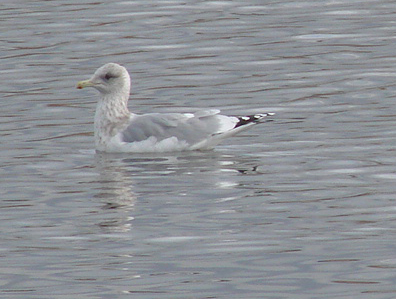
There’s definite movement among the gulls of Vancouver this week. A California Gull was at Kitsilano Pool early this morning, and another adult was on the sewage ponds at Iona with three score Mew Gulls and 19 Thayer’s Gulls as the tide rose mid-day.
That taxon is named for John Eliot Thayer, who bankrolled the 1913 Alaska expedition that collected the first specimens. Maybe we’ll hear a little more more about him next year, the 150th anniversary of his birth–but I’ve been thinking about a different Thayer these past days.
You will have noticed all the attention being devoted to Richard Crossley’s impressive new ID Guide: for a month now, not a day has gone by without a glowing notice at one blog or another, and my own review seemed almost tardy when I “finally”–two days after receiving the book–posted it at the ABA blog.
Birders’ reactions so far (those reactions, that is to say, that have done more than just repeat the breathless jacket text) have concentrated on the guide’s plates, an entirely appropriate focus given the innovative nature of the illustrations in this book that so proudly “doesn’t like text.” And there have been some perceptive characterizations. Spencer, one of the most critically alert birders I know, has pointed out how the vitiation of perspective in the plates highlights the “constructedness” of identification texts, while several ‘bloggers’ have noticed that viewing these plates recalls the contemplation of Victorian dioramas. And not a few reviewers have — rather absurdly — compared Crossley’s photo montages to the work of Louis Agassiz Fuertes.
If all you know of Fuertes are the paintings in Pearson’s venerable Birds of America, then I suppose I can squint just hard enough to see it: there is a certain bustle to those images, particularly among the birds of prey, that anticipates in a very distant way the cheek-to-jowl figures in Crossley’s plates. There is a faint stylistic echo, too, in the prominence with which the larger figures seize the foreground. But the source of each work’s pictorial density is very different: economic in the case of Birds of America, pedagogic in Crossley’s.
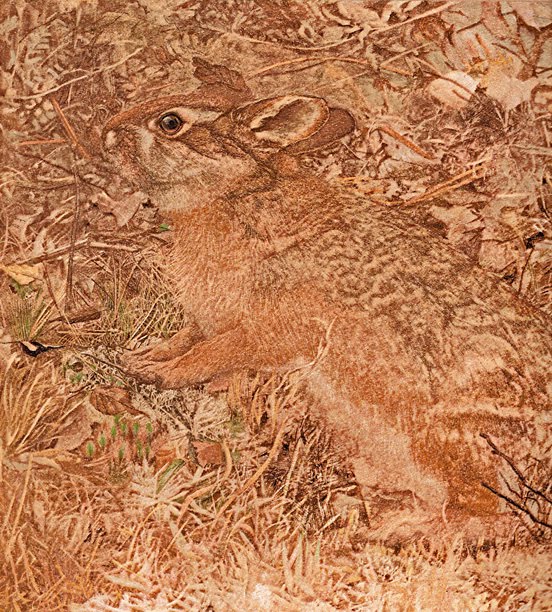
What many of the photographs in Crossley’s ID Guide do remind me of, and sometimes forcefully, is the work and the ideas of Abbott Thayer (no close relation, so far as I know, to John Eliot).
Look at Crossley’s owls, his grouse, his nightjars, his thrushes, and on and on, and you’ll find illustrations–literally–of the Thayerian principles of camouflage and obliteration almost as striking as the artist’s own.
abbott-thayer.blogspot.com
By the time of his death in 1921, Thayer’s theory that all coloration was ultimately and exclusively disruptive was largely dismissed as overstated and inflexible, and his influence on natural history illustration remained negligible at best for nine decades.