Archive for January, 2009
Neck-ringed Duck
Posted by: | CommentsIt’s one of those names that beginners and linguistic naifs always rail against; it doesn’t bother me in the least (the name is not the thing, and all that), but all the same I enjoy getting to see the drake Ring-necked Duck’s eponymous collar every once in a while.
Blackbirds and a White-winged Dove
Posted by: | CommentsA chilly, windy day, but I couldn’t resist a lunchtime visit to Fort Lowell, a site so important to the history of North American ornithology–and, because it’s reachable by SunTran bus, one no less significant to my history as a Tucson birder. I’d hoped to come across the Wood Duck reported there this weekend, but the little pond was the exclusive province of 50 or so American Wigeon, Ring-necked Ducks, and a ragbag of domestic and wild-type Mallards doing their immodest best to ensure the survival of the species.
So I went for a walk instead. Anna’s Hummingbirds are at it, too, with their scritchy songs audible even over the brisk wind. Mourning Doves and Rock Pigeons were sunning in the shelter of hundred-year-old adobe walls, with them a couple of White-winged Doves; that latter species is rare in Tucson in winter, though it lingers in small numbers to our south even through the coldest weather–we’d had a singing bird in the Dragoons over the weekend. I can’t wait ’til the so-sad singers return to our yard in a couple of months.
The white-wings were a reminder that today’s chill notwithstanding, our winter will soon be over, and with it will go some of the common cold-season birds I take too much for granted. So I spent some time with the small flock of icterids; there were a few Great-tailed Grackles and Red-winged Blackbirds, but most were Brewer’s Blackbirds, a species I’ve always been irrationally fond of. It’s strange how some birds capture the imagination early on and never let it go. Brewer’s is a common bird, widespread, easily identified, an undistinguished singer, addicted to such unappealing habitats as dumpsters and feedlots. But I’ve loved it before I even saw my first one, 30-some years ago, and I never tire of watching them patrol the pecan grove and parking lots of Fort Lowell, striding delicately among the European Starlings and chunkier, clunkier blackbirds they consort with.
The Dragoons
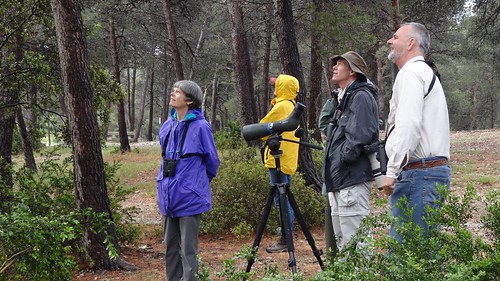
Posted by: | CommentsTheir martial name notwithstanding, the Dragoon Mountains–separating the San Pedro and the Sulphur Springs Valleys–turned out to be magically beautiful on Saturday’s visit with Darlene, Starr, and John. We left Tucson in the dark and unwonted damp of an early spring morning, then made our way through eerie fog towards the Dragoons. As the haze lifted, it revealed no fewer than eight Greater Roadrunners along Middlemarch Road, the black down of their rumps raised to greet the warming sun.
Climbing gently into the oaks, we began to encounter the usual wintertime flocks of Chipping Sparrows, stunningly beautiful, cheerful little birds displaying the plumage variation that so surprised me when I first came to Arizona: winter chippies range from rather dull, brown birds to bright-capped, neat-faced individuals lacking only the black bill of spring. As usual, the flocks were rather homogeneous, though one aggregation included a single Black-chinned Sparrow, a common breeder on at least the east side of the mountain range. And a few Vesper Sparrows and Gray-headed and Oregon Juncos accompanied the flocks, too.
The other passerine action was provided by Bridled Titmouses, forming the core of small and active flocks containing Ruby-crowned Kinglets, Hutton’s and a single Plumbeous Vireo, and woodpeckers. Ladder-backed Woodpeckers were easy to see–not always the case with this common but usually inconspicuous creature–and Red-naped Sapsuckers were common and uncharacteristically noisy, their hawk-like squealing sometimes the only voice in the otherwise silent woods.
We were out for the birds, of course, but I was particularly eager to see Council Rocks, a site thought to have been continuously occupied for a thousand years, from the time of the Hohokam to the end of the Apache. It is a dramatic place indeed, with great boulders piled up and columns weathering out of the mountainside.
The scenery was so spectacular that I don’t know whether we saw birds or not up there!
In the center of Council Rocks, slabs and pillars have fallen together to create a series of natural shelters; it was here that the prehistoric inhabitants prepared their harvest in small grinding holes and decorated the walls and ceilings with images as beautiful as they are inscrutable.
And it was here, they say, that Cochise and his followers met to ponder their betrayal, hiding in the tightly angled chambers created by the rocks.
After gazing nearly our fill, we moved on north along the west flank of the mountains, where a good road led us to one of the most beautiful riparian areas I’ve seen yet in Arizona’s sky islands. 
It was quiet, nearly birdless (though a mean-spirited Townsend’s Solitaire did fly past us, moving up-canyon too fast for all of us to get on it in time). But the dense vegetation, the promise of water in the moist seasons, and the remoteness of the place made me eager to go back in spring. Who knows what’s in there? Saturday was not just a beautiful day, it was a reminder that southeast Arizona still holds more secrets than we sometimes remember. And this is just the sort of locality where they’re hiding out.
New AOU Check-list Website
Posted by: | CommentsI don’t know about you, but I find myself using the AOU Check-list almost every day for one thing or another–and almost always on line. The website has been updated and massively improved, making it much easier now to search by species, family, and order. Check it out! (Hm, we used to say that about printed books.)
New Photo Quiz On Line
Posted by: | CommentsThe photo quiz in this month’s “Birding” is now on line at the ABA website. I have a sinking feeling that nobody will be surprised–either by the answers or by the new geographic direction the quizes are taking–but it was fun to work through it!