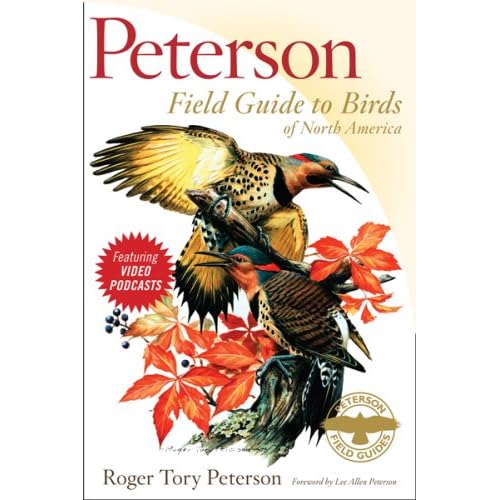
A hundred years ago tomorrow, Roger Tory Peterson was born in Jamestown, New York. Houghton Mifflin is marking the centennial of one of its most valuable authors with the publication of a new Field Guide, fusing in one handsome, generously formatted volume the old eastern, western, and Texas guides. The new book will please and instruct most of those who use it, and destined for bestsellerdom, it will ensure the seaworthiness of the Peterson juggernaut for another generation at least.
Those birders likely to use this guide will rely in the first instance on the plates. I’ll leave to others a full analysis of the travels and traditions of the paintings included here, but will note that most are, unfortunately, from the editions letzter Hand of the eastern and western books. I, for one, miss the brilliant little smudges illustrating Peterson’s earliest guides, and I wish that the editorial team had risked the worthy experiment of introducing their startling eloquence to a generation that has learned to think of Peterson not as an outstanding illustrator but as a poor painter. A number of Peterson’s images have been digitally corrected under the supervision of Michael O’Brien; O’Brien also contributes new paintings of species not included in earlier editions of the guides and supplementary images of some taxa, such as jaegers, originally depicted only in flight.
The familiar Petersonian pointers draw the user’s attention to each species’ field marks. In this version, the designer’s quiver bristles with arrows of widely different lengths, making plates where they are mixed look poorly planned; arrows are not consistently placed, either, making the user wonder, for example, why the leg color of Stilt Sandpiper should be marked at the “ankle” and that of Wilson’s Phalarope at the toes. In my review copy, at least, the arrows are thicker, heavier, and blacker than in earlier editions, and intrude badly on some figures: look at the face of the lower Philadelphia Vireo, for instance, whose (badly painted) dark lore nearly merges with the clunky head of the arrow pointing it out.
The paintings themselves are large and bright, crisply reproduced and generally pleasing to the eye. This guide’s new format allows the images to be reproduced some 20% larger than in its most recent predecessors. The effect is frequently stunning for those used to the small images in, say, the “big Sibley” or even the National Geographic guide–and almost literally stunning for those of us who grew up with the 1947 Peterson. Paradoxically, in a few cases (the Calidris sandpipers, most notably), the superior size of the images reveals their disappointing blandness, as the eye seeks feather details that just aren’t there; this seems to me a missed opportunity for enhancement, digital or analogue.
As they have in Peterson bird guides since 1980, the plates in this new volume share the opening with the corresponding species accounts. Notoriously, the facing-page format reduces the space available to the text, and some pages that have to squeeze in several species run dangerously close to the bottom edge; other modern field guides have dealt with this problem by slightly reducing the print size (as in NatGeo) or by making brilliant use of captions (as in big Sibley) or both (as in Mullarney/Svensson/Zetterstrom/Grant). No such effort to pack information in is apparent here; indeed, there are vast white spaces where the text apparently runs out of things to say, even about such challenging groups as gulls, gadfly petrels, and rails. The two text pages devoted to the skuas and jaegers are fully half blank–surely one or the other member of the editorial team could have filled those creamy acres with a simple essay introducing the techniques that many birders (not, I hasten to add, those of us who grew up on the Great Plains and live in the desert southwest) now use to identify these difficult birds.
The identification material we are given in the texts is generally accurate and helpful, likely to satisfy most of the time most of those who reach for this guide. A quick scan finds less new information than old resignation: female Archilochus hummingbirds, for example, are simply “very difficult to separate.” To be fair, the treatment of the gulls here is more extensive than in any previous incarnation of the Peterson guides, and the fall parulids are no longer “confusing,” a discouraging label they were forced to bear for 75 years. Ambitious users of the guide will find occasional references to more thorough identification guides, too, making it easier for them to take the next step to sophistication if they wish.
While most of the text is hippocratically harmless, there are a few passages that may mislead the user, especially in matters of taxonomy. The words “wader” and “shorebird” are, or should be, synonymous, the former more frequent in European usage, the other current in North America, as the general introduction to the families concerned notes; but the headers to the plates and the separate family introductions switch back and forth without motivation, and in one case seem to draw a distinction between “snipelike waders” and “sandpipers.” The beginning birder can be forgiven her confusion on trying to tease these sloppily applied terms apart.
More seriously and more pervasively, the new guide is hopelessly muddled in its approach to geographic variation. This is sadly ironic, of course, as the 1947 Peterson remains (alongside Pyle) perhaps the best source for information on the identification of subspecies in North America. The new guide reveals both its eastern bias and a lack of taxonomic awareness when it labels the Song Sparrows of the east “typical”; they are no more “typical” than any other subspecies or subspecies group of that species.
The Introduction’s brief discussion of the subspecies concept is equally inaccurate. It is nonsensical to write that “When the distinct geographic forms of a species reach a point when [sic, for: the point that] the population is dominated by individuals that are recognizably different from typical individuals of the ‘parent’ species, the local group is formally designated a subspecies of the parent species.” Members of a subspecies differ consistently from members of other subspecies of the same species, not from “typical” individuals of the species. The same illogic renders incomprehensible this sentence: “Often a subspecific group is so distinct from the parent species that several members can be easily recognized in the field….” Huh? Subspecies and subspecies groups are by definition identical to and part of the parent species that they make up. (And I have no idea what “several members” is supposed to mean here: several “members” of “a subspecific group”? several “members” of “the parent species”?) This is poor thinking clouded by a weird Platonic notion of what constitutes a species, and Roger Tory Peterson would roll in his grave to hear such nonsense imputed to him.
Apart from such goofs, the language of the texts in the new guide is noticeably less lively than in earlier editions. Peterson was never much of a stylist, at his best attaining a sort of even-toned weekly-reader clarity; but I wish that the editorial team responsible for this new edition had retained the occasional bits of humor and poetry that flash through the earlier guides. In 1947, Lincoln’s Sparrow was “a skulker, ‘afraid of its own shadow’,” and displaying Common Nighthawks could be seen “zooming up sharply … with a sudden deep whir that sounds like the well-known ‘Bronx cheer’.” Sixty-one years later, the charm of the birds is no longer reflected in the charm of the language; Lincoln’s Sparrow is now simply and pleonastically a “somewhat skulking species [that] prefers to be near cover,” and Common Nighthawks have learned their company manners. At least Prothonotary Warbler is still “a golden bird of the wooded swamps”!
If the new guide disappoints in some respects, the large-scale maps–gathered in the back of the book and reproduced as thumbnails in the species accounts–are a great and greatly appreciated improvement. Created by Paul Lehman, the large and clearly visible maps are both precise and accurate; the few quibbles one could raise are matters of degree, not of fact. American Black Ducks, for example, are probably too rare nowadays in southeast Nebraska to merit mapping. Conversely, the range of White-winged Dove across the continent could have been painted much more lavishly. Telegraphic notes on the maps indicate vagrancy patterns for many species; while completeness would be an unrealizable goal, there are occasional instances where records worth mentioning are passed over in silence: the vagrant ranges of White-eared Hummingbird and Sulphur-bellied Flycatcher, for instance, are understated here. But few are the questions that these laudable maps do not answer, and authoritatively; I am especially pleased to see many species’ ranges in northern Mexico and the Caribbean limned with the same care given their distribution in the US and Canada.
With the publication of this new single-volume guide, the Peterson legacy is assured. And now it’s up to a new generation of birders to decide whether that legacy is a living one, or merely a tribute to the book that in some ways started it all.