
Archive for November, 2008
The Tyrants of Fort Lowell Park
Posted by: | Comments‘Tis the season to tour the Tucson parks for waterfowl, one of the best ways I know to while away a chilly November morning (well, chilly by Tucson standards, at least). Duck numbers have been notably low this fall so far, and diversity unimpressive, but that can’t spoil the fun of easy close-up views of birds that in other parts of the country usually look like their cardboard profiles in an ancient field guide.
Yesterday morning at Fort Lowell, the pond had its usual gang of American Wigeon and Ring-necked Ducks, with a few Mallards of uncertain parentage bobbing around hoping for bread and cheetohs. The crippled drake Northern Shoveler survives, to my surprise and no doubt to his, and four Hooded Mergansers, rarish birds in southeast Arizona, alternated dozing and diving, greatly to the frustration of curious passers-by who would really have enjoyed a good scope view!
There were three hens and this fantastic drake, sporting a plumage we don’t often see here. The birds have been in residence for several days, but Mark tells me that they were not there Thanksgiving afternoon, suggesting that any small pond in the area may host the quartet for a while.
The waterbirds were a lot of fun, as always, but the edges of the pond are often good for other southwestern specialties too. A Say’s Phoebe had staked a claim to various signposts and control structures, flycatching blithely around the dogwalkers and football players and even birders.
This dryland species is not one I expect at the site, more typically the realm of Black Phoebes and Vermilion Flycatchers. A dazzling male Vermilion put on his usual show from the mesquites bordering the pond, but this female was the true stealer of hearts as she perched near overhead, her sweet expression belying the ferocity with which she pursued the insects waking to the warming day.
Jacana Goes Mainstream
Posted by: | CommentsI had just enough time after dropping Alison at Phoenix this morning to run past the golf course at Casa Grande to pay my respects to the only known Northern Jacana in the US. You’ll recall the furor this bird occasioned when its presence became known last fall: forty years ago, this species bred in the lower Rio Grande Valley, but for an entire generation of birders, ABA-area jacanas have been among the rarest of the rare, worth a chase wherever one shows up.
Last year, every visit to this reliable stray was a social occasion. Not only was the bird almost always easy to see, but I could always count on a happy reunion with old birding companions, or a happy getting to know new birding friends. I don’t think I was ever once there without a crowd to keep me company.
Today is the day after Thanksgiving, a traditional day set aside for birding if ever there was one, and I expected to be standing cheek to jowl on the edge of the golf course pond. Not so. I was the only birder there for the 20 minutes I could spend, and at shortly before noon, mine were the first tires to track the mud from yesterday’s rains. Even more tellingly, I could hear the golfers from across the ponds: “Is the jacana there? Oh, there he is.” And I saw two of them snap the obliging bird’s picture (getting, I hope, better results from their side of the pond than I got from mine).
This Northern Jacana is no longer a birder’s bird, but belongs to everybody now; it’s a local fixture, a golf course mascot, a public curiosity. But I sure like it, and there’s no way this lovely and wackily out-of-place shorebird will ever be ho-hum for me.
Thanksgiving Fowl
Posted by: | CommentsWe’d planned a day trip to the Gulf of California today, but waking to heavy rain, we decided to stay home instead. Late in the afternoon, the skies lightened a bit, so we went into Tucson for a walk around Reid Park.
The roses were even more beautiful after the rain.
And we agreed that this one offered the best combination of color, form, and fragrance.
The birds enjoyed the brief dry spell, too. The bare ground beneath the rose bushes was covered with lovely White-crowned Sparrows, among them at least one black-lored oriantha, a subspecies normally rare at this season this far north. Every once in a while, the spirit would overcome them, and they’d burst into song, buzzing and whistling at the tops of the zonotrichian lungs.
The rain was more welcome to some of the other common park residents.
Great-tailed Grackles were patrolling the moistened ground, and were having a ball in the newly filled ditches.
Of course, the weather was water off a duck’s back to others. A drake Canvasback:
And a drake Ring-necked Duck, even showing his brown collar:
Both species were vastly outnumbered by American Wigeon, grazing nervously on the lawns and whistling on the water:
It’s a fine time of year to be in the desert!
The Santa Cruz Flats
Posted by: | CommentsThe birds weren’t overwhelming, but the birding was great on the Santa Cruz Flats Saturday morning with Michael. We started out with the largest flock of Eurasian Collared-Doves I’d ever seen in Arizona, 260 birds perched on wires in Marana. It was a puzzling sight at first, but the nearly total absence of that species at Red Rock suggested that the survivors of a recent pigeon-shoot there had merely relocated to safer spaces. They are charming and beautiful birds, and you can’t help admiring the “success” of this exotic, but I find the day troubling when I see more of them than Mourning Doves.
Under the influence of my earliest birding companions, I’ve long espoused the most puritanical of views when it comes to introduced species. I can find them fascinating, admirable, dazzlingly beautiful; but they don’t belong here, and I’ve done my share of, ahem, removal. As I grow older and the world grows more complex, though, I’m finding it all less clear-cut.
In a way, we know where Arizona’s Eurasian Collared-Doves came from. The species was introduced to the Caribbean 30 or 40 years ago now, and taking advantage of that same pioneer spirit that had let it spread, apparently on its own, from the Balkans to Iceland in the 1950s, a few ecdos made the short flight to Florida in the 1970s; from there, adhering to what seems to be a pre-programmed predilection for flying northwest, the species has colonized pretty much all of the continental US outside of New England the Mid-Atlantic, and seems to be looking forward to cozy winters in western Canada and Alaska, too.
Collared-doves reached southeast Arizona with this new century, and have since become abundant around feedlots and rural settlements. I suppose we can’t rule out the possibility of secondary introductions–one possible explanation for the local population explosions we’re still seeing–but even so, it’s almost certain that some of the doves in Arizona are the descendants, 30 or 40 generations removed, of the introduced Bahamas birds: and so ultimately, of course, ours are of introduced origin, but the birds of 2008 have come much farther on their own from that tainted source population than did, for example, the state’s first Inca Doves a hundred years earlier, or the White-winged Doves that are now breeding in the midwest.
I’m not suggesting that any exotic species, plant or animal, be left to thrive just because of the antiquity of its introduction or its self-powered success once it got here; gracious, then we’d have, oh, Norway rats and red foxes eating island seabirds or something! There can be no statute of limitations when an introduced organism starts munching on the habitat and its native denizens; no sign yet that Eurasian Collared-Doves are engaged in anything like that, but introductions of any kind are rarely so benign as they’re thought to be at the start.
Just around the corner, at one of their “secret” sites on the Flats, Michael and I found a pair of Burrowing Owls, perched up to absorb the morning sunlight.
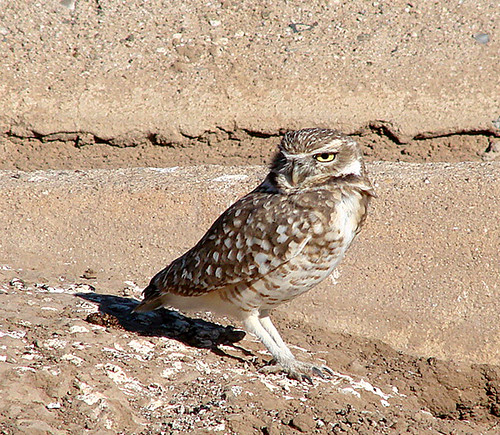
Both birds were remarkably active, flying up and down the concrete-lined ditches they call home, chirping and bobbing when a car went past. Too bad they don’t eat collared-doves!
We moved on to Red Rock and its endangered feedlot: the signs are up announcing the zoning hearings, and it won’t be long before that bit of flat desert is houses, too (with preternaturally green lawns, I bet). There were massive flocks of icterids: Red-winged, Yellow-headed, and Brewer’s Blackbirds, Great-tailed Grackles, Brown-headed Cowbirds, and a couple of Western Meadowlarks; but no small doves and virtually no large ones. A glorious Prairie Falcon was perched on a telephone pole, but we didn’t find any other of the “special” raptors of the Flats in the couple of hours we spent out there. But it’s good birding, not necessarily good birds, that makes a good day, and we had lots of the first and enough of the second.

Here, Kitty Kitty!
Posted by: | CommentsFinally, after five years in our house, I’ve seen a mammal that so many Tucson neighborhoods take for granted. When I pulled out of the long driveway onto the paved road this morning, a square face poked out of the shallow wash, and loped easily across the road into the vegetation on the other side. Bobcat!
We knew they had to be out there. This adaptable feline is common enough all around southeast Arizona, a virtually inevitable sight if you spend enough time outside, and we’ve long suspected that the quiet footsteps on our roof of a midnight belonged to Robert the Cat. But even where they’re common, bobcats are secretive, and being in the right place at the right time isn’t always easy.
So I’ve thrown out an extra handful of seed for our packrats and wished the bobcat well. Here, kitty kitty!


